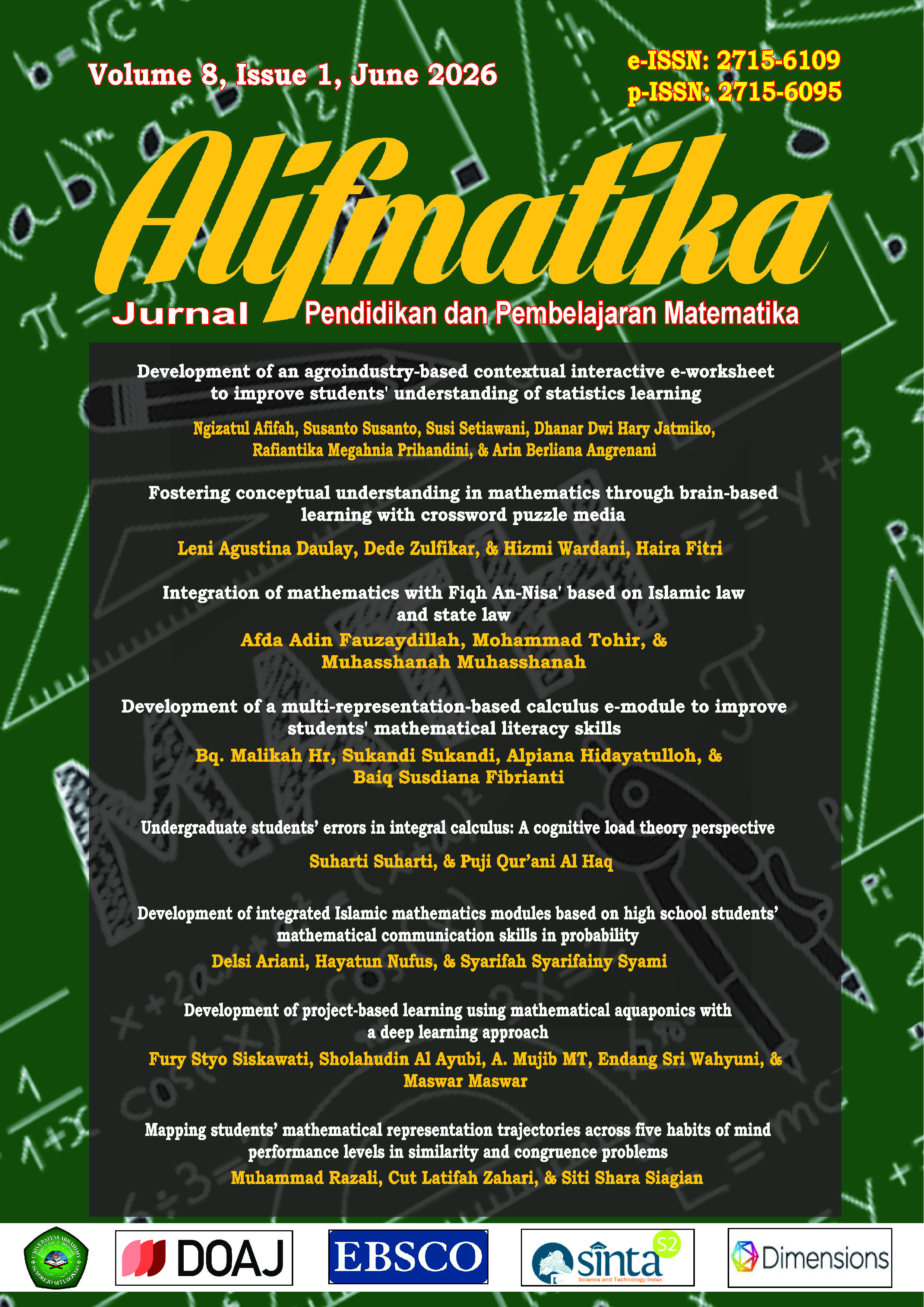
Development of project-based learning using mathematical aquaponics with a deep learning approach
DOI:
https://doi.org/10.35316/alifmatika.2026.v8i1.121-134Keywords:
Deep Learning, Mathematic Aquaponic, Project-Based LearningAbstract
This study developed a mathematics learning medium based on aquaponics (Mathematic Aquaponik) to support Project-Based Learning (PjBL) with a deep learning approach in a Mathematical Modelling course. The study was motivated by low mathematical literacy and problem-solving skills among Indonesian students, particularly at higher cognitive levels, highlighting the need for contextual and authentic learning media. Research and development (R&D) using the ADDIE model-analysis, design, development, implementation, and evaluation was employed. Validity was assessed by content and media experts. At the same time, practicality and effectiveness were tested through a limited trial of six students and a field trial using a one-group pretest–posttest design. Results indicate that the media is valid, practical, and effective in enhancing conceptual understanding, problem-solving, higher-order thinking skills, and deep learning behaviours (pretest 48.60 → posttest 76.20; N-gain 0.53). Mathematic Aquaponik provides authentic, contextual learning experiences that foster HOTS and 21st-century competencies aligned with the Kurikulum Merdeka and Profil Pelajar Pancasila.
Downloads
References
Audina, C. P., Susanti, E., & Aisyah, N. (2025). Development of inquiry-based digital worksheet to improve mathematical thinking ability. AKSIOMA: Jurnal Program Studi Pendidikan Matematika, 14(2), 570–581. https://doi.org/10.24127/ajpm.v14i2.10811
Bhary, F., Maswar, M., Atikurrahman, M., & Afandi, A. (2023). Analysis of the problem-based learning (PBL) models on geometry material in improving students’ mathematics learning outcomes. Alifmatika: Jurnal Pendidikan Dan Pembelajaran Matematika, 5(2), 207–225. https://doi.org/10.35316/alifmatika.2023.v5i2.207-225
Guo, P., Saab, N., Post, L. S., & Admiraal, W. (2020). A review of project-based learning in higher education: Student outcomes and measures. International Journal of Educational Research, 102, 101586. https://doi.org/10.1016/j.ijer.2020.101586
Hadi, A., & Ramadhana, R. (2022). Efektivitas model pembelajaran berbasis proyek (project based learning) terhadap kemampuan berpikir tingkat tinggi kelas VIII‑A MTs Negeri 2 Makassar. Journal of Mathematics Education Research, 5(4), 78–89. https://doi.org/10.46918/equals.v5i1.1228
Harahap, R., Ahmad, N. Q., & Fiteri, R. (2022). Peningkatan kemampuan kreativitas matematis siswa melalui pendekatan STEM (science, technology, engineering, and mathematics) berbasis project based learning [Improving students' mathematical creativity abilities through a STEM (science, technology, engineering, and mathematics) approach based on project-based learning.]. Edukatif: Jurnal Ilmu Pendidikan, 4(3), 3479–3488. https://doi.org/10.31004/edukatif.v4i3.2621
Hart, E. R. (2013). Implementation of aquaponics in education: an assessment of challenges, solutions and success. In Master’s thesis, University of Massachusetts Amherst.
Indrawan, E., & Jalinus, N. (2018). Review project-based learning. International Journal of Science and Research, 8(4), 1014–1018. https://www.ijsr.net/archive/v8i4/ART20196959.pdf
Ismail, S., Jusuf, N. F. A., Zakaria, P., Achmad, N., & Rif’at, N. (2024). Effect of project-based learning model on students’ higher-order thinking skills. Mosharafa: Jurnal Pendidikan Matematika, 13(1), 187–198. https://doi.org/10.31980/mosharafa.v13i1.1986
Kouicem, K. (2020). Constructivist theories of piaget and vygotsky: Implications for pedagogical practices. Psychological & Educational Studies, 13(3), 359–372. https://doi.org/10.35156/1192-013-003-023
Lusvinaningtyas, N. (2024). Aquaponics‑assisted project‑based learning enhances students’ creative thinking in science topics related to ecosystems and sustainability. Journal of STEM Education and Sustainability, 5(1), 45–58. https://doi.org/10.XXXXX/jstemss.2024.005
Lutfiyah, F. M., Sari, A. C., & Kurniawati, N. (2025). Media matematika interaktif exploring math berbasis google sites untuk pembelajaran transformasi geometri [Interactive mathematical media exploring math based on Google Sites for learning geometric transformations]. AKSIOMA: Jurnal Program Studi Pendidikan Matematika, 14(2), 546–557. https://doi.org/10.24127/ajpm.v14i2.10811
Maswar, M. (2022). Mathematics problem solving based on cognitive style to determine of student reasoning abilities in the Covid-19 pandemic era. Alifmatika: Jurnal Pendidikan Dan Pembelajaran Matematika, 4(1), 37–51. https://doi.org/10.35316/alifmatika.2022.v4i1.37-51
Milaturrahmah, N., Mardiyana, M., & Pramudya, I. (2017). Mathematics learning process with science, technology, engineering, and mathematics (STEM) approach in indonesia. Journal of Physics: Conference Series, 895(1). https://doi.org/10.1088/1742-6596/895/1/012030
Munawwaroh, A. M., Sugiman, & Munahefi, D. N. (2024). Kemampuan berpikir kreatif siswa pada model pembelajaran project based learning berbasis STEM (science, technology, engineering, and mathematics) [Students' creative thinking abilities in the STEM (science, technology, engineering, and mathematics) based project based learning model]. PRISMA: Prosiding Seminar Nasional Matematika, 2024. https://proceeding.unnes.ac.id/prisma/article/view/3056
Ndiung, S., & Menggo, S. (2024). Project‑Based learning in fostering creative thinking and mathematical problem‑solving skills: Evidence from primary education in Indonesia. Journal of Educational Innovation, 3(2), 45–60.
Nuraini, N., Asri, I. H., Fajri, N., Sarwati, S., & Ariandani, N. (2022). Project-based activities through lesson study: Improvements of creative thinking performance of pre-service biology teachers in Indonesia. Jurnal Pendidikan Progresif, 12(3), 1060–1073. https://doi.org/10.23960/jpp.v12.i3.202206
Nurfitriyanti, M. (2016). Model pembelajaran project based learning terhadap kemampuan pemecahan masalah matematika. Formatif: Jurnal Ilmiah Pendidikan MIPA, 6(2), 149–160. https://doi.org/10.30998/formatif.v6i2.950
Nurhadi, M., Yerizon, Y., Arnawa, I. M., Yarman, Y., & Arnellis, A. (2025). The ethnomathematics integrated teaching module to increase the mathematical problem-solving skills. AKSIOMA: Jurnal Program Studi Pendidikan Matematika, 14(2), 650–662. https://doi.org/10.24127/ajpm.v14i2.10986
Nuria, S., Ahmad, S., Zainil, M., & Rayendra, R. (2025). Pengembangan e-modul berbasis realistic mathematics education materi bangun datar terhadap kemampuan pemecahan masalah matematis siswa [Development of e-modules based on realistic mathematics education on flat shapes material on students' mathematical problem-solving abilities]. AKSIOMA: Jurnal Program Studi Pendidikan Matematika, 14(2), 447–457. https://doi.org/10.24127/ajpm.v14i2.11956
OECD. (2024). PISA 2022 results (volume I): The state of learning and equity in education. OECD Publishing.
Özdemir, A. Ş., Yıldız, F., & Yıldız, S. G. (2015). The effect of project-based learning in “ratio, proportion and percentage” unit on mathematics success and attitude. European Journal of Science and Mathematics Education, 3(1), 1–13. https://files.eric.ed.gov/fulltext/EJ1107876.pdf
Pramasdyahsari, A. S., Aini, S. N., & Setyawati, R. D. (2024). Enhancing students’ mathematical critical thinking skills through ethnomathematics digital book STEM‑PjBL. Mosharafa: Jurnal Pendidikan Matematika, 13(1), 97–112. https://doi.org/10.31980/mosharafa.v13i1.1979
Rahayu, H., Purwanto, J., & Hasanah, D. (2017). Pengaruh model pembelajaran project based learning (pjbl) terhadap kemampuan berpikir tingkat tinggi siswa [The influence of the project based learning (PJBL) learning model on students' high-level thinking skills]. COMPTON: Jurnal Ilmiah Pendidikan Fisika, 4(1), 21–28. https://jurnal.ustjogja.ac.id/index.php/COMPTON/article/view/1384
Septian, A., Widodo, S. A., Afifah, I. N., Nisa, D. Z., Putri, N. P. K., Tyas, M. D., Nisa, R. H., & Andriani, A. (2022). Mathematical problem-solving ability in Indonesia. Journal of Instructional Mathematics, 3(1), 16–25. https://doi.org/10.37640/jim.v3i1.1223
Siskawati, F. S., & Chandra, F. E. (2024). The effect of numeracy literacy skills on verbal and written communication skills. ICES: International Conference on Education and Sharia, 1, 173–183.
Siskawati, F. S., Irawati, T. N., & Salabila, S. Z. (2024). The development of learning videos with problem-solving by using the screencast o matic. AKSIOMA: Jurnal Program Studi Pendidikan Matematika, 13(1), 25–33.
Susanti, M., Retnawati, H., Sulistyaningsih, E., Kartianom, K., Rosyada, M. N., Kassymova, G. K., & Sotlikova, R. (2023). Project‑based learning in mathematics education: a bibliometric study on 2014–2023 scopus database. Jurnal Riset Pendidikan Matematika, 10(1), 32–53. https://doi.org/10.21831/jrpm.v10i1.60531
Teimourtash, M., & YazdaniMoghaddam, M. (2017). On the plausibility of bloom’s higher order thinking strategies on learner autonomy: The paradigm shift. Asian‑Pacific Journal of Second and Foreign Language Education, 2(1), 14–29. https://doi.org/10.1186/s40862-017-0037-8
Thompson, K. R., Webster, C. D., Pomper, K. W., & Krall, R. M. (2023). Use of aquaponics project‑based environments to improve students’ perception of Science, Technology, Engineering, and Mathematics (STEM) disciplines and career pathways. Interdisciplinary Journal of Environmental and Science Education, 19(2), e2309. https://doi.org/10.29333/ijese/13102
Wahyuni, I., Suwarno, & Afdhila, D. (2024). Realistic mathematics‑based e‑booklets to improve students’ mathematical literacy ability. Mosharafa: Jurnal Pendidikan Matematika, 13(1), 151–162. https://doi.org/10.31980/mosharafa.v13i1.1983
Wahyuningsih, S. L. D., Sutama, Hidayati, Y. M., Rahmawati, F. P., & Minsih. (2025). Strategi deep learning melalui kegiatan kokurikuler di sekolah dasar [Deep learning strategies through co-curricular activities in elementary schools]. Didaktika: Jurnal Kependidikan, 14(3). https://doi.org/10.58230/27454312.2800
Yulia, P., & Nasution, E. Y. P. (2024). Geometry and Islamic values: Validity of teaching materials based on modified project-based learning model. Mosharafa: Jurnal Pendidikan Matematika, 13(1), 113–124. https://doi.org/10.31980/mosharafa.v13i1.1980
Downloads
Published
How to Cite
Issue
Section
License
Copyright (c) 2026 Alifmatika: Jurnal Pendidikan dan Pembelajaran Matematika

This work is licensed under a Creative Commons Attribution-ShareAlike 4.0 International License.
COPYRIGHT NOTICE
Author (s) who publish in Alifmatika: Jurnal Pendidikan dan Pembelajaran Matematika agree to the following terms:
- The Author (s) submitting a manuscript do so on the understanding that if accepted for publication, copyright of the article shall be assigned to Alifmatika: Jurnal Pendidikan dan Pembelajaran Matematika, Tarbiyah Faculty of Ibrahimy University as the publisher of the journal. Consecutively, author(s) still retain some rights to use and share their own published articles without written permission from Alifmatika: Jurnal Pendidikan dan Pembelajaran Matematika. This work is licensed under a Creative Commons Attribution-ShareAlike 4.0 International License.
- Copyright encompasses rights to publish and provide the manuscripts in all forms and media for the purpose of publication and dissemination, and the authority to enforce the rights in the manuscript, for example in the case of plagiarism or in copyright infringement.
- Alifmatika: Jurnal Pendidikan dan Pembelajaran Matematika and the Editors make every effort to ensure that no wrong or misleading data, opinions or statements be published in the journal. In any way, the contents of the articles and advertisements published in Alifmatika: Jurnal Pendidikan dan Pembelajaran Matematika are the sole responsibility of their respective authors and advertisers.
- The Copyright Transfer Form can be downloaded here [Copyright Transfer Form Alifmatika]. The copyright form should be signed originally and send to the Editorial Office in the form of original mail, scanned document to alifmatika[at]ibrahimy.ac.id or upload the scanned document in the comments column when sending the manuscript.















_by_Matematohir.jpg)