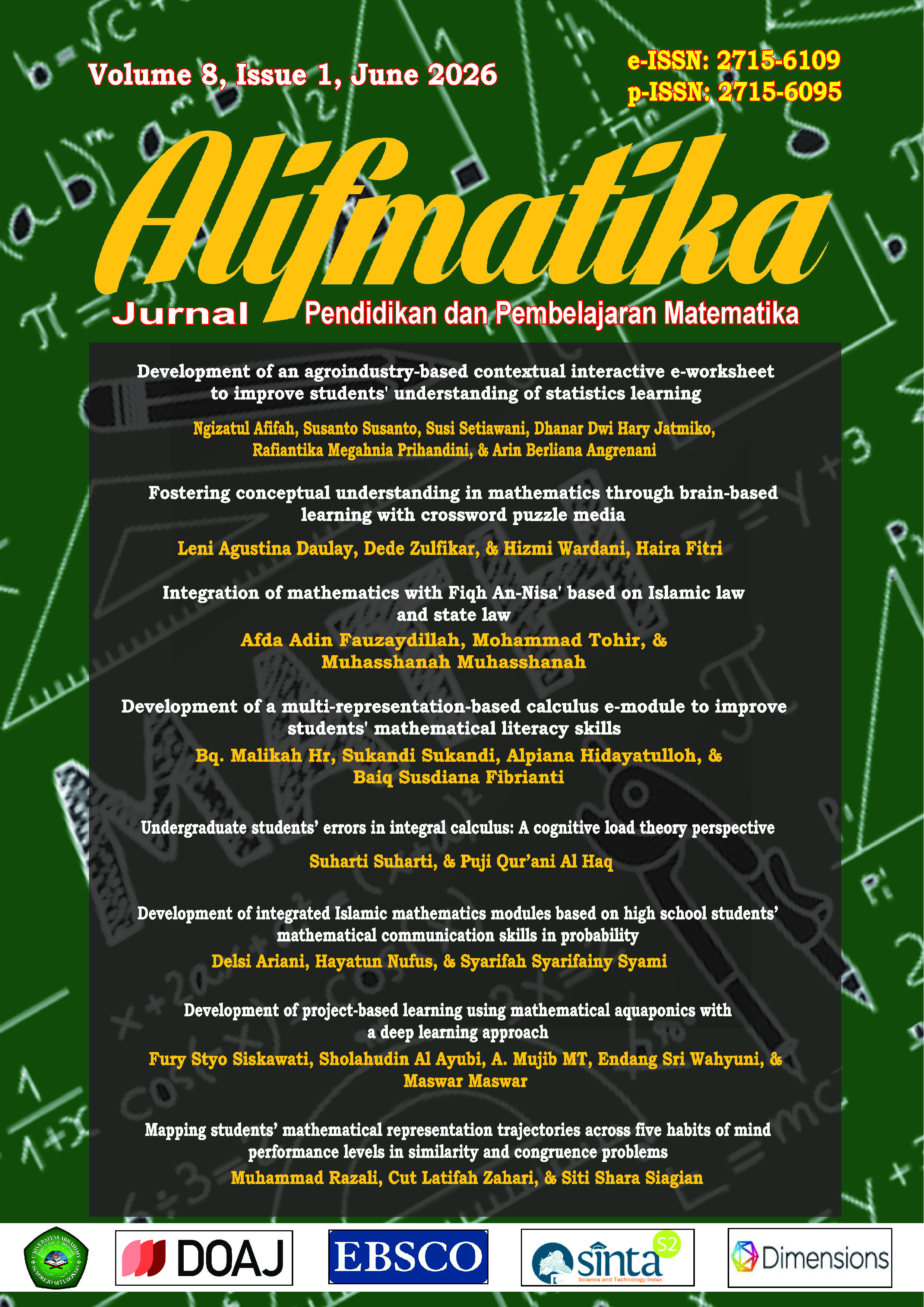
Development of an agroindustry-based contextual interactive e-worksheet to improve students' understanding of statistics learning
DOI:
https://doi.org/10.35316/alifmatika.2026.v8i1.1-27Keywords:
Agroindustry, e-Worksheet, Statistics Learning, wizer.meAbstract
The digital transformation of Statistics learning is crucial in the technology era, as the subject's abstract nature often limits students' comprehension without contextual support. Leveraging Jember Regency's agroindustrial potential provides a meaningful context to make statistical concepts more concrete. This study aimed to develop an interactive agroindustry-based electronic worksheet (e-worksheet) integrated into the Wizer.me platform to enhance Statistics learning on measures of central tendency and measures of dispersion. Using Borg and Gall's Research and Development (R&D) model, the study involved students at SMP Negeri 4 Jember. Three experts validated both the research instruments and the developed e-worksheet. The research instruments included diagnostic and summative assessments, teacher response questionnaires, and student response questionnaires. The e-worksheet achieved validity scores of Vₐ = 3.84 (very valid) and practicality scores of Vᵤₛ = 83.42% and Vₐᵤ = 96.67% (high practicality). A paired t-test revealed a significant improvement of 25.39 points in student outcomes at the 95% confidence level, while the N-Gain score of 0.57 indicated moderate effectiveness. These results confirm that the interactive e-worksheet developed meets the criteria for validity, practicality, and effectiveness in supporting Statistics learning, while also fostering contextual learning, enhancing students' understanding, and serving as an enjoyable and engaging learning medium through an innovative digital platform.
Downloads
References
Afif, N. (2019). Pengajaran dan pembelajaran di era digital [Teaching and learning in the digital era]. IQ (Ilmu Al-Qur’an): Jurnal Pendidikan Islam, 2(1), 117–129. https://doi.org/10.37542/iq.v1i01
Afifah, N., & Salim, A. (2021). Statistik pendidikan (bagian 1) [Education statistics (part 1)]. Polije Press.
Afifah, N., Setiawani, S., Prihandini, R. M., Berliana, A., Angrenani, Putri, I. W. S., & Salim, A. (2025). Aplikasi uji wilcoxon signed rank untuk menganalisis pengaruh covid-19 pada prestasi belajar [Application of the Wilcoxon signed rank test to analyze the effect of Covid-19 on learning achievement]. Jurnal Axioma: Jurnal Matematika Dan Pembelajaran, 10(2), 14–25. https://doi.org/10.56013/axi.v10i2.3668
Ahadi, G. D., & Zain, N. N. L. E. (2023). The simulation study of normality test using Kolmogorov-Smirnov, Anderson-Darling, and Shapiro-Wilk. Eigen Mathematics Journal, 6(1), 11–19. https://doi.org/10.29303/emj.v6i1.131
Ahmad, F., & Indah, N. I. S. (2025). Exploring the Wilcoxon test in science education: A literature review of empirical research. Indonesian Journal of Educational Science, 7(2), 158–169. https://doi.org/10.31605/ijes.v7i2.4712
Alhadi, D. F., & Cholik, M. (2021). Pengembangan media pembelajaran interaktif berbasis articulate storyline pada mata pelajaran gambar teknik kelas X SMK Negeri 1 Sidoarjo [Development of interactive learning media based on articulate storylines in the technical drawing subject of class X SMK Negeri 1 Sidoarjo]. JPTM, 11(01), 126–132. https://doi.org/10.26740/jptm.v11n1
Asfar, A. M. I. T., Trisnowali, A., Dahlan, J. A., Prabawanto, S., Asfar, A. M. I. A., & Nurannisa, A. (2022). Validity and practicality of learning model development of LAPS-heuristics with local wisdom on students' metacognitive ability. Jurnal Penelitian Dan Pengembangan Pendidikan, 6(3), 492–499. https://doi.org/10.23887/jppp.v6i3.51990
Cahayu, S. A., Siburian, J., & Hamidah, A. (2024). The effect of problem-based learning (PBL) model based on local wisdom to improve students' critical thinking skills. Integrated Science Education Journal, 5(2), 82–90. https://doi.org/10.37251/isej.v5i2.985
Cartwright, M., Freeman, K., & Berrett, D. (2025). Unlocking potential: Evaluation of a digital math learning solution. Educational Researcher, 54(8). https://doi.org/10.3102/0013189X2513461
Creswell, J. W., & Creswell, J. D. (2023). Research design: Qualitative, quantitative, and mixed methods approaches. SAGE Publications Ltd.
Dinata, V. M., Wedi, A., & Fajarianto, O. (2024). Pengembangan model pembelajaran adaptif dengan implementasi learning analytics berdasarkan gaya belajar VARK [Development of an adaptive learning model with the implementation of learning analytics based on the VARK learning style]. Didaktika: Jurnal Kependidikan (Special Issue 2024), 13(1), 177–185. https://doi.org/10.58230/27454312.1444
Farida, U., Caswita, & Sutiarso, S. (2022). Pengembangan bahan ajar berbasis realistic mathematics education berorientasi kemampuan berpikir kritis [Development of teaching materials based on realistic mathematics education oriented towards critical thinking skills]. AKSIOMA: Jurnal Program Studi Pendidikan Matematika, 11(2), 1563–1572. https://doi.org/10.24127/ajpm.v11i2.4942
Hakim, L. N., Hartanto, S., Amelia, F., & Sitanggang, P. (2023). Pengembangan media pembelajaran matematika digital berbasis kontekstual untuk siswa SMP [Development of contextual-based digital mathematics learning media for junior high school students]. JCP (Jurnal Cahaya Pendidikan), 9(1), 77–87. https://doi.org/10.33373/chypend.v9i1.5351
Harahap, O. F. M., Napitupulu, M., & Batubara, N. S. (2022). Media pembelajaran: Teori dan perspektif penggunaan media pembelajaran dalam pembelajaran bahasa inggris [Learning media: Theories and perspectives on the use of learning media in English language learning]. CV. Azka Pustaka.
Hobri. (2010). Metodologi penelitian pengembangan (aplikasi pada penelitian pendidikan matematika) [Development research methodology (application to mathematics education research)]. Pena Salsabila.
Irawan, A., & Hakim, M. A. R. (2021). Kepraktisan media pembelajaran komik matematika pada materi himpunan kelas VII SMP/MTs [Practicality of mathematics comic learning media on the set material of class VII SMP/MTs]. Pythagoras: Jurnal Program Studi Pendidikan Matematika, 10(1), 91–100. https://doi.org/10.33373/pythagoras.v10i1.2934
Machendranath, S., & Naik, U. (2019). Statistical tools for research scholars: A comparative study of SPSS and PSPP. International Journal of Current Research and Academic Review, 7(9), 54–59. https://doi.org/10.20546/ijcrar.2019.709.007
Maswar, Pradita, D. A. R., Atikurrahman, M., Muslimin, & Saiful. (2022). Peran penting statistika dalam pendidikan dan perekonomian Islam modern [The important role of statistics in modern Islamic education and economics]. Jurnal Axioma : Jurnal Matematika Dan Pembelajaran, 7(2), 107–118. https://doi.org/10.56013/axi.v7i2.1288
Mayangsari, J., Satinem, Y., & Lotoh, W. (2024). Pengembangan LKPD berbasis PMRI materi statistika menggunakan konteks wisata Musi Rawas SDN 1 Lubuk Ngin [Development of PMRI-based LKPD on statistics material using the Musi Rawas tourism context at SDN 1 Lubuk Ngin]. Jurnal MathEducation Nusantara, 7(2), 38–42. https://doi.org/10.32696/jmn.v7i2.380
Nildasari, & Nur, R. (2024). Effectiveness of wizer.me in developing electronic learning materials: A study with English teachers. JELITA: Journal of English Language Teaching and Literature, 5(2), 501–515. https://doi.org/10.56185/jelita.v5i2.649
Okpatrioka. (2023). Research and development (R&D) penelitian yang inovatif dalam pendidikan [Research and development (R&D) innovative research in education]. Dharma Acariya Nusantara: Jurnal Pendidikan, Bahasa Dan Budaya, 1(1), 86–100. https://doi.org/10.47861/jdan.v1i1.154
Oktaviani, F., Mulyawati, Y., & Susanto, L. H. (2023). Pengembangan E-LKPD interaktif berbasis wizer.me pada tema 9 subtema 1 pembelajaran 3 [Development of interactive E-LKPD based on wizer.me on theme 9 subtheme 1 learning 3]. Pendas: Jurnal Ilmiah Pendidikan Dasar, 8(3), 637–648. https://doi.org/10.23969/jp.v8i3.10603
Pahlevy, S. C. I., Widjayanti, F. N., & Fauziah, N. F. (2024). Analisis keuntungan dan strategi pengembangan tape singkong di kabupaten Jember [Analysis of the benefits and strategies for developing cassava tape in Jember district]. Agri Analytics Journal, 2(1), 67–71. https://doi.org/doi.org/10.47134/agri.v2i1
Pangemanan, A. (2020). Application of contextual teaching and learning approach on statistics material against student results. International Education Studies, 13(4), 1–7. https://doi.org/10.5539/ies.v13n4p1
Prihandini, R. M., Dafik, & Iskandar, D. N. U. (2023). Developing smart fractions as a learning media assisted by iSpring Suite 9 and GeoGebra for escalating students' computational thinking skills. Alifmatika Journal, 5(2), 188–206. https://doi.org/10.35316/alifmatika.2023.v5i2.188-206
Puspitasari, S. N., Suyono, & Astutiningtyas, E. L. (2021). Efektivitas penerapan e-modul dalam meningkatkan pemahaman siswa kelas VIII pada materi pola bilangan masa pandemi [The effectiveness of implementing e-modules in improving the understanding of grade VIII students on number pattern material during the pandemic.]. Journal of Mathematics Education and Learning, 1(3), 274–286. https://doi.org/10.19184/jomeal.v1i3.26773
Rahmatin, J. A., Larasati, S. A. N., & Alawiyah, R. (2025). A literature review: The implementation of the Borg & Gall development model in science learning. Indonesian Journal of STEM Education, 7(1), 40–46.
Ramadhan, F., Soendjoto, M. A., & Dharmono. (2020). Practicality of the pocketbook "keanekaragaman lepidoptera di hutan mangrof." BIO-INOVED : Jurnal Biologi-Inovasi Pendidikan, 2(1), 71–75. https://doi.org/10.20527/bino.v2i2.8551
Salim, A., Afifah, N., Andriani, H., & Alfian, M. R. (2024). Statistik pendidikan (bagian 2) [Education statistics (part 2)]. Polije Press.
Salsabila, A. N., Legthonia, I. F., Azzara, M., Supriyad, Setya, J., & Hermawan. (2025). Optimalisasi penggunaan media interaktif digital dalam pembelajaran matematika di sekolah dasar untuk meningkatkan keterlibatan dan hasil belajar siswa [Optimizing the use of digital interactive media in mathematics learning in elementary schools to increase student engagement and learning outcomes]. Jurnal Lensa Pendas, 10(1), 138–153. https://doi.org/10.33222/jlp.v10i1.4273
Sari, H., Pratiwi, M. P., & Syutaridho. (2025). Memahami konsep statistika (pemusatan data: mean, median, dan modus) dalam kehidupan sehari-hari menggunakan pendekatan PMRI [Understanding the concept of statistics (data centralization: mean, median, and mode) in everyday life using the PMRI approach]. Blaze : Jurnal Bahasa Dan Sastra Dalam Pendidikan Linguistik Dan Pengembangan, 3(2), 132–137. https://doi.org/10.59841/blaze.v3i2.2735
Shongwe, B. (2024). The effect of STEM problem-based learning on students' mathematical problem-solving beliefs. Eurasia Journal of Mathematics, Science and Technology Education, 20(8), em2486. https://doi.org/10.29333/ejmste/14879
Susanto, P. A., Hiltrimartrin, C., & Manulang, L. S. J. (2024). Penerapan pendekatan pembelajaran kontekstual sebagai upaya meningkatkan hasil belajar peserta didik kelas 5 SD pada mata pelajaran IPAS [Implementation of a contextual learning approach as an effort to improve the learning outcomes of 5th grade elementary school students in the subject of science and natural sciences.]. PTK: Jurnal Tindakan Kelas, 5(1), 114–124. https://doi.org/10.53624/ptk.v5i1.470
Talikan, A. I., Salapuddin, R., Aksan, J. A., Rahimulla, R. J., Ismael, A., Jimlah, R., Idris, N., Dammang, R. B., Jamar, D. A., Sarahadil, E., & Ajan, R. (2024). On paired-samples t-tests: Applications, examples, and limitations. Ignatian International Journal for Multidisciplinary Research, 2(4). https://doi.org/10.5281/zenodo.10987546
Tasya, S. E., & Novitasari, H. (2020). Analisis kelayakan pada agroindustri jeruk siam di kecamatan sumbersari kabupaten Jember [Feasibility analysis of the Siamese orange agroindustry in Sumbersari sub-district, Jember district]. Jurnal Ilmiah Mahasiswa AGROINFO GALUH, 7(2), 455–487. https://doi.org/10.25157/jimag.v7i2.3491
Tiara, V., Ninawati, Liska, F., Alya, R., & Barella, Y. (2024). Menggali potensi problem-based learning: definisi, sintaks, dan contoh nyata [Exploring the potential of problem-based learning: definition, syntax, and real-world examples]. Sosial : Jurnal Ilmiah Pendidikan IP, 2(2), 121–128. https://doi.org/10.62383/sosial.v2i2.153
Tsabita, H., Ahmadi, A., & Raharjo, R. P. (2024). Pemanfaatan media wizer.me sebagai alat evaluasi pemahaman siswa dalam pembelajaran bahasa Indonesia [Utilization of wizer.me media as a tool for evaluating student understanding in Indonesian language learning]. Alfabeta: Jurnal Bahasa, Sastra, Dan Pembelajarannya, 7(2), 450–457. https://doi.org/10.33503/alfabeta.v7i2.144
Umar, U., Purwanto, M. B., & Firdaus, M. M. Al. (2023). Research and development: As the primary alternative to educational research design frameworks. JELL (Journal of English Language and Literature), 8(1), 73–82. https://doi.org/10.37110/jell.v8i01.172
Wahyuni, V., Himmah, E. F., & Yuntari, D. (2023). Media edukasi berbasis pertanian industrial meningkatkan hasil belajar siswa materi kegiatan ekonomi [Industrial agriculture-based educational media improves students' learning outcomes in economic activity material.]. Jurnal Promosi: Jurnal Pendidikan Ekonomi UM Metro, 11(2), 13–19. https://doi.org/10.24127/pro.v11i2.9091
Waruwu, M. (2024). Metode penelitian dan pengembangan (R&D): Konsep, jenis, tahapan dan kelebihan [Research and development (R&D) methods: Concepts, types, stages and advantages]. Jurnal Ilmiah Profesi Pendidikan, 9(2), 1220–1230. https://doi.org/10.29303/jipp.v9i2.2141
Widiari, N. K. S., & Wiarta, I. W. (2024). Interactive multimedia based on contextual approach in mathematics subjects for fourth grade of elementary schools. Jurnal Pedagogi Dan Pembelajaran, 7(2), 352–360. https://doi.org/10.23887/jp2.v7i2.81831
Widiartini, K. L., & Sudiatmika, A. A. I. A. R. (2025). Meta-analisis penerapan model pembelajaran problem based learning (PBL) dalam meningkatkan hasil belajar peserta didik. INKUIRI: Jurnal Pendidikan IPA, 14(1), 82–85. https://doi.org/10.20961/inkuiri.v14i1.82468
Wulandari, A., Dasna, I. W., & Wonorahardjo, S. (2019). The effectiveness of contextual-based instructional materials of elements of group 15 for inorganic chemistry. Jurnal Pendidikan Dan Pembelajaran, 26(1), 28–35. https://doi.org/10.17977/um047v26i12019p028
Zahari, C. L., Razali, M., & Ridwan, M. (2023). Pengembangan media pembelajaran berbasis powtoon pada materi statistika siswa SMP [Development of Powtoon-based learning media for statistics material for junior high school students]. Aksioma: Jurnal Program Studi Pendidikan Matematika, 12(3), 2751–2763. https://doi.org/10.24127/ajpm.v12i3.7209
Downloads
Published
How to Cite
Issue
Section
License
Copyright (c) 2026 Alifmatika: Jurnal Pendidikan dan Pembelajaran Matematika

This work is licensed under a Creative Commons Attribution-ShareAlike 4.0 International License.
COPYRIGHT NOTICE
Author (s) who publish in Alifmatika: Jurnal Pendidikan dan Pembelajaran Matematika agree to the following terms:
- The Author (s) submitting a manuscript do so on the understanding that if accepted for publication, copyright of the article shall be assigned to Alifmatika: Jurnal Pendidikan dan Pembelajaran Matematika, Tarbiyah Faculty of Ibrahimy University as the publisher of the journal. Consecutively, author(s) still retain some rights to use and share their own published articles without written permission from Alifmatika: Jurnal Pendidikan dan Pembelajaran Matematika. This work is licensed under a Creative Commons Attribution-ShareAlike 4.0 International License.
- Copyright encompasses rights to publish and provide the manuscripts in all forms and media for the purpose of publication and dissemination, and the authority to enforce the rights in the manuscript, for example in the case of plagiarism or in copyright infringement.
- Alifmatika: Jurnal Pendidikan dan Pembelajaran Matematika and the Editors make every effort to ensure that no wrong or misleading data, opinions or statements be published in the journal. In any way, the contents of the articles and advertisements published in Alifmatika: Jurnal Pendidikan dan Pembelajaran Matematika are the sole responsibility of their respective authors and advertisers.
- The Copyright Transfer Form can be downloaded here [Copyright Transfer Form Alifmatika]. The copyright form should be signed originally and send to the Editorial Office in the form of original mail, scanned document to alifmatika[at]ibrahimy.ac.id or upload the scanned document in the comments column when sending the manuscript.












_by_Matematohir.jpg)