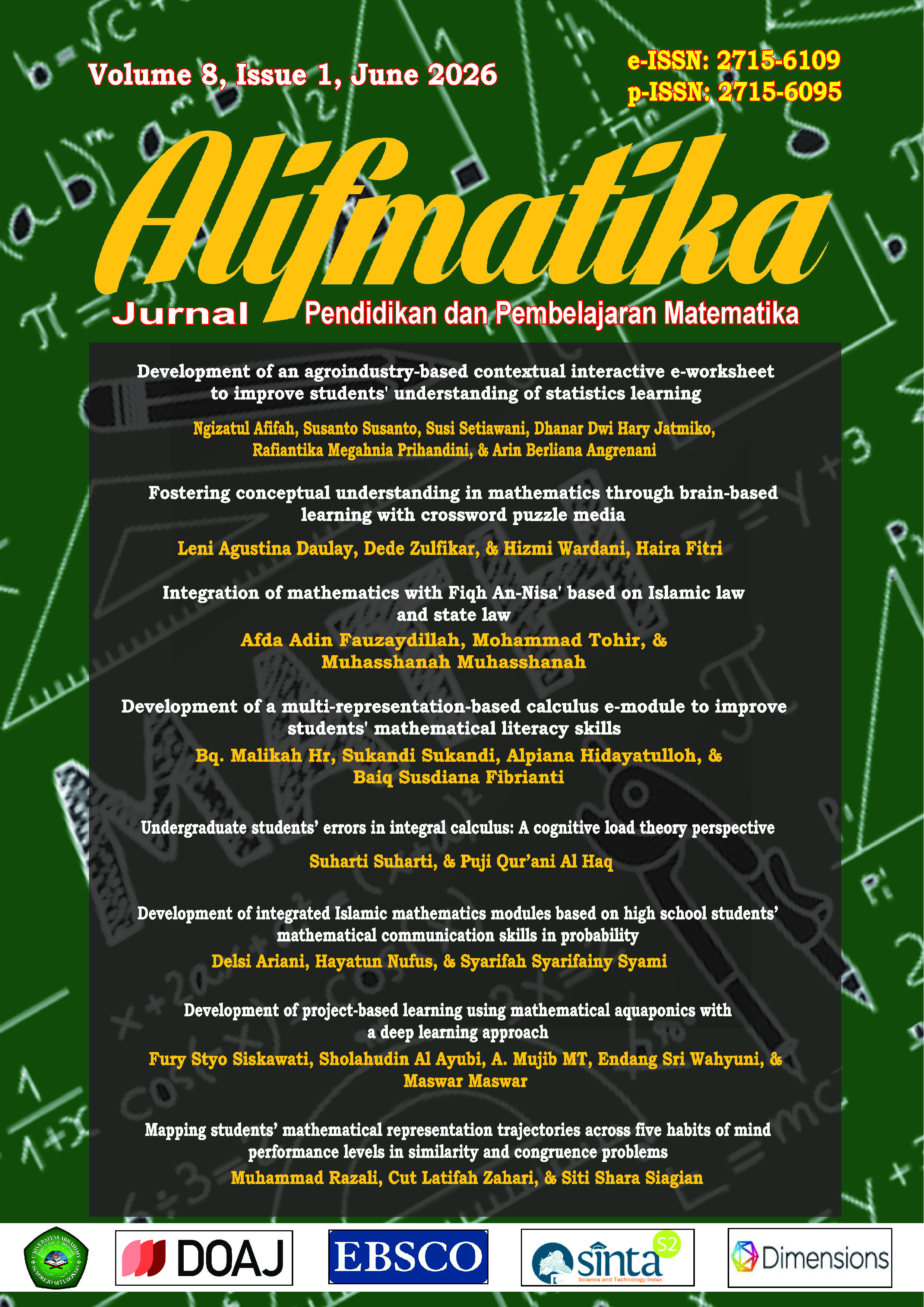
Undergraduate students’ errors in integral calculus: A cognitive load theory perspective
DOI:
https://doi.org/10.35316/alifmatika.2026.v8i1.82-100Keywords:
Cognitive Load Theory, Error Diagnosis, Integral Technique, Newman's Error AnalysisAbstract
This study aims to analyze students' errors in solving integral calculus problems based on Newmann's Error Analysis (NEA) and relate them to the Cognitive Load Theory (CLT) perspective. This study employs a descriptive quantitative approach, involving 74 students selected by purposive sampling because they have learned integral material in calculus courses. Data were obtained through an integral calculus test and analyzed using descriptive statistics, including grouping errors according to NEA, tabulating frequencies and percentages, calculating proportions and standard deviations of proportions, and presenting data in tables. The results showed that the most dominant student errors were transformation errors with a high category, which are related to difficulties in choosing the right integral technique, followed by process skill errors due to inappropriate algebraic procedures or symbol manipulation, and comprehension errors, which indicate a relatively good understanding of the problem concept, both in the moderate category. Reading errors and encoding errors were not found, indicating that students were able to read and write answers correctly. From a CLT perspective, the high intrinsic cognitive load in integral calculus material causes transformation and process skill errors, while process skill errors also reflect extraneous cognitive load due to inefficient information management. Moderate comprehension errors indicate that germane cognitive load is managed quite well, although students still have difficulty selecting the appropriate technique and performing algebraic manipulations. These results confirm that students' primary difficulties in integral calculus lie in selecting integration techniques and processing information during the solution process.
Downloads
References
Angco, R. J. N. (2021). Error analysis in integral calculus: A modified newman’s approach. American Research Journal of Humanities Social Science (ARJHSS), 04(09), 38–52. https://www.arjhss.com/wp-content/uploads/2021/09/F493852.pdf
Bressoud, D. M. (2011). Historical reflections on teaching the fundamental theorem of integral calculus. American Mathematical Monthly, 118(2), 99–115. https://doi.org/10.4169/amer.math.monthly.118.02.099
Darvishzadeh, M., Semnani, A. S., Alamolhodaei, H., & Behzadi, M. H. (2019). Analysis of students’ mistakes in solving integrals to minimize their mistakes. Control and Optimization in Applied Mathematics (COAM), 4(2), 49–60. http://mathco.journals.pnu.ac.ir
de Jong, T. (2010). Cognitive load theory, educational research, and instructional design: Some food for thought. Instructional Science, 38(2). https://doi.org/10.1007/s11251-009-9110-0
Dinçer, B. (2022). The relationship between multiple representations and thinking structures: example of the integral concept. Journal for the Education of Gifted Young Scientists, 10(4), 563–571. https://doi.org/10.17478/jegys.1213997
García-García, J., Rodríguez-Nieto, C. A., Salgado-Beltrán, G., & Zavaleta-Bautista, A. (2025). Alternative conceptions emerging in pre-university students while making mathematical connections in derivative and integral tasks. Eurasia Journal of Mathematics, Science and Technology Education, 21(8). https://doi.org/10.29333/ejmste/16732
Garcia Tobar, M., Gonzalez Alvarez, N., & Martinez Bustamante, M. (2025). A structured AHP-based approach for effective error diagnosis in mathematics: Selecting classification models in engineering education. Education Sciences, 15(7). https://doi.org/10.3390/educsci15070827
Greefrath, G., Oldenburg, R., Siller, H. S., Ulm, V., & Weigand, H. G. (2021). Basic mental models of integrals: theoretical conception, development of a test instrument, and first results. ZDM - Mathematics Education, 53(3). https://doi.org/10.1007/s11858-020-01207-0
Gupta, U., & Zheng, R. Z. (2020). Cognitive load in solving mathematics problems: validating the role of motivation and the interaction among prior knowledge, worked examples, and task difficulty. European Journal of STEM Education, 5(1), 1–14. https://doi.org/10.20897/ejsteme/9252
Kalyuga, S. (2011). Cognitive load theory: How many types of load does it really need? Educational Psychology Review, 23(1), 1–19. https://doi.org/10.1007/s10648-010-9150-7
Khounphia, S., Piasai, K., Hajisalah, S., & Janjaroon, A. (2020). A Study of Misconceptions in Mathematics About Indefinite Integral for Preservice Teacher of Lao People’s Democratic Republic. 2, 91–98. https://ph01.tci-thaijo.org/index.php/JIE/article/view/242699
Kidron, I. (2020). Calculus teaching and learning. In Encyclopedia of Mathematics Education. https://doi.org/10.1007/978-3-030-15789-0_18
Kouropatov, A., & Dreyfus, T. (2014). Learning the integral concept by constructing knowledge about accumulation. ZDM - Mathematics Education, 46(4). https://doi.org/10.1007/s11858-014-0571-5
Kusumaningrum, B., Irfan, M., & Zainnur Wijayanto. (2020). Errors analysis of students in solving volume of the solid of revolution problem in term of critical thinking aspects. Kalamatika: Jurnal Pendidikan Matematika, 5(2), 119–132. https://doi.org/10.22236/kalamatika.vol5no2.2020pp119-132
Leung, M., Low, R., & Sweller, J. (1997). Learning from equations or words. Instructional Science, 25(1). https://doi.org/10.1023/A:1002969618881
Li, V. L., Julaihi, N. H., & Eng, T. H. (2017). Misconceptions and errors in learning integral calculus. Asian Journal of University Education, 13(1), 17–39. https://files.eric.ed.gov/fulltext/EJ1207815.pdf
Machromah, I. U., & Purnomo, M. E. R. (2017). Process skill error: The majority student’s error in problem solving of integral calculus. Daya Matematis: Jurnal Inovasi Pendidikan Matematika, 5(3), 358. https://doi.org/10.26858/jds.v5i3.4843
Mahadewsing, R., Getrouw, D., & Calor, S. M. (2024). Prior knowledge of a calculus course: The impact of prior knowledge on students’ errors. International Electronic Journal of Mathematics Education , 19(3). https://doi.org/10.29333/iejme/14765
Mateus-Nieves, E., & Moll, V. F. (2021). Epistemic complexity of the mathematical object “integral.” Mathematics, 9(19), 1–25. https://doi.org/10.3390/math9192453
Meika, I., Mauladaniyati, R., Sujana, A., Sartika, N. S., & Pebriyani, N. (2023). Analisis kesalahan dalam hasil belajar mahasiswa pada mata kuliah kalkulus integral [An analysis of errors in students’ learning outcomes in the integral calculus course]. AKSIOMA: Jurnal Program Studi Pendidikan Matematika, 12(2), 2663. https://doi.org/10.24127/ajpm.v12i2.5651
Moradi, F., Rahimi, Z., & Nekouee, Z. (2023). Analysis of engineering students’ errors and misunderstandings of integration methods during the COVID-19. Tuning Journal for Higher Education, 11(1), 369–387. https://doi.org/10.18543/tjhe.2434
Newman, A. (1977). An analysis of sixth-grade pupil’s error on written mathematical tasks. Victorian Institute for Educational Research Bulletin, 39, 31–43. https://cir.nii.ac.jp/crid/1573105976160816128.bib?lang=en
Nilsen, H. K., & Knutsen, K. H. (2023). First-year engineering students’ interpretations of differentials and definite integrals. International Journal of Research in Undergraduate Mathematics Education, 9(1), 173–200. https://doi.org/10.1007/s40753-022-00208-6
Nurhasanah, N., & Dollo, A. (2021). Diagnosis of students’ errors in finding areas by integration. MaPan, 9(2), 335. https://doi.org/10.24252/mapan.2021v9n2a10
Nurhayati, L., Priatna, N., Herman, T., & Dasari, D. (2023). Learning obstacle pada materi integral (antiderivative) dalam teori situasi didaktis [Learning obstacles in integral (antiderivative) material in didactic situation theory]. AKSIOMA: Jurnal Program Studi Pendidikan Matematika, 12(1), 984. https://doi.org/10.24127/ajpm.v12i1.6470
Nurhayati, L., Suryadi, D., Dasari, D., & Herman, T. (2023). Integral (antiderivative) learning with APOS perspective: A case study. Journal on Mathematics Education, 14(1), 129–148. https://doi.org/10.22342/jme.v14i1.pp129-148
Nurrasa, S., & Nurrohman, H. (2024). Analisis kesalahan mahasiswa dalam menggunakan teknik integral subtitusi dan parsial berdasarkan newmann’s error analysis [An analysis of students’ errors in applying substitution and partial integration techniques based on newman’s error analysis]. AB-JME: Al-Bahjah Journal of Mathematics Education, 2(2), 110–123. https://doi.org/10.61553/abjme.v2i2.253
Nursyahidah, F., & Albab, I. U. (2017). Investigating student difficulties on integral calculus based on critical thinking aspects. Jurnal Riset Pendidikan Matematika, 4(2), 211. https://doi.org/10.21831/jrpm.v4i2.15507
Oktaviyanthi, R., & Agus, R. N. (2025). Mapping cognitive load and thinking zones in understanding function limits. Plusminus: Jurnal Pendidikan Matematika, 5(2). https://doi.org/10.31980/plusminus.v5i2.3018
Özgeldi, M., & Aydın, U. (2021). Identifying competency demands in calculus textbook examples: the case of integrals. International Journal of Science and Mathematics Education, 19(1). https://doi.org/10.1007/s10763-019-10046-9
Palha, S., & Spandaw, J. (2019). The integral as accumulation function approach: A proposal of a learning sequence for collaborative reasoning. European Journal of Science and Mathematics Education, 7(3), 109–136. https://doi.org/10.30935/scimath/9538
Parveen, N. (2025). Evidence-based practices of cognitive load management to enhance learning. Psychological Studies, 70(2). https://doi.org/10.1007/s12646-025-00841-6
Rahmawati, A. D., Ardianzah, F., & Novitasari, P. (2024). Penerapan teori beban kognitif dalam pengajaran matematika dalam mengurangi beban kognitif tak esensial [Application of cognitive load theory in mathematics instruction to reduce extraneous cognitive load]. Jurnal Jendela Pendidikan, 4(04). https://doi.org/10.57008/jjp.v4i04.1112
Rahmawati, R. D., Mardiyana, & Triyanto. (2019). Analysis of student misconception on calculus materials based on student mathematical reasoning. AIP Conference Proceedings. https://doi.org/10.1063/1.5141659
Richardo, R., & Cahdriyana, R. A. (2021). Strategi meminimalkan beban kognitif eksternal dalam pembelajaran matematika berdasarkan load cognitive theory [Strategies to minimize extraneous cognitive load in mathematics learning based on cognitive load theory]. Humanika, 21(1), 17–32. https://doi.org/10.21831/hum.v21i1.38228
Riduwan. (2009). Skala Pengukuran Variabel-Variabel Penelitian [Measurement Scales of Research Variables]. CV Alfabeta.
Sugiyono, P. D. (2014). Statistika untuk Penelitian [Statistics for Research]. CV Alfabeta.
Sumargiyani, Yusnia, I., Nurhasanah, R., & Nafi’ah, B. (2021). Analisis kesalahan mahasiswa dalam menyelesaikan soal kalkulus [An analysis of students’ errors in solving calculus problems]. AlphaMath : Journal of Mathematics Education, 7(1), 20–31.
Susilo, B. E., Darhim, D., & Prabawanto, S. (2021). Students’ learning difficulties in integral calculus based on critical thinking skills. Journal of Physics: Conference Series, 1918(4). https://doi.org/10.1088/1742-6596/1918/4/042058
Sweller, J. (2010). Element interactivity and intrinsic, extraneous, and germane cognitive load. In Educational Psychology Review (Vol. 22, Issue 2, pp. 123–138). https://doi.org/10.1007/s10648-010-9128-5
Sweller, J., van Merriënboer, J. J. G., & Paas, F. (2019). Cognitive architecture and instructional design: 20 years later. In Educational Psychology Review (Vol. 31, Issue 2, pp. 261–292). Springer New York LLC. https://doi.org/10.1007/s10648-019-09465-5
Thomson, B. S. (2013). Theory of the integral. In Mathematical Analysis. ClassicalRealAnalysis.com. https://doi.org/10.1016/b978-0-08-010796-7.50008-0
Valdez, F. A. O., & Taganap, E. C. (2024). Error analysis of pre-service mathematics teachers in solving verbal problems. Mathematics Teaching-Research Journal, 16(4), 6–34.
Walpole, R. E., Myers, R. H., Myers, S. L., & Ye, K. (2017). Probability & statistics for engineers & scientists (9th ed., Vol. 17). Pearson Education Inc.
Yohanes, B., & Yusuf, F. I. (2021). Teori beban kognitif: Peta kognitif dalam pemecahan masalah pada matematika sekolah [Cognitive load theory: Cognitive mapping in problem solving in school mathematics]. AKSIOMA: Jurnal Program Studi Matematika, 10(4), 2215–2224. http://repository.unibabwi.ac.id/id/eprint/647/1/C1. ARTIKEL AKSIOMA.pdf
Downloads
Published
How to Cite
Issue
Section
License
Copyright (c) 2026 Alifmatika: Jurnal Pendidikan dan Pembelajaran Matematika

This work is licensed under a Creative Commons Attribution-ShareAlike 4.0 International License.
COPYRIGHT NOTICE
Author (s) who publish in Alifmatika: Jurnal Pendidikan dan Pembelajaran Matematika agree to the following terms:
- The Author (s) submitting a manuscript do so on the understanding that if accepted for publication, copyright of the article shall be assigned to Alifmatika: Jurnal Pendidikan dan Pembelajaran Matematika, Tarbiyah Faculty of Ibrahimy University as the publisher of the journal. Consecutively, author(s) still retain some rights to use and share their own published articles without written permission from Alifmatika: Jurnal Pendidikan dan Pembelajaran Matematika. This work is licensed under a Creative Commons Attribution-ShareAlike 4.0 International License.
- Copyright encompasses rights to publish and provide the manuscripts in all forms and media for the purpose of publication and dissemination, and the authority to enforce the rights in the manuscript, for example in the case of plagiarism or in copyright infringement.
- Alifmatika: Jurnal Pendidikan dan Pembelajaran Matematika and the Editors make every effort to ensure that no wrong or misleading data, opinions or statements be published in the journal. In any way, the contents of the articles and advertisements published in Alifmatika: Jurnal Pendidikan dan Pembelajaran Matematika are the sole responsibility of their respective authors and advertisers.
- The Copyright Transfer Form can be downloaded here [Copyright Transfer Form Alifmatika]. The copyright form should be signed originally and send to the Editorial Office in the form of original mail, scanned document to alifmatika[at]ibrahimy.ac.id or upload the scanned document in the comments column when sending the manuscript.
















_by_Matematohir.jpg)