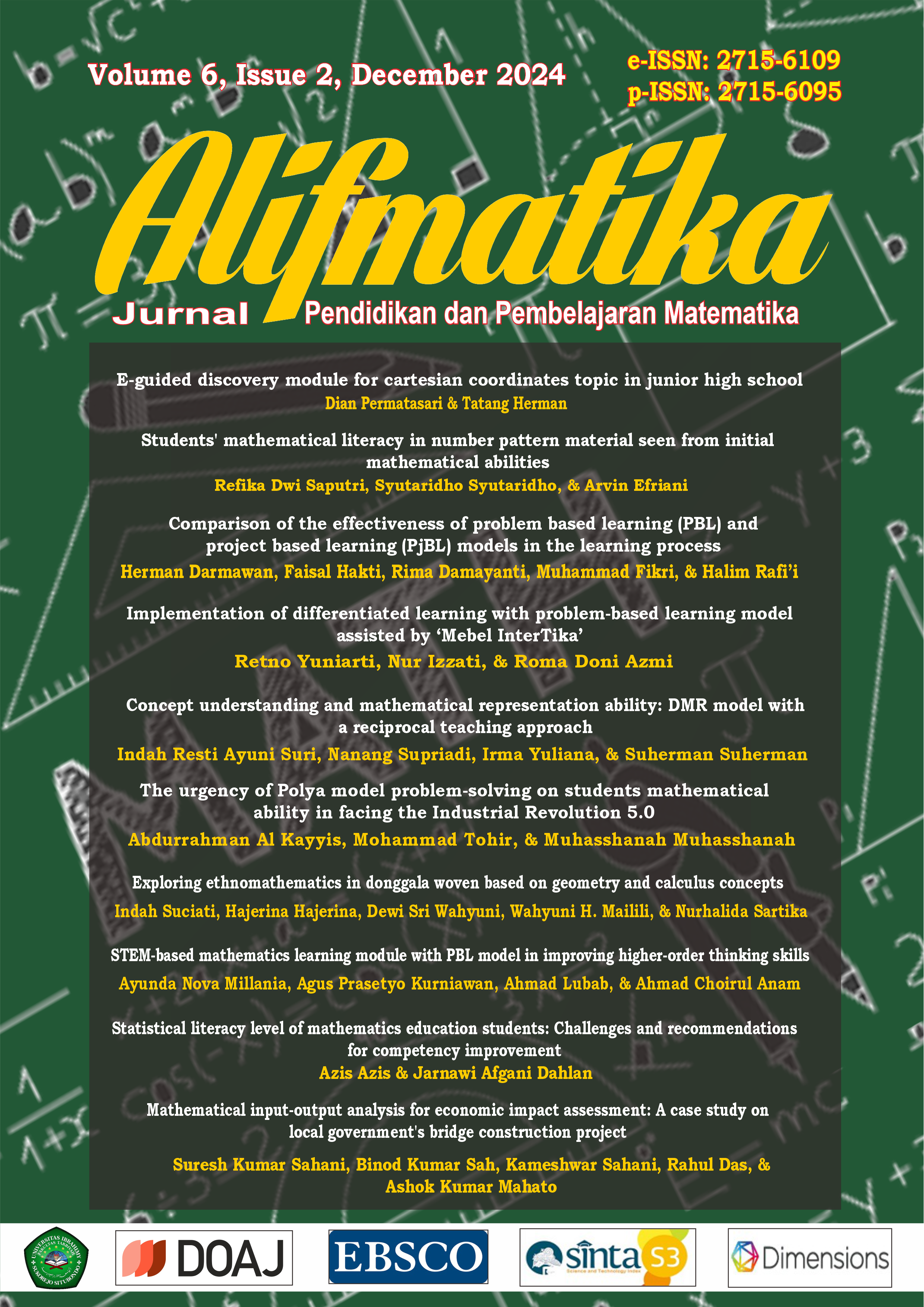
Implementation of differentiated learning with problem-based learning model assisted by ‘Mebel InterTika’
DOI:
https://doi.org/10.35316/alifmatika.2024.v6i2.192-204Keywords:
Differentiated Learning, Learning Results, Problem-Based LearningAbstract
Problems that often arise in mathematics subjects include low learning outcomes.. This study aims to analyze the differences in learning outcomes of students who learn by implementing differentiated learning strategies with the Problem-Based Learning model assisted by MeBel InterTika with students who learn by implementing the Problem-Based Learning model in class VIII statistics material. This research uses a quantitative approach with a quasi-experimental research type. Data were collected using questionnaire techniques, test techniques, and observation techniques. The main research instruments include a learning style questionnaire, learning results tests, and observation sheets. Supporting research instruments are Learning Implementation Plans and MeBel InterTika. The data analyzed are quantitative data obtained from pretest and posttest data on student learning outcomes in the experimental and control classes. The results of the nonparametric test using the Mann-Whitney test, with a significance level of 5%, obtained a significance value of 0.0175, so it was found that the increase in student learning outcomes through the application of differentiated learning strategies with the Problem-Based Learning model assisted by MeBel InterTika was significantly higher than students who received the Problem-Based Learning model in grade VIII of Junior High School.
Downloads
References
Ally, M. (2009). Mobile Learning: Transforming the delivery of education and training. International Review of Research in Open and Distance Learning, 10(4). 1-3. https://doi.org/10.56059/jl4d.v3i2.153
Aminingtyas, M., & Wardhani, J. D. (2023). Hubungan minat dan motivasi belajar berbasis portal rumah belajar terhadap hasil belajar kognitif anak [The relationship between learning interest and motivation based on the learning home portal on children's cognitive learning outcomes]. Murhum : Jurnal Pendidikan Anak Usia Dini, 4(1), 590–601. https://doi.org/10.37985/murhum.v4i1.268
Arnidha, Y., & Noerhasmalina, N. (2018). Model problem based learning (PBL) pada Pembelajaran Matematika [Problem-based learning (PBL) model in mathematics learning]. JURNAL E-DuMath, 4(2), 46–51. https://doi.org/10.26638/je.755.2064
Aung, M. M. (2020). The analysis of the using student-centered learning Method at Dawei University. Taiwan Education Review Monthly, 7(7), 1–9. https://doi.org/10.13140/RG.2.2.26907.41764
Awalia, F. H. (2018). Penerapan model pembelajaran problem based learning untuk meningkatkan hasil belajar matematika SD [Implementation of problem-based learning model to improve elementary school mathematics learning outcomes]. Primary, 7(1), 40–47. https://doi.org/http://dx.doi.org/10.33578/jpfkip.v7i1.5338
Darnanta, I. W., Pradnyana, I. M. A., & Agustini, K. (2020). Development of mathematics interactive learning media with gamification concept for mentally disabled students. Journal of Physics: Conference Series, 1516(1), 1–9. https://doi.org/10.1088/1742-6596/1516/1/012043
Djonomiarjo, T. (2019). Pengaruh model problem based learning terhadap hasil belajar [The influence of problem-based learning model on learning outcomes]. Aksara: Jurnal Ilmu Pendidikan Nonformal, 5(1), 39–46. https://doi.org/10.37905/aksara.5.1.39-46.2019
Hakim, A. R., & Windayana, H. (2016). Pengaruh penggunaan multimedia interaktif dalam pembelajaran matematika untuk meningkatkan hasil belajar siswa SD [The influence of using interactive multimedia in mathematics learning to improve elementary school students' learning outcomes]. EduHumaniora | Jurnal Pendidikan Dasar Kampus Cibiru, 4(2), 1–13. https://doi.org/10.17509/eh.v4i2.2827
Hanif, A., Herman, Mudinillah, A., & Rahmi, P. W. L. (2023). Development of the quizizz platform as an interactive quiz-based learning media for arabic language lessons at Madrasah Ibtidaiyah. International Journal of Membrane Science and Technology, 10(2), 372–384. https://doi.org/10.15379/ijmst.v10i2.1207
Hermuttaqien, B. P. F., Aras, L., & Lestari, S. I. (2023). Penerapan model pembelajaran problem based learning untuk meningkatkan hasil belajar siswa [Implementation of problem based learning model to improve student learning outcomes]. Kognisi: Jurnal Penelitian Pendidikan Sekolah Dasar, 3(1), 16–22. https://doi.org/10.56393/kognisi.v2i4.1354
Hew, K. F., & Cheung, W. S. (2014). Students’ and instructors’ use of massive open online courses (MOOCs): Motivations and challenges. Educational Research Review, 12(June 2014), 45–58. https://doi.org/10.1016/j.edurev.2014.05.001
Husna, M., Degeng, I. N. ., & Kuswandi, D. (2017). Peran multimedia interaktif dalam pembelajaran tematik di sekolah dasar [The role of interactive multimedia in thematic learning in elementary schools]. Prosiding TEP & PDs, 1(7), 34–41.
Indriati, W. (2022). Peningkatan keaktifan dan hasil belajar siswa pada pembelajaran statistika melalui model problem based learning berbantuan microsoft excel [increasing student activity and learning outcomes in statistics Learning through the problem-based learning model assisted by microsoft excel]. Ideguru: Jurnal Karya Ilmiah Guru, 7(2), 157–163. https://doi.org/10.51169/ideguru.v7i2.321
Iskandar, D. (2021). Peningkatan hasil belajar siswa pada materi report text melalui pembelajaran berdiferensiasi di kelas IX.A SMP Negeri 1 Sape tahun pelajaran 2020/2021 [Improving student learning outcomes on report text material through differentiated learning in class IX.A of Sape 1 state junior high school 2020/2021 Academic Year]. Jurnal Pendidikan Dan Pembelajaran Indonesia (JPPI), 1(2), 123–140. https://doi.org/10.53299/jppi.v1i2.48
Izzati, N., & Yuniarti, R. (2023). The development of interactive learning multimedia support differentiated learning with problem-based learning implementation. Jurnal Pendidikan MIPA, x(x). https://doi.org/10.21831/jitp.vxix.xxxxx. (not yet published).
Makovec, D. (2018). The teacher’s role and professional development. International Journal of Cognitive Research in Science, Engineering and Education, 6(2), 33–45. https://doi.org/10.5937/ijcrsee1802033M
Mbagho, H. M., & Tupen, S. N. (2020). Pembelajaran matematika realistik dalam meningkatkan hasil belajar matematika materi operasi bilangan pecahan [Realistic mathematics learning in improving mathematics learning outcomes in fractional number operation material]. Jurnal Basicedu, 5(1), 121–132. https://doi.org/10.31004/basicedu.v5i1.632
Means, B., Toyama, Y., Murphy, R., Bakia, M., & Jones, K. (2009). Evaluation of Evidence-Based Practices in Online Learning: A Meta-Analysis and Review of Online Learning Studies. Washington D.C: Department of Education, Office of Planning, Evaluation, and Policy Development,
Muslimin, Hirza, B., Nery, R. S., Yuliani, R. E., Heru, Supriadi, A., Desvitasari, T., & Khairani, N. (2022). Peningkatan hasil belajar matematika siswa melalui pembelajaran berdiferensiasi dalam mewujudkan merdeka belajar [Improving students' mathematics learning outcomes through differentiated learning in realizing independent learning]. Jurnal Pendidikan Matematika RAFA, 8(2), 22–32. https://doi.org/https://doi.org/10.19109/jpmrafa.v8i2.14770
Nabillah, T., & Abadi, A. P. (2019). Faktor penyebab rendahnya hasil belajar siswa [Factors causing low student learning outcomes]. Prosiding Seminar Nasional Matematika Dan Pendidikan Matematika Sesiomadika 2019, 2(1), 659–663. https://journal.unsika.ac.id/index.php/sesiomadika/article/view/2685/1908
Nini, Y., Aunurrahman, & Faadillah. (2015). Pemanfaatan multimedia interaktif pada model problem based learning (PBL) dalam pembelajaran matematika di Kelas VIII [Utilization of interactive multimedia in the problem-based learning (PBL) model in mathematics learning in class VIII]. Jurnal Pendidikan Tambusai, 4(11), 832–840. https://doi.org/http://dx.doi.org/10.26418/jppk.v4i11.12314
O.I., O. (2021). Effects of graphic organizer and animation on students learning outcomes in Mathematics. International Journal of Research and Innovation in Applied Science, 06(05), 47–51. https://doi.org/10.51584/ijrias.2021.6502
Orhan, A. (2024). Investigating the effectiveness of problem based learning on academic achievement in EFL classroom: A meta ‑ analysis. The Asia-Pacific Education Researcher, 1–11. https://doi.org/10.1007/s40299-024-00889-4
Paseleng, M. C., & Arfiyani, R. (2015). Pengimplementasian media pembelajaran berbasis multimedia interaktif pada mata pelajaran matematika di sekolah dasar [Implementation of interactive multimedia-based learning media in mathematics subjects in elementary schools]. Sholaria: Jurnal Pendidikan Dan Kebudayaan, 5(2), 131–149. https://doi.org/https://doi.org/10.24246/j.scholaria.2015.v5.i2.p131-149
Pavešić, B. J., Koršňáková, P., & Meinck, S. (2019). Dinaric perspectives on TIMSS 2019 A series of in-depth analyses based on data of the international association for the evaluation of educational achievement (IEA) Teaching and learning mathematics and science in south-eastern europe (13th ed.). Springer Nature Switzerland AG. https://link.springer.com/bookseries/14293
Pelealu, A. A., Pitoy, C., & Pesik, A. (2022). Penerapan model problem based learning pada pembelajaran matematika materi statistika [Implementation of problem-based learning model in mathematics learning statistics material]. Adiba: Journal of Education, 2(2), 253–262. https://doi.org/https://adisampublisher.org/index.php/adiba/article/view/106/102
Purwowidodo, A., & Zaini, M. (2023). Teori dan praktik model pembelajaran berdiferensiasi implementasi kurikulum merdeka belajar [Theory and practice of differentiated learning models for implementing the merdeka belajar curriculum]. Yogyakarta: Penebar Media Pusaka.
Putri, F. E., Amelia, F., & Gusmania, Y. (2019). Hubungan antara gaya belajar dan keaktifan belajar matematika terhadap hasil belajar siswa [The relationship between learning styles and mathematics learning activity on student learning outcomes]. Edumatika: Jurnal Riset Pendidikan Matematika, 2(2), 83–88. https://doi.org/10.32939/ejrpm.v2i2.406
Rahdiyanta, D., Prasetya, H. T., & Rezani, R. (2020). Development of interactive learning media in producing straight gears of milling subjects. Journal of Physics: Conference Series, 1446(1), 1–6. https://doi.org/10.1088/1742-6596/1446/1/012011
Ratna Wati, E. D. (2020). Keefektifan model realistic mathematics education berbantuan media dakon terhadap hasil belajar perkalian [The effectiveness of the realistic mathematics education model assisted by dakon media on multiplication learning outcomes]. Joyful Learning Journal, 9(1), 1–5. https://doi.org/10.15294/jlj.v9i1.39114
Sugiyono. (2019). Metode penelitian kuantitatif, kualitatif, dan R&D [Quantitative, qualitative, and R&D Research Methods] (7th ed.). Bandung: Alfabeta.
Suwartiningsih, S. (2021). Penerapan pembelajaran berdiferensiasi untuk meningkatkan hasil belajar siswa pada mata pelajaran ipa pokok bahasan tanah dan keberlangsungan kehidupan di kelas ixb semester genap SMPN 4 Monta tahun pelajaran 2020/2021 [Implementing differentiated learning to improve student learning outcomes in science subjects on land and sustainability of life in class IXB even semester of Monta 4 state junior high school in the 2020/2021 Academic Year]. Jurnal Pendidikan Dan Pembelajaran Indonesia (JPPI), 1(2), 80–94. https://doi.org/10.53299/jppi.v1i2.39
Syarifuddin, & Nurmi. (2022). Pembelajaran berdiferensiasi dalam meningkatkan hasil belajar matematika siswa kelas IX semester genap SMP Negeri 1 Wera tahun pelajaran 2021/2022 [Differentiated learning in improving mathematics learning outcomes of grade IX students in even semester of Wera 1 state junior high school in the 2021/2022 Academic Year]. JagoMIPA: Jurnal Pendidikan Matematika Dan IPA, 2(2), 93–102. https://doi.org/10.53299/jagomipa.v2i2.184
Tomlinson, C. A. (2001). How to differentiate instruction in mixed-ability classrooms (2nd ed.). Virginia: Association for Supervision and Curriculum Development.
Trullàs, J. C., Blay, C., Sarri, E., & Pujol, R. (2022). Effectiveness of problem-based learning methodology in undergraduate medical education: a scoping review. BMC Medical Education, 22(1), 1–12. https://doi.org/10.1186/s12909-022-03154-8
Uyanto, S. S. (2009). Pedoman analisis data dengan SPSS [Data analysis guidelines with SPSS ] (3rd ed.). Yogyakarta: Graha Ilmu.
Wahono, B., Lin, P. L., & Chang, C. Y. (2020). Evidence of STEM enactment effectiveness in Asian student learning outcomes. International Journal of STEM Education, 7(1), 1–18. https://doi.org/10.1186/s40594-020-00236-1
Wang, C. C. (2021). The process of implementing problem-based learning in a teacher education programme: an exploratory case study. Cogent Education, 8(1), 1–13. https://doi.org/10.1080/2331186X.2021.1996870
Yestiani, D. K., & Zahwa, N. (2020). Peran guru dalam pembelajaran pada siswa sekolah dasar [The Role of teachers in learning for elementary school students]. Fondatia, 4(1), 41–47. https://doi.org/10.36088/fondatia.v4i1.515
Zuhrotunnisa, & Fitrianto, E. S. (2022). Implementasi problem based learning berbantuan aplikasi web pada materi statistika [Implementation of problem-based learning assisted by web applications on statistics material]. Jurnal Pembelajaran Matematika Inovatif, 5(4), 959–970. https://doi.org/10.22460/jpmi.v5i4.959-970
Zuniari, N. I., Wahyuni, S., Ulfa, E. M., & Dharmawan, M. K. S. (2022). The Effectiveness of Implementation Learning Media Based on Augmented Reality in Elementary School in Improving Critical Thinking Skills in Solar System Course. Journal of Physics: Conference Series, 2392(1), 1–13. https://doi.org/10.1088/1742-6596/2392/1/012010
Downloads
Published
How to Cite
Issue
Section
License
Copyright (c) 2024 Alifmatika: Jurnal Pendidikan dan Pembelajaran Matematika

This work is licensed under a Creative Commons Attribution-ShareAlike 4.0 International License.
COPYRIGHT NOTICE
Author (s) who publish in Alifmatika: Jurnal Pendidikan dan Pembelajaran Matematika agree to the following terms:
- The Author (s) submitting a manuscript do so on the understanding that if accepted for publication, copyright of the article shall be assigned to Alifmatika: Jurnal Pendidikan dan Pembelajaran Matematika, Tarbiyah Faculty of Ibrahimy University as the publisher of the journal. Consecutively, author(s) still retain some rights to use and share their own published articles without written permission from Alifmatika: Jurnal Pendidikan dan Pembelajaran Matematika. This work is licensed under a Creative Commons Attribution-ShareAlike 4.0 International License.
- Copyright encompasses rights to publish and provide the manuscripts in all forms and media for the purpose of publication and dissemination, and the authority to enforce the rights in the manuscript, for example in the case of plagiarism or in copyright infringement.
- Alifmatika: Jurnal Pendidikan dan Pembelajaran Matematika and the Editors make every effort to ensure that no wrong or misleading data, opinions or statements be published in the journal. In any way, the contents of the articles and advertisements published in Alifmatika: Jurnal Pendidikan dan Pembelajaran Matematika are the sole responsibility of their respective authors and advertisers.
- The Copyright Transfer Form can be downloaded here [Copyright Transfer Form Alifmatika]. The copyright form should be signed originally and send to the Editorial Office in the form of original mail, scanned document to alifmatika[at]ibrahimy.ac.id or upload the scanned document in the comments column when sending the manuscript.













_by_Matematohir.jpg)