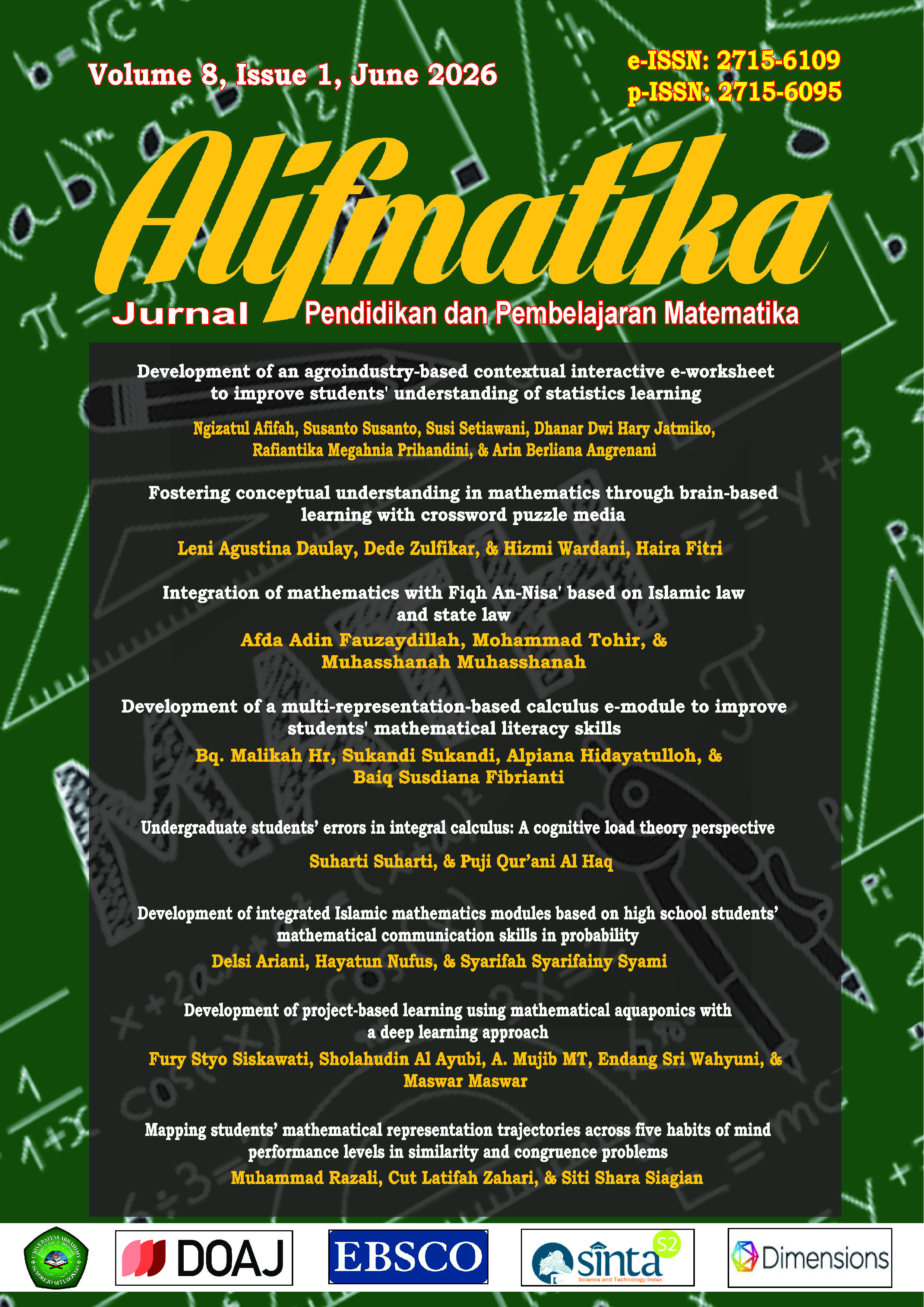
Mapping students’ mathematical representation trajectories across five habits of mind performance levels in similarity and congruence problems
DOI:
https://doi.org/10.35316/alifmatika.2026.v8i1.135-162Keywords:
Habits of Mind Performance, Mathematical Representation Trajectory, Pictorial Representation, Similarity and Congruence Problems, Symbolic Representation, Verbal RepresentationAbstract
This study aims to map students’ trajectories of mathematical representation across five Habits of Mind performance levels in solving similarity and congruence problems. Unlike previous descriptive studies, which generally examine the relationship between mathematical representation ability and Habits of Mind, this study emphasizes how students’ pictorial, symbolic, and verbal representations develop, intersect, and differ across performance levels. A descriptive qualitative approach was employed involving 30 ninth-grade junior high school students selected through purposive sampling. The data were collected using a mathematical representation ability test, a Habits of Mind questionnaire, and semi-structured interviews. The findings reveal five representation trajectories. At the beginner level, students’ representations were fragmented and lacked meaningful connections to the problem. At the limited level, representations began to appear but remained partial, inconsistent, and procedurally weak. At the developing level, students showed emerging ability to connect pictorial, symbolic, and verbal forms, although conceptual errors still occurred. At the proficient level, students demonstrated more structured symbolic and pictorial representations, but their written verbal explanations still required refinement. At the superior level, students were able to coordinate representations flexibly, systematically, and meaningfully. A notable finding is that representation development does not always progress linearly; some students at the developing level showed representational characteristics close to the proficient level. Therefore, this study contributes a five-level trajectory map that explains the dynamics of students’ mathematical representation ability through the lens of Habits of Mind performance.
Downloads
References
Ahmad, A., Akhsani, L., & Mohamed, Z. (2023). The profile of students’ mathematical representation competence, self-confidence, and habits of mind through problem-based learning models. Infinity Journal, 12(2), 323–338. https://doi.org/10.22460/infinity.v12i2.p323-338
Aini, K. N., & Hidayah, N. (2024). Analisis kemampuan representasi matematis siswa dalam menyelesaikan soal matematika ditinjau dari tipe kepribadian florence littauer [Analysis of students' mathematical representation abilities in solving mathematical problems viewed from Florence Littauer's personality type]. Indo-MathEdu Intellectuals Journal, 5(2), 1916–1922. https://doi.org/10.54373/imeij.v5i2.987
Anggraena, Y. (2019). Pengembangan kurikulum matematika untuk meningkatkan kemampuan siswa dalam penalaran dan pemecahan masalah [Developing a mathematics curriculum to improve students' reasoning and problem-solving abilities]. Alifmatika: Jurnal Pendidikan Dan Pembelajaran Matematika, 1(1), 15–27. https://doi.org/10.35316/alifmatika.2019.v1i1.15-27
Annisa, G., & Liberna, H. (2025). Peran disposisi matematis dan kemandirian belajar dalam meningkatkan kompetensi representasi matematis: Kajian literatur [The role of mathematical disposition and learning independence in improving mathematical representation competence: A literature review]. JIIP (Jurnal Ilmiah Ilmu Pendidikan), 8(2), 1169–1175. http://jiip.stkipyapisdompu.ac.id
Aprilia, A., Asih, E. C. M., & Usdiyana, D. (2023). The effect of mathematical habits of mind and early mathematical ability on modeling ability of high school students. JTAM (Jurnal Teori Dan Aplikasi Matematika), 7(4), 914–923. https://doi.org/10.31764/jtam.v7i4.11924
Aringga, D., Shodiqin, A., & Albab, I. U. (2020). Penelusuran kebiasaan berpikir (habits of mind) matematis siswa dalam menyelesaikan soal cerita bilangan pecahan ditinjau dari gaya kognitif [Exploring students' mathematical thinking habits (habits of mind) in solving fractional story problems from the perspective of cognitive style.]. Thinking Skills and Creativity Journal, 2(2), 121–129. https://doi.org/10.23887/tscj.v2i2.22666
Barokah, R., & Madawistama, S. T. (2024). Kemampuan literasi matematis dalam menyelesaikan soal AKM ditinjau dari keyakinan matematis siswa [Mathematical literacy ability in solving AKM problems is reviewed from students' mathematical beliefs.]. Jurnal Kongruen, 3(3), 208-217. https://jurnal.unsil.ac.id/index.php/kongruen/article/view/14085
Bülbül, B. Ö., & Güler, M. (2023). Examining the effect of dynamic geometry software on supporting geometric habits of mind: A qualitative inquiry. Industry and Higher Education, 37(1), 100–113. https://doi.org/10.1177/20427530221107776
Bülbül, B. Ö. (2021). Factors affecting prospective mathematics teachers’ beliefs about geometric habits of mind. Journal of Pedagogical Research, 5(2), 36–48. https://doi.org/10.33902/JPR.2021068370
Choiriyaza, A. E., & Fatma, M. (2021). Pemodelan matematika: Dapatkah autograph meningkatkan representasi semiotik matematik siswa? [Mathematical modeling: Can autographs improve students' mathematical semiotic representations?]. JNPM (Jurnal Nasional Pendidikan Matematika), 5(2), 264–276. https://doi.org/doi.org/10.33603/jnpm.v5i2.1210
Coşkun, İ., Özen-Ünal, D., Eryalçın, S., & Yazıcı, E., & Ünal, D. Ö. (2023). Investigation of pre-service middle school mathematics teachers habits of mind in pattern generalization problems. Osmangazi Journal of Educational Research, 10(2), 52–75. https://doi.org/10.59409/ojer.1359752
Cuoco, A. L., Goldenberg, E. P., & Mark, J. (1996). Habits of mind: An organizing principle for mathematics curricula. Journal of Mathematical Behavior, 15(4), 375–402.
Dwirahayu, G., Kustiawati, D., & Bidari, I. (2018). Pengaruh habits of mind terhadap kemampuan generalisasi matematis [The influence of habits of mind on mathematical generalization ability]. Jurnal Penelitian dan Pembelajaran Matematika, 11(2), 91-104. https://doi.org/10.30870/jppm.v11i2.3757
Haryadi, J., Mujib, A., & Siagian, S. S. (2024). Analysis of student image concepts in constructing proof and mathematical communication in terms of gender. International Journal of Multidisciplinary and Current Educational Research, 6(4), 103–109. www.ijmcer.com
Hasnarika. (2022). Penerapan Metaphorical thinking untuk meningkatkan kemampuan representasi matematis dan habits of mind siswa SMP [The application of metaphorical thinking to improve the mathematical representation skills and habits of mind of junior high school students]. Jurnal Pendidikan MIPA, 12, 255–264. https://doi.org/10.37630/jpm.v12i2.586
Hilmi, Y., Matematika, P. P., & Tasikmalaya, U. C. (2023). Analisis Kemampuan Representasi Matematis Siswa SMP Ditinjau dari Habits of Mind. J-PiMat: Jurnal Pendidikan Matematika, 5(2), 979-988. https://doi.org/10.31932/j-pimat.v5i2.2906
Hutajulu, M., & Minarti, E. D. (2017). Meningkatkan kemampuan advanced mathematical thinking dan habits of mind mahasiswa melalui pendekatan keterampilan metakognitif [Improving students' advanced mathematical thinking skills and habits of mind through a metacognitive skills approach]. JES-MAT, 3(2), 177–194. https://doi.org/10.25134/jes-mat.v3i2.690
Ikhsan, N. M., Dewi, N. R., & Waluya, S. B. (2024). Kemampuan representasi matematis siswa pada model pembelajaran preprospec berbantuan aplikasi game android: Systematic literature review (SLR) [Students' mathematical representation ability in the preprospec learning model assisted by an Android game application: Systematic literature review (SLR)]. PRISMA, Prosiding Seminar Nasional Matematika, 7, 253–260. https://proceedings.unnes.ac.id/prisma/article/view/2960
Ikhsan, R., Abdillah, N., Zahari, C., & Wardani, H. (2024). Meta analisis pembelajaran bidang matematika dengan menggunakan model pembelajaran problem based learning [Meta-analysis of mathematics learning using the problem-based learning model]. Jurnal Cendekia: Jurnal Pendidikan Matematika, 8(2), 1409–1417. https://doi.org/10.31004/cendekia.v8i2.3080
Janah, N., Akbar, R. O., & Kusmanto, H. (2022). Analisis kemampuan literasi matematika ditinjau dari habits of mind siswa di SMPN 14 Kota Cirebon [Analysis of mathematical literacy skills reviewed from the habits of mind of students at SMPN 14 Cirebon City]. Polynom : Journal in Mathematics Education, 2(3), 167-180. https://doi.org/10.14421/polynom.2022.23.167-180
Lim, K. H., & Selden, A. (2009). Mathematical habits of mind. PME-NA Working Group Paper, 5(2) 1576-1583. https://scholarworks.utep.edu/math_papers/242/
Lubis, L. K., Lubis, A. M., Fitriani, F., & ... (2024). Analysis of Students' Mathematical Concept Understanding Ability in Terms of Student Resilience at Ban Kadeng School Thailand. Kreano, Jurnal Matematika Kreatif-Inovatif, 15(2), 409-422. https://doi.org/10.15294/bc59ec96
Maarif, S., & Akbari, H. A. (2024). Sociomathematical norm, mathematical resilience and mathematical representation ability in mathematics learning. Jurnal Penelitian dan Pengembangan Pendidikan, 8(3), 621-631. https://doi.org/10.23887/jppp.v8i3.65238
Maarif, S., & Fitriani, N. (2023). Mathematical resilience, habits of mind, and sociomathematical norms by senior high school students in learning mathematics: a structured equation model. Infinity Journal, 12(1), 117–132. https://doi.org/10.22460/infinity.v12i1.p117-132
Malasari, P. N., Herman, T., & Jupri, A. (2019). Kontribusi habits of mind terhadap kemampuan literasi matematis siswa pada materi geometri [The contribution of habits of mind to students' mathematical literacy skills in geometry material]. Jurnal Pendidikan Matematika (Kudus), 2(2), 153–164. https://doi.org/10.21043/jpm.v2i2.6361
Mujib, A., Firmansyah, Siagian, S. S., & M. (2025). The I-CON model in constructing mathematical proof. Jurnal Eduscience, 12(3), 844–858. https://doi.org/10.36987/jes.v12i3.7240
Mujib, A. F. (2022). Improvement habits of minds in constructing mathematical proof using DNR-model. Aip Conference Proceedings, 020038(May 2017). https://doi.org/https://doi.org/10.1063/5.0096095
Mustangin. (2015). Representasi konsep dan peranannya dalam pembelajaran matematika di sekolah [Concept representation and its role in mathematics learning in schools]. Jurnal Pendidikan Matematika, I(1), 15–21. https://doi.org/10.33474/jpm.v1i1.405
Nauli, N., Harisman, Y., Armiati, & Y. (2024). Junior high school students’ habits of mind in solving mathematical problems. Jurnal Pendidikan Matematika, 18(1), 39–58. https://doi.org/10.22342/jpm.v18i1.pp39-58
Nisa, F. B., Mukhlis, M., & Maswar, M. (2020). Analisis hubungan antara kecerdasan logis matematis dengan kemampuan komunikasi matematis siswa [Analysis of the relationship between logical mathematical intelligence and students' mathematical communication abilities]. Alifmatika: Jurnal Pendidikan Dan Pembelajaran Matematika, 2(2), 199–211. https://doi.org/10.35316/alifmatika.2020.v2i2.199-211
OECD. (2022). PISA 2022 Results (Volume I): The state of learning and equity in education: Vol. I. https://doi.org/10.1787/53f23881-en
Purwasih, R., Sari, N. R., & Agustina, S. (2018). Analisis kemampuan literasi matematik dan mathematical habits of mind siswa SMP pada materi bangun ruang sisi datar [Analysis of mathematical literacy skills and mathematical habits of mind of junior high school students on the material of flat-sided geometric shapes]. Numeracy, 5(1), 67-76. https://doi.org/10.46244/numeracy.v5i1.318
Rahmah, M., & Zulfadewina, Z. (2025). Analysis of fifth-grade students’ numeracy literacy skills in Mathematics. Curricula: Journal of Curriculum Development, 4(2), 1847-1858. https://ejournal-education.upi.edu/curricula/article/view/561
Siagian, S. S., Mujib, A., & Zahari, C. L. (2022). Analisis tingkat kecemasan matematika dalam pembentukan konsep image siswa [Analysis of the level of mathematical anxiety in the formation of students' image concepts]. Paradikma Jurnal Pendidikan Matematika, 15(1), 8–13. https://doi.org/10.24114/paradikma.v15i1.34569
Siregar, N. F. (2021). Pemahaman konsep matematika siswa smp melalui pendekatan realistic mathematics education [Understanding of junior high school students' mathematical concepts through a realistic mathematics education approach]. Jurnal Cendekia, 5(2), 1919-1927. https://doi.org/10.31004/cendekia.v5i2.635
Suri, I. R. A., Supriadi, N., Yuliana, I., & Suherman, S. (2024). Concept understanding and mathematical representation ability: dmr model with a reciprocal teaching approach. Alifmatika: Jurnal Pendidikan Dan Pembelajaran Matematika, 6(2), 205–217. https://doi.org/10.35316/alifmatika.2024.v6i2.205-217
Tashtoush, M. A. (2022). The effect of a training program based on TIMSS to developing the levels of habits of mind and mathematical reasoning skills among pre-service mathematics teachers. Eurasia Journal of Mathematics, Science and Technology Education, 18(11). https://doi.org/https://doi.org/10.29333/ejmste/12557
Wahyuni, G., Mujib, A., & Zahari, C. L. (2022). Analisis kemampuan berpikir visual siswa ditinjau dari adversity quotient [Analysis of students' visual thinking abilities in terms of adversity quotient]. JUPE : Jurnal Pendidikan Mandala, 7(2), 289–295. https://doi.org/10.58258/jupe.v7i2.3335
Zahari, C. L., & Razali, M. (2022). Penjumlahan dan pengurangan penanaman konsep bilangan bulat dengan pendekatan pembelajaran matematika realistik [Addition and subtraction of the concept of integers with a realistic mathematics learning approach]. Jurnal Cendekia: Jurnal Pendidikan Matematika, 6(2), 2040–2047. https://doi.org/10.31004/cendekia.v6i2.1377
Downloads
Published
How to Cite
Issue
Section
License
Copyright (c) 2026 Alifmatika: Jurnal Pendidikan dan Pembelajaran Matematika

This work is licensed under a Creative Commons Attribution-ShareAlike 4.0 International License.
COPYRIGHT NOTICE
Author (s) who publish in Alifmatika: Jurnal Pendidikan dan Pembelajaran Matematika agree to the following terms:
- The Author (s) submitting a manuscript do so on the understanding that if accepted for publication, copyright of the article shall be assigned to Alifmatika: Jurnal Pendidikan dan Pembelajaran Matematika, Tarbiyah Faculty of Ibrahimy University as the publisher of the journal. Consecutively, author(s) still retain some rights to use and share their own published articles without written permission from Alifmatika: Jurnal Pendidikan dan Pembelajaran Matematika. This work is licensed under a Creative Commons Attribution-ShareAlike 4.0 International License.
- Copyright encompasses rights to publish and provide the manuscripts in all forms and media for the purpose of publication and dissemination, and the authority to enforce the rights in the manuscript, for example in the case of plagiarism or in copyright infringement.
- Alifmatika: Jurnal Pendidikan dan Pembelajaran Matematika and the Editors make every effort to ensure that no wrong or misleading data, opinions or statements be published in the journal. In any way, the contents of the articles and advertisements published in Alifmatika: Jurnal Pendidikan dan Pembelajaran Matematika are the sole responsibility of their respective authors and advertisers.
- The Copyright Transfer Form can be downloaded here [Copyright Transfer Form Alifmatika]. The copyright form should be signed originally and send to the Editorial Office in the form of original mail, scanned document to alifmatika[at]ibrahimy.ac.id or upload the scanned document in the comments column when sending the manuscript.














_by_Matematohir.jpg)