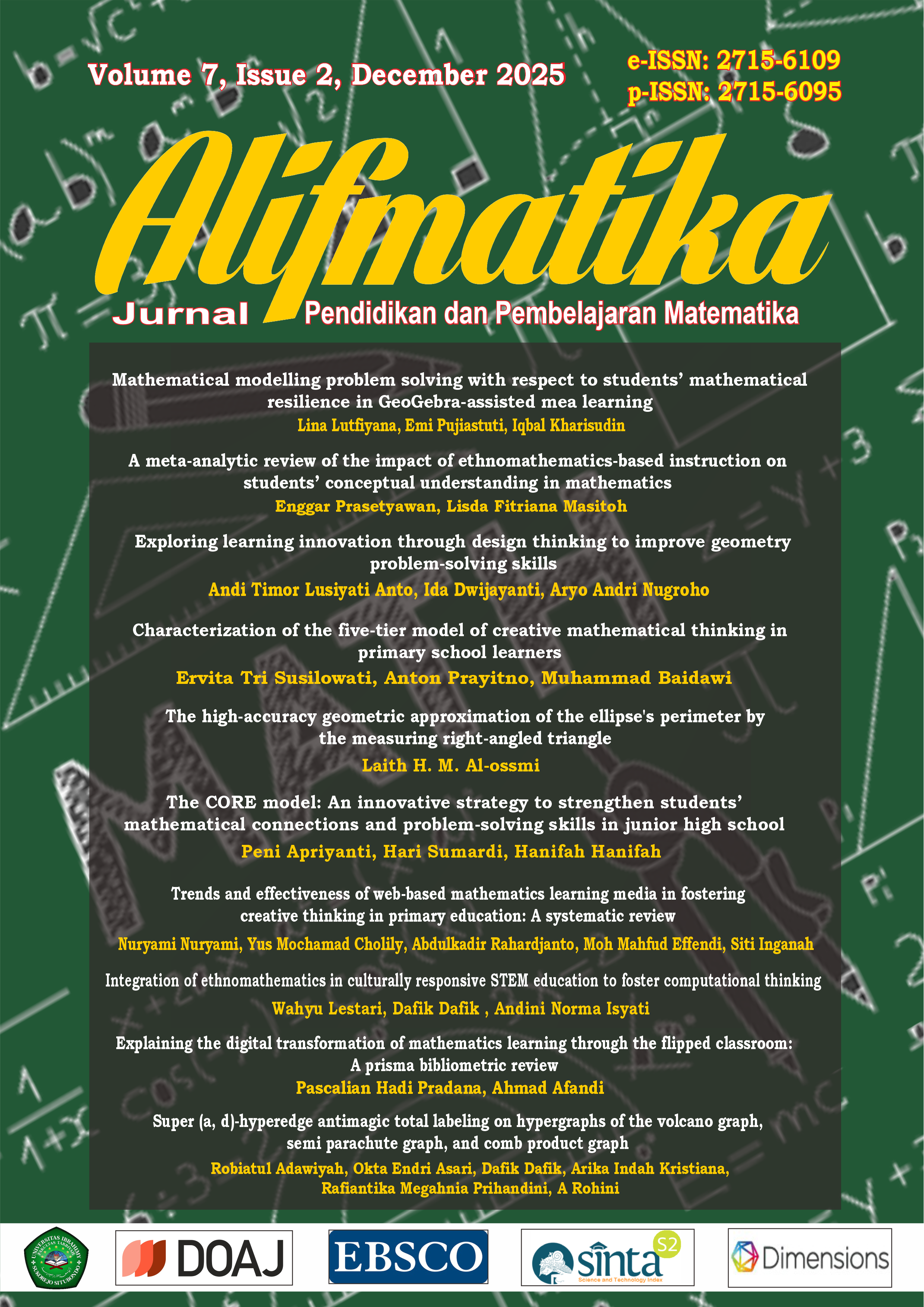
The CORE model: An innovative strategy to strengthen students’ mathematical connections and problem-solving skills in junior high school
DOI:
https://doi.org/10.35316/alifmatika.2025.v7i2.332-344Keywords:
CORE, Mathematical Connection, Mathematical Problem Solving, Prior KnowledgeAbstract
Developing students’ mathematical connection and problem-solving skills remains a persistent challenge in Indonesian secondary mathematics education. This study examined the impact of the CORE (Connecting, Organizing, Reflecting, Extending) instructional model on students’ mathematical connections and problem-solving abilities at SMPN 02 Kota Bengkulu. A quantitative approach with a controlled-comparison design was employed, and data were analyzed using Analysis of Covariance (ANCOVA) to assess the model’s effects while controlling for prior ability. The findings revealed that prior mathematical ability significantly explained 25.3% of the variance in students’ mathematical connection skills and 55.3% of the variance in their problem-solving performance. After implementing the CORE model, students demonstrated substantial improvement in both areas. The model accounted for 57.0% of the variance in mathematical connection ability, particularly enhancing students’ capacity to relate mathematics to other disciplines and real-life contexts, and 19.9% of the variance in problem-solving skills, especially in understanding problems, planning, and reviewing solutions. These results suggest that the CORE model effectively promotes cross-disciplinary integration, contextual understanding, and reflective reasoning in mathematics learning. Theoretically, the findings reinforce the role of constructivist and reflective learning frameworks in strengthening students’ higher-order thinking and meaningful engagement with mathematical concepts.
Downloads
References
Albab, R. U., Wanabuliandari, S., & Sumaji, S. (2021). Pengaruh model problem-based learning berbantuan aplikasi gagung duran terhadap kemampuan pemecahan masalah siswa [The influence of the problem-based learning model assisted by the Gagung Duran application on students' problem-solving abilities]. AKSIOMA: Jurnal Program Studi Pendidikan Matematika, 10(3), 1767. https://doi.org/10.24127/ajpm.v10i3.3969
Asmara, F. A. B., Susilawati, S., & Sari, N. M. (2021). Peningkatan kemampuan koneksi dan self-efficacy matematis melalui model learning cycle 7E [Improving connection skills and mathematical self-efficacy through the 7E learning cycle model]. JNPM (Jurnal Nasional Pendidikan Matematika), 5(1), 160. https://doi.org/10.33603/jnpm.v5i1.3628
Ayudia, G., & Mariani. (2022). Penerapan model pembelajaran CORE untuk meningkatkan kemampuan berpikir kritis matematis siswa SMP S Methodist Rantauprapat [Application of the CORE learning model to improve the critical mathematical thinking skills of students at SMP S Methodist Rantauprapat]. Jurnal Genta Mulia, 13(2), 1-19. https://doi.org/https://doi.org/10.61290/gm.v13i2.101
Buyung, B., Wahyuni, R., & Mariyam, M. (2022). Faktor penyebab rendahnya pemahaman siswa pada mata pelajaran matematika di SD 14 semperiuk a. Journal of Educational Review and Research, 5(1), 46. https://doi.org/10.26737/jerr.v5i1.3538
Damayanti, D., Purwaningrum, J. P., & Ulya, H. (2023). Pengaruh model pembelajaran connected mathematics project terhadap kemampuan koneksi matematis berbantuan desmos pada siswa SMA kelas X. JIPMat, 8(2), 163–173. https://doi.org/10.26877/jipmat.v8i2.15960
Flavell, J. H. (1979). Metacognition and cognitive monitoring a new area of cognitive-developmental inquiry a model of cognitive monitoring. American Psychological Association, 34(10), 906–911. https://eric.ed.gov/?id=ED212019
Isnaina, Z., Muhaimin, M. R., & Sutriyani, W. (2022). Peranan media audio visual pada keaktifan bertanya mata pelajaran matematika kelas 2 SD. Jurnal Pendidikan Matematika, 38–50. https://doi.org/10.18592/jpm.v1i1.6628
Jatisunda, M. G., & Nahdi, D. S. (2020). Kemampuan pemecahan masalah matematis melalui pembelajaran berbasis masalah dengan scaffolding. Jurnal Elemen, 6(2), 228–243. https://doi.org/10.29408/jel.v6i2.2042
Jerry Johnson. (2000). Teaching and Learning Mathematics: Using Research to Shift From the “Yesterday” Mind to the “Tomorrow” Mind. WA: Office of Superintendent of Public Instruction. www.k12.wa.us
Kemdikbudristek. (2022). Capaian pembelajaran mata pelajaran matematika fase a-fase F untuk SDLB, SMPLB, dan SMALB. Kurikulum Kemdikbud, 19.
Khaidir, C., & Suhaili, N. (2023). Pengaruh Bimbingan Konseling dalam Upaya Mengatasi Rendahnya Motivasi Belajar Matematika Siswa SMP. Journal on Education, 6(1), 2244–2253. https://doi.org/10.31004/joe.v6i1.3226
Mardiana, M., Deswita, H., & Isharyadi, R. (2020). Pengaruh Model Pembelajaran CORE (Connecting, Organizing, Reflecting, Extending) Terhadap Kemampuan Koneksi Matematis Siswa Kelas VIII SMP N 3 Rambah. Jurnal Absis : Jurnal Pendidikan Matematika Dan Matematika, 2(2), 180–187. https://doi.org/10.30606/absis.v2i2.390
Miller, R. G., & Calfee, R. C. (2004). Making Thinking Visible: A Method to Encourage Science Writing in Upper Elementary Grades. National Science Teachers Association, 42(3), 20–25.
Niarti, N., Azmi, S., Turmuzi, M., & Hayati, L. (2021). Pembelajaran Kooperatif Tipe CORE (Connecting – Organizing – Reflecting – Extending) Terhadap Kemampuan Komunikasi Matematis Siswa pada Siswa Kelas VIII SMP. Griya Journal of Mathematics Education and Application, 1(3), 297–305. https://doi.org/10.29303/griya.v1i3.68
Polya, G. (1973). How to Solve it. In Stochastic Optimization in Continuous Time. https://doi.org/10.1017/cbo9780511616747.007
S. Posamentier, A., & Krulik, S. (2009). Problem solving in mathematics, grades 3–6: powerful strategies to deepen understanding (Issue 112). Corwin A SAGE Company.
Schoenfeld, H. H. (1985). Mathematical Problem Solving. Orlando: Academic Press.
Siregar, E. Y., Holila, A., & Ahmad, M. (2020). The validity of learning devices with a contextual approach to improve concept understanding abilities. Akademika, 9(02), 145–159. https://doi.org/10.34005/akademika.v9i02.929
Skemp, R. R. (1976). Relational understanding and instrumental understanding. 77, 20–26. https://www.mathshistory.st-andrews.ac.uk/Extras/Skemp_Relational_Understanding/
Thamsir, T., Silalahi, D. W., & Soesanto, R. H. (2019). Upaya meningkatkan kemampuan pemecahan masalah soal non-rutin pada materi persamaan dan pertidaksamaan linear satu variabel dengan penerapan metode peer tutoring [Efforts in improving mathematical problem-solving skills of non-routine problems of one-variable linear equations and inequalities by implementing the peer tutoring method]. JOHME: Journal of Holistic Mathematics Education, 3(1), 96. https://doi.org/10.19166/johme.v3i1.927
Udyani, K. R., Gita, I. N., & Suryawan, I. P. P. (2018). Pengaruh penerapan model pembelajaran CORE berbantuan masalah terbuka terhadap keterampilan berpikir kritis matematis siswa [The effect of implementing the open problem-based core learning model on students' mathematical critical thinking skills]. Jurnal Pendidikan Matematika Undiksha, 9(1), 54-62. https://doi.org/10.23887/jjpm.v9i1.19886
Ulfa, Y. L., Roza, Y., & Maimunah. (2022). Kemampuan pemecahan masalah matematis siswa sma pada materi jarak pada bangun ruang [High school students' mathematical problem-solving abilities on the topic of distance in geometric shapes]. Mosharafa: Jurnal Pendidikan Matematika, 11(3), 415–424. https://doi.org/10.31980/mosharafa.v11i3.732
Vygotsky, L. S. (1978). Mind in society: The development of higher psychological processes. Cambridge: Harvard University Press. https://www.ebsco.com/terms-of-use
Yusron, E., Retnawati, H., & Rafi, I. (2020). Bagaimana hasil penyetaraan paket tes USBN pada mata pelajaran matematika dengan teori respon butir? [What are the results of the USBN test package equivalence in mathematics subjects with item response theory?]. Jurnal Riset Pendidikan Matematika, 7(1), 1–12. https://doi.org/10.21831/jrpm.v7i1.31221
Zengin, Y. (2019). Development of mathematical connection skills in a dynamic learning environment. Education and Information Technologies, 24(3), 2175–2194. https://doi.org/10.1007/s10639-019-09870-x
Downloads
Published
How to Cite
Issue
Section
License
Copyright (c) 2025 Alifmatika: Jurnal Pendidikan dan Pembelajaran Matematika

This work is licensed under a Creative Commons Attribution-ShareAlike 4.0 International License.
COPYRIGHT NOTICE
Author (s) who publish in Alifmatika: Jurnal Pendidikan dan Pembelajaran Matematika agree to the following terms:
- The Author (s) submitting a manuscript do so on the understanding that if accepted for publication, copyright of the article shall be assigned to Alifmatika: Jurnal Pendidikan dan Pembelajaran Matematika, Tarbiyah Faculty of Ibrahimy University as the publisher of the journal. Consecutively, author(s) still retain some rights to use and share their own published articles without written permission from Alifmatika: Jurnal Pendidikan dan Pembelajaran Matematika. This work is licensed under a Creative Commons Attribution-ShareAlike 4.0 International License.
- Copyright encompasses rights to publish and provide the manuscripts in all forms and media for the purpose of publication and dissemination, and the authority to enforce the rights in the manuscript, for example in the case of plagiarism or in copyright infringement.
- Alifmatika: Jurnal Pendidikan dan Pembelajaran Matematika and the Editors make every effort to ensure that no wrong or misleading data, opinions or statements be published in the journal. In any way, the contents of the articles and advertisements published in Alifmatika: Jurnal Pendidikan dan Pembelajaran Matematika are the sole responsibility of their respective authors and advertisers.
- The Copyright Transfer Form can be downloaded here [Copyright Transfer Form Alifmatika]. The copyright form should be signed originally and send to the Editorial Office in the form of original mail, scanned document to alifmatika[at]ibrahimy.ac.id or upload the scanned document in the comments column when sending the manuscript.














_by_Matematohir.jpg)