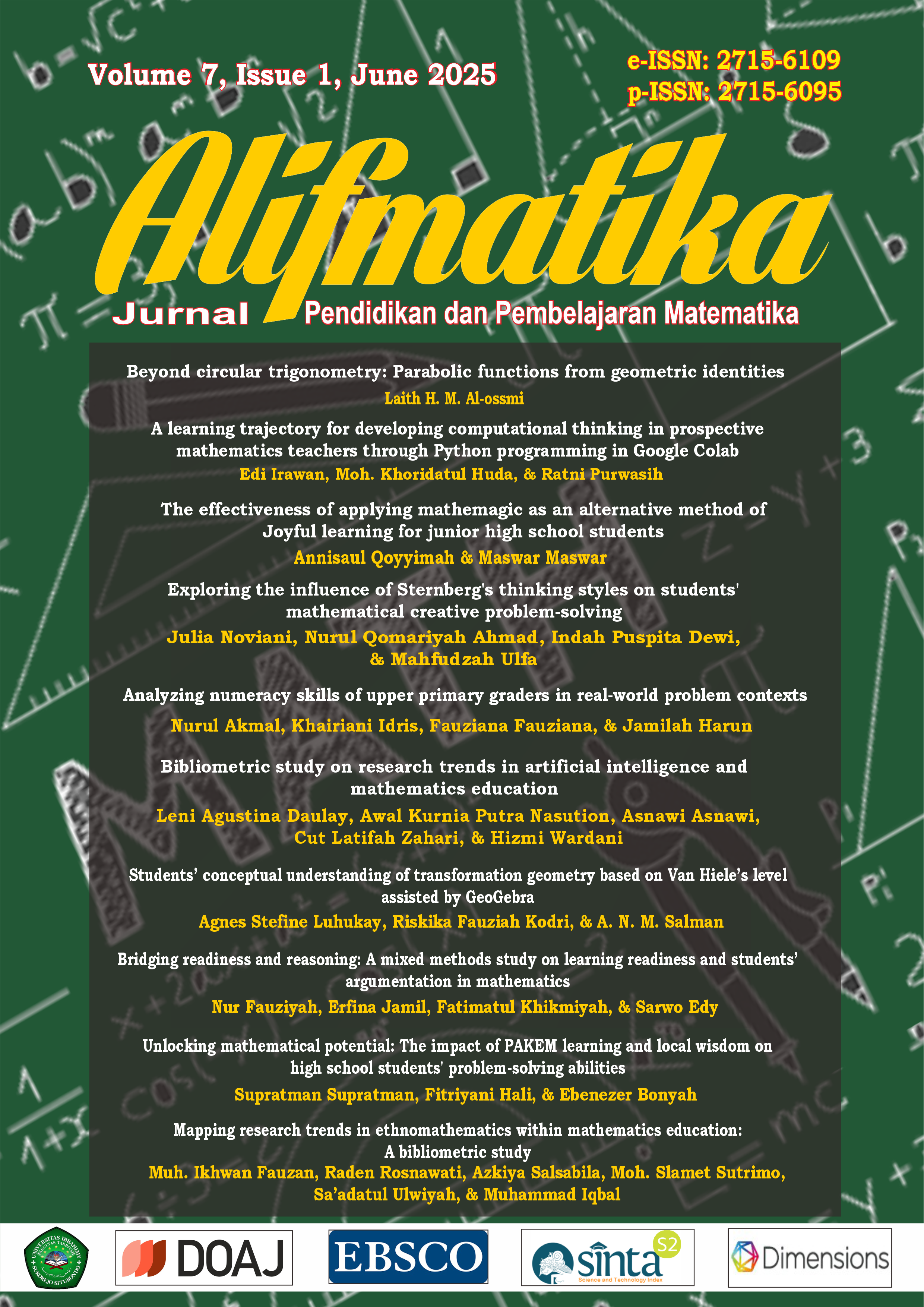
Unlocking mathematical potential: The impact of PAKEM learning and local wisdom on high school students' problem-solving abilities
DOI:
https://doi.org/10.35316/alifmatika.2025.v7i1.190-214Keywords:
Local Wisdom, Mathematical Potential, Mathematical Problem, PAKEM Learning, Problem-Solving AbilitiesAbstract
Mathematical problem-solving ability refers to the capacity to solve problems through sound decision-making, which is essential for effective learning. Students must be able to think positively, logically, and methodically to address mathematical problems. Based on local cultural knowledge, this study aims to examine how high school students taught using the PAKEM model (Active, Creative, Effective, and Fun Learning) differ in their mathematical problem-solving abilities compared to those taught through direct instruction. The population of this study comprised all Grade X students at SMA Negeri 1 Tanggetada, Tanggetada District, Kolaka Regency. The sample was selected using purposive sampling, consisting of 30 students each from classes X1 (experimental group) and X3 (control group) of the same school. This quasi-experimental study employed quantitative research methods. Data were collected using test instruments, and the analysis techniques applied included Ngain analysis, independent t-test, homogeneity test, and normality test. The research results show that the H₀ was rejected and H₁ was accepted, with a tcount of 5.239 and a significance value (2-tailed) of 0.000, which is less than the alpha level of 0.05. It indicates that the experimental class taught with the PAKEM model performed better in mathematical problem-solving than the control class taught through direct instruction. Qualitative analysis showed that three students' strong potential in solving mathematical problems through the application of the PAKEM learning model. The pretest and posttest scores show significant improvement: the experimental group increased from 57.90 to 85.13, while the control group improved from 56.57 to 78.13. These results indicate that the PAKEM model, grounded in regional local wisdom, has greater instructional effectiveness than direct instruction in improving students’ mathematical problem-solving abilities.
Downloads
References
Akbar, S., Imamuddin, M., Rahmi, F., & Isnaniah, I. (2022). The effectiveness of innovative learning on mathematical problem-solving ability: Quasi-experimental. International Journal of Learning and Instruction (IJLI), 4(2), 111. https://doi.org/10.26418/ijli.v4i2.59784
Al-Fananie, A. Z., Syahputra, E., & Eviyanti, E. (2020). The influence of PAKEM model using tangram media on learning motivation and spatial mathematical ability of grade II students of SD IT Khalisaturrahmi Binjai. Budapest International Research and Critics in Linguistics and Education (BirLE) Journal, 3(4), 2244–2258. https://doi.org/10.33258/birle.v3i4.1508
Al, R. et al. (2024). The analysis of senior high school students’ mathematical literacy viewed from PISA problems. Aksioma: Jurnal Program Studi Pendidikan Matematika, 13(2), 586–599. http://doi.org/10.24127/ajpm.v13i2.8624
Al Kayyis, A., Tohir, M., & Muhasshanah, M. (2024). The urgency of Polya model problem-solving on students mathematical ability in facing the Industrial Revolution 5.0. Alifmatika: Jurnal Pendidikan dan Pembelajaran Matematika, 6(2), 218-231. https://doi.org/10.35316/alifmatika.2024.v6i2.218-231
Andrijati, S. R. E. P. & N. (2024). Discovery learning model assisted by geogebra-based napier bones on students' division problem-solving ability. Jurnal Pendidikan MIPA, 25(August), 223–235. http://doi.org/10.23960/jpmipa/v25i1.pp223-235
Arifiani, K. N., Wijaya, C. K. W., Irfan, A., Septiasari, A., Iskandar, J., Iskandar, B. S., Partasasmita, R., & Setyawan, A. D. (2019). Review: Local wisdom of Baduy people (south Banten, Indonesia) in environmental conservation. Asian Journal of Ethnobiology, 2(2), 92–107. https://doi.org/10.13057/asianjethnobiol/y020204
Arion, K. (2024). Exploring local wisdom: Utilizing ethnomathematics to improve mathematical creative thinking skills. Jurnal Theorems (The Original Research of Mathematics), 9(1), 100–113. https://doi.org/10.31949/th.v9i1.9538
As’ari, A. R., Kurniati, D., & Subanji. (2019). Teachers' expectation of students' thinking processes in written works: A survey of teachers' readiness in making thinking visible. Journal on Mathematics Education, 10(3), 409–424. https://doi.org/10.22342/jme.10.3.7978.409-424
Ayllon, M. E., Gomez, I. A., & Claver, J. B. (2016). Mathematical thinking and creativity through mathematical problem posing and solving. Propósitos y Representaciones, 4(1), 169–218. https://eric.ed.gov/?id=EJ1126306
Chen, G., & Fan, Y. (2025). The effectiveness of digital game-based pedagogy in language abilities among children with delay. International Journal of Distance Education Technologies, 23(1), 1–19. https://doi.org/10.4018/IJDET.369824
Dimitriadis, C. (2012). How are schools in England addressing the needs of mathematically gifted children in primary classrooms? A review of practice. Gifted Child Quarterly, 56(2), 59–76. https://doi.org/10.1177/0016986211433200
Djong, K. D., Lusi, Y. K., Lakapu, M., & Guterres, I. (2024). Students’ thinking process in solving mathematics problems oriented to higher order thinking skills. Jurnal Pendidikan MIPA, 25(1), 155–165. https://doi.org/10.23960/jpmipa/v25i1.pp155-165
Eviota, J. S., & Liangco, M. M. (2020). Students’ performance on inquiry-based physics instruction through virtual simulation. Jurnal Pendidikan MIPA, 21(1), 22-34. http://doi.org/10.23960/jpmipa/v21i1.pp22-34
Flannelly, K. J., Flannelly, L. T., & Jankowski, K. R. B. (2018). Threats to the internal validity of experimental and quasi-experimental research in healthcare. Journal of Health Care Chaplaincy, 24(3), 107–130. https://doi.org/10.1080/08854726.2017.1421019
Godino, J. D., Batanero, C., & Burgos, M. (2023). Theory of didactical suitability: An enlarged view of the quality of mathematics instruction. Eurasia Journal of Mathematics, Science and Technology Education, 19(6). https://doi.org/10.29333/ejmste/13187
Gravett, K., & Carless, D. (2024). Feedback literacy-as-event: relationality, space and temporality in feedback encounters. Assessment and Evaluation in Higher Education, 49(2), 142–153. https://doi.org/10.1080/02602938.2023.2189162
Hidayati, A., & Dharin, A. (2023). The Importance of active, innovative, creative, effective, and fun learning applications on natural science subject at islamic elementary school. International Journal of Multidisciplinary Research and Analysis, 6(9), 4425–4435. https://doi.org/10.47191/ijmra/v6-i9-61
Irwan, Taufiq, M. A., & Fernando, R. (2019). A review of the integration of local wisdom in english language teaching in 5.0 Society Era. Proceeding of 4th International Conference on Education, 1990, 143–148. https://ojs.iainbatusangkar.ac.id/ojs/index.php/proceedings/article/viewFile/2171/1607
Jala, J. (2024). Development of a problem-solving learning model based on local wisdom for junior high school students in Sidrap. Lotus: Education Journal, 1(1), 17-25. https://jurnal.umsrappang.ac.id/LOTUS/article/view/1790
Kuhnlein, H. V., & Chotiboriboon, S. (2022). Why and how to strengthen indigenous peoples' food systems with examples from two unique indigenous communities. Frontiers in Sustainable Food Systems, 6(5), 1–20. https://doi.org/10.3389/fsufs.2022.808670
Lestari, N., P., & Suyanto, S. (2024). A systematic literature review about local wisdom and sustainability: Contribution and recommendation to science education. Eurasia Journal of Mathematics, Science and Technology Education, 20(2), 1–19. https://doi.org/10.29333/ejmste/14152
Made, I., Acwin, N. K., & Wisdom, L. (2020). Local wisdom in reducing greenhouse effect on balinese traditional settlement patterns in Bongli village, Bali, Indonesia. Engineering and Technology Quarterly Reviews, 3(1), 23-33. https://papers.ssrn.com/sol3/papers.cfm?abstract_id=3581784
Mahanal, S., Zubaidah, S., Setiawan, D., Maghfiroh, H., & Muhaimin, F. G. (2022). Empowering college students’ problem-solving skills through RICOSRE. Education Sciences, 12(3), 1-17. https://doi.org/10.3390/educsci12030196
Masaki, F. (2023). Self-regulation from the sociocultural perspective—A literature review. Cogent Education, 10(2), 1-15. https://doi.org/10.1080/2331186X.2023.2243763
Mazid, H., Rachmalia, L., Suyanta, S., & Widjajanti, E. (2023). Teacher strategies in managing chemistry learning time to improve student learning achievement. Jurnal Penelitian Pendidikan IPA, 9(11), 1129–1136. https://doi.org/10.29303/jppipa.v9i11.5192
Nurmala Sari Agustina, E., Widadah, S., & Afinanun Nisa, P. (2021). Developing realistic mathematics problems based on sidoarjo local wisdom. Mathematics Teaching Research Journal, 13(4), 181–201. https://eric.ed.gov/?id=EJ1332336
Nursakiah, N., Arriah, F., & Dharma, S. (2022). Developing mathematical literacy test with context of Bugis-Makassar local wisdom for junior high school students. Jurnal Elemen, 8(1), 16–28. https://doi.org/10.29408/jel.v8i1.4049
Olivares, D., Lupiáñez, J. L., & Segovia, I. (2021). Roles and characteristics of problem solving in the mathematics curriculum: a review. International Journal of Mathematical Education in Science and Technology, 52(7), 1079–1096. https://doi.org/10.1080/0020739X.2020.1738579
Ota, M. K., & Wali, M. (2019). Pembelajaran matematika berbasis budaya daerah ngada untuk melatihkan keterampilan berpikir kritis siswa kelas III sekolah dasar Inpres Turekisa [Regional culture-based mathematics learning in Ngada to train critical thinking skills of grade III students of Inpres Turekisa Elementary School]. Wahana Matematika Dan Sains: Jurnal Matematika, Sains, Dan Pembelajarannya, 13(2), 14–26. https://doi.org/10.23887/wms.v13i2.19266
Parwati, N. N., Sudiarta, I. G. P., Mariawan, I. M., & Widiana, I. W. (2018). Local wisdom-oriented problem-solving learning model to improve mathematical problem-solving ability. Journal of Technology and Science Education, 8(4), 310–320. https://doi.org/10.3926/jotse.401
Prasetyawan, W. (2023). Willingness to Pay for Environmental Conservation of Peat and Aquatic Ecosystems in a Cash-Poor Community: A Riau Case Study. Local Governance of Peatland Restoration in Riau, Indonesia: A Transdisciplinary Analysis, 193-209. Singapore: Springer Nature Singapore. https://doi.org/10.1007/978-981-99-0902-5_9
Samura, A. O., & Juandi, D. (2022). Application of the PAKEM learning model to improve student learning outcomes in mathematics. Journal of Didactic Mathematics, 3(1), 17–27. https://doi.org/10.34007/jdm.v3i1.1285
Suastra, I. W. (2017). Balinese local wisdoms and their implications in science education at school. International Research Journal of Management, IT & Social Sciences, 4(2), 48–57. https://doi.org/10.21744/irjmis.v4i2.389
Supiyati, S., Halqi, M., Waluyo, E., & Rasidi, A. (2023). Development of collaborative based inquiry learning tools using local wisdom context to improve students metacognitive. Jurnal Elemen, 9(1), 246–255. https://doi.org/10.29408/jel.v9i1.6969
Supriyanto Manurung, A., & Halim, A. (2021). Pengaruh model pembelajaran PAKEM terhadap prestasi belajar matematika siswa kelas V SDN Pondok Kelapa 05 Pagi Jakarta [The influence of the PAKEM learning model on the mathematics learning achievement of class V students at SDN Pondok Kelapa 05 Pagi Jakarta]. Jurnal Ilmiah Kependidikan, 8(1), 93–103. https://doi.org/10.30998/fjik.v8i1.8638
Susanto, Y. K., Rudyanto, A., & Rahayuningsih, D. A. (2022). Redefining the concept of local wisdom-based csr and its practice. Sustainability (Switzerland), 14(19), 1-23. https://doi.org/10.3390/su141912069
Wakhata, R., Mutarutinya, V., & Balimuttajjo, S. (2023). Relationship between active learning heuristic problem-solving approach and students’ attitude towards mathematics. Eurasia Journal of Mathematics, Science and Technology Education, 19(2), 1-19. https://doi.org/10.29333/ejmste/12963
Yulia, P., & Suhendra, B. (2017). Efektivitas model pembelajaran PAKEM masalah matematis siswa [The effectiveness of the PAKEM learning model is reviewed from the mathematical problem solving abilities of class VIII students at SMP Negeri 11 Batam]. Pythagoras: Jurnal Program Studi Pendidikan Matematika, 6(1), 31–36. https://doi.org/10.33373/pythagoras.v6i1.623
Zulkarnain, R. S., Hartatiana, H., & Efriani, A. (2022). Penerapan model PAKEM (Partisipatif, Aktif, Kreatif, Efektif Dan Menyenangkan) terhadap hasil belajar matematika [Application of the PAKEM model (Participatory, Active, Creative, Effective and Enjoyable) to mathematics learning outcomes]. JEMST (Jurnal of Education in Mathematics, Science, and Technology), 5(1), 18–27. https://doi.org/10.30631/jemst.v5i1.69
Downloads
Published
How to Cite
Issue
Section
License
Copyright (c) 2025 Alifmatika: Jurnal Pendidikan dan Pembelajaran Matematika

This work is licensed under a Creative Commons Attribution-ShareAlike 4.0 International License.
COPYRIGHT NOTICE
Author (s) who publish in Alifmatika: Jurnal Pendidikan dan Pembelajaran Matematika agree to the following terms:
- The Author (s) submitting a manuscript do so on the understanding that if accepted for publication, copyright of the article shall be assigned to Alifmatika: Jurnal Pendidikan dan Pembelajaran Matematika, Tarbiyah Faculty of Ibrahimy University as the publisher of the journal. Consecutively, author(s) still retain some rights to use and share their own published articles without written permission from Alifmatika: Jurnal Pendidikan dan Pembelajaran Matematika. This work is licensed under a Creative Commons Attribution-ShareAlike 4.0 International License.
- Copyright encompasses rights to publish and provide the manuscripts in all forms and media for the purpose of publication and dissemination, and the authority to enforce the rights in the manuscript, for example in the case of plagiarism or in copyright infringement.
- Alifmatika: Jurnal Pendidikan dan Pembelajaran Matematika and the Editors make every effort to ensure that no wrong or misleading data, opinions or statements be published in the journal. In any way, the contents of the articles and advertisements published in Alifmatika: Jurnal Pendidikan dan Pembelajaran Matematika are the sole responsibility of their respective authors and advertisers.
- The Copyright Transfer Form can be downloaded here [Copyright Transfer Form Alifmatika]. The copyright form should be signed originally and send to the Editorial Office in the form of original mail, scanned document to alifmatika[at]ibrahimy.ac.id or upload the scanned document in the comments column when sending the manuscript.













_by_Matematohir.jpg)