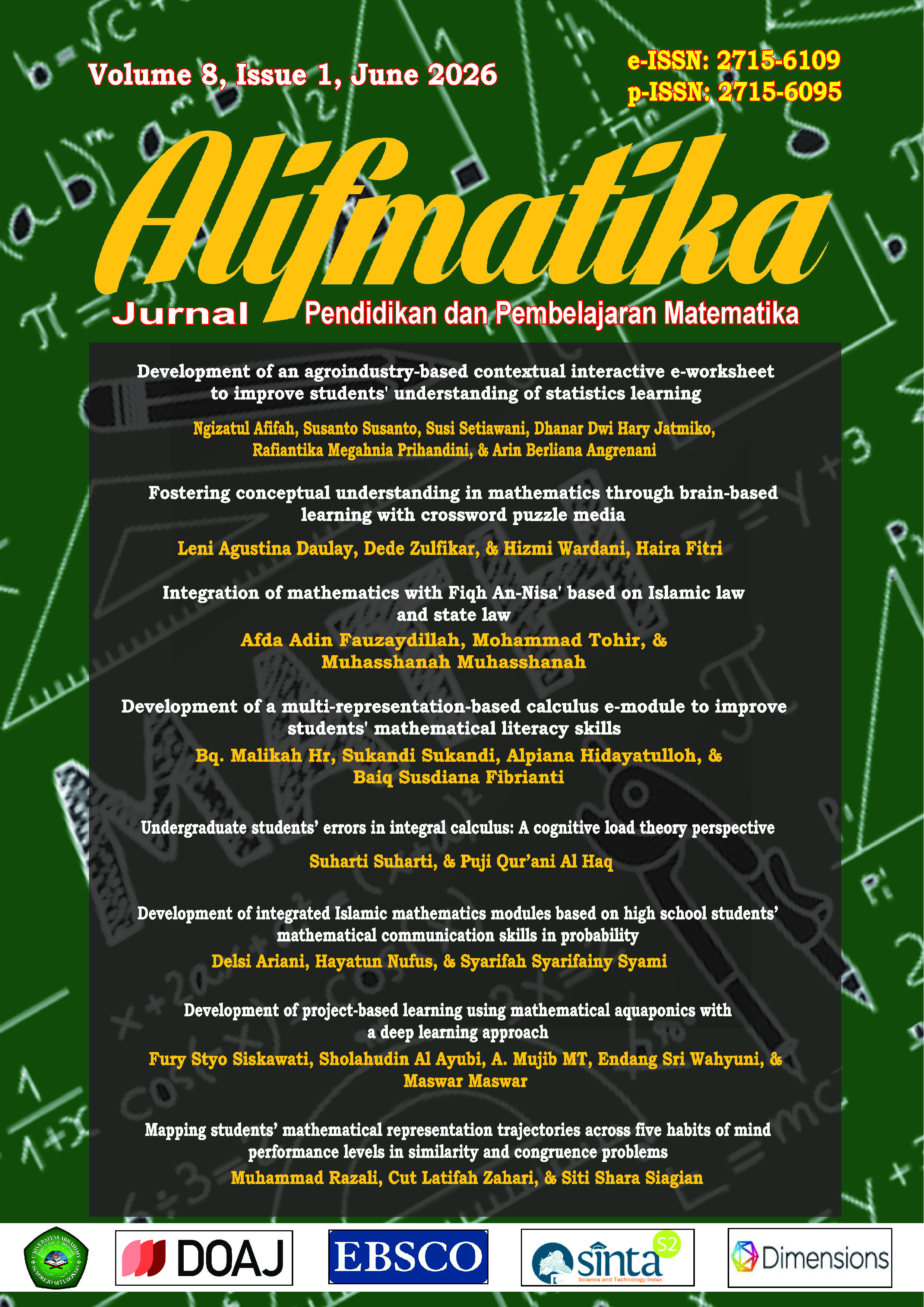
Development of a multi-representation-based calculus e-module to improve students' mathematical literacy skills
DOI:
https://doi.org/10.35316/alifmatika.2026.v8i1.61-81Keywords:
E-module, Calculus, Multi-Representation, Mathematical LiteracyAbstract
The study aims to develop a multi-representation-based calculus e-module and to examine its effectiveness in improving students’ mathematical literacy skills. The research method employed was research and development (R&D) using the DDD-E model. The effectiveness of the e-module was tested through a quasi-experimental design with a pretest-posttest control group design and analysed using ANCOVA based on students’ pretest and posttest scores. The subjects were 62 first-semester students of the Civil Engineering Department at Mandalika University of Education, consisting of 32 students in the experimental class and 30 students in the control class. The results indicated that the developed e-module was validated by subject-matter, learning, and design experts and was effective in improving students’ mathematical literacy skills. The ANCOVA results showed a significance value of p < 0.001, which is less than 0.05, indicating a significant difference between the class that received treatment using the multi-representation-based e-module and the control class. The average posttest score of the experimental class (70.19) was higher than that of the control class (55.77), indicating that the use of a multi-representation-based calculus e-module had a positive impact on students’ mathematical literacy skills. In addition, the effect size value was 0.868, which was categorised as a large effect size. This result indicates that the developed e-module had a strong effect on improving students’ mathematical literacy skills. These findings suggest that the multi-representation-based calculus e-module is effective in improving students’ mathematical literacy skills and is suitable for implementation in calculus learning, particularly in the civil engineering program.
Downloads
References
Adelia, D., Linda, R., & Erna, M. (2023). Development of e-module based on multiple representation to improve the competence of chemical literacy and learning independence of students on the material reaction rate. Jurnal Penelitian Pendidikan IPA, 9(12), 11101–11110. https://doi.org/10.29303/jppipa.v9i12.5541
Agustina, L., Zaenuri, & Wardono. (2021). Description of students’ mathematical concept understanding ability, in terms of initial mathematical ability. Journal of Physics: Conference Series, 1918(4). https://doi.org/10.1088/1742-6596/1918/4/042109
Alwi, D. P., Sinaga, P., & Aviyanti, L. (2024). Multiple representations in the context of education in the 21st century. ICEETE Conference Series, 2(1), 63–74. https://doi.org/10.36728/iceete.v2i1.152
Aninditto, A., Wardani, S., & Suminar, T. (2024). Development of electronic modules (e-module) based on cultural ethnoscience of cirebon to improve the character of cultural love. International Journal of Research and Review, 11(1), 352–358. https://doi.org/10.52403/ijrr.20240139
Aulia, S., S, L. A., & Linda, R. (2023). Development of multiple representation-based e-modules utilizing augmented reality in the material of molecular shapes and inter-molecular interactions. Al-Ishlah: Jurnal Pendidikan, 15(4). https://doi.org/10.35445/alishlah.v15i4.3668
Banos, N. S. (2023). Civil engineering students’ problem-solving skills on calculus-based problems. Mountain Journal of Science and Interdisciplinary Research (Formerly Benguet State University Research Journal), 82(2), 91–101. https://doi.org/10.70884/mjsir.v82i2.334
Barniol, P., Zavala, G., & Dominguez, A. (2024). The effect of calculus and kinematics contexts on students’ understanding of graphs. Eurasia Journal of Mathematics, Science and Technology Education, 20(11), 1–22. https://doi.org/10.29333/EJMSTE/15581
Chusni, M. M. (2022). Effectiveness of discovery learning-based multiple representation module on enhancing the critical thinking skills of the students with high and low science process skills. Jurnal Inovasi Pendidikan IPA, 8(2), 199–209. https://doi.org/10.21831/jipi.v8i2.49340
Croft, T., Grove, M., & Lawson, D. (2022). The importance of mathematics and statistics support in English universities: an analysis of institutionally-written regulatory documents. Journal of Higher Education Policy and Management, 44(3), 240–257. https://doi.org/10.1080/1360080X.2021.2024639
Gafoor, K. A., & Kurukkan, A. (2015). Why high school students feel mathematics difficult? An Exploration of Affective Beliefs. https://www.semanticscholar.org/paper/Why-High-School-Students-Feel-Mathematics-Difficult-Gafoor-Kurukkan/d7c3f5b301b569c9caca64fce97ebb3688744d75
Gulkilik, H., Moyer-Packenham, P. S., Ugurlu, H. H., & Yuruk, N. (2020). Characterizing the growth of one student’s mathematical understanding in a multi-representational learning environment. The Journal of Mathematical Behavior, 58, 100756. https://doi.org/10.1016/j.jmathb.2020.100756
Indraswari, A. S., Budiarti, I. S., & Bo, B. Y. (2024). The multi-representation-based module development to improve the metacognition of circular motion. Scientific Journal of Physics Education/Berkala Ilmiah Pendidikan Fisika, 12(3), 343. https://doi.org/10.20527/bipf.v12i3.18968
Isnani, T., Handoko, H., & Syekh Nurjati Cirebon, I. (2023). Analysis of Students’ Mathematical Literacy Ability in Solving Mathematical Problems in View of Logical Intelligence. Educational Insights, 1(2), 3025–6658. https://doi.org/10.58557/eduinsights.v1i2
Ivers, K. S., & Barron, A. E. (2002). Multimedia projects in education: Designing, producing, and assessing libraries unlimited teacher ideas press. Libraries Unlimited
Kandaga, T., Krisnadi, E., Nurhayati, S., & Gusti, V. Y. K. (2024). Improving Indonesian students’ mathematical literacy with brain-based learning: a comparative study of pisa scores. Jurnal Konseling Dan Pendidikan, 12(3), 99–111. https://doi.org/10.29210/1118500
Langoban, M. (2020). What makes mathematics difficult as a subject for most students in higher education? International Journal of English and Education, 9(3), 214-220. https://ijee.org/ijee/article/view/225
Lara-Porras, A. M., Rueda-García, M. D. M., & Molina-Muñoz, D. (2019). Identifying the factors influencing mathematical literacy in several spanish regions. South African Journal of Education, 39. https://doi.org/10.15700/saje.v39ns2a1630
Li, C. (2020). The core literacy of mathematics-the cultivation of mathematical operation ability. Lifelong Education, 9(7), 1. https://doi.org/10.18282/le.v9i7.1451
Mahardika, I. K., & Wicaksono, I. (2023). Implementation of multirepresentation based physics modules to improve students critical thinking skills. Journal of Education, Society and Behavioural Science, 36(10), 72–79. https://doi.org/10.9734/jesbs/2023/v36i101268
Mestanza-Ramón, C., Mazón-Fierro, G., López-Paredes, C., Cunalata-García, A., & Proaño-Lucero, G. (2023). Importance of mathematics for the management of protected areas and tourism development. Journal of Southwest Jiaotong University, 58(2). https://doi.org/10.35741/issn.0258-2724.58.2.66
Meti, M. H., Rodiana, I., Laelasari, L., & Subroto, T. (2024). Systematic literature review: Mathematical literacy skills in terms of mathematics learning motivation. IJCER (International Journal of Chemistry Education Research), 104–112. https://doi.org/10.20885/ijcer.vol8.iss2.art3
Muhaimin, L. H., Sholikhakh, R. A., Yulianti, S., Ardani, Hendriyanto, A., & Sahara, S. (2024). Unlocking the secrets of students’ mathematical literacy to solve mathematical problems: A systematic literature review. Eurasia Journal of Mathematics, Science and Technology Education (Vol. 20, Issue 4). Modestum LTD. https://doi.org/10.29333/ejmste/14404
National Council of Teachers of Mathematics. (2000). Principles Standards and for School Mathematics. Reston, VA.
OECD. (2013). Education at a Glance 2013. OECD. https://doi.org/10.1787/eag-2013-en
OECD. (2024). PISA 2022 Results Volume III: Creative Minds, Creative Schools.
Permata, B., Netson, H., & Ain, S. Q. (2021). Factors causing difficulty in learning mathematics for elementary school students. International Journal of Elementary Education, 6(1), 134–141. https://doi.org/10.23887/ijee.v6i1
Prahastiwi, R. B., & Zain, Z. A. (2023). Multirepresentation-Based Physics E-Module Development. 8(1). http://jurnalkonstan.ac.id/index.php/jurnal
Purwanti, I. T., Eliwarti, E., & Jismulatif, J. (2023). E-Module of meaning in interpersonal context in online learning: implementation and students’ feedback. Al-Ishlah: Journal of Education/Al-Ishlah: Jurnal Pendidikan, 15(1), 271–286. https://doi.org/10.35445/alishlah.v15i1.2566
Putra, H. D., Setiawan, W., & Afrilianto, M. (2020). Indonesian high scholar difficulties in learning mathematics. International Journal Of Scientific & Technology Research, 9, 1. www.ijstr.org
Rahmawati, I., Nisrina, N., & Abdani, M. R. (2022). Multi-representation-based interactive physics electronic module as teaching materials in online learning. Al-Biruni Journal of Physics Education/Jurnal Ilmiah Pendidikan Fisika Al-Biruni, 11(1), 47–55. https://doi.org/10.24042/jipfalbiruni.v11i1.10544
Resmanti, P., Faridah, A., Yusmerita, Y., & Hendriyani, Y. (2024). Development of the E-module with project-based learning for the flat pattern design course. Journal of Innovation in Educational and Cultural Research, 5(3), 408–416. https://doi.org/10.46843/jiecr.v5i3.1505
Risdiyanti, I., Zulkardi, Putri, R. I. I., & Prahmana, R. C. I. (2024). Mathematical literacy learning environment for inclusive education teachers: A framework. Journal on Mathematics Education, 15(3), 1003–1026. https://doi.org/10.22342/jme.v15i3.pp1003-1026
Sadji Evenddy, S., Gailea, N., & Syafrizal, S. (2024). Implementation of e-module in Indonesia EFL higher education: A literature review. IJORER : International Journal of Recent Educational Research, 5(5), 1174–1185. https://doi.org/10.46245/ijorer.v5i5.688
Sarimsakova, K. K. (2022). The importance of mathematics in the digital age. International Journal of Multidisciplinary Research and Analysis, 5(2), 436-439 https://doi.org/10.47191/ijmra/v5-i2-28
Satiti, W. S., Alfatah, D. A., & Umardiyah, F. (2021). Development of PISA-like mathematics problems within personal-context for junior high school students. APPLICATION: Applied Science in Learning Research, 1(2), 99–105. https://doi.org/10.32764/application.v1i2.1966
Schoenfeld, A. H. (2020). Mathematical practices, in theory and practice. ZDM - Mathematics Education, 52(6), 1163–1175. https://doi.org/10.1007/s11858-020-01162-w
Sidiq, R., & Suhendro, P. (2021). Utilization of interactive e-modules in formation of students’s independent characters in the era of pandemic. https://doi.org/https://doi.org/10.51601/ijersc.v2i6.194
Sreylak, O., Sampouw, F., Victor, T., Saputro, D., & Lumbantobing, W. L. (2022). Mathematics concept in elementary school: A bibliometric analysis. Journal of Educational Learning and Innovation, 2(2), 268. https://doi.org/10.46229/elia.v2i2
Sugiyono. (2017). Metode Penelitian Kuantitatif, Kualitatif, dan R&D. Alfabeta.
Syam, I. K., & Louise, I. S. Y. (2023). implementation of electronic module based multiple representation on buffer solution materials to improve students’ self-regulated learning and cognitive learning outcomes. journal of science education research. Jurnal Penelitian Pendidikan IPA, 9(10), 7816–7825. https://doi.org/10.29303/jppipa.v9i10.3656
Turner, K. R., & Mendoza Alvarez, J. A. (2021). Supporting connections to teaching in an undergraduate calculus course background and theoretical perspective. https://par.nsf.gov/servlets/purl/10308950
Uslima, U., Ertikanto, C., & Rosidin, U. (2018). Contextual learning module based on multiple representations: the influence on students’ concept understanding. Tadris: Jurnal Keguruan Dan Ilmu Tarbiyah, 3(1), 11–20. https://doi.org/10.24042/tadris.v3i1.2534
Verma, R. K. (2024). A study on the significance of mathematics in our daily life. International Journal of Applied Research, 10(12), 72–75. https://doi.org/10.22271/allresearch.2024.v10.i12b.12215
Verma, R. K., & Mahajan, M. (2021). EPRA international journal of research and development (IJRD) significance of differential calculus in the field of engineering. https://doi.org/10.36713/epra2016
Yenzi, I. P., Mujahidawati, M., & Novferma, N. (2023). Pengembangan komik matematika berbasis problem based learning untuk meningkatkan kemampuan literasi matematis siswa [Development of problem-based learning-based mathematics comics to improve students’ mathematical literacy skills]. Journal of Mathematics and Science Education/Jurnal Pendidikan MIPA, 13(4), 1114–1125. https://doi.org/10.37630/jpm.v13i4.1303
Yulita, & Ain, S. Q. (2021). Analysis of students’ learning difficulties in learning mathematics at elementary schools. Al-Ishlah: Journal of Education/Al-Ishlah: Jurnal Pendidikan, 13(2), 892–899. https://doi.org/10.35445/alishlah.v13i2.745
Downloads
Published
How to Cite
Issue
Section
License
Copyright (c) 2026 Alifmatika: Jurnal Pendidikan dan Pembelajaran Matematika

This work is licensed under a Creative Commons Attribution-ShareAlike 4.0 International License.
COPYRIGHT NOTICE
Author (s) who publish in Alifmatika: Jurnal Pendidikan dan Pembelajaran Matematika agree to the following terms:
- The Author (s) submitting a manuscript do so on the understanding that if accepted for publication, copyright of the article shall be assigned to Alifmatika: Jurnal Pendidikan dan Pembelajaran Matematika, Tarbiyah Faculty of Ibrahimy University as the publisher of the journal. Consecutively, author(s) still retain some rights to use and share their own published articles without written permission from Alifmatika: Jurnal Pendidikan dan Pembelajaran Matematika. This work is licensed under a Creative Commons Attribution-ShareAlike 4.0 International License.
- Copyright encompasses rights to publish and provide the manuscripts in all forms and media for the purpose of publication and dissemination, and the authority to enforce the rights in the manuscript, for example in the case of plagiarism or in copyright infringement.
- Alifmatika: Jurnal Pendidikan dan Pembelajaran Matematika and the Editors make every effort to ensure that no wrong or misleading data, opinions or statements be published in the journal. In any way, the contents of the articles and advertisements published in Alifmatika: Jurnal Pendidikan dan Pembelajaran Matematika are the sole responsibility of their respective authors and advertisers.
- The Copyright Transfer Form can be downloaded here [Copyright Transfer Form Alifmatika]. The copyright form should be signed originally and send to the Editorial Office in the form of original mail, scanned document to alifmatika[at]ibrahimy.ac.id or upload the scanned document in the comments column when sending the manuscript.














_by_Matematohir.jpg)