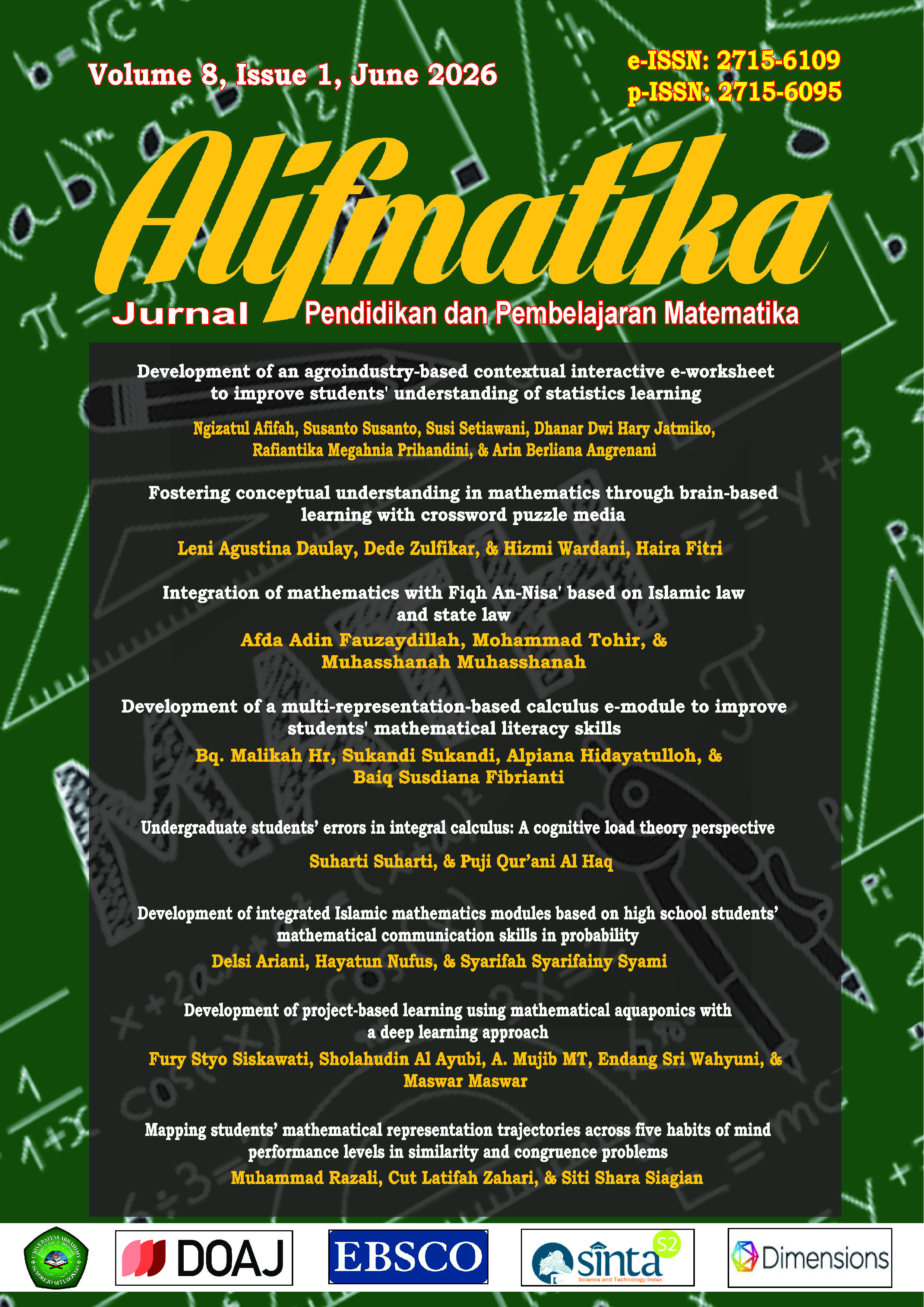
Integration of mathematics with Fiqh An-Nisa' based on Islamic law and state law
DOI:
https://doi.org/10.35316/alifmatika.2026.v8i1.38-60Keywords:
Fiqh An-Nisa’, Mathematics, Menstruation, Islamic Law, Postpartum, State LawAbstract
This study aims to describe the integration between mathematics and An-Nisa' Fiqh, especially regarding menstruation and postpartum bleeding for women, based on the perspective of Islamic law and state law. Fiqh An-Nisa' discusses special laws for women, such as menstruation, postpartum bleeding, and Istihadhah, which have direct implications for prayer, fasting, and the implementation of state law. State law also provides regulations on inheritance distribution and women's rights, which can influence the implementation of An-Nisa' Fiqh. Meanwhile, mathematics provides arithmetic, analytical, and logical skills that can facilitate understanding of the law. The research method employs a qualitative analytical approach, incorporating literature studies from Fiqh books, mathematics books, Islamic law references, and state law. The study results indicate that (1) aspects of arithmetic, number lines, mathematical logic, and simple statistics can be applied in calculating the duration of menstruation/postpartum, determining the obligation to make up fasting, and visualizing the menstrual cycle. This integration not only improves religious understanding, but also fosters students' numerical and critical thinking skills; (2) there is potential to integrate mathematics in the application of An-Nisa' Fiqh to achieve more objective justice, both from the perspective of Islamic law and state law; and (3) The integration of mathematics and An-Nisa' Fiqh is relevant to support the madrasah curriculum in Islamic boarding schools that emphasize the development of religious knowledge as well as general knowledge.
Downloads
References
Abdullah, M. A. (2014). Religion, science, and culture: An integrated, interconnected paradigm of science. Al-Jami’ah: Journal of Islamic Studies, 52(1), 175–203.
Agha, S. M. H., Ullah, M. S., & Akhter, N. (2023). The Necessity and Significance of Hadith in The Light of Quranic Verses, Investigative Analysis. Jahan-e-Tahqeeq, 6(4), 674–684.
Al-Khasyt, M. U. (2017). Fikih Wanita: empat mazhab. Ahsan Publishing.
Alimah, S. (2021). Analisis Kitab Risalatul Mahid Karya Masruhan Ihsan dan Relevansinya dengan Materi Fiqih di Madrasah Ibtidaiyah. IAIN Ponorogo.
Almubarok, F. (2018). Keadilan Dalam Perspektif Islam. ISTIGHNA: Jurnal Pendidikan Dan Pemikiran Islam, 1(2), 115–143.
Asiyah, A., Febrini, D., Topano, A., Mustamin, A. A., & Hakim, M. A. R. (2024). Measuring the impact of Islamic values-based scientific literacy on scientific competency of madrasah teachers. International Journal of Learning, Teaching and Educational Research, 23(4), 476–496.
Asmawati, R. U. (2021). Pengaruh Pemahaman Santriwati Tentang Haid Terhadap Perilaku Keagamaan Di Pondok Pesantren Putri Ar-Roudloh Kota Kediri. IAIN Kediri.
Bans-Akutey, A., & Tiimub, B. M. (2021). Triangulation in research. Academia Letters, 2(3392), 1–7.
Binti Abdullah, N., bin Abdul Aziz, A., Mustafa, W. A., Almusawi, M., & Hussein, A. H. A. (2023). Women’s Health Diary: Tracker System for Menstruation, Intermenstrual, Ovulation, and Postnatal Bleeding Using Rules-Based Technique. 2023 3rd International Conference on Mobile Networks and Wireless Communications (ICMNWC), 1–5.
Chasanah, S. N. R. (2021). Peningkatan Pemahaman Fikih Wanita Melalui Kajian Kitab Risalat Al-Mahid dan Implementasinya bagi Santri Kelas IV M Madrasah Diniyah Miftahul Huda Mayak Ponorogo. IAIN Ponorogo.
Critchley, T. (2018). Antidotes for Healing the Human Body the Complete Version: Understanding the Root Causes of Sickness and Disease. WestBow Press.
Daulay, A. I., & Hakim, F. (2025). Kesetaraan Gender dalam Hukum Perkawinan Islam: Antara Idealitas Normatif dan Realitas Sosial. Journal of Dual Legal Systems, 2(1), 14–24.
Donkoh, S., & Mensah, J. (2023). Application of triangulation in qualitative research. Journal of Applied Biotechnology and Bioengineering, 10(1), 6–9.
Fadhilah, A. U. (2023). Women’s Fiqih (Haid, Nifas, And Istihadhah) on Reproductive Health. Proceeding International Conference on Religion, Science and Education, 2, 1029–1034.
Faizi, H. F. S., & Ali, H. S. (2024). The core principles of Islamic jurisprudence within legal theory: A comprehensive analysis. Online Journal of Research in Islamic Studies, 11(2), 57–72.
Fauzizah, A., & Masruri, M. (2024). A Comparative Study of The Fiqh Approach to The Hadith on Menstruation. RIWAYAH: JURNAL STUDI HADIS Учредители: State Islamic College of Kudus, 9(2), 385.
Feminia, O. (2025). Penafsiran ayat ayat tentang haid dan keterkaitannya dengan kesehatan perempuan (Kajian Tafsir Tematik).
Fitri, S. R., & Redi, A. (2024). Efforts for Legal Renewal in the Fulfillment of Women’s Health Rights in Indonesia. Journal of Social Science (JoSS), 3(12), 1998–2007.
Gillani, S. H. A. S., & Farzand, A. (2024). Laws Regarding Family Inclusive of Marriage, Dowry, Custody, Divorce, Maintenanace and Inheritance. AL-IDRAK JOURNAL, 4(1), 91–106.
Indonesia, R. (2009). Undang-undang Republik Indonesia nomor 36 tahun 2009 tentang Kesehatan. Jakarta Republik Indones.
Kamal, M., Zalikha, S., Wahdi, S., & Ikbal, M. (2019). Blood Women in Perspective of Fiqh Syafi’iyyah and Medical Science. Britain International of Humanities and Social Sciences (BIoHS) Journal, 1(2), 159–166.
Kasim, T. S. A. B. T., Yaakob, S. F. B., & Razif, N. F. B. M. (2024). Family Influence on Female’s Blood Education in the Context of Islamic Practice in Malaysia. El-Usrah: Jurnal Hukum Keluarga, 7(2), 623–647.
Khoirunnisa, K., & Hidayati, R. (2023). The Jurimetri Formulation of Court Decisions in the Division of Joint Property. SMART: Journal of Sharia, Tradition, and Modernity, 28–40.
Komariah, N., & Nihayah, I. (2023). Improving the personality character of students through learning Islamic religious education. At-Tadzkir: Islamic Education Journal, 2(1), 65–77.
Lubis, M. H. A., & Marpaung, Z. A. (2024). Alasan Pembuktian Tindak Pidana Perzinahan Dengan Saksi Berjumlah 4 Orang Laki-Laki Dalam Hukum Pidana Islam. Justicia Sains: Jurnal Ilmu Hukum, 9(2), 417–435.
Manshur, A. Q. M. (2019). Panduan Shalat an-Nisaa Menurut Empat Mazhab. Republika Penerbit.
Mappasessu, M., & Akmal, A. M. (2025). Studying Fiqh Based on the Quran and Hadith in the Modern Era by Revisiting the Methodology of Legal Istinbat. Nuris Journal of Education and Islamic Studies, 5(2), 151–167.
Mihm, M., Gangooly, S., & Muttukrishna, S. (2011). The normal menstrual cycle in women. Animal Reproduction Science, 124(3–4), 229–236.
Moon, M. D. (2019). Triangulation: A method to increase validity, reliability, and legitimation in clinical research. Journal of Emergency Nursing, 45(1), 103–105.
Muchtar, A., & Sunhaji, S. (2022). Efforts to Erode Dichotomies Using Integrative Learning Models in Islamic Religious Education. FONDATIA, 6(4), 1162–1172.
Musthofa, M. W. (2024). Building an Applicative Model of Integration-Interconnection of Mathematics and Islamic Sciences. JRPM (Jurnal Review Pembelajaran Matematika), 9(1), 33–51.
Ningsih, T., Purnomo, S., Muflihah, M., & Wijayanti, D. (2022). Integration of science and religion in value education. IJORER: International Journal of Recent Educational Research, 3(5), 569–583.
Nugraha, I. S. (2024). Justice in Inheritance Distribution: Comparative Study of Islamic and Customary Law on Equal Distribution. Indonesian Journal of Islamic Jurisprudence, Economic and Legal Theory, 2(4), 1815–1829.
Nukhman, N. N., & Osman, S. (2024). A Preliminary Study on The Need of Women’s Fiqh Module at Rehabilitation Centre in Malaysia. SALAM Digest: Syariah and Law Undergraduate Symposium, 2(1), 195–206.
Nurlatifah, L. (2020). Protection of women’s reproductive health rights based on international law and regulation on laws in Indonesia. Lampung Journal of International Law, 2(1), 25–40.
Nuroniyah, W. (2022). Menakar Ulang Diskursus Menstruasi: Kajian atas Aturan Puasa bagi Perempuan Haid dalam Fikih sebagai Upaya Menghapus Stereotype dan Menstrual Taboo. Al-Manahij: Jurnal Kajian Hukum Islam, 16(1), 59–76.
Pratama, T., Muhammad, H., Syahmirwan, S., & Safarsyah, A. (2023). Managing menstrual cycle medication during hajj and fasting: juridical considerations. Research Horizon, 3(3), 172–181.
Putri, M. Z. A., Nawawi, M. K., & Yono, Y. (2023). Hukum Talak pada Wanita Haid Menurut Empat Imam Madzhab. As-Syar’i: Jurnal Bimbingan & Konseling Keluarga, 5(1), 195–203.
Rangkuti, A. (2017). Konsep keadilan dalam perspektif Islam. TAZKIYA: Jurnal Pendidikan Islam, 6(1).
Rudiana, R., Solehudin, D., Wasliman, I., & Sukandar, A. (2025). Integrasi Pendidikan Karakter Moderasi Islam dalam Kurikulum STEM di Sekolah Islam. JIIP-Jurnal Ilmiah Ilmu Pendidikan, 8(8), 9666–9676.
Santos, K. da S., Ribeiro, M. C., Queiroga, D. E. U. de, Silva, I. A. P. da, & Ferreira, S. M. S. (2020). The use of multiple triangulations as a validation strategy in a qualitative study. Ciencia & Saude Coletiva, 25, 655–664.
Santoso, F. S., & Batubara, I. (2024). The Concept of Justice in the Perspective of Islamic Law: A Comparative Study with Western Legal Philosophy. At-Tasyrih: Jurnal Pendidikan Dan Hukum Islam, 10(2), 410–421.
Saputri, D. Y. (2024). Pemahaman Santriwati terhadap Haid dan Istihadhah (Studi di Pondok Pesantren Mambaul Huda 43 Polos Sumberrejo). IAIN Metro.
Schilbrack, K. (2018). Mathematics and the definitions of religion. International Journal for Philosophy of Religion, 83(2), 145–160.
Setiawan, E. (2021). Analisis Pasal 5 Dan 8 Undang-Undang Pkdrt Nomor 23 Tahun 2004 Tentang Hukum Kekerasan Seksual Dalam Perkawinan Ditinjau Dari Perspektif Hukum Islam. UNIVERSITAS ISLAM NEGERI SULTAN SYARIF KASIM RIAU.
Taber, K. S. (2013). Methodological issues in science education research: a perspective from the philosophy of science. In International handbook of research in history, philosophy and science teaching (pp. 1839–1893). Springer.
Tohir, M., Maswar, M., Atikurrahman, M., Saiful, S., & Rizki Pradita, D. A. (2020). Prospective teachers’ expectations of students’ mathematical thinking processes in solving problems. European Journal of Educational Research, 9(4), 1735–1748. https://doi.org/10.12973/EU-JER.9.4.1735
Wongkar, W., & Ekaputra, I. W. G. A. (2025). Abortion and Human Rights: An Analysis of Indonesian Legal Perspectives in Balancing the Right to Life of the Fetus and Women’s Reproductive Health. Journal of Law, Politic and Humanities, 5(4), 2421–2428.
Zazilatun, N. (2020). Pemahanan Santri Tentang Haid Dalam Kajian Fiqih Wanita Karya Anshori Umar Di Pondok Pesantren Mahasiswa Al-Amin Ronowijayan Siman Ponorogo. IAIN Ponorogo.
Downloads
Published
How to Cite
Issue
Section
License
Copyright (c) 2026 Alifmatika: Jurnal Pendidikan dan Pembelajaran Matematika

This work is licensed under a Creative Commons Attribution-ShareAlike 4.0 International License.
COPYRIGHT NOTICE
Author (s) who publish in Alifmatika: Jurnal Pendidikan dan Pembelajaran Matematika agree to the following terms:
- The Author (s) submitting a manuscript do so on the understanding that if accepted for publication, copyright of the article shall be assigned to Alifmatika: Jurnal Pendidikan dan Pembelajaran Matematika, Tarbiyah Faculty of Ibrahimy University as the publisher of the journal. Consecutively, author(s) still retain some rights to use and share their own published articles without written permission from Alifmatika: Jurnal Pendidikan dan Pembelajaran Matematika. This work is licensed under a Creative Commons Attribution-ShareAlike 4.0 International License.
- Copyright encompasses rights to publish and provide the manuscripts in all forms and media for the purpose of publication and dissemination, and the authority to enforce the rights in the manuscript, for example in the case of plagiarism or in copyright infringement.
- Alifmatika: Jurnal Pendidikan dan Pembelajaran Matematika and the Editors make every effort to ensure that no wrong or misleading data, opinions or statements be published in the journal. In any way, the contents of the articles and advertisements published in Alifmatika: Jurnal Pendidikan dan Pembelajaran Matematika are the sole responsibility of their respective authors and advertisers.
- The Copyright Transfer Form can be downloaded here [Copyright Transfer Form Alifmatika]. The copyright form should be signed originally and send to the Editorial Office in the form of original mail, scanned document to alifmatika[at]ibrahimy.ac.id or upload the scanned document in the comments column when sending the manuscript.














_by_Matematohir.jpg)