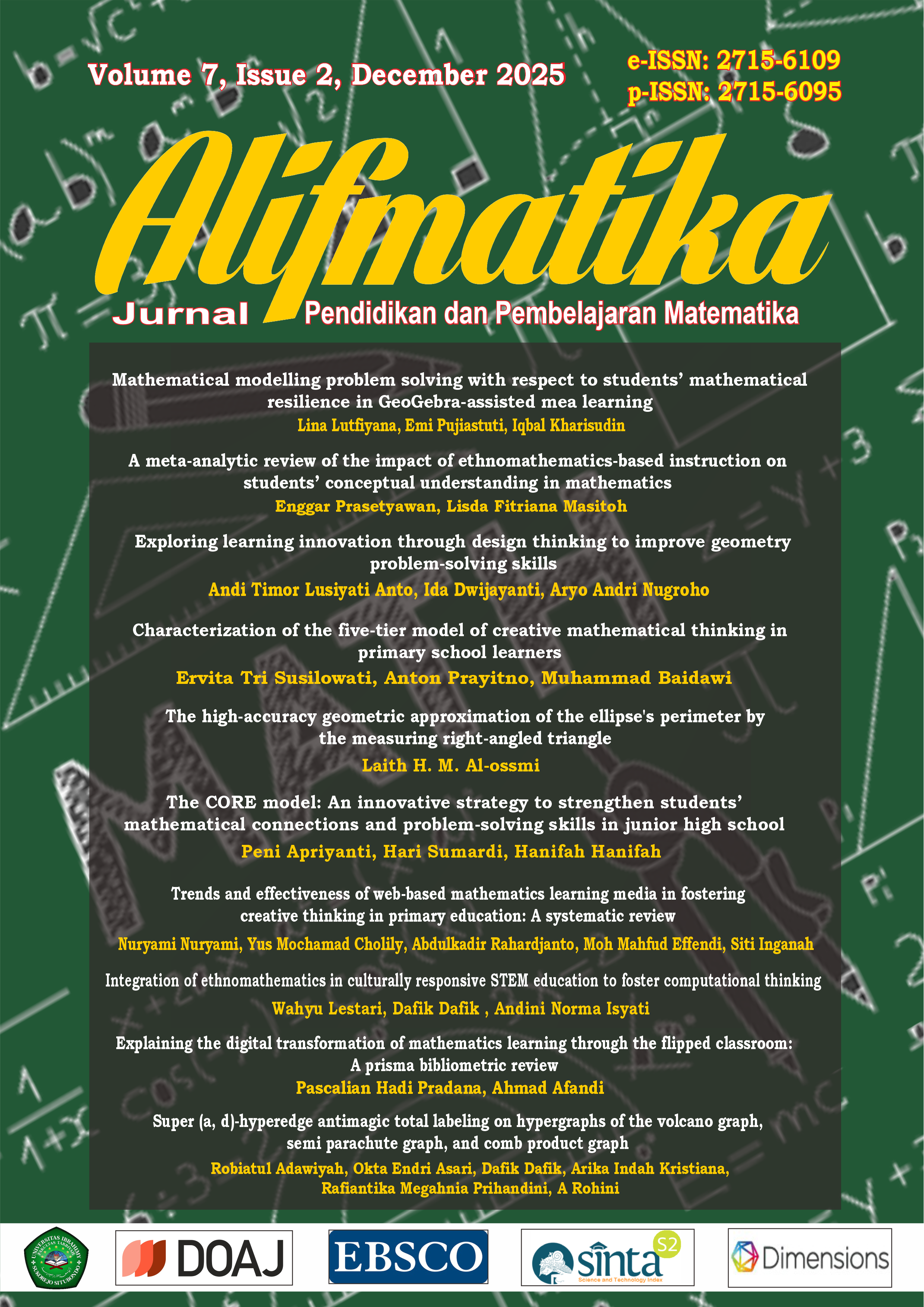
Integration of ethnomathematics in culturally responsive STEM education to foster computational thinking
DOI:
https://doi.org/10.35316/alifmatika.2025.v7i2.361-374Keywords:
Computational Thinking, Contextual, Ethnomathematics, Local Culture, STEM LearningAbstract
This study aims to describe the implementation of culturally responsive STEM learning integrated with an ethnomathematics approach to enhance students’ computational thinking skills. The research employed a descriptive qualitative method and was conducted at SMA Zainul Hasan Genggong, involving 30 tenth-grade students (class X-A) and one mathematics teacher. Data were collected through observation, interviews, documentation, and bibliometric analysis using VOSviewer. The findings indicate that incorporating local cultural elements such as Madurese batik motifs, bamboo weaving, and traditional culinary units created meaningful and contextual learning experiences. Students showed clear progress in key components of computational thinking, including breaking down cultural tasks into smaller mathematical components, identifying geometric and symmetrical patterns in cultural artefacts, and developing structured steps to address practical problems. Both teachers and students responded positively, highlighting increased engagement, motivation, and collaboration during group projects. The teacher reported that students became more active, creative, and critical, while students expressed that learning felt more relevant and enjoyable. Word Cloud visualisation revealed dominant keywords such as culture, mathematics, patterns, symmetry, problem-solving, and collaboration, reflecting the strong connection between cultural contexts and STEM education. Bibliometric analysis further confirmed the interrelation between STEM, computational thinking, and contextual learning. These findings suggest that culturally rooted STEM learning not only enhances conceptual mastery but also fosters systematic, reflective, and creative thinking, positioning it as an effective strategy for addressing the challenges of 21st-century education.
Downloads
References
Amalia, A., Syamsuri, S., & Ihsanudin, I. (2021). Eksplorasi etnomatematika batik krakatoa cilegon sebagai sumber belajar matematika SMP [Exploration of ethnomathematics of Krakatoa Cilegon batik as a source for learning junior high school mathematics]. Wilangan: Jurnal Inovasi Dan Riset Pendidikan Matematika, 2(1). https://doi.org/10.56704/jirpm.v2i1.11640
Candraningtyas, S. R., & Khusna, H. (2023). Computational thinking ability becomes a predictor of mathematical critical thinking ability. Alifmatika: Jurnal Pendidikan Dan Pembelajaran Matematika, 5(2). https://doi.org/10.35316/alifmatika.2023.v5i2.247-263
Dwi Sari, N., & Setiawan, J. (2020). Papan gekola sebagai media pembelajaran matematika yang inovatif dengan pendekatan STEAM [The school board as an innovative mathematics learning medium with a STEAM approach]. Jurnal Saintika Unpam : Jurnal Sains Dan Matematika Unpam, 3(1). https://doi.org/10.32493/jsmu.v3i1.4728
Fatimah, A. E., & Purba, A. (2021). Meningkatkan resiliensi matematis mahasiswa pada mata kuliah matematika dasar melalui pendekatan differentiated instruction [Improving students' mathematical resilience in basic mathematics courses through a differentiated instruction approach.]. Journal of Didactic Mathematics, 2(1). https://doi.org/10.34007/jdm.v2i1.617
Hadiyanto, A., Samitri, C., & Maria Ulfah, S. (2020). Model pembelajaran bahasa arab multiliterasi berbasis kearifan lokal dan moderasi islam di perguruan tinggi negeri [Multiliteracy Arabic language learning model based on local wisdom and Islamic moderation in state universities]. Hayula: Indonesian Journal of Multidisciplinary Islamic Studies, 4(1). https://doi.org/10.21009/004.01.07
Hidayat, E. Y., Affandy, A., & Pertiwi, A. (2020). Pembelajaran computational thinking untuk siswa SMA institut Indonesia Semarang [Computational thinking learning for high school students at the Indonesian Institute of Semarang]. ABDIMASKU : Jurnal Pengabdian Masyarakat, 3(3). https://doi.org/10.33633/ja.v3i3.104
Irawan, D. D., & Tirta, I. M. (n.d.). The development of RBL-STEM learning materials to improve students’ computational thinking skills in solving rainbow vertex antimagic coloring in ijcsrr.org. https://ijcsrr.org/wp-content/uploads/2023/07/144-31-2023.pdf
Ismail, H. H., Fauzi, M., & Sitompul, P. (2023). Perkembangan penelitian etnomatematika di Indonesia [The development of ethnomathematics research in Indonesia]. Jurnal Pencerahan, 17(2), 1-16. http://www.jurnalpencerahan.org/index.php/jp/article/view/87
Jumriani, J., Mutiani, M., Putra, M. A. H., Syaharuddin, S., & Abbas, E. W. (2021). The Urgency of Local Wisdom Content in Social Studies Learning: Literature Review. The Innovation of Social Studies Journal, 2(2). https://doi.org/10.20527/iis.v2i2.3076
Lestari, W., & Kurniati, D. (2025a). Development of RBL-STEM Learning Materials to Improve Students’ Computational Thinking Skills. International Journal of Instruction. https://e-iji.net/ats/index.php/pub/article/view/749
Lestari, W., & Kurniati, D. (2025b). Innovative Application of Strong Rainbow Antimagic Coloring in River Erosion Prediction Using STGNN Model. Advanced Mathematical Models & Applications, 10(1), 120-137. https://doi.org/10.62476/amma101120
Mariatul, K. C. (2019). Analisis etnomatematika pada batik tulis dan kaitannya dengan materi matematika [Ethnomathematic analysis of hand-drawn batik and its relation to mathematical material]. SKRIPSI Jurusan Matematika-Fakultas MIPA Universitas Negeri Malang
Marleny, F. D., Fitriansyah, M., Sa’adah, Astria Nuansa Saputri, W., Emiliya, R., & Fitriansyah, M. (2023). Edukasi pembelajaran dini untuk mengembangkan keterampilan berpikir komputasi siswa [Early learning education to develop students' computational thinking skills]. Majalah Ilmiah UPI YPTK, 30(1), 1-6. https://doi.org/10.35134/jmi.v30i1.141
Miles & Huberman. (2014). Qualitative data analysis: An expanded sourcebook (3rd ed.). Thousand Oaks.
Muharromah, M. D., & Kristiana, A. I. (2024). The development of RBL-STEM learning materials to improve students’ computational thinking skills in solving convolutional neural network problems. World Journal of Advanced Research and Reviews, 21(1), 2373–2381. https://doi.org/10.30574/wjarr.2024.21.1.0219
Muharromah M D, Kristiana A I, Slamin, & Dafik. (2024). The development of RBL - STEM learning materials to improve students’ computational thinking skills in solving convolutional neural network problems. World Journal of Advanced Research and Reviews, 21(1), 2373–2381. https://doi.org/10.30574/wjarr.2024.21.1.0219
Nielsen, W., Nicol, C., & Owuor, J. (2008). Culturally-Responsive Mathematics Pedagogy Through Complexivist Thinking. Faculty of Education - Papers, 5. https://doi.org/10.29173/cmplct8780
Octaviani, R., Juhana Senjaya, A., & Taufan, M. (2021). Eksplorasi etnomatematika pada permainan tradisional engklek di kabupaten indramayu. PROSIDING Seminar Nasional Matematika Dan Sains, 3(1), 282-291. https://prosiding.biounwir.ac.id/article/view/165
Pitaloka, D. D. A., & Susanti, M. (2022). Kajian etnomatematika : Eksplorasi etnomatematika pada rumah adat joglo tumiyono di klaten jawa tengah [Ethnomathematical study: Exploration of ethnomathematical elements in the Joglo Tumiyono traditional house in Klaten, Central Java.]. Prisma, Prosiding Seminar Nasional Matematika, 2022(1), 254-261 .
Sumardi, Puji, R. P. N., Dafik, & Ridlo, Z. R. (2023). The Implementation of RBL-STEM Learning Materials to Improve Students Historical Literacy in Designing the Indonesian Batik Motifs. International Journal of Instruction, 16(2), 581–602. https://doi.org/10.29333/iji.2023.16231a
Wikipedia, C. (2025). Ethnocomputing. Wikipedia, The Free Encyclopedia. https://doi.org/10.1145/110745
Ye, H., Liang, B., Ng, O. L., & Chai, C. S. (2023). Integration of computational thinking in K-12 mathematics education: a systematic review on CT-based mathematics instruction and student learning. International Journal of STEM Education, 10(1), 1-26 . https://doi.org/10.1186/s40594-023-00396-w
Downloads
Published
How to Cite
Issue
Section
License
Copyright (c) 2025 Alifmatika: Jurnal Pendidikan dan Pembelajaran Matematika

This work is licensed under a Creative Commons Attribution-ShareAlike 4.0 International License.
COPYRIGHT NOTICE
Author (s) who publish in Alifmatika: Jurnal Pendidikan dan Pembelajaran Matematika agree to the following terms:
- The Author (s) submitting a manuscript do so on the understanding that if accepted for publication, copyright of the article shall be assigned to Alifmatika: Jurnal Pendidikan dan Pembelajaran Matematika, Tarbiyah Faculty of Ibrahimy University as the publisher of the journal. Consecutively, author(s) still retain some rights to use and share their own published articles without written permission from Alifmatika: Jurnal Pendidikan dan Pembelajaran Matematika. This work is licensed under a Creative Commons Attribution-ShareAlike 4.0 International License.
- Copyright encompasses rights to publish and provide the manuscripts in all forms and media for the purpose of publication and dissemination, and the authority to enforce the rights in the manuscript, for example in the case of plagiarism or in copyright infringement.
- Alifmatika: Jurnal Pendidikan dan Pembelajaran Matematika and the Editors make every effort to ensure that no wrong or misleading data, opinions or statements be published in the journal. In any way, the contents of the articles and advertisements published in Alifmatika: Jurnal Pendidikan dan Pembelajaran Matematika are the sole responsibility of their respective authors and advertisers.
- The Copyright Transfer Form can be downloaded here [Copyright Transfer Form Alifmatika]. The copyright form should be signed originally and send to the Editorial Office in the form of original mail, scanned document to alifmatika[at]ibrahimy.ac.id or upload the scanned document in the comments column when sending the manuscript.














_by_Matematohir.jpg)