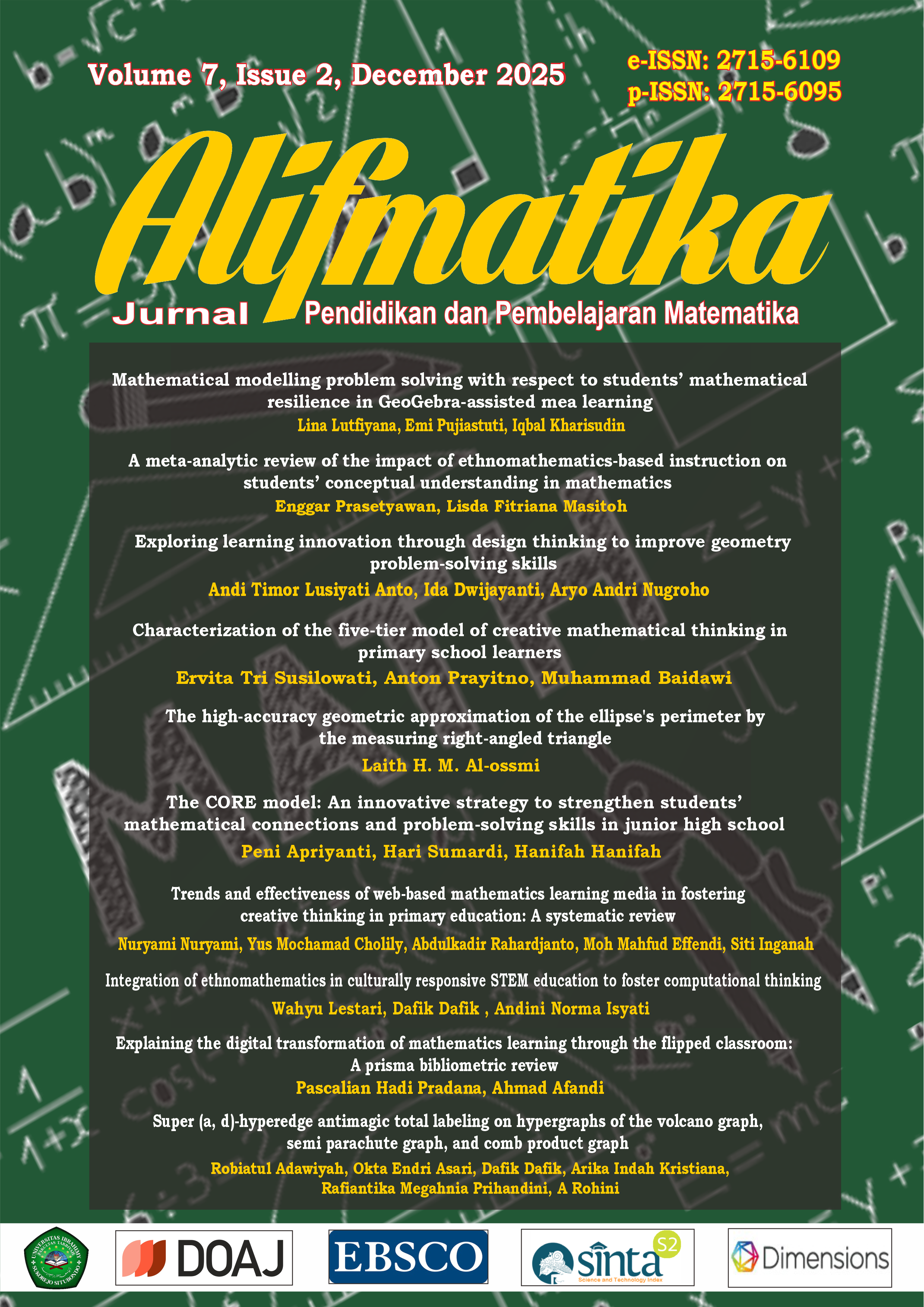
Exploring learning innovation through design thinking to improve geometry problem-solving skills
DOI:
https://doi.org/10.35316/alifmatika.2025.v7i2.275-294Keywords:
Mathematical Abilities, Problem-Solving Skills, Design Thinking, Learning InnovationAbstract
This study aims to provide innovative learning solutions for schools in special regions that are striving to improve the quality of education, particularly in improving mathematical problem-solving skills. This study employs a design thinking approach comprising the stages of empathise, define, ideate, prototype, and test. This study consisted of mathematics students and teachers from schools in special areas in Sumba, East Nusa Tenggara, namely SMP Negeri 2 Wewewa Timur, SMP Negeri 3 Wewewa Timur, and SMP Negeri 2 Wewewa Tengah, as well as several other schools whose teachers are members of the Mathematics Teacher Working Group (MGMP). The respondents included 99 students from the three schools and 19 mathematics teachers. Data collection methods included questionnaires, interviews, and observations with the respondents. The findings of this study, considering the conditions and facilities of the schools, indicate that to improve geometric mathematical problem-solving skills in special regions, the following solutions are required: (1) designing E-Modules for CTL-based ethnomathematics learning, (2) developing CTL and PBL learning activities using the CRT approach based on Augmented Reality, and (3) integrating CTL with the CRT approach using GeoGebra as a medium.
Downloads
References
Andang, A., Hadi, A. M., Sowanto, S., Fitrah, M., & Febrianti, D. (2024). Pengembangan e-modul geometri berbasis etnomatematika untuk meningkatkan kemampuan pemecahan masalah matematis siswa SMP [Development of ethnomathematics-based geometry e-modules to improve junior high school students' mathematical problem-solving abilities]. Paedagoria: Jurnal Kajian, Penelitian Dan Pengembangan Kependidikan, 15(4), 316-323. https://doi.org/10.31764/paedagoria.v15i4.25842
Aisah, A., & Widodo, S. (2024). Perancangan user interface game edukasi android pada mata pelajaran operasi hitung matematika dengan metode design thinking [Designing the user interface for an Android educational game on the subject of mathematical operations using the design thinking method.]. Sudo Jurnal Teknik Informatika, 3(1), 9–18. https://doi.org/10.56211/sudo.v3i1.462
Amsidi, M. (2025). Penerapan Model Problem Based Learning untuk Meningkatkan Kemampuan Pemecahan Masalah Matematika Siswa Ma Nurul Falah Kangge Pada Materi Persamaan Kuadrat [Implementation of Problem Based Learning Model to Improve Students' Mathematical Problem Solving Ability at MA Nurul Falah Kangge on Quadratic Equation Material]. Jurnal Edukasi, 1(1), 24-33. https://doi.org/10.11377/h0wzmr33
Anzani, V., & Juandi, D. (2022). Meta-analysis: The effect of problem-based learning assisted geogebra software on students mathematic ability. Jurnal Cendekia : Jurnal Pendidikan Matematika, 6(2), 1900–1907. https://doi.org/10.31004/cendekia.v6i2.1425
Azmi, J., & Gaol, R. L. (2025). Upaya Meningkatkn Hasil Belajar Siswa pada Materi Bangun Datar melalui Model Pembelajaran CTL (Contextual Teaching and Learning) di Kelas III SDN 067159 Kecamatan Medan Johor. Didaktik: Jurnal Ilmiah PGSD STKIP Subang, 11(2), 215-223. https://doi.org/10.36989/didaktik.v11i02.6060
Benamen, R. B., Achmad Buchori, & Didik Purwosetiyono. (2025). Analisis kebutuhan media pembelajaran berbasis augmented reality menggunakan kerangka design thinking untuk meningkatkan numerasi [Analysis of the needs of augmented reality-based learning media using a design thinking framework to improve numeracy]. JIPMat, 10(1), 13–20. https://doi.org/10.26877/b813zm44
Chuseri, A., Anjarini, T., & Purwoko, R. Y. (2021). Pengembangan modul matematika berbasis realistik terintegrasi higher order thinking skills (HOTS) pada materi bangun ruang [Development of a realistic-based mathematics module integrated with higher order thinking skills (HOTS) on the material of spatial structures]. Alifmatika: Jurnal Pendidikan Dan Pembelajaran Matematika, 3(1), 18–31. https://doi.org/10.35316/alifmatika.2021.v3i1.18-31
Cut Najwa Aulia, Lukman Hakim Laia, Nisa Rahmadani, & Fevi Rahmawati Suwanto. (2025). Visualisasi geometri netral berbasis augmented reality. Afore : Jurnal Pendidikan Matematika, 4(1), 69–84. https://doi.org/10.57094/afore.v4i1.2881
Cynthia, R. E., & Sihotang, H. (2023). Melangkah bersama di era digital : pentingnya literasi digital untuk meningkatkan kemampuan berpikir kritis dan kemampuan pemecahan masalah peserta didik [Stepping together in the digital era: the importance of digital literacy to improve students' critical thinking and problem-solving skills]. Jurnal Pendidikan Tambusai, 7(3), 31712-31723. https://doi.org/10.31004/jptam.v7i3.12179
Dasilva, M. (2025). The role of emerging technologies in transforming education: a comprehensive review. International Journal of Technology & Energy, 01(2), 107–120. https://ijte.americanjournal.us/index.php/ijte/issue/view/1
Eviota, J. S., & Liangco, M. M. (2020). Students’ performance on inquiry-based physics instruction through virtual simulation. Jurnal Pendidikan MIPA, 21(1), 22-34. https://doi.org/10.23960/jpmipa/v21i1.pp22-34
Fitriyah, N., Wiryanto, W., & Ekawati, R. (2025). Batik matika builds critical thinking and geometry problem solving skills. Indonesian Journal of Innovation Studies, 26(3), 1–13. https://doi.org/10.21070/ijins.v26i3.1396
Gembong, S. (2023). Design thinking pembelajaran geometri [Design thinking in geometry learning]. UNIPMA PRESS, Universitas PGRI Madiun. https://eprint.unipma.ac.id/331/
Hamidah, K. N., Ardiansyah, R., & Misrani, M. (2024). Penggunaan model pembelajaran contextual teaching and learning (CTL) untuk meningkatkan hasil belajar pada materi pecahan siswa kelas 4 sekolah dasar [The use of the contextual teaching and learning (CTL) learning model to improve learning outcomes in fraction material for 4th grade elementary school students.]. Journal of Educational Science and E-Learning, 1(2), 89–96. https://doi.org/10.62354/jese.v1i2.14
Hayati, E. N., Gembong, S. ., & Nurnaningsih, D. R. (2024). Peningkatkan hasil belajar siswa kelas VIII B SMPN 6 Madiun melalui model pembelajaran problem based learning (pbl) dengan menerapkan pendekatan culturally responsive teaching (CRT) pada bab peluang. Seminar Nasional Sosial, Sains, Pendidikan, Humaniora (Senassdra), 3(2), 170–175. https://prosiding.unipma.ac.id/index.php/SENASSDRA/article/view/5787
Ikhlas, A., Kamid, K., Syaiful, S., & Huda, N. (2024). Analisis Kemampuan Pemecahan Masalah Matematika dan Komunikasi Matematik dengan Penerapan Model Problem Based Learning Terintegrasi Etnomatematika. Indonesian Research Journal on Education, 4(4), 3128-3134. https://doi.org/10.31004/irje.v4i4.1491
Ikhwan, A., Lubis, T. A., Ananda, M. R., Putri, S. S., & Pangestu, A. D. (2025). Perancangan UI/UX aplikasi pembelajaran matematika usia sekolah dasar menggunakan metode design thinking di SDN No. 101827 Tuntungan [UI/UX design for elementary school mathematics learning applications using the design thinking method at SDN No. 101827 Tuntungan]. Journal of Informatics and Busisnes, 2(4), 549-554. https://doi.org/10.47233/jibs.v2i4.2238
Janah, R., Anzani, R. A., Herlina, R., Hidayah, T., Purnawan, F. S., & Sumarah, I. E. (2025). Penerapan design thinking untuk membantu peserta didik kelas IV mempelajari bilangan bulat dengan media quizizz [The application of design thinking to help fourth grade students learn integers using Quizizz media.]. Journal of Innovation and Teacher Professionalism, 3(3), 572–581. https://doi.org/10.17977/um084v3i32025p572-581
Kistian, A., & Fahreza, F. (2020). Perbedaan model pembelajaran contextual teaching and learning (CTL) dan ekspositori terhadap kemampuan pemecahan masalah matematis siswa di Kelas IV SDN Peunaga Cut Ujong [The difference between the contextual teaching and learning (CTL) and expository learning models on students' mathematical problem-solving abilities in Class IV of SDN Peunaga Cut Ujong]. Jurnal Tunas Bangsa, 7(1), 50-59. https://doi.org/10.46244/tunasbangsa.v7i1.975
Kotu, A., & Weldeyesus, K. M. (2022). Instructional use of Geometer’s Sketchpad and students geometry learning motivation and problem-solving ability. Eurasia Journal of Mathematics, Science and Technology Education, 18(12), em2201. https://doi.org/10.29333/ejmste/12710
Larasati, L., Azis, B. H., Anasyahrie, N. S., Fitriani, N. A., & Purwanto, E. (2025). Pengaruh media, budaya, dan pendidikan karakter lingkungan pada anak sekolah [The influence of media, culture, and environmental character education on school children]. CONVERSE Journal Communication Science, 2(1), 9. https://doi.org/10.47134/converse.v2i1.4290
Lestari, M. Z. D., Alifiani, A., & Yakusni, Y. (2025). Penerapan model problem based learning dan culturally responsive teaching untuk meningkatkan pemahaman konsep peserta didik [Application of problem-based learning and culturally responsive teaching models to improve students' conceptual understanding]. Jurnal Cendekia : Jurnal Pendidikan Matematika, 9(2), 845–856. https://doi.org/10.31004/cendekia.v9i2.4115
Mahlina, M., Fajriah, N., & Sari, A. (2025). Kemampuan siswa kelas VII dalam memecahkan masalah berbasis etnomatematika rumah bulat marabahan [The ability of grade VII students to solve ethnomathematics-based problems of the Marabahan round house]. Jurmadikta, 5(1), 55–65. https://doi.org/10.20527/jurmadikta.v5i1.2296
Man, M. Z. G., Hidayat, R., Kashmir, M. K., Suhaimi, N. F., Adnan, M., & Saswandila, A. (2022). Design thinking in mathematics education for primary school: a systematic literature review. Alifmatika: Jurnal Pendidikan Dan Pembelajaran Matematika, 4(1), 17–36. https://doi.org/10.35316/alifmatika.2022.v4i1.17-36
Mariana, M., Khairani, P., & Aulia, R. (2025). Kajian literatur tentang penerapan aplikasi geogebra dalam pembelajaran transformasi geometri siswa SLTA sederajat [Literature review on the application of GeoGebra application in learning geometric transformation for high school students]. Bilangan: Jurnal Ilmiah Matematika, Kebumian dan Angkasa, 3(3), 215-225. https://doi.org/10.62383/bilangan.v3i3.613
Musyarrofah, S. (2024). Implementation of augmented reality media use on mathematics problem solving ability of elementary school students. JEES: Journal of Education and Educational Sciences, 1(1), 17-25.. https://doi.org/10.70152/jees.v1i1.14
Najma Ulya, & Hasanuddin Hasanuddin. (2025). Penggunaan GeoGebra untuk meningkatkan pemahaman konsep kesebangunan: Analisis bibliometrik [Using GeoGebra to improve understanding of the concept of similarity: Bibliometric analysis]. Bilangan : Jurnal Ilmiah Matematika, Kebumian Dan Angkasa, 3(3), 18–31. https://doi.org/10.62383/bilangan.v3i3.492
Nazwa, P., Apriani, D. E., Siburian, G. M. B., Situmorang, R., Simamora, S. A., Rambe, Y. M., Aprilia, Y., & Siregar, B. H. (2025). Improving understanding of mathematical concepts through contextual teaching and learning (CTL): A case study at junior high school 14 Pematangsiantar. Jurnal Pendidikan Matematika (JPM), 11(1), 23–33. https://doi.org/10.33474/jpm.v11i1.23382
Nurlailiyah, L., Nugroho, A. A., & Harun, L. (2025). Eksplorasi pembelajaran yang berpihak pada siswa menggunakan design thinking untuk meningkatkan kemampuan pemecahan masalah pada bangun ruang sisi lengkung [Student-centered learning exploration using design thinking to improve problem-solving skills in curved-sided geometric shapes]. Teorema: Teori Dan Riset Matematika, 10(01), 73–82. https://doi.org/10.25157/teorema.v10i1.18178.
Prahmana, R. C. I., & D’Ambrosio, U. (2020). Learning geometry and values from patterns: Ethnomathematics on the batik patterns of Yogyakarta, Indonesia. Journal on Mathematics Education, 11(3), 439–456. https://doi.org/10.22342/jme.11.3.12949.439-456
Purnomo, D. J., Dwijayanti, I., & Nugroho, A. A. (2025). Enhancing Trigonometric critical thinking through innovative learning: A design thinking approach. AL-ISHLAH: Jurnal Pendidikan, 17(2), 2402–2414. https://doi.org/10.35445/alishlah.v17i2.6891
Rahman, M. S. (2025). Eksplorasi hubungan augmented reality dan kecemasan terhadap penerapan kecakapan matematis pada pembelajaran geometri [Exploration of the relationship between augmented reality and anxiety regarding the application of mathematical skills in geometry learning]. RADIAN Journal : Research and Review in Mathematics Education, 3(2), 49–60. https://doi.org/10.35706/rjrrme.v3i2.22
Ratna Kartika Sari, R. K. S. (2023). Upaya Meningkatkan kemampuan pemecahan masalah matematis siswa smk dengan pembelajaran berbasis masalah berbantuan GeoGebra [Efforts to improve the mathematical problem-solving abilities of vocational school students with problem-based learning assisted by GeoGebra]. Eksponen, 13(1), 25–36. https://doi.org/10.47637/eksponen.v13i1.682
Regita, A. P., & Rani, S. (2023). Gamifikasi pembelajaran matematika untuk anak SMP menggunakan metode design thinking berbasis android [Gamification of mathematics learning for junior high school students using the Android-based design thinking method]. JIKA (Jurnal Informatika), 7(1), 117. https://doi.org/10.31000/jika.v7i1.7550
Riyadi, S., Ida Dwi Jayanti, & Didik Purwosetiyono. (2024). Eksplorasi desain media android untuk meningkatkan kemampuan numerasi siswa dengan metode design thinking [Exploration of Android media design to improve students' numeracy skills using the design thinking method]. JIPMat, 9(1), 170–179. https://doi.org/10.26877/jipmat.v9i1.495
Salsabila, A. T., & Mardhiyana, D. (2025). Efektivitas model pembelajaran contextual teaching and learning (CTL) dengan menggunakan alat peraga stantick terhadap kemampuan pemecahan masalah matematika [The effectiveness of the contextual teaching and learning (CTL) learning model using standard teaching aids on mathematical problem-solving abilities]. Jurnal Pendidikan Indonesia, 6(8), 4289-4296. https://doi.org/10.59141/japendi.v6i8.8520
Santoso, G., Yulia, P., & Rusliah, N. (2020). Validitas lembar kerja peserta didik (LKPD) berbasis etnomatematika pada materi geometri dan pengukuran [Validity of ethnomathematics-based student worksheets (LKPD) on geometry and measurement materials]. Jurnal Program Studi Pendidikan Matematika, 9(2), 165–172. https://doi.org/10.33373/pythagoras.v9i2.2674
Saparudin, A., & Pabolo, M. (2017). Pengaruh penerapan pendekatan kontekstual berbasis budaya lokal terhadap kemampuan pemecahan masalah matematika [The influence of applying a local culture-based contextual approach on mathematical problem-solving abilities]. Jurnal Pendidikan Progresif, 7(1), 1–12. https://doi.org/10.23960/jpp.v7.i1.201701
Setiyani, & Winanto, A. (2024). Peningkatan kemampuan pemecahan masalah matematika melalui model problem based learning dengan pendekatan culturally responsive teaching [Improving mathematical problem-solving skills through a problem-based learning model with a culturally responsive teaching approach.]. Jurnal BELAINDIKA (Pembelajaran Dan Inovasi Pendidikan), 6(2), 205–215. https://doi.org/10.52005/belaindika.v6i2.171
Siti, R. S. S., & Nuur Wachid Abdul Majid. (2024). The effectiveness of augmented reality technology in mathematics: a case study of SMP Al Azhar Plus Bogor. Jurnal Nasional Pendidikan Teknik Informatika (JANAPATI), 13(2), 316–325. https://doi.org/10.23887/janapati.v13i2.74582
Sugiyono, Y. S., Kusuma Dewi, N., Susi, T., Wati, A., Pgri, U., & Kertobanyon, S. (2024). Implementasi model problem based learning (PBL) dengan pendekatan culturally responsive teaching (CRT) untuk meningkatkan hasil belajar matematika peserta didik kelas IV SDN Kertobanyon [Implementation of the problem based learning (PBL) model with a culturally responsive teaching (CRT) approach to improve mathematics learning outcomes of fourth grade students at SDN Kertobanyon]. Didaktik: Jurnal Ilmiah PGSD STKIP Subang, 10(04), 221-229. https://doi.org/10.36989/didaktik.v11i01.4209
Sulispala, N. S., Jannah, M. H., Putra, M. J. A., & Sari, M. Y. (2025). Peran guru dalam mengintegrasi teknologi pada kurikulum merdeka [The role of teachers in integrating technology in the independent curriculum]. Jurnal Pendidikan Dasar dan Keguruan, 10(1), 22-31. https://doi.org/10.47435/jpdk.v10i1.3210
Sutarto, Hastuti, I. D., Sukarma, I. K., & Untu, Z. (2022). Ethnomathematics-based e-module development for improving conjecturing ability in object configuration materials. Journal of Positive Psychology & Wellbeing, 6(1), 2813–2823. http://journalppw.com
Szabo, Z. K., Körtesi, P., Guncaga, J., Szabo, D., & Neag, R. (2020). Examples of problem-solving strategies in mathematics education supporting the sustainability of 21st-century skills. Sustainability (Switzerland), 12(23), 1–28. https://doi.org/10.3390/su122310113
Tanjung, R. M. (2025). Analisis kemampuan pemecahan masalah matematika siswa di jabodetabek: pendekatan systematic literature review [Analysis of students' mathematical problem-solving abilities in Jabodetabek: a systematic literature review approach]. Jurnal Ilmiah Research and Development Student, 3(1), 204–216. https://doi.org/10.59024/jis.v3i1.1099
Thesalonika, P. (2025). Pengaruh Model PBL dalam meningkatkan kemampuan pemecahan masalah dan komunikasi siswa pada Kurikulum Merdeka SMP Negeri 1 Yogyakarta. Jurnal Pendidikan, 25(2), 89-99. https://doi.org/10.52850/jpn.v25i2.15677
Utomo, H. N., Muhtarom, M., & Dwijayanti, I. (2024). Eksplorasi media interaktif googles site dengan alur merdeka berbasis design thinking [Explore Google Site's interactive media with a design thinking-based independent flow.]. Jurnal Riset Dan Inovasi Pembelajaran, 4(1), 42–58. https://doi.org/10.51574/jrip.v4i1.1262
Vera, T. O., Yulia, P., & Rusliah, N. (2021). Peningkatan kemampuan pemecahan masalah matematis melalui model problem based learning dengan menggunakan soal-soal berbasis budaya lokal [Improving mathematical problem-solving skills through problem-based learning models using local culture-based questions]. Logaritma : Jurnal Ilmu-Ilmu Pendidikan Dan Sains, 9(01), 1–14. https://doi.org/10.24952/logaritma.v9i01.2782
Wardono, & Mariani, S. (2019). Problem based learning with Indonesian realistic mathematics education approach assisted e-schoology to improve student mathematization. Journal of Physics: Conference Series, 1321(3). https://doi.org/10.1088/1742-6596/1321/3/032094
Widana, I. W. (2021). Realistic mathematics education (RME) untuk meningkatkan kemampuan pemecahan masalah matematis siswa di Indonesia [Realistic mathematics education (RME) to improve students' mathematical problem-solving abilities in Indonesia]. Jurnal Elemen, 7(2), 450–462. https://doi.org/10.29408/jel.v7i2.3744
Widyastuti, E. N., & Supardi, S. (2025). Peningkatan kemampuan pemecahan masalah matematis siswa MTs melalui model pembelajaran contextual teaching and learning (CTL) [Improving the mathematical problem-solving abilities of MTs students through the contextual teaching and learning (CTL) learning model]. Innovative: Journal Of Social Science Research, 5(3), 4110–4129.
Yulius, R., Nasrullah, M. F. A., Sari, D. K., & Alban, M. A. (2022). Design thinking: Konsep dan aplikasinya. Eureka Media Aksara. https://repository.penerbiteureka.com/id/publications/559112/design-thinking-konsep-dan-aplikasinya
Downloads
Published
How to Cite
Issue
Section
License
Copyright (c) 2025 Alifmatika: Jurnal Pendidikan dan Pembelajaran Matematika

This work is licensed under a Creative Commons Attribution-ShareAlike 4.0 International License.
COPYRIGHT NOTICE
Author (s) who publish in Alifmatika: Jurnal Pendidikan dan Pembelajaran Matematika agree to the following terms:
- The Author (s) submitting a manuscript do so on the understanding that if accepted for publication, copyright of the article shall be assigned to Alifmatika: Jurnal Pendidikan dan Pembelajaran Matematika, Tarbiyah Faculty of Ibrahimy University as the publisher of the journal. Consecutively, author(s) still retain some rights to use and share their own published articles without written permission from Alifmatika: Jurnal Pendidikan dan Pembelajaran Matematika. This work is licensed under a Creative Commons Attribution-ShareAlike 4.0 International License.
- Copyright encompasses rights to publish and provide the manuscripts in all forms and media for the purpose of publication and dissemination, and the authority to enforce the rights in the manuscript, for example in the case of plagiarism or in copyright infringement.
- Alifmatika: Jurnal Pendidikan dan Pembelajaran Matematika and the Editors make every effort to ensure that no wrong or misleading data, opinions or statements be published in the journal. In any way, the contents of the articles and advertisements published in Alifmatika: Jurnal Pendidikan dan Pembelajaran Matematika are the sole responsibility of their respective authors and advertisers.
- The Copyright Transfer Form can be downloaded here [Copyright Transfer Form Alifmatika]. The copyright form should be signed originally and send to the Editorial Office in the form of original mail, scanned document to alifmatika[at]ibrahimy.ac.id or upload the scanned document in the comments column when sending the manuscript.














_by_Matematohir.jpg)