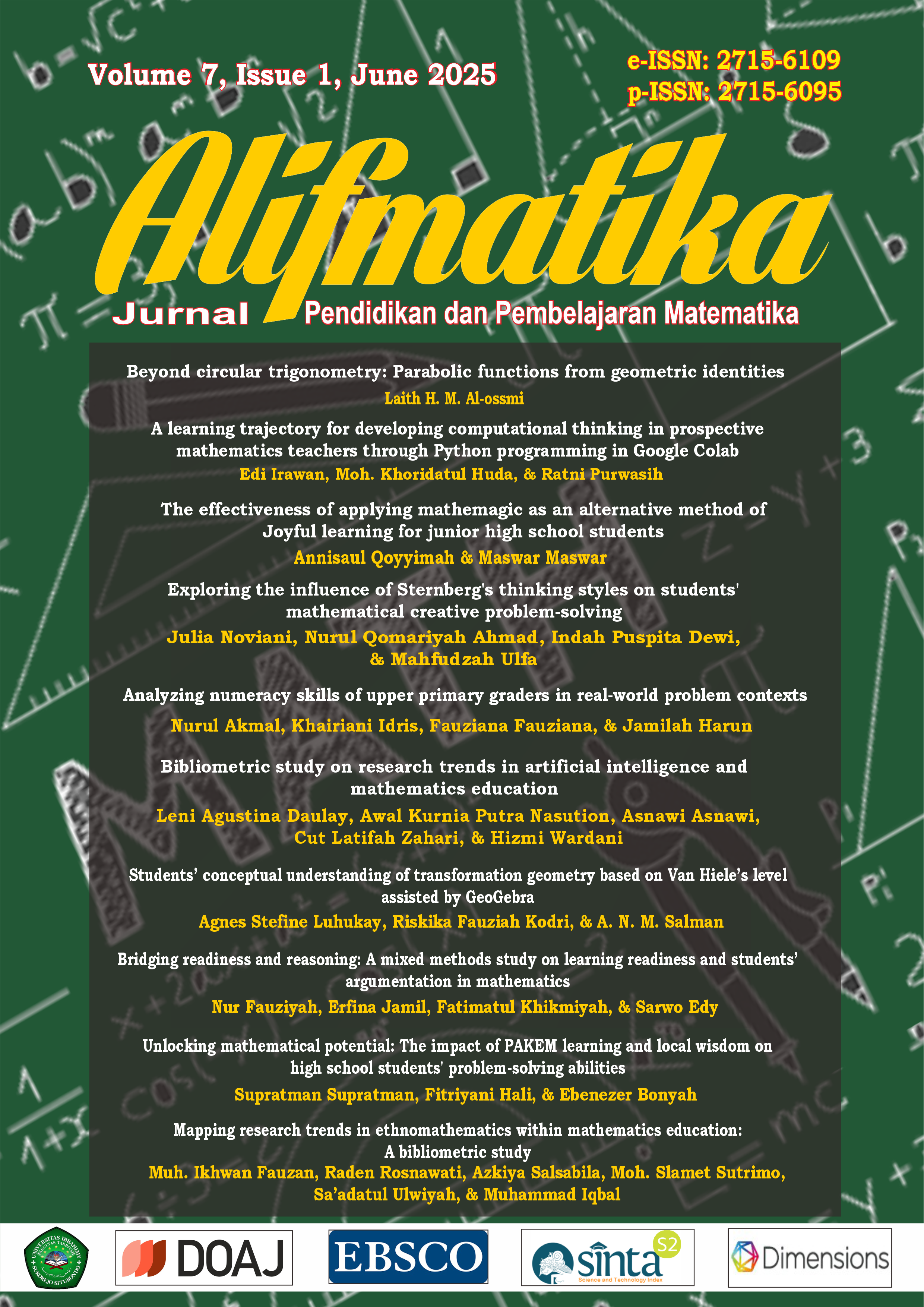
Bibliometric study on research trends in artificial intelligence and mathematics education
DOI:
https://doi.org/10.35316/alifmatika.2025.v7i1.124-147Keywords:
Artificial Intelligence, Bibliometrics, Mathematics Education, Research TrendsAbstract
This research analyzes the emerging AI and Mathematics Education nexus from the years 2015 to 2024, aiming to ascertain primary research patterns, significant contributors, and thematic progressions in the specialized bibliometric discourse. By conducting a bibliometric analysis of 840 articles indexed in Scopus, this research uncovers accelerated growth, especially post-2020, in scholarly interest concerning AI applications in mathematics education. The findings emphasize a notable decline in using teaching methods grounded in pedagogy to more sophisticated techniques focused on leveraging machine learning and tutoring systems to maximize educational achievement for students. The United States and China are pointed out as the main players in the mapped research framework. Unlike other studies that vaguely address AI and education, this review stands out in providing a comprehensive assessment of how AI tools are integrated within the teaching of mathematics and tracking the evolution of research in this context. The design seeks to aid educators, policymakers, and even researchers focusing on the intersection of technological advancements and educational reform in mathematics teaching.
Downloads
References
Aria, M., & Cuccurullo, C. (2017). bibliometrix: An R-tool for comprehensive science mapping analysis. Journal of Informetrics, 11(4), 959–975. https://doi.org/https://doi.org/10.1016/j.joi.2017.08.007
Baker, R. S., Martin, T., & Rossi, L. M. (2016). Educational data mining and learning analytics. The Wiley Handbook of Cognition and Assessment: Frameworks, Methodologies, and Applications, 379–396. https://doi.org/https://doi.org/10.1007/978-1-4614-3305-7_4
Botelho, A., Baral, S., Erickson, J. A., Benachamardi, P., & Heffernan, N. T. (2023). Leveraging natural language processing to support automated assessment and feedback for student open responses in mathematics. Journal of Computer Assisted Learning, 39(3), 823–840. https://doi.org/https://doi.org/10.1111/jcal.12793
Chen, L., Chen, P., & Lin, Z. (2020). Artificial intelligence in education: A review. Ieee Access, 8, 75264–75278. https://doi.org/https://doi.org/10.1109/ACCESS.2020.2988510
Dimitriadou, E., & Lanitis, A. (2023). A critical evaluation, challenges, and future perspectives of using artificial intelligence and emerging technologies in smart classrooms. Smart Learning Environments, 10(1), 12. https://doi.org/https://doi.org/10.1186/s40561-023-00231-3
Donthu, N., Kumar, S., Mukherjee, D., Pandey, N., & Lim, W. M. (2021). How to conduct a bibliometric analysis: An overview and guidelines. Journal of Business Research, 133, 285–296. https://doi.org/https://doi.org/10.1016/j.jbusres.2021.04.070
Durak, G., Çankaya, S., Özdemir, D., & Can, S. (2024). Artificial intelligence in education: A bibliometric study on its role in transforming teaching and learning. International Review of Research in Open and Distributed Learning, 25(3), 219–244. https://doi.org/https://doi.org/10.19173/irrodl.v25i3.7757
Holmes, W., Bialik, M., & Fadel, C. (2019). Artificial intelligence in education promises and implications for teaching and learning. Center for Curriculum Redesign.
Howland, J. L., Jonassen, D. H., & Marra, R. M. (2013). Meaningful learning with technology: Pearson new international edition. Pearson Higher Ed.
Ji, Y., Zhan, Z., Li, T., Zou, X., & Lyu, S. (2025). Human-Machine Co-creation: the Effects of ChatGPT on Students’ Learning Performance, AI Awareness, Critical Thinking, and Cognitive Load in a STEM Course towards Entrepreneurship. IEEE Transactions on Learning Technologies, 18, 402–415. https://doi.org/https://doi.org/10.1109/TLT.2025.3554584
Jung, I. (2022). International Collaboration in Educational Technology Research: A Personal Reflection on Research Process, Experience, and Outcomes. Information and Technology in Education and Learning, 2(1), 1–10. https://doi.org/10.12937/itel.2.1.inv.p003
Kaushik, R., Parmar, M., & Jhamb, S. (2021). Roles and Research Trends of Artificial Intelligence in Mathematics Education. Proceedings - 2021 2nd International Conference on Computational Methods in Science and Technology, ICCMST 2021, 9(6), 202–205. https://doi.org/10.1109/ICCMST54943.2021.00050
Lee, I., Ali, S., Zhang, H., DiPaola, D., & Breazeal, C. (2021). Developing middle school students’ AI literacy. Proceedings of the 52nd ACM Technical Symposium on Computer Science Education, 191–197. https://doi.org/https://doi.org/10.1145/3408877.3432513
Levis, M. (2024). Understanding The Limitations Of AI (Artificial Intelligence). Medium. Retrieved February 13, 2024. https://medium.com/@marklevisebook/understanding-the-limitations-of-ai-artificial-intelligence-a264c1e0b8ab
Lo, C. K. (2023). What Is the Impact of ChatGPT on Education? A Rapid Review of the Literature. Education Sciences, 13(4), 1–15. https://doi.org/10.3390/educsci13040410
Luckin, R., & Holmes, W. (2016). Intelligence unleashed: An argument for AI in education. UCL Knowledge Lab.
Manduca, C. A., Iverson, E. R., Luxenberg, M., Macdonald, R. H., McConnell, D. A., Mogk, D. W., & Tewksbury, B. J. (2017). Improving undergraduate STEM education: The efficacy of discipline-based professional development. Science Advances, 3(2), e1600193. https://doi.org/https://doi.org/10.1126/sciadv.1600193
Melaas, А., & Zhang, F. (2016). National innovation systems in the United States and China. The Center for International Environment and Resource Policy, 36, 1–36. https://sites.tufts.edu/cierp/files/2017/11/ECI_Innovation-Systems_WEB.pdf
Mustafa, M. Y., Tlili, A., Lampropoulos, G., Huang, R., Jandrić, P., Zhao, J., Salha, S., Xu, L., Panda, S., & López-Pernas, S. (2024). A systematic review of literature reviews on artificial intelligence in education (AIED): a roadmap to a future research agenda. Smart Learning Environments, 11(1), 1–33. https://doi.org/https://doi.org/10.1186/s40561-024-00350-5
Papasarantou, C., Alimisis, D., Geramani, K., & Ioannidis, G. (2002). Introducing Artificial Intelligence in school education: the Edu4AI project. Proc. of the 17th Edition of the EUTIC–In the Intersection of Art, Science and Technology: Dialogos between Humans and Machines. Corfu, Greece: Department of Audio & Visual Arts, Ionian University, 272–280. https://avarts.ionio.gr/eutic/en/presentations/797/
Qiao, L., Mu, R., & Chen, K. (2016). Scientific effects of large research infrastructures in China. Technological Forecasting and Social Change, 112, 102–112. https://doi.org/https://doi.org/10.1016/j.techfore.2016.07.029
Roll, I., & Wylie, R. (2016). Evolution and revolution in artificial intelligence in education. International Journal of Artificial Intelligence in Education, 26, 582–599. https://doi.org/https://doi.org/10.1007/s40593-016-0110-3
Sánchez-Ruiz, L. M., Moll-López, S., Nuñez-Pérez, A., Moraño-Fernández, J. A., & Vega-Fleitas, E. (2023). ChatGPT challenges blended learning methodologies in engineering education: A case study in mathematics. Applied Sciences, 13(10), 1–22. https://doi.org/https://doi.org/10.3390/app13106039
Sarabipour, S. (2020). Virtual conferences raise standards for accessibility and interactions. ELife, 9, 1–9. https://doi.org/10.7554/eLife.62668
Specht, A., & Crowston, K. (2022). Interdisciplinary collaboration from diverse science teams can produce significant outcomes. PLoS One, 17(11), e0278043. https://doi.org/https://doi.org/10.1371/journal.pone.0278043
Sun, Z., Anbarasan, M., & Praveen Kumar, D. (2021). Design of online intelligent English teaching platform based on artificial intelligence techniques. Computational Intelligence, 37(3), 1166–1180. https://doi.org/https://doi.org/10.1111/coin.12351
Talan, T. (2021). Artificial intelligence in education: A bibliometric study. International Journal of Research in Education and Science, 7(3), 822–837. https://doi.org/https://doi.org/10.46328/ijres.2409
Theodoridis, S. (2020). Machine Learning: A Bayesian and Optimization Perspective, Second Edition. In Machine Learning: A Bayesian and Optimization Perspective, Second Edition. Academic press. https://doi.org/10.1016/C2019-0-03772-7
Wang, S., Wang, H., Jiang, Y., Li, P., & Yang, W. (2023). Understanding students’ participation of intelligent teaching: an empirical study considering artificial intelligence usefulness, interactive reward, satisfaction, university support and enjoyment. Interactive Learning Environments, 31(9), 5633–5649. https://doi.org/https://doi.org/10.1080/10494820.2021.2012813
Wardat, Y., Tashtoush, M. A., Ali, R., & Jarrah, A. M. (2023). ChatGPT: A revolutionary tool for teaching and learning mathematics. Eurasia Journal of Mathematics, Science and Technology Education, 19(7), em2286. https://doi.org/https://doi.org/10.29333/ejmste/13272
Xu, Y., Liu, X., Cao, X., Huang, C., Liu, E., Qian, S., Liu, X., Wu, Y., Dong, F., & Qiu, C. W. (2021). Artificial intelligence: A powerful paradigm for scientific research. The Innovation, 2(4), 100179. https://doi.org/https://doi.org/10.1016/j.xinn.2021.100179
Zawacki-Richter, O., Marín, V. I., Bond, M., & Gouverneur, F. (2019). Systematic review of research on artificial intelligence applications in higher education–where are the educators? International Journal of Educational Technology in Higher Education, 16(1), 1–27. https://doi.org/https://doi.org/10.1186/s41239-019-0171-0
Downloads
Published
How to Cite
Issue
Section
License
Copyright (c) 2025 Alifmatika: Jurnal Pendidikan dan Pembelajaran Matematika

This work is licensed under a Creative Commons Attribution-ShareAlike 4.0 International License.
COPYRIGHT NOTICE
Author (s) who publish in Alifmatika: Jurnal Pendidikan dan Pembelajaran Matematika agree to the following terms:
- The Author (s) submitting a manuscript do so on the understanding that if accepted for publication, copyright of the article shall be assigned to Alifmatika: Jurnal Pendidikan dan Pembelajaran Matematika, Tarbiyah Faculty of Ibrahimy University as the publisher of the journal. Consecutively, author(s) still retain some rights to use and share their own published articles without written permission from Alifmatika: Jurnal Pendidikan dan Pembelajaran Matematika. This work is licensed under a Creative Commons Attribution-ShareAlike 4.0 International License.
- Copyright encompasses rights to publish and provide the manuscripts in all forms and media for the purpose of publication and dissemination, and the authority to enforce the rights in the manuscript, for example in the case of plagiarism or in copyright infringement.
- Alifmatika: Jurnal Pendidikan dan Pembelajaran Matematika and the Editors make every effort to ensure that no wrong or misleading data, opinions or statements be published in the journal. In any way, the contents of the articles and advertisements published in Alifmatika: Jurnal Pendidikan dan Pembelajaran Matematika are the sole responsibility of their respective authors and advertisers.
- The Copyright Transfer Form can be downloaded here [Copyright Transfer Form Alifmatika]. The copyright form should be signed originally and send to the Editorial Office in the form of original mail, scanned document to alifmatika[at]ibrahimy.ac.id or upload the scanned document in the comments column when sending the manuscript.













_by_Matematohir.jpg)