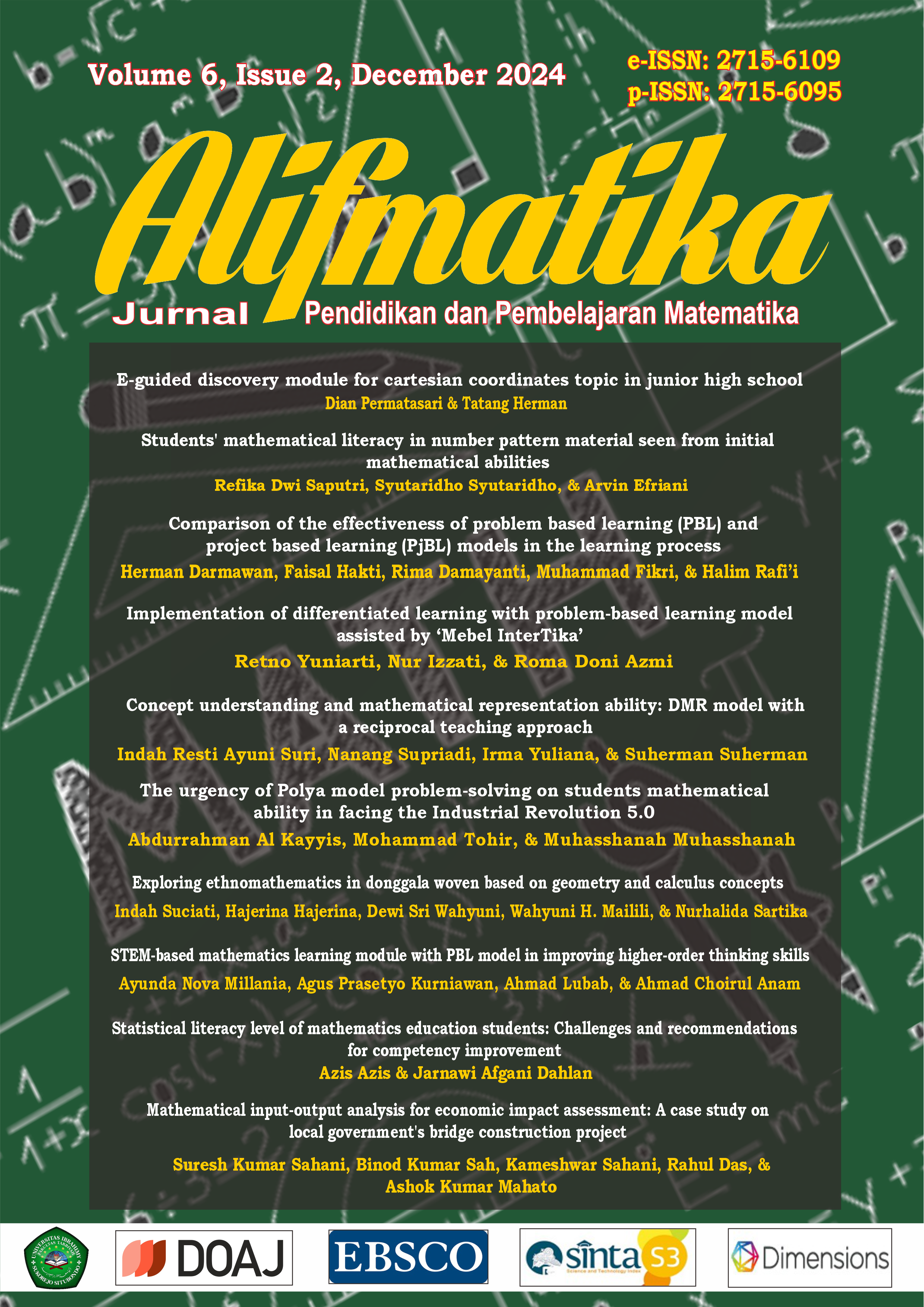
Comparison of the effectiveness of problem based learning (PBL) and project based learning (PjBL) models in the learning process
DOI:
https://doi.org/10.35316/alifmatika.2024.v6i2.176-191Keywords:
Comparation, Learning Model, Problem Based Learning, Project Based LearningAbstract
A learning model is a collection of methods, strategies, and the integration of methods used by teachers from start to finish. Choosing the right learning model can enhance the effectiveness and accuracy of the learning process. Additionally, learners can learn better due to the selection of the appropriate methods in the learning process, making the learning experience more engaging and ultimately impacting the quality of learning. This research aims to compare the PBL (Problem-Based Learning) and PjBL (Project-Based Learning) models and to determine the proper placement of these models in education. This study employs a qualitative-descriptive method with a semantic literature review. PBL is driven by problems faced by students and focuses on research and investigation, whereas the PjBL approach is driven by the final product they aim to produce, with the primary focus on the entire production process. PBL begins with a problem, and that problem becomes the main focus in PBL, where every progress, plan, and effort made by students is directed towards solving the problem. On the other hand, PjBL starts with the assignment to carry out one or more tasks leading to the production of a final product.
Downloads
References
Abdullah. (2023). Comparative Analysis. Springer texts in education.
Almulla, M. A. (2020). The effectiveness of the project-based learning (pbl) approach as a way to engage students in learning. Sage Open, 10(3), 2158244020938702. https://doi.org/10.1177/2158244020938702
Bayyurt, N., & Baday, S. (2022). Descriptive analytics. In A. Ustundag, E. Cevikcan, & O. F. Beyca (Eds.), Business Analytics for Professionals (pp. 21–48). Springer International Publishing. https://doi.org/10.1007/978-3-030-93823-9_2
Blair-Walcott, K. (2023). Comparative analysis. In J. M. Okoko, S. Tunison, & K. D. Walker (Eds.), Varieties of Qualitative Research Methods (pp. 79–84). Springer International Publishing. https://doi.org/10.1007/978-3-031-04394-9_13
Blumenfeld, P. C., Soloway, E., Marx, R. W., Krajcik, J. S., Guzdial, M., & Palincsar, A. (1991). Motivating Project-based learning: sustaining the doing, supporting the learning. Educational Psychologist, 26(3–4), 369–398. https://doi.org/10.1080/00461520.1991.9653139
Brignardello-Petersen, R., Santesso, N., & Guyatt, G. H. (2024). Systematic reviews of the literature: An introduction to current methods. American Journal of Epidemiology, kwae232. https://doi.org/10.1093/aje/kwae232
Burdick, R. K. (2023). Comparison of analytical procedures in method transfer and bridging experiments. The AAPS Journal, 25(5), 74(1). https://doi.org/10.1208/s12248-023-00834-1
Darmawan, H., Malik, H., Qadir, A., Khairani, A., & Effendy, A. N. (2024). Korelasi konsep at-ta’dib dan conscientizacao dalam lingkup pendidikan (Tinjauan pemikiran Syed Muhammad Naquib al-Attas dan Paulo Freire) [Correlation of the concepts of at-ta'dib and conscientizacao in the scope of education (Review of the thoughts of Syed Muhammad Naquib al-Attas and Paulo Freire)]. Pendas: Jurnal Ilmiah Pendidikan Dasar, 9(3), 294-310. https://doi.org/10.23969/jp.v9i3.18186
Dole, S., Bloom, L., & Doss, K. K. (2017). Engaged Learning: Impact of PBL and PjBL with Elementary and Middle Grade Students. Interdisciplinary Journal of Problem-Based Learning, 11(2), 7–11. https://doi.org/10.7771/1541-5015.1685
Evenddy, S. S., Gailea, N., & Syafrizal, S. (2023). Exploring the benefits and challenges of project-based learning in higher education. PPSDP International Journal of Education, 2(2), 458–469. https://doi.org/10.59175/pijed.v2i2.148
Fauzia, N. L. U., & Kelana, J. B. (2020). Natural science problem solving in elementary school students using the project based learning (PjBL) model. Jurnal Ilmiah Sekolah Dasar, 4(4), 569–603. https://doi.org/10.23887/jisd.v4i4.28377
Gallagher, S. E., & Savage, T. (2023). Challenge-based learning in higher education: An exploratory literature review. Teaching in Higher Education, 28(6), 1135–1157. https://doi.org/10.1080/13562517.2020.1863354
Gough, D., & Richardson, M. (2024). Systematic reviews. In P. Brough, Advanced Research Methods for Applied Psychology (2nd ed., pp. 71–86). Routledge. https://doi.org/10.4324/9781003362715-8
Həsənli, N. (2024). Apcilation of the vark model to the subject of geography in the learning process. Scientific Works, 91(1), 160–162. https://doi.org/10.69682/azrt.2024.91(1).160-162
Hong, J.-C. (2007). The Comparison of Problem-based Learning (PmBL) Model and Project-based Learning (PtBL) Model. International Conference on Engineering Education - ICEE, Coimbra, Portugal.
Hunaepi, H., Suma, I. K., & Subagia, I. W. (2024). Curiosity in science learning: a systematic literature review. International Journal of Essential Competencies in Education, 3(1), 77–105. https://doi.org/10.36312/ijece.v3i1.1918
Inayah, Z., Buchori, A., & Pramasdyahsari, A. S. (2021). The Effectiveness of problem based learning (PBL) and project based learning (PjBL) assisted kahoot learning models on student learning outcomes. International Journal of Research in Education, 1(2), 129-137. https://doi.org/10.26877/ijre.v1i2.8630
Indrasari, A., & Wulandari, F. E. (2024). STEM PjBL sparks global ecoliteracy advancement. Indonesian Journal of Education Methods Development, 19(2). https://doi.org/10.21070/ijemd.v19i2.824
Johnson, S. L., & VanLaningham, E. (2022). Introduction. In S. L. Johnson & E. VanLaningham, Cultivating Vocation in Literary Studies (pp. 1–22). Edinburgh University Press. https://doi.org/10.3366/edinburgh/9781474490009.003.0001
Kaur, A., & Sasikumar, M. (2017). A comparative analysis of various approaches for automated assessment of descriptive answers. 2017 International Conference on Computational Intelligence in Data Science(ICCIDS), 1–7. https://doi.org/10.1109/ICCIDS.2017.8272650
Made, A. M., Ambiyar, A., Riyanda, A. R., Sagala, M. K., & Adi, N. H. (2022). Implementasi model project based learning (PjBL) dalam upaya meningkatkan hasil belajar mahasiswa teknik mesin [Implementation of the project based learning (PjBL) model in an effort to improve the learning outcomes of mechanical engineering students]. Edukatif : Jurnal Ilmu Pendidikan, 4(4), 5162–5169. https://doi.org/10.31004/edukatif.v4i4.3128
Maundeni, W. B. (2023). Literature study: The value of the character of love for the motherland in science learning. Journal Evaluation in Education (JEE), 4(3), 110–119. https://doi.org/10.37251/jee.v4i3.334
Mohammed, M., & Omar, N. (2020). Question classification based on Bloom’s taxonomy cognitive domain using modified TF-IDF and word2vec. PLOS ONE, 15(3), 1-21. https://doi.org/10.1371/journal.pone.0230442
Mustika Sa, A. R., Rakimahwati, R., Suryana, D., Jamna, J., & Jasrial, J. (2024). Effectiveness of seven steps of project based learning (PJBL) in kndergarten. Educational Administration: Theory and Practice, 30(4), 2211–2220. https://doi.org/10.53555/kuey.v30i4.1835
Ndaryanti, R. B. I., Sumardjoko, B., Musiyam, Muh., . S., & Sutopo, A. (2024). Development of PJBL-oriented interactive learning media to develop the profile of pancasila students’ creative dimensions of junior high school science subjects. International Journal of Religion, 5(11), 3061–3065. https://doi.org/10.61707/x80b4t18
Noordin, M. K., Nasir, A. N., Ali, D. F., & Nordin, M. S. (2011). Problem-based learning (PBL) and Project-Based Learning (PjBL) in engineering education: A comparison. Proceedings of the IETEC’11 Conference. http://ietec.apaqa.org/wp-content/uploads/IETEC-2011-Proceedings/papers/Conference%20Papers%20Refereed/Tuesday/TP2/TP2.3_19.pdf
Nugroho, A. C., Irianto, W. S. G., & Herwanto, H. W. (2019). Comparison of problem based learning with project based learning assisted by mobile based learning media on students’ learning outcomes. Letters in Information Technology Education (LITE), 1(2), 29-33. https://doi.org/10.17977/um010v1i22018p029
Nurhidayah, I. J., Wibowo, F. C., & Astra, I. M. (2021). Project based learning (PjBL) learning model in science learning: Literature review. Journal of Physics: Conference Series, 2019(1), 012043. https://doi.org/10.1088/1742-6596/2019/1/012043
Purnama, A. R. (2023). Pengembangan model pembelajaran problem based learning melalui media video digital untuk meningkatkan pengetahuan pada materi permainan bola voli [Development of a problem based learning model through digital video media to improve knowledge of volleyball game material]. Tesis. Universitas Negeri Yogyakarta.
Riddle, N. C., Biga, P. R., Bronikowski, A. M., Walters, J. R., Wilkinson, G. S., IISAGE Consortium, Duan, J. E., Gamble, A., Larschan, E., Meisel, R. P., Singh, R., & Webb, A. (2023). Comparative analysis of animal lifespan. GeroScience, 46(1), 171–181. https://doi.org/10.1007/s11357-023-00984-2
Sanjaya, W. (2007). Strategi Pembelajaran Berorientasi Standar Proses Pendidikan [Standard-Oriented Learning Strategy for Educational Process]. Kencana.
Saputra, H. (2016). Pengembangan mutu pendidikan menuju era global: penguatan mutu pembelajaran dengan penerapan HOTS (high order thinking skills) [Developing the quality of education towards the global era: strengthening the quality of learning by implementing HOTS (high order thinking skills)]. Smile’s Publishing.
Simbolon, R., & Koeswanti, H. D. (2020). Comparison of PBL (project based learning) models with PBL (problem based learning) models to determine student learning outcomes and motivation. International Journal of Elementary Education, 4(4), 519–529. https://doi.org/10.23887/ijee.v4i4.30087
Stiadi, E. (2024). The influence of the problem based learning model on students’ problem. International Journal of Research and Review, 11(6), 713–718. https://doi.org/10.52403/ijrr.20240678
Trianto. (2012). Mendesain model pembelajaran inovatif-prgoresif [Designing an innovative-progressive learning model]. Kencana Prenada Media Group.
Wajdi, F. (2017). Implementasi project based learning (PBL) dan penilaian autentik dalam pembelajaran drama indonesia [Implementation of project based learning (PBL) and authentic assessment in Indonesian drama learning]. Jurnal Pendidikan Bahasa Dan Sastra, 17(1), 86-101. https://doi.org/10.17509/bs_jpbsp.v17i1.6960
Yanti, R. A., & Novaliyosi. (2023). Systematic literature review: model pembelajaran project based learning (PjBL) terhadap skill yang dikembangkan dalam tingkatan satuan pendidikan [Systematic literature review: project based learning (PjBL) learning model on skills developed at the level of educational units]. Jurnal Cendekia: Jurnal Pendidikan Matematika, 7(3), 2191–2207. https://doi.org/10.31004/cendekia.v7i3.2463
Downloads
Published
How to Cite
Issue
Section
License
Copyright (c) 2024 Alifmatika: Jurnal Pendidikan dan Pembelajaran Matematika

This work is licensed under a Creative Commons Attribution-ShareAlike 4.0 International License.
COPYRIGHT NOTICE
Author (s) who publish in Alifmatika: Jurnal Pendidikan dan Pembelajaran Matematika agree to the following terms:
- The Author (s) submitting a manuscript do so on the understanding that if accepted for publication, copyright of the article shall be assigned to Alifmatika: Jurnal Pendidikan dan Pembelajaran Matematika, Tarbiyah Faculty of Ibrahimy University as the publisher of the journal. Consecutively, author(s) still retain some rights to use and share their own published articles without written permission from Alifmatika: Jurnal Pendidikan dan Pembelajaran Matematika. This work is licensed under a Creative Commons Attribution-ShareAlike 4.0 International License.
- Copyright encompasses rights to publish and provide the manuscripts in all forms and media for the purpose of publication and dissemination, and the authority to enforce the rights in the manuscript, for example in the case of plagiarism or in copyright infringement.
- Alifmatika: Jurnal Pendidikan dan Pembelajaran Matematika and the Editors make every effort to ensure that no wrong or misleading data, opinions or statements be published in the journal. In any way, the contents of the articles and advertisements published in Alifmatika: Jurnal Pendidikan dan Pembelajaran Matematika are the sole responsibility of their respective authors and advertisers.
- The Copyright Transfer Form can be downloaded here [Copyright Transfer Form Alifmatika]. The copyright form should be signed originally and send to the Editorial Office in the form of original mail, scanned document to alifmatika[at]ibrahimy.ac.id or upload the scanned document in the comments column when sending the manuscript.














_by_Matematohir.jpg)