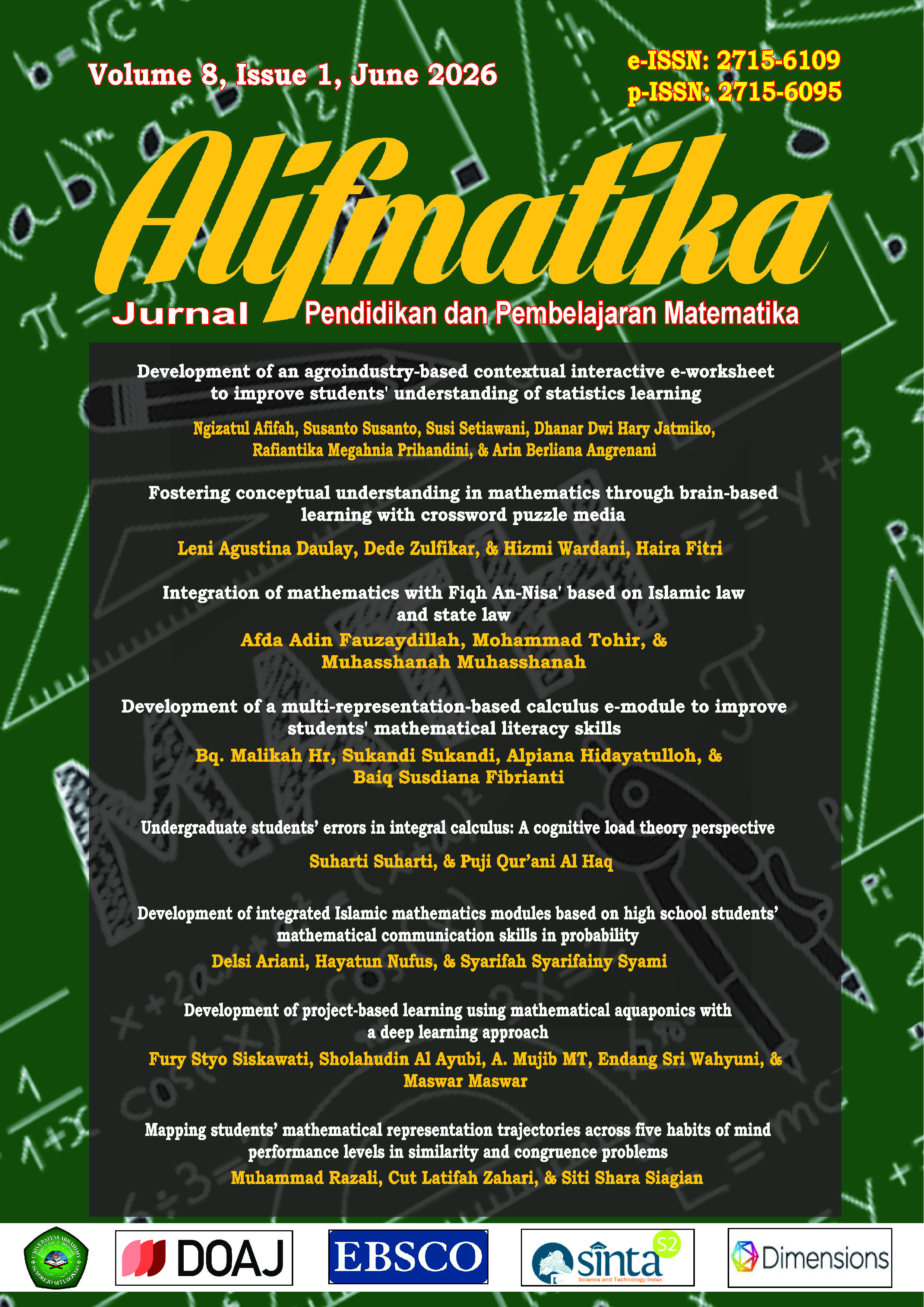
Development of integrated Islamic mathematics modules based on high school students’ mathematical communication skills in probability
DOI:
https://doi.org/10.35316/alifmatika.2026.v8i1.101-120Keywords:
Development, Islamic Integration, Islamic Knowledge, Mathematical Communication Skills, Module, ProbabilityAbstract
This study employs a research and development (R&D) methodology based on the ADDIE model, comprising the analysis, design, development, implementation, and evaluation phases. The objective is to produce a mathematics module integrated with Islamic values, grounded in high school students’ mathematical communication skills, particularly regarding probability. The module aims to be valid, practical, and effective, and to enhance students’ knowledge of Islamic studies. The study was conducted at MAN 4 Kampar during the odd semester of 2025/2026, with 10th-grade students in Class X.A and experts as subjects, and the developed module as the object of study. The research design used was a pre-experimental one-shot case study. Data were collected through questionnaires, tests, and documentation, resulting in both quantitative and qualitative data. Data analysis included the Aiken index (validity), percentage (practicality), normality test, and one-sample t-test (effectiveness and Islamic knowledge). The data analysis showed that the module was highly valid (0.87) and highly practical (81.26% for small groups and 88.69% for limited groups). The posttest results were calculated using the left-tailed t-test, yielding. Therefore, it is accepted and rejected, indicating that students' average learning outcomes have reached the mastery level. Furthermore, the results of the Islamic knowledge questionnaire were analyzed using a right-tailed t-test, yielding. Therefore, it was rejected and accepted, indicating that students' average Islamic knowledge had increased. Based on these methods, it can be concluded that the integrated mathematics module grounded in Islamic values, which focuses on high school students’ mathematical communication skills in probability, demonstrates high validity, practicality, and effectiveness in the learning process and can enhance students’ religious knowledge.
Downloads
References
Assegaf, S. (2020). Meraih prestasi belajar dengan Tahfidz Al-Qur’an tinjauan sekolah Islam di Jakarta [Achieving academic success with Tahfidz Al-Qur'an, a review of Islamic schools in Jakarta]. A-Empat.
Astuti, N. D., Hapsan, A., Herianto, Mutmainna, Warsyidah, A. A., Riskawati, Mahmud, N., Febriana, B. W., & Toron, V. B. (2024). Prinsip-prinsip pengukuran dan evaluasi pendidikan disertai dengan contoh kasus [Principles of educational measurement and evaluation accompanied by case examples]. CV. Ruang Tentor.
Ats-Tsauri, M. S., Cholily, Y. M., Azmi, R. D., & Kusgiarohmah, P. A. (2021). Modul relasi dan fungsi berbasis kemampuan komunikasi matematis [Relation and function module based on mathematical communication skills]. JNPM (Jurnal Nasional Pendidikan Matematika), 5(1), 109–124. https://doi.org/10.33603/jnpm.v5i1.3569
Baidowi, Wahidaturrahmi, Kertiyani, N. M. I., & Wulandari, N. P. (2024). Statistika dasar teori dan praktik [Basic statistics theory and practice]. Pusat Pengembangan Pendidikan dan Penelitian Indonesia.
Darto, & Afandi, M. (2022). Matematika dalam Islam [Mathematics in Islam]. PT Rajagrafindo Persada.
Diana, N., Suhendra, Turmudi, & Juandi, D. (2023). Mengembangkan media pembelajaran matematika dengan pendekatan STEM [Developing mathematics learning media with a STEM approach]. Syiah Kuala University Press.
Eryandi. (2023). Integrasi nilai-nilai keislaman dalam pendidikan karakter di era digital [Integration of Islamic values in character education in the digital era]. Kumpulan Artikel Ilmiah Pendidikan Islam, 1(1), 12–16. https://doi.org/10.62070/kaipi.v1i1.27
Famulaqih, S., & Lukman, A. (2024). Pengembangan bahan ajar modul pembelajaran [Development of learning module teaching materials]. Karakter: Jurnal Riset Ilmu Pendidikan Islam, 1(2), 1–12. https://doi.org/10.61132/karakter.v1i4.156
Fatmawati, K., Jailani, M. S., Hasanah, J., & Efendi, R. (2023). Validitas, praktikalitas, dan efektivitas modul ajar berbasis kontekstual [Validity, practicality, and effectiveness of contextual-based teaching modules]. Primary Education journal, 7(1), 20–28. https://doi.org/10.30631/pej.v7i1.112
Febriana, A., Pefbrianti, D., Ifansyah, M. N., & Lestari, D. H. (2023). Validitas dan reliabilitas instrumen kualitas hidup lansia dengan hipertensi [Validity and reliability of the quality of life instrument for elderly with hypertension]. Media Publikasi Promosi Kesehatan Indonesia, 6(7), 1401–1406. https://doi.org/10.56338/mppki.v6i7.3660
Hayatun Nufus, & Amri Darwis. (2023). Program linier terintegrasi keislaman [Integrated Islamic linear program] (1 ed.). Rajawali Pers.
Hendrina, H., Rohaeti, E. E., & Sumarno, U. (2021). Hard skills dan soft skills matematik siswa [Students' mathematical hard skills and soft skills]. PT Refika Aditama.
Hilda, L. (2021). APMOL: Media teknologi geometri molekul berbasis augmented reality dan JMOL [Augmented reality and JMOL based molecular geometry technology media]. Samudra Biru.
Joko, D., Tegor, & Silitonga, F. (2023). Metode penelitian terapan [Applied research methods]. Deepublish Digital.
Kinanti, V., & Wulantina, E. (2023). Pengembangan modul pembelajaran matematika berbasis discovery learning terintegrasi nilai-nilai keislaman [Development of a mathematics learning module based on discovery learning integrated with Islamic values]. (J-PiMat) Jurnal Pendidikan Matematika, 5(1), 635–644. https://doi.org/10.31932/j.pimat.v5i1.2280
Kosasih, E. (2021). Pengembangan bahan ajar [Development of teaching materials]. PT Bumi Aksaraa.
Kustandi, C., & Darmawan, D. (2020). Pengembangan media pembelajaran konsep & aplikasi pengembangan media pembelajaran bagi pendidik di sekolah dan masyarakat [Development of learning media concepts & applications of learning media development for educators in schools and communities]. Kencana .
Lajiba, S. B. S. (2021). Pengembangan modul matematika berbasis CTL (contextual teaching and learning) terintegrasikan nilai-nilai keislaman pada materi himpunan [Development of a CTL (contextual teaching and learning) based mathematics module integrating Islamic values into the set material]. Linear: Jurnal Ilmu Pendidikan, 5(1), 1–16. https://doi.org/10.53090/jlinear.v5i1.129
Lestari, K. E., & Yudhanegara, M. R. (2018). Penelitian pendidikan matematika: Panduan praktis menyusun skripsi, tesis, dan laporan penelitian dengan pendekatan kuantitatif, kualitatif, dan kombinasi disertai dengan model pembelajaran dan kemampuan matematis) [Mathematics education research: Practical guide to compiling undergraduate theses, dissertations, and research reports using quantitative, qualitative, and combined approaches accompanied by learning models and mathematical abilities]. PT Refika Aditama.
Liang, K. K., & Ahad, N. A. (2020). Normality for nonnormal distributions. Journal of Science and Mathematics Letters, 8(2), 51–60. https://doi.org/10.37134/jsml.vol8.2.7.2020
Lutfi, M. K., Dzulfikar, A., Juandi, D., Sari, R. N., Isharyadi, R., & Muslim, A. P. (2024). Merespon keterampilan abad 21 melalui pembelajaran matematika sekolah [Responding to 21st century skills through school mathematics learning]. Deepublish Digital.
Ma’muroh. (2021). Aktualisasi nilai-nilai pendidikan humanis dan religius di sekolah [Actualization of humanist and religious educational values in schools]. Publica Indonesia Utama.
Maha, L. N., Halimah, S., & Ananda, R. (2022). Pengembangan modul pembelajaran Al-Quran Hadits [Development of Al-Quran Hadith learning modules]. Research and Development Journal of Education, 8(1), 417–423. https://doi.org/0.30998/rdje.v8i1.13850
Maulyda, M. A. (2020). Paradigma pembelajaran matematika berbasis NCTM [NCTM-based mathematics learning paradigm]. CV IRDH.
Meiliasari, R., Alfianti, U. U. A., & Purwanti, F. (2022). Implementasi tujuan pendidikan islam dalam undang-undang nomor 20 tahun 2003 [Implementation of the objectives of Islamic education in Law Number 20 of 2003]. Jurnal Mahasiswa TARBAWI: Journal on Islamic Educaation, 6(2), 122–131. https://doi.org/10.24269/tarbawi.v6i2.1216
Muslich, M. (2020). Text book writting; dasar-dasar pemahaman penulisan dan pemakaian buku teks [Textbook writing; the basics of understanding writing and using textbooks]. Ar-Ruzz Media.
Mustaring, D. I. (2021). Buku ajar pendidikan agama Islam [Islamic religious education textbook]. Cipta Media Nusantara.
Nasional, M. P. (2006). Peraturan menteri pendidikan nasional republik indonesia [Regulation of the Minister of National Education of the Republic of Indonesia]. Pemerintah RI
Ndruru, D. (2022). Pengembangan modul peluang untuk meningkatkan hasil belajar matematika [Development of opportunity modules to improve mathematics learning outcomes]. FAGURU: Jurnal Ilmiah Mahasiswa Keguruan, 1(2), 108–118. https://doi.org/10.57094/faguru.v1i2.674
Ningtyas, Y. D. W. K. (2019). Media pembelajaran matematika dilengkapi contoh alat peraga manipulatif untuk tingkat SMP dan SMA [Mathematics learning media equipped with examples of manipulative teaching aids for junior high and high school levels]. Mahameru Press.
Nurlatifah, S. C., Hodijah, S. R. N., & Nestiadi, A. (2022). Pengembangan modul berbasis multimedia dengan menggunakan flip PDF professional pada tema udara yang sehat [Development of multimedia-based modules using professional flip PDF on the theme of healthy air]. PENDIPA Journal of Science Education, 6(1), 226–232. https://doi.org/10.33369/pendipa.6.1.226-232
Puspitaningrum, A., Abdulkarim, A., Komalasari, K., & Fitriasari, S. (2024). Bahan ajar pendidikan kewarganegaraan dalam membentuk karakter mandiri peserta didik sekolah mengah atas [Civic education teaching materials in forming the independent character of high school students]. Jurnal Moral Kemasyarakatan, 9(1), 163–174. https://doi.org/10.21067/jmk.v9i1.10316
Ritonga, F. U. (2025). Statistik sosial humaniora teori dan aplikasi menggunakan SPSS [Social statistics humanities theory and application using SPSS]. Jejak Pustaka.
Riyanto, O. R., Widyastuti, Yustitia, V., Oktaviyanthi, R., Rina, N. H. M., Izzati, N., Sukmaangara, B., Indartiningsih, D., Wibowo, A., Maharbid, B. A., & Wahid, S. (2024). Kemampuan matematis [Mathematical ability]. CV. Zenius Publisher.
Rudini, A., & Azmi, R. (2023). Metodologi penelitian bisnis dan manajemen pendekatan kuantitatif [Quantitative approach business and management research methodology]. AE Publishing.
Rustam, R., & A. Haris, Z. (2018). Buku ajar pendidikan agama islam di perguruan tinggi [Islamic religious education textbooks in higher education]. Deepublish.
Saputro, A., Wibowo, T., & Darmono Prasetyo Budi. (2025). Pengembangan modul pembelajaran matematika berbasis contextual teaching and learning (CTL) untuk meningkatkan komunikasi matematis pada siswa SMP [Development of a mathematics learning module based on contextual teaching and learning (CTL) to improve mathematical communication in junior high school students.]. Jurnal Derivat: Jurnal Matematika dan Pendidikan Matematika, 12(3). https://doi.org/10.31316/j.derivat.v12i3.4190
Saragih, L. S., Dharma, J., & Siahaan, S. D. N. (2023). Efektifitas penggunaan bahan ajar perilaku organisasi dengan 3D realist berbasis project based learning terhadap hasil belajar mahasiswa [The effectiveness of using organizational behavior teaching materials with 3D realists based on project-based learning on student learning outcomes.]. Jurnal Dimensi Pendidikan dan Pembelajaran, 11(1), 14–30. https://doi.org/10.24269/dpp.v11i1.7725
Sinaga, M. (2017). Riset kesehatan panduan praktis menyusun tugas akhir bagi mahasiswa kesehatan [Health research: a practical guide to compiling final assignments for health students]. Deepublish.
Sudirman. (2026). Pilar-pilar Islam menuju kesempurnaan sumber daya Muslim [The pillars of Islam towards the perfection of Muslim resources]. UIN-MALIKI PRESS.
Susilawati, W. O., Friska, S. Y., & Eroza, E. (2023). Pengembangan modul ajar mata pelajaran pendidikan pancasila kelas IV sekolah dasar dalam kurikulum merdeka [Development of teaching modules for Pancasila education subjects for grade IV elementary schools in the independent curriculum]. INNOVATIVE: Journal of Social Science Research, 3(2), 9142–9155.
Tanzimah, & Sutrianti, D. (2023). Analisis kesalahan siswa dalam menyelesaikan soal cerita pada materi peluang berdasarkan prosedur newman’s error analysis (NEA) [Analysis of student errors in solving story problems on probability material based on the Newman's error analysis (NEA) procedure]. Indiktika: Jurnal Inovasi Pendidikan Matematika, 5(2), 191–200. https://doi.org/10.31851/indikta.v5i2.11469
Tpoenifu, E. Y., Mamangkey, J., & Silalahi, M. (2023). Pengembangan modul keanekaragaman hayati berbasis pangan tradisional Nusa Tenggara Timur [Development of a biodiversity module based on traditional food from East Nusa Tenggara]. Bioscientist: Jurnal Ilmiah Biologi, 11(2), 1195–1207. https://doi.org/10.33394/bioscientist.v11i2.8370
Wahyudi, A. (2022). Pentingnya pengembangan bahan ajar dalam pembelajaran IPS [The importance of developing teaching materials in social studies learning]. JESS: Jurnal Education Social Science, 2(1), 51–61. https://doi.org/10.21274
Yusuf, K. M. (2022). Model integrasi sains dan Islam [Model of integration of science and Islam]. CV. Literasi Nusantara Abadi.
Zarkasyi, M. W. (2018). Penelitian Pendidikan Matematika: Panduan Praktis Menyusun Skripsi, Tesis, dan Laporan Penelitian dengan Pendekatan Kuantitatif, Kualitatif, dan Kombinasi Disertai dengan Model Pembelajaran dan Kemampuan matematis [Mathematics Education Research: A Practical Guide to Writing Theses, Dissertations, and Research Reports Using Quantitative, Qualitative, and Combined Approaches, Accompanied by Learning Models and Mathematical Abilities]. PT Refika Aditama.
Downloads
Published
How to Cite
Issue
Section
License
Copyright (c) 2026 Alifmatika: Jurnal Pendidikan dan Pembelajaran Matematika

This work is licensed under a Creative Commons Attribution-ShareAlike 4.0 International License.
COPYRIGHT NOTICE
Author (s) who publish in Alifmatika: Jurnal Pendidikan dan Pembelajaran Matematika agree to the following terms:
- The Author (s) submitting a manuscript do so on the understanding that if accepted for publication, copyright of the article shall be assigned to Alifmatika: Jurnal Pendidikan dan Pembelajaran Matematika, Tarbiyah Faculty of Ibrahimy University as the publisher of the journal. Consecutively, author(s) still retain some rights to use and share their own published articles without written permission from Alifmatika: Jurnal Pendidikan dan Pembelajaran Matematika. This work is licensed under a Creative Commons Attribution-ShareAlike 4.0 International License.
- Copyright encompasses rights to publish and provide the manuscripts in all forms and media for the purpose of publication and dissemination, and the authority to enforce the rights in the manuscript, for example in the case of plagiarism or in copyright infringement.
- Alifmatika: Jurnal Pendidikan dan Pembelajaran Matematika and the Editors make every effort to ensure that no wrong or misleading data, opinions or statements be published in the journal. In any way, the contents of the articles and advertisements published in Alifmatika: Jurnal Pendidikan dan Pembelajaran Matematika are the sole responsibility of their respective authors and advertisers.
- The Copyright Transfer Form can be downloaded here [Copyright Transfer Form Alifmatika]. The copyright form should be signed originally and send to the Editorial Office in the form of original mail, scanned document to alifmatika[at]ibrahimy.ac.id or upload the scanned document in the comments column when sending the manuscript.












_by_Matematohir.jpg)