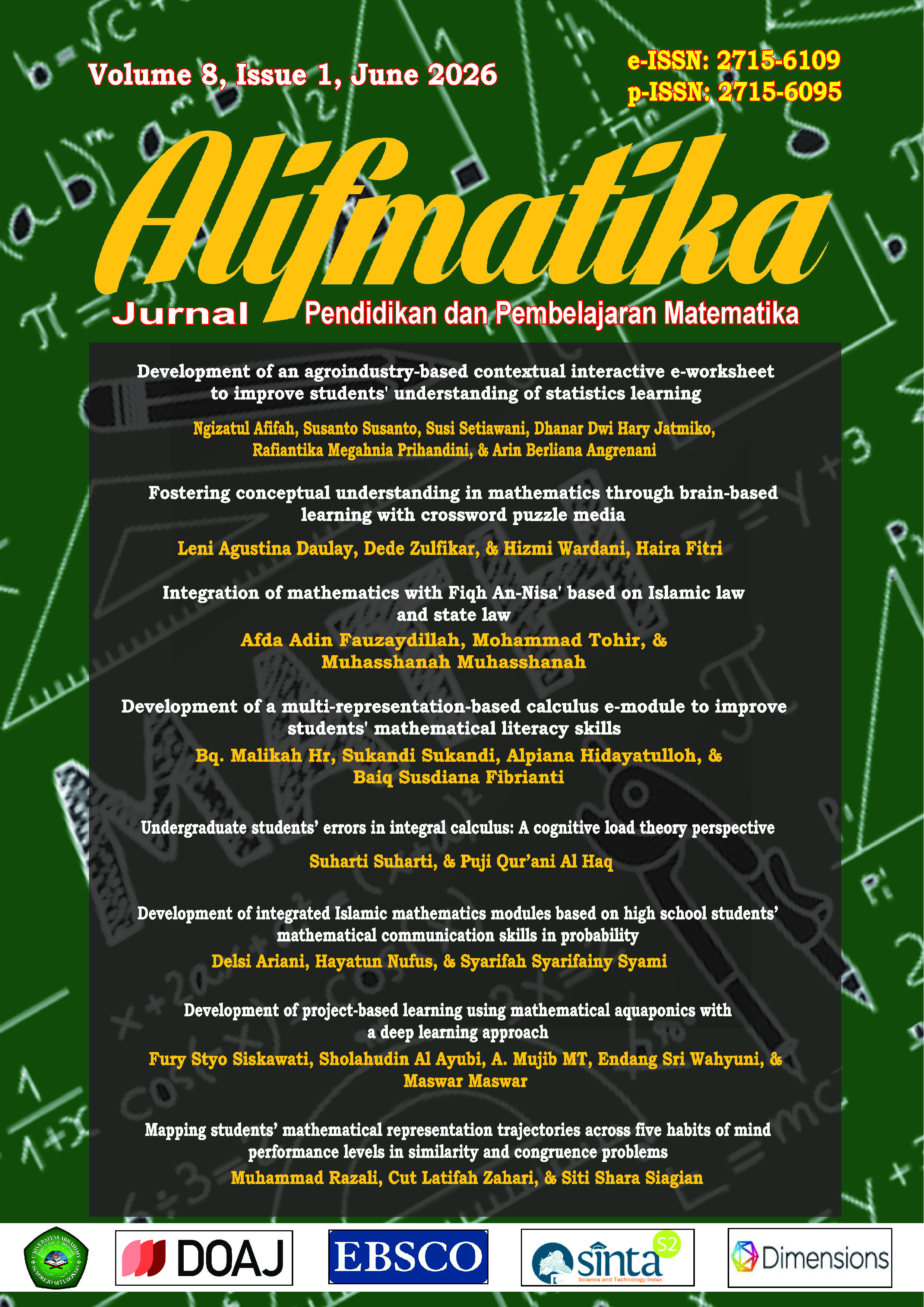
Fostering conceptual understanding in mathematics through brain-based learning with crossword puzzle media
DOI:
https://doi.org/10.35316/alifmatika.2026.v8i1.28-37Keywords:
Brain-Based Learning, Crossword Puzzles, Conceptual UnderstandingAbstract
This study aimed to foster seventh-grade students' conceptual understanding in mathematics, particularly in algebra, through the Brain-Based Learning (BBL) model supported by crossword puzzle media. Conceptual understanding is essential for mastering higher-level mathematics, highlighting the need for effective instructional strategies. A quasi-experimental design with a nonequivalent control group was employed, involving two classes randomly selected from the 2024/2025 seventh-grade population using a spin wheel application. Students' conceptual understanding was assessed via essay tests and analyzed using Welch's t-test on normalized gain (N-Gain) scores. The experimental group achieved a significantly higher mean N-Gain (M = 0.66) compared to the control group (M = 0.41) at the 0.05 significance level. The findings reveal a clear and meaningful difference between the groups, backed by strong statistical evidence t(33.731) = −4.324, p < 0.001, Cohen's d = 1.31), indicating that Brain-Based Learning with crossword puzzle media significantly enhanced students' conceptual understanding compared to conventional instruction. However, the study is limited by a small sample from a single school and the exclusion of specialized classes, which may affect generalizability. These findings suggest that integrating Brain-Based Learning with interactive media can effectively foster deeper mathematical understanding.
Downloads
References
Adiansha, A. A., Sani, K., Sudarwo, R., Nasution, N., & Mulyadi, M. (2021). Brain-based learning: How does mathematics creativity develop in elementary school students? Premiere Educandum : Jurnal Pendidikan Dasar Dan Pembelajaran, 11(2), 191–202. https://doi.org/10.25273/pe.v11i2.8950
Amjad, A. I., Habib, M., & Saeed, M. (2022). Effect of brain-based learning on students' mathematics. Pakistan Journal of Social Research, 4(3), 38–51.
Asfar, N. U., Permana, D., Fauzan, A., & Yarman, Y. (2022). Improving students mathematical critical thinking ability with learning modules using brain-based learning models. Numerical: Jurnal Matematika Dan Pendidikan Matematika, 6, 91–100. https://doi.org/10.25217/numerical.v6i1.2415
Buch, E. R., Claudino, L., Quentin, R., Bönstrup, M., & Cohen, L. G. (2021). Consolidation of human skill linked to waking hippocampo-neocortical replay. Cell Reports, 35(10). https://doi.org/10.1016/j.celrep.2021.109193
Caine, R. N., & Caine, G. (2019). Making connections: Teaching and the human brain. In Journal of Arts and Humanities (Vol. 3, Number 218).
Carr, M. F., Jadhav, S. P., & Frank, L. M. (2011). Substrate of memory consolidation and retrieval. Nature Neuroscience, 14(2), 147–153. https://doi.org/10.1038/nn.2732.Hippocampal
Cholily, Y. M., Darmayanti, R., Lovat, T., Choirudin, C., Usmiyatun, U., & Muhammad, I. (2023). Si-GEMAS: Serious game mathematical crossword puzzle learning media for students critical thinking ability. Al-Jabar : Jurnal Pendidikan Matematika, 14(1), 165–179. https://doi.org/10.24042/ajpm.v14i1.16113
Creswell, J. W., & Creswell, J. D. (2018). Research design qualitative, quantitative, and mixed methods approaches. In SAGE Publications India Pvt. Ltd. https://doi.org/10.4324/9780429469237
Freeman, G. G., & Wash, P. D. (2013). You can lead students to the classroom, and you can make them think: Ten brain-based strategies for college teaching and learning success. Journal on Excellence in College Teaching, 24(January), 99–120. http://search.ebscohost.com/login.aspx?direct=true&AuthType=ip,url,cookie,uid&db=ehh&AN=90316252&site=ehost-live
Funa, A. A., Ricafort, J. D., Jetomo, F. G. J., & Lasala, Jr., N. L. (2024). Effectiveness of brain-based learning toward improving students' conceptual understanding: A meta-analysis. International Journal of Instruction, 17(1), 361–380. https://doi.org/10.29333/iji.2024.17119a
Hidayat, R., & Iksan, Z. H. (2015). The effect of realistic mathematic education on students' conceptual understanding of linear progamming. Creative Education, 06(22), 2438–2445. https://doi.org/10.4236/ce.2015.622251
Jensen, E. P. (2008). A fresh look at brain-based education. Phi Delta Kappan, 89(6), 408–417. https://doi.org/10.1177/003172170808900605
Karpicke, J. D., & Roediger, H. L. (2008). The critical importance of retrieval for learning. Science, 319(5865), 966–968. https://doi.org/10.1126/science.1152408
Khaedar, M., & Alam, S. (2023). The effect of using crossword puzzle model on learning interest in indonesian learning based on students' literacy. Jurnal Pendidikan Dan Pengajaran, 56(1), 160–171. https://doi.org/10.23887/jpp.v56i1.52533
Killpatrick, J., Swafford, J., & Findell, B. (2010). Adding it up: Helping children learn mathematics. In Washington, DC: National Academy Press (Number October).
Made Suarsana, I., Widiasih, N. P. S., & Nengah Suparta, I. (2018). The effect of brain based learning on second grade junior students' mathematics conceptual understanding on polyhedron. Journal on Mathematics Education, 9(1), 145–155. https://doi.org/10.22342/jme.9.1.5005.145-156
Mullis, I. V. S., Martin, M. O., & Arora, A. (2011). TIMSS 2011 international results in mathematics. In TIMSS & PIRLS International Study Center (Vol. 2011, Number 136). http://www.pubmedcentral.nih.gov/articlerender.fcgi?artid=3295935&tool=pmcentrez&rendertype=abstract
OECD. (2019). PISA 2018 results (volume I): What students know and can do. In OECD Publishing: I. https://www.oecd.org/pisa/publications/pisa-2018-results-volume-iii-acd78851-en.htm
Pillai, J. A., Hall, C. B., Dickson, D. W., Buschke, H., Lipton, R. B., & Verghese, J. (2011). Association of crossword puzzle participation with memory decline in persons who develop dementia. Journal of the International Neuropsychological Society : JINS, 17(6), 1006–1013. https://doi.org/10.1017/S1355617711001111
Sugiyono. (2020). Metodologi Penelitian Kuantitatif, Kualitatif dan R & D.
Susanti, V. D., Adamura, F., Lusiana, R., & Andari, T. (2019). Development of learning devices: Brain-based learning and mathematics critical thinking. Journal of Physics: Conference Series, 1254(1). https://doi.org/10.1088/1742-6596/1254/1/012082
Sweller, J. (2011). Cognitive load theory. Psychology of Learning and Motivation, 55, 37–76. https://doi.org/https://doi.org/10.1016/B978-0-12-387691-1.00002-8
Syafmen, W., & Indri, S. (2023). Development of m-learning media illustrated crossword puzzles to increase learning motivation for middle school students. Journal of Educational Science and Technology (EST), 9(2), 111. https://doi.org/10.26858/est.v9i2.44064
Torres, E. R., Williams, P. R., Kassahun-Yimer, W., & Gordy, X. Z. (2022). Crossword puzzles and knowledge retention. Journal of Effective Teaching in Higher Education, 5(1), 18–29. https://doi.org/10.36021/jethe.v5i1.244
Triana, M., Zubainur, C. M., & Bahrun, B. (2019). Students' mathematical communication ability through the brain-based learning approach using autograph. JRAMathEdu (Journal of Research and Advances in Mathematics Education), 4(1), 1–10. https://doi.org/10.23917/jramathedu.v4i1.6972
Wiantara, I. G. N. O., Astawan, I. G., & Renda, N. T. (2020). Brain based learning using media crossword puzzle enhances students understanding of concepts and thinking skills. Jurnal Pendidikan Dan Pengajaran, 53(2), 156. https://doi.org/10.23887/jpp.v53i2.25120
Yulian, V. N., & Hayati, N. (2019). Enhancing students' mathematical connection by brain based learning model. Journal of Physics: Conference Series, 1315(1). https://doi.org/10.1088/1742-6596/1315/1/012029
Downloads
Published
How to Cite
Issue
Section
License
Copyright (c) 2026 Alifmatika: Jurnal Pendidikan dan Pembelajaran Matematika

This work is licensed under a Creative Commons Attribution-ShareAlike 4.0 International License.
COPYRIGHT NOTICE
Author (s) who publish in Alifmatika: Jurnal Pendidikan dan Pembelajaran Matematika agree to the following terms:
- The Author (s) submitting a manuscript do so on the understanding that if accepted for publication, copyright of the article shall be assigned to Alifmatika: Jurnal Pendidikan dan Pembelajaran Matematika, Tarbiyah Faculty of Ibrahimy University as the publisher of the journal. Consecutively, author(s) still retain some rights to use and share their own published articles without written permission from Alifmatika: Jurnal Pendidikan dan Pembelajaran Matematika. This work is licensed under a Creative Commons Attribution-ShareAlike 4.0 International License.
- Copyright encompasses rights to publish and provide the manuscripts in all forms and media for the purpose of publication and dissemination, and the authority to enforce the rights in the manuscript, for example in the case of plagiarism or in copyright infringement.
- Alifmatika: Jurnal Pendidikan dan Pembelajaran Matematika and the Editors make every effort to ensure that no wrong or misleading data, opinions or statements be published in the journal. In any way, the contents of the articles and advertisements published in Alifmatika: Jurnal Pendidikan dan Pembelajaran Matematika are the sole responsibility of their respective authors and advertisers.
- The Copyright Transfer Form can be downloaded here [Copyright Transfer Form Alifmatika]. The copyright form should be signed originally and send to the Editorial Office in the form of original mail, scanned document to alifmatika[at]ibrahimy.ac.id or upload the scanned document in the comments column when sending the manuscript.















_by_Matematohir.jpg)