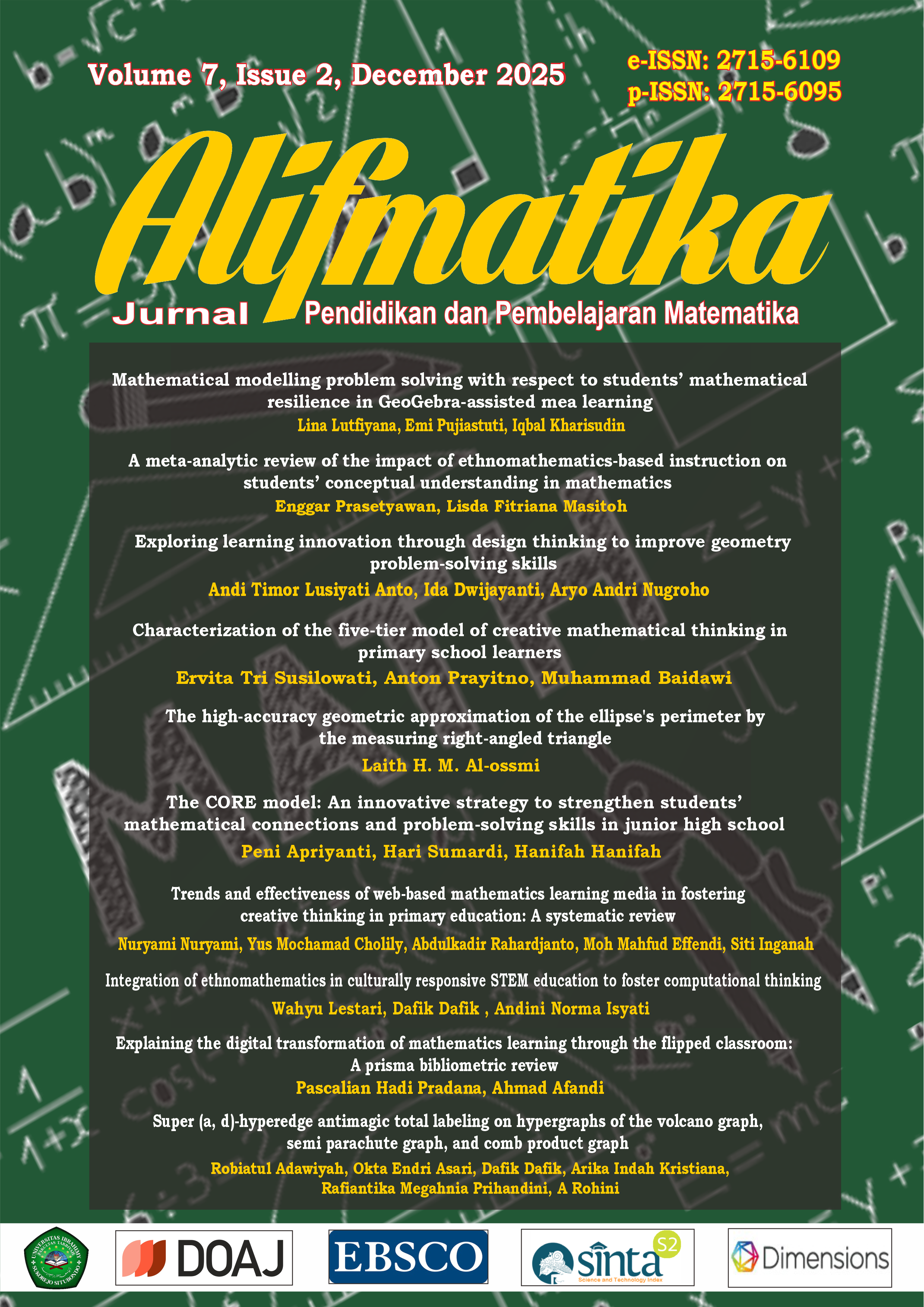
Trends and effectiveness of web-based mathematics learning media in fostering creative thinking in primary education: A systematic review
DOI:
https://doi.org/10.35316/alifmatika.2025.v7i2.345-360Keywords:
Creative Thinking, Elementary School, Mathematics Learning, Systematic Literature Review, Web-Based Learning MediaAbstract
This study evaluates the trends and effectiveness of web-based learning media in fostering creative thinking in elementary mathematics education through a Systematic Literature Review (SLR). Data were collected from Scopus and screened using clearly defined inclusion and exclusion criteria based on population, intervention type, study design, and creativity-related outcomes. Of the 36 identified documents, 7 met all criteria and were analyzed. The findings indicate a substantial increase in the use of web-based mathematics media over the last five years, driven by digital transformation and the demand for interactive learning environments. Web-based media were shown to enhance creative thinking through simulations, dynamic visualisations, and contextual problem-solving tasks. However, effectiveness depends on media design, pedagogical strategies, digital infrastructure, and teacher readiness. This review highlights the need for developing creativity-oriented web-based mathematics media that directly support higher-order thinking.
Downloads
References
Ahmar, D. S., Rahmawati, S., Ahmar, A. S., Azzajjad, M. F., Manalu, Y. F., & Anisa, N. (2024). Digital learning innovation: mentoring to improving access to education through ICT and website-based media. Mattawang: Jurnal Pengabdian Masyarakat, 5(3), 121–129. https://doi.org/10.35877/454RI.mattawang3111
Astuti, L., Wihardi, Y., & Rochintaniawati, D. (2020). The development of web-based learning using interactive media for science learning on levers in human body topic. Journal of Science Learning, 3(2), 89–98.
Bettany-Saltikov, J., & McSherry, R. (2024). How to do a Systematic Literature Review in Nursing: A Step-by-Step Guide, 3/e.
Eriksen, M. B., & Frandsen, T. F. (2018). The impact of patient, intervention, comparison, outcome (PICO) as a search strategy tool on literature search quality: a systematic review. Journal of the Medical Library Association: JMLA, 106(4), 420.
Firdaus, F. M., Yuliana, L., Prasojo, L. D., Akalili, A., Wibowo, S., & Maulyda, M. A. (2024). Enhancing Mathematics Quality of Instruction (MQI) Competency in Pre-Service Teachers through Digital Flipbooks: Digital Didactics Design. International Journal of Information and Education Technology, 14(12), 1770–1778. https://doi.org/10.18178/ijiet.2024.14.12.2208
Foti, C., Anttila, D., Maniscalco, S., & Chiofalo, M. L. (2021). Quantum physics literacy aimed at k12 and the general public. Universe, 7(4). https://doi.org/10.3390/universe7040086
Haleem, A., Javaid, M., Qadri, M. A., & Suman, R. (2022). Understanding the role of digital technologies in education: A review. Sustainable Operations and Computers, 3, 275–285. https://doi.org/10.1016/j.susoc.2022.05.004
Halimatusyadiah, H., & Disman, D. (2023). The Benefits of Interactive Media Websites Through Google Sites on Learning Outcomes of Elementary School Students. Jurnal Lingua Idea, 14(1), 92. https://doi.org/10.20884/1.jli.2023.14.1.8305
Hrybiuk, O. (2019). Improvement of the educational process by the creation of centers for intellectual development and scientific and technical creativity. Cham: Springer International Publishing. In International Scientific-Technical Conference MANUFACTURING, 2(4), 370–382.. https://doi.org/10.1007/978-3-030-18789-7_31
Huang, R. H., Liu, D. J., Guo, J., Yang, J. F., Zhao, J. H., Wei, X. F., Knyazeva, S., Li, M., Zhuang, R. X., & Looi, C. K. (2020). Guidance on flexible learning during campus closures: Ensuring course quality of higher education in COVID-19 outbreak. Beijing: Smart Learning Institute of Beijing Normal University.
Hudson, B., Henderson, S., & Hudson, A. (2015). Developing mathematical thinking in the primary classroom: liberating students and teachers as learners of mathematics. Journal of Curriculum Studies, 47(3), 374–398. https://doi.org/10.1080/00220272.2014.979233
Khalid, M., Saad, S., Hamid, S. R. A., Abdullah, M. R., Ibrahim, H., & Shahrill, M. (2020). Enhancing creativity and problem solving skills through creative problem solving in teaching mathematics. Creativity Studies, 13(2), 270–291. https://doi.org/10.3846/cs.2020.11027
Moch. Sukardjo, & Sugiyanta, L. (2018). Measurement of usability for multimedia interactive learning based on website in mathematics for SMK. IOP Conference Series: Materials Science and Engineering, 336, 012032. https://doi.org/10.1088/1757-899X/336/1/012032
Novi Prayekti, N. (2020). Development of web-based differential equation learning media. International Journal of Innovative Science and Research TechnologyInternational Journal of Innovative Science and Research Technology, 5(9), 1312–1316. https://ijisrt.com/development-of-webbased-differential-equation-learning-media
Parums, D. V. (2021). Review articles, systematic reviews, meta-analysis, and the updated preferred reporting items for systematic reviews and meta-analyses (PRISMA) 2020 guidelines. Medical Science Monitor: International Medical Journal of Experimental and Clinical Research, 27, e934475-1. https://doi.org/10.12659/msm.934475
Pertiwi, N. P., Saputro, S., Yamtinah, S., & Kamari, A. (2024). Enhancing critical thinking skills through STEM problem-based contextual learning: an integrated e-module education website with virtual experiments. Journal of Baltic Science Education, 23(4), 739–766. https://doi.org/10.33225/jbse/24.23.739
Phonnong, I., & Keeratichamroen, W. (2023). Perspectives on STEAM education during the COVID-19 pandemic at an underprivileged elementary school in Thailand. International Journal of Science, Mathematics and Technology Learning, 30(2), 15–32. https://doi.org/10.18848/2327-7971/CGP/v30i02/15-32
Rusmin, L., Misrahayu, Y., Pongpalilu, F., Radiansyah, R., & Dwiyanto, D. (2024). Critical thinking and problem-solving skills in the 21st century. Join: Journal of Social Science, 1(5), 144–162. https://doi.org/10.59613/svhy3576
Sauer, P. C., & Seuring, S. (2023). How to conduct systematic literature reviews in management research: a guide in 6 steps and 14 decisions. Review of Managerial Science, 17(5), 1899–1933. https://doi.org/10.1007/s11846-023-00668-3
Schoevers, E. M., Leseman, P. P. M., Slot, E. M., Bakker, A., Keijzer, R., & Kroesbergen, E. H. (2019). Promoting pupils’ creative thinking in primary school mathematics: A case study. Thinking Skills and Creativity, 31(3), 323–334. https://doi.org/10.1016/j.tsc.2019.02.003
Simanjuntak, M. P., Hutahaean, J., Marpaung, N., & Ramadhani, D. (2021). Effectiveness of problem-based learning combined with computer simulation on students’ problem-solving and creative thinking skills. International Journal of Instruction, 14(3), 519–534. https://doi.org/10.29333/iji.2021.14330a
Soomro, S. A., Casakin, H., Nanjappan, V., & Georgiev, G. V. (2023). Makerspaces fostering creativity: A systematic literature review. Journal of Science Education and Technology, 32(4), 530–548. https://doi.org/10.1007/s10956-023-10041-4
Susanto, H. A., & Nugrahaningsih, T. K. (2021). Developing a handbook on multimedia integration in mathematics teaching for indonesian primary school students. International Journal of Education in Mathematics, Science and Technology, 9(2), 236–251. https://doi.org/10.46328/IJEMST.1550
Thornhill-Miller, B., Camarda, A., Mercier, M., Burkhardt, J.-M., Morisseau, T., Bourgeois-Bougrine, S., Vinchon, F., El Hayek, S., Augereau-Landais, M., & Mourey, F. (2023). Creativity, critical thinking, communication, and collaboration: assessment, certification, and promotion of 21st century skills for the future of work and education. Journal of Intelligence, 11(3), 1-32. https://doi.org/10.3390/jintelligence11030054
Umam, K., Susandi, A. D., Irfan, M., Awang, M. lsha Bin, Susanti, E. N., & Supandi. (2025). Mathematical creative thinking skills: Using APOS theory to identify student errors in solving contextual problems. Humanities, Arts and Social Sciences Studies. https://doi.org/10.69598/hasss.25.1.269211
Yayuk, E., & As’ ari, A. R. (2020). Primary school students’ creative thinking skills in mathematics problem solving. European Journal of Educational Research, 9(3), 1281–1295. https://doi.org/10.12973/eu-jer.9.3.1281
Zainil, M., Kenedi, A. K., Indrawati, T., & Handrianto, C. (2024). The influence of STEM-based digital learning on 6c skills of elementary school students. Open Education Studies, 6(1). https://doi.org/10.1515/edu-2024-0039
Downloads
Published
How to Cite
Issue
Section
License
Copyright (c) 2025 Alifmatika: Jurnal Pendidikan dan Pembelajaran Matematika

This work is licensed under a Creative Commons Attribution-ShareAlike 4.0 International License.
COPYRIGHT NOTICE
Author (s) who publish in Alifmatika: Jurnal Pendidikan dan Pembelajaran Matematika agree to the following terms:
- The Author (s) submitting a manuscript do so on the understanding that if accepted for publication, copyright of the article shall be assigned to Alifmatika: Jurnal Pendidikan dan Pembelajaran Matematika, Tarbiyah Faculty of Ibrahimy University as the publisher of the journal. Consecutively, author(s) still retain some rights to use and share their own published articles without written permission from Alifmatika: Jurnal Pendidikan dan Pembelajaran Matematika. This work is licensed under a Creative Commons Attribution-ShareAlike 4.0 International License.
- Copyright encompasses rights to publish and provide the manuscripts in all forms and media for the purpose of publication and dissemination, and the authority to enforce the rights in the manuscript, for example in the case of plagiarism or in copyright infringement.
- Alifmatika: Jurnal Pendidikan dan Pembelajaran Matematika and the Editors make every effort to ensure that no wrong or misleading data, opinions or statements be published in the journal. In any way, the contents of the articles and advertisements published in Alifmatika: Jurnal Pendidikan dan Pembelajaran Matematika are the sole responsibility of their respective authors and advertisers.
- The Copyright Transfer Form can be downloaded here [Copyright Transfer Form Alifmatika]. The copyright form should be signed originally and send to the Editorial Office in the form of original mail, scanned document to alifmatika[at]ibrahimy.ac.id or upload the scanned document in the comments column when sending the manuscript.














_by_Matematohir.jpg)