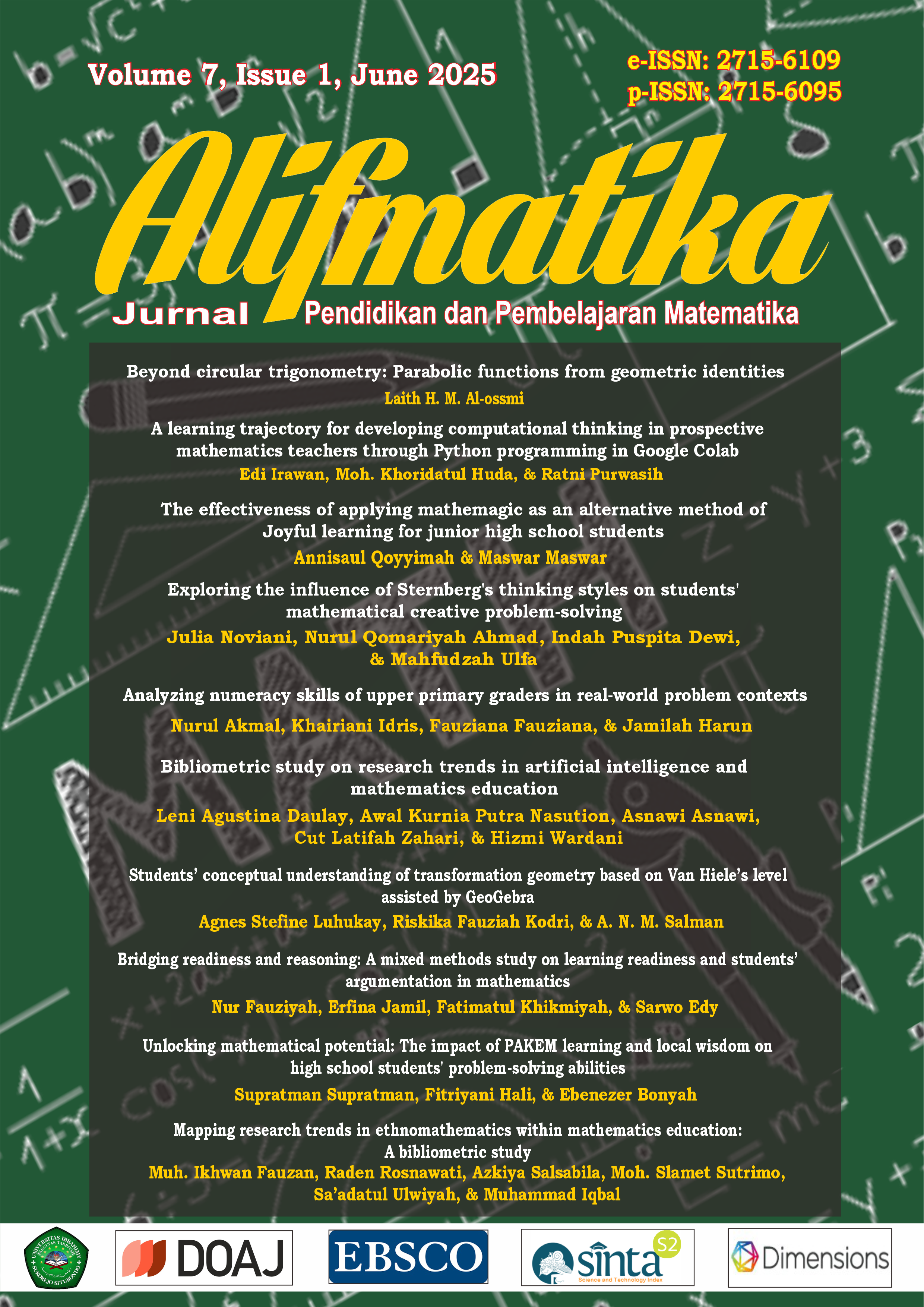
Analyzing numeracy skills of upper primary graders in real-world problem contexts
DOI:
https://doi.org/10.35316/alifmatika.2025.v7i1.108-123Keywords:
Math for Elementary, Numeracy Skill, Upper Primary GradersAbstract
Numeracy skill is a critical skill for elementary school students, enabling them to apply mathematical concepts in everyday contexts and make informed decisions. This study investigates the numeracy skills of 55 fifth-grade students from Lhokseumawe City, Aceh Province. The students’ numeracy skills were measured across three key indicators: counting, numerical relations, and arithmetic operations. A descriptive quantitative approach was used to assess students' abilities. The results indicated that while students performed well in basic counting and arithmetic tasks, they struggled with tasks involving numerical relations and distinguishing quantities. The highest performance was observed in "counting an object verbally" (73%), while the lowest average score was in "distinguishing the quantity of an object" (41%). The study emphasizes the importance of integrating real-life scenarios into math instruction to improve numeracy skills. It also highlights the need for teacher training, scaffolded learning strategies, and the incorporation of higher-order thinking skills (HOTS) in the curriculum. The findings offer valuable insights for educators and policymakers aiming to enhance numeracy skills in elementary education, with implications for both academic performance and practical application.
Downloads
References
Almarashdi, H. S., & Jarrah, A. M. (2023). Assessing tenth-grade students’ mathematical literacy skills in solving PISA problems. Social Sciences, 12(1). https://doi.org/10.3390/socsci12010033
Asmara, S. D., & Purnomo, Y. W. (2023). Context of data and uncertainty: One of the challenges for numeracy provision in elementary school teacher education. Acta Scientiae, 25(6), 235–271. https://doi.org/10.17648/acta.scientiae.7276
Azizah, A. R., Studi, P., Guru, P., Dasar, S., & Keguruan, F. (2024). Project-based learning strategies to optimize the intellectual intelligence of elementary school students. Jurnal Elementaria Edukasia, 7(4), 3367–3376. https://doi.org/10.31949/jee.v7i4.11539
Azizah, D., & Fadlikah, V. (2023). Analysis of mathematical problem-solving ability in view of mathematical disposition. Mathline : Jurnal Matematika dan Pendidikan Matematika, 8(1), 153–169. https://doi.org/10.31943/mathline.v8i1.298
Burrill, G. (2022). Statistical literacy and quantitative reasoning: rethinking the curriculum. In: New skills in the changing world of statistics education: Proceedings of the roundtable conference of the International Association for Statistical Education (IASE), Held online. https://doi.org/10.52041/srap.20104
Cam, T. C., Tien, D. N., & Anh, T. (2020). A role of consumer and financial literacy context in numeracy education for junior high school students. Journal of Science, Educational Science. https://doi.org/10.18173/2354-1075.2020-0122
Chang, I. (2023). Early numeracy and literacy skills and their influences on fourth-grade mathematics achievement: a moderated mediation model. Large-Scale Assessments in Education, 11(1). https://doi.org/10.1186/s40536-023-00168-6
Creswell, J. W. (2015). Penelitian Kualitatif & Desain Rise. Pustaka Pelajar.
de Carvalho, A. L., Durksen, T. L., & Beswick, K. (2023). Developing collective teacher efficacy in mathematics through professional learning. Theory into Practice, 62(3), 279–292. https://doi.org/10.1080/00405841.2023.2226553
Dix, A. (2021). Qualitative–quantitative reasoning: thinking informally about formal things. Springer International Publishing, 12819(1),18-35. https://doi.org/10.1007/978-3-030-85315-0_2
Ekowati, D. W., Astuti, Y. P., Utami, I. W. P., Mukhlishina, I., & Suwandayani, B. I. (2019). Literasi numerasi di SD Muhammadiyah. ELSE (Elementary School Education Journal): Jurnal Pendidikan Dan Pembelajaran Sekolah Dasar, 3(4), 93–103. https://doi.org/10.30651/else.v3i1.2541
Ellen, P. (2020). Innumeracy in the wild: Misunderstanding and misusing numbers. Oxford University Press.
Fawziawati, D. (2022). Numerical literacy approach in mathematics education in junior high school. Research and Development Journal of Education, 8(2), 525. https://doi.org/10.30998/rdje.v8i2.13266
Gal, I., Grotlüschen, A., Tout, D., & Kaiser, G. (2020). Numeracy, adult education, and vulnerable adults: a critical view of a neglected field. ZDM - Mathematics Education, 52(3), 377–394. https://doi.org/10.1007/s11858-020-01155-9
Girard, C., Bastelica, T., Léone, J., Epinat-Duclos, J., Longo, L., & Prado, J. (2021). The relation between home numeracy practices and a variety of math skills in elementary school children. PLoS ONE, 16(9 September), 1–25. https://doi.org/10.1371/journal.pone.0255400
Goos, M., & O’Sullivan, K. (2023). The evolution and uptake of numeracy and mathematical literacy as drivers for curriculum reform. In New ICMI Study Series: Vol. Part F776. https://doi.org/Https://Doi.Org/10.1007/978-3-031-13548-4_21
Gradini, E., & Firmansyah, F. (2020). Measuring Students’ Mathematical Literacy in Culturally Responsive Mathematics Classroom. Al-Ta Lim Journal, 26(3), 233–242. https://doi.org/10.15548/jt.v26i3.551
Hamidi, F., Soleymani, S., Dazy, S., & Meshkat, M. (2024). Teaching mathematics based on integrating reading strategies and working memory in elementary school. Athens Journal of Education, 11(1), 9–22. https://doi.org/10.30958/aje.11-1-1
Jones, D. A. (2023). A review and critical analysis of qualitative methodologies and data-collection techniques used for code-switching research. American Journal of Qualitative Research, 7(2), 53–72. https://doi.org/10.29333/ajqr/12988
Mahmud, M. R., & Pratiwi, I. M. (2019). Literasi numerasi siswa dalam pemecahan masalah tidak terstruktur [Students' numeracy literacy in unstructured problem solving]. Kalamatika Jurnal Pendidikan Matematika, 4(1), 69–88. https://doi.org/10.22236/kalamatika.vol4no1.2019pp69-88
Milutinović, V. (2020). Examining the digital competencies of pre-service teachers. Professional Competences For Teaching In The 21st Century, 373–391. https://doi.org/10.46793/pctja.19.373m
Mmasa, M., & Anney, V. N. (2016). Exploring literacy and numeracy teaching in Tanzanian classrooms: Insights from teachers’ classroom practices. European Journal of Educational Studies, 7(9), 18. https://files.eric.ed.gov/fulltext/EJ1095841.pdf
Perdana, R., & Suswandari, M. (2021). Numerical literacy in thematic learning for upper-grade elementary school students. Absis: Mathematics Education Journal, 3(1), 9–15.
Reyna, V., & Brainerd, C. (2023). Numeracy, gist, literal thinking, and the value of nothing in decision making. Nature Reviews Psychology, 421–439. https://doi.org/https://doi.org/10.1038/s44159-023-00188-7
Ridwan, M., Misbahudholam AR, M., Budiyono, F., & Tri Sukitman. (2023). Improve the numeracy skills of fifth-grade students through self-efficacy in elementary schools. Jurnal Ilmiah Sekolah Dasar, 7(3), 526–535. https://doi.org/10.23887/jisd.v7i3.58660
Runtu, P. V. J., Pulukadang, R. J., Mangelep, N. O., Sulistyaningsih, M., & Sambuaga, O. T. (2023). Student’s mathematical literacy: a study from the perspective of ethnomathematics context in north sulawesi indonesia. Journal of Higher Education Theory and Practice, 23(3), 57–65. https://doi.org/10.33423/jhetp.v23i3.5840
Rusdi, Fauzan, A., Arnawa, I. M., & Lufri. (2020). Designing mathematics learning models based on realistic mathematics education and literacy. Journal of Physics: Conference Series, 1471(1). https://doi.org/10.1088/1742-6596/1471/1/012055
Saputri, J. A., Sari, R. K., Barroso, U., & Mark, E. (2023). Analysis of children’s numeracy skills in the village pagar dewa kaur with math approach realistic. International Journal of Educational Narratives, 1(4), 164–169. https://doi.org/10.55849/ijen.v1i4.382
Satrio Ardiansyah, A., Permata Octalia, R., Siswandari, H., Rizal, N., & Fadiarahma Vistara, M. (2024). Students’ perspectives on innovation of mathematics learning online course on their ability to develop innovative textbooks. KnE Social Sciences, 2024, 519–530. https://doi.org/10.18502/kss.v9i8.15610
Sobkow, A., Olszewska, A., & Traczyk, J. (2020). Multiple numeric competencies predict decision outcomes beyond fluid intelligence and cognitive reflection. Intelligence, 80(September 2019), 101452. https://doi.org/10.1016/j.intell.2020.101452
Vessonen, T., Widlund, A., Hakkarainen, A., & Aunio, P. (2023). Validating the early numeracy teacher rating scale for preschoolers (TRS–EN). European Early Childhood Education Research Journal, 31(2), 205–224. https://doi.org/10.1080/1350293X.2022.2081350
Wallace, E., Wang, Y., Li, S., Singh, S., & Gardner, M. (2019). Do NLP models know numbers? Probing numeracy in embeddings. EMNLP-IJCNLP 2019 - 2019 Conference on Empirical Methods in Natural Language Processing and 9th International Joint Conference on Natural Language Processing, Proceedings of the Conference, Section 2, 5307–5315. https://doi.org/10.18653/v1/d19-1534
Yuliawanti, E., Suciati, S., & Ariyanto, J. (2019). Pengaruh model problem based learning dengan scaffolding learning activities terhadap kemampuan memecahkan masalah siswa [The influence of the problem based learning model with scaffolding learning activities on students' problem solving abilities]. Bio-Pedagogi, 8(1), 23. https://doi.org/10.20961/bio-pedagogi.v8i1.35547
Yustitia, V., Siswono, T. Y. E., & Abadi. (2021). Numeracy of prospective elementary school teachers: A case study. Journal of Physics: Conference Series, 1918(4). https://doi.org/10.1088/1742-6596/1918/4/042077
Downloads
Published
How to Cite
Issue
Section
License
Copyright (c) 2025 Alifmatika: Jurnal Pendidikan dan Pembelajaran Matematika

This work is licensed under a Creative Commons Attribution-ShareAlike 4.0 International License.
COPYRIGHT NOTICE
Author (s) who publish in Alifmatika: Jurnal Pendidikan dan Pembelajaran Matematika agree to the following terms:
- The Author (s) submitting a manuscript do so on the understanding that if accepted for publication, copyright of the article shall be assigned to Alifmatika: Jurnal Pendidikan dan Pembelajaran Matematika, Tarbiyah Faculty of Ibrahimy University as the publisher of the journal. Consecutively, author(s) still retain some rights to use and share their own published articles without written permission from Alifmatika: Jurnal Pendidikan dan Pembelajaran Matematika. This work is licensed under a Creative Commons Attribution-ShareAlike 4.0 International License.
- Copyright encompasses rights to publish and provide the manuscripts in all forms and media for the purpose of publication and dissemination, and the authority to enforce the rights in the manuscript, for example in the case of plagiarism or in copyright infringement.
- Alifmatika: Jurnal Pendidikan dan Pembelajaran Matematika and the Editors make every effort to ensure that no wrong or misleading data, opinions or statements be published in the journal. In any way, the contents of the articles and advertisements published in Alifmatika: Jurnal Pendidikan dan Pembelajaran Matematika are the sole responsibility of their respective authors and advertisers.
- The Copyright Transfer Form can be downloaded here [Copyright Transfer Form Alifmatika]. The copyright form should be signed originally and send to the Editorial Office in the form of original mail, scanned document to alifmatika[at]ibrahimy.ac.id or upload the scanned document in the comments column when sending the manuscript.















_by_Matematohir.jpg)