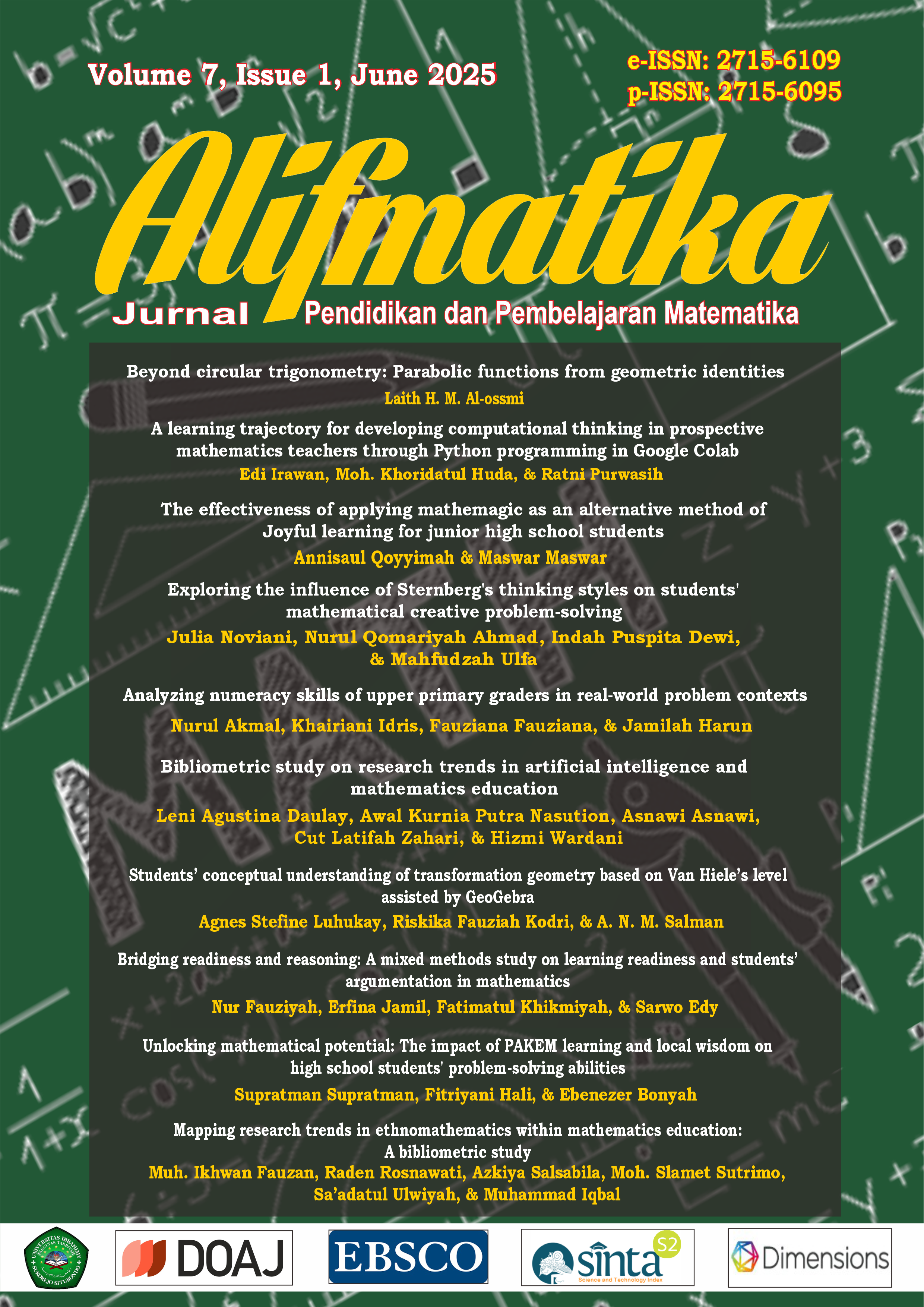
Exploring the influence of Sternberg's thinking styles on students' mathematical creative problem-solving
DOI:
https://doi.org/10.35316/alifmatika.2025.v7i1.68-107Keywords:
Creative Thinking, High School Student, Sternberg’s Thinking Styles, Thinking StylesAbstract
Creative thinking is an essential skill for students in the 21st century, especially in mathematics, requiring problem-solving and analytical abilities. This study aims to analyze the creative thinking abilities of high school students in solving mathematical problems, analyzed through Sternberg’s legislative, executive, and judicial thinking styles. A mixed method approach was employed, combining quantitative analysis of thinking style questionnaires and mathematics ability tests with qualitative examination of students’ creative thinking task responses and interview data. Nine students were purposively selected from the 37 participants for in-depth analysis based on their dominant thinking styles and mathematical ability levels. These students were analyzed further through their written responses and semi-structured interviews to gain deeper insights into their mathematical creative thinking processes. Students completed a mathematical creative thinking task, evaluated on four indicators: fluency, flexibility, originality, and elaboration. Findings revealed that all students were categorized at MCT Level 2 (Quite Creative), demonstrating only partial fluency and elaboration. No subject fulfilled flexibility or originality criteria, indicating limited strategic and novel thinking across styles. Interestingly, students with low mathematical ability also reached MCT Level 2, suggesting that creative thinking can be independent of academic performance. Legislative students lacked strategic variation despite their preference for autonomy, executive students relied strictly on procedural methods, and judicial students remained evaluative but unoriginal. Future research should involve a larger and more diverse sample to explore broader dimensions of students’ cognitive processes in mathematical learning. These findings imply that differentiated instruction based on thinking styles may be key to cultivating creativity in mathematics classrooms. The study underscores the need for instructional approaches emphasizing divergent thinking and creative exploration to align with diverse cognitive styles and enhance students' mathematical creativity.
Downloads
References
Aiken, L. R. (1980). Content validity and reliability of single items or questionnaires. Educational and Psychological Measurement, 40(4), 955–959. https://doi.org/10.1177/001316448004000419
Aljojo, N. (2017). Differences in styles of thinking “in light of sternberg’s theory”: A case study of different educational levels in Saudi Arabia. Journal of Technology and Science Education, 7(3), 333–346. https://doi.org/10.3926/jotse.291
Allen, T., Queen, S., Gallardo-Williams, M., Parks, L., Auten, A., & Carson, S. (2019). Building a culture of critical and creative thinking. Creating and sustaining higher-order thinking as part of a quality enhancement plan. 5th International Conference on Higher Education Advances, 1391–1398. https://doi.org/10.4995/head19.2019.9536
Anderson, R. C., & Graham, M. (2021). Creative potential in flux: The leading role of originality during early adolescent development. Thinking Skills and Creativity, 40, 100816. https://doi.org/https://doi.org/10.1016/j.tsc.2021.100816
Barlow, A., & Brown, S. (2020). Correlations between modes of student cognitive engagement and instructional practices in undergraduate STEM courses. International Journal of STEM Education, 7, 1–15. https://doi.org/10.1186/s40594-020-00214-7
Chegeni, S., Darabi, R., & Niroomandi, M. (2016). Predicting creative thinking of students based on Sternberg thinking styles. Academic Journal of Psychological Studies, 5(3), 228–240. http://worldofresearches.com/ojs-2.4.4-1/index.php/ajps/article/view/267
Ellamil, M., Dobson, C., Beeman, M., & Christoff, K. (2012). Evaluative and generative modes of thought during the creative process. NeuroImage, 59(2), 1783–1794. https://doi.org/https://doi.org/10.1016/j.neuroimage.2011.08.008
Elsayed, A. M. (2015). Effectiveness of using elaboration theory in teaching mathematics to develop academic achievement and critical thinking for primary students in Oman. International Journal of Humanities and Cultural Studies, 2(3), 851–865. http://ijhcschiefeditor.wix.com/ijhcs
Fatmawati, B., Jannah, B. M., & Sasmita, M. (2022). Students’ creative thinking ability through creative problem solving based learning. Jurnal Penelitian Pendidikan IPA, 8(4), 2384–2388. https://doi.org/10.29303/jppipa.v8i4.1846
Field, A. (2013). Discovering statistics using IBM SPSS statistics. Sage Publications.
Fraenkel, J., Wallen, N., & Hyun, H. (1993). How to Design and Evaluate Research in Education 10th ed. McGraw-Hill Education.
Gafoor, K. A., & P., L. M. (2016). Thinking Styles Inventory. July. https://doi.org/10.13140/RG.2.1.1134.7443
Gregory, R. J. (2004). Psychological testing: History, principles, and applications. Allyn & Bacon.
Grigorenko, Elena L, & Sternberg, Robert J. (1997). Styles of thinking, abilities, and academic performance. Exceptional Children, 63(3), 295–312. https://doi.org/10.1177/001440299706300301
Guilford, J. P. (1966). Measurement and Creativity. Theory Into Practice, 5(4), 185–189. https://doi.org/10.1080/00405846609542023
Guilford, J. P. (1967). Characteristics of Creativity. In The Nature of Human Intelligence. McGraw-Hill.
Güner, P., & Erbay, H. N. (2021). Prospective mathematics teachers’ thinking styles and problem-solving skills. Thinking Skills and Creativity, 40(February), 100827. https://doi.org/10.1016/j.tsc.2021.100827
Hage, J. (2015). The (Onto) logical structure of law: A conceptual toolkit for legislators BT - Logic in the theory and practice of lawmaking (M. Araszkiewicz & K. Płeszka (eds.); pp. 3–48). Springer International Publishing. https://doi.org/10.1007/978-3-319-19575-9_1
Hakim, A. (2020). Penggunaan batu cermat dalam mengembangkan kemampuan berpikir kreatif dan budaya literasi siswa [The use of careful stones in developing students' creative thinking skills and literacy culture]. Alifmatika: Jurnal Pendidikan Dan Pembelajaran Matematika, 2(1), 14–36. https://doi.org/10.35316/alifmatika.2020.v2i1.14-36
Heard, J., Ramalingam, D., Scoular, C., Anderson, P., & Duckworth, D. (2025). Creative thinking: Skill development framework. The Australian Council for Educational Research, 1–16. https://doi.org/10.37517/978-1-74286-753-3
Hendriyana, H., Rohaeti, E. E., & Sumarmo, U. (2018). Hard Skills dan Soft Skills Matematika Siswa. PT Refika Aditama.
Ho, S., & Kozhevnikov, M. (2023). Cognitive style and creativity: The role of education in shaping cognitive style profiles and creativity of adolescents. British Journal of Educational Psychology, 93(4), 978–996. https://doi.org/10.1111/bjep.12615
Hulinggato, A., Pikoli, M., & Uloli, R. (2024). Analysis of students ’ creative thinking abilities on the topic of energy in living systems. Pijar MIPA, 19(6), 954–958. https://doi.org/10.29303/jpm.v19i6.7649
Kadir, I. A., Machmud, T., Usman, K., & Katili, N. (2022). Analisis kemampuan berpikir kreatif matematis siswa pada materi segitiga [Analysis of students' mathematical creative thinking abilities on triangle material]. Jambura Journal of Mathematics Education, 3(2), 128–138. https://doi.org/10.34312/jmathedu.v3i2.16388
Kim, S.-H., & Song, K.-S. (2012). The effects of thinking style based cooperative learning on group creativity. Creative Education, 03(08), 20–24. https://doi.org/10.4236/ce.2012.38b005
Lambertus. (2010). Peningkatan kemampuan berpikir kreatif siswa sd melalui pendekatan matematika realistik lambertus [Improving the creative thinking skills of elementary school students through Lambertus' realistic mathematics approach]. Jurnal Pendidikan Matematika, 1(2), 130–142. https://ojs.uho.ac.id/index.php/JPM/article/view/130-142
Lestari, L. B., & Budiarto, M. T. (2018). Profil berpikir kreatif siswa dalam memecahkan masalah matematika open ended berdasarkan gaya berpikir sternberg menurut fungsinya [Profile of students' creative thinking in solving open-ended mathematical problems based on Sternberg's thinking style according to its function]. MATHEdunesa: Jurnal Ilmiah Pendidikan Matematika, 2(7), 240–247. https://doi.org/10.25139/smj.v7i2.1520
Lestari, R., & Lingga, L. J. (2024). Factors analysis inhibiting elementary school students' creative thinking in learning science and social subject. ELSE (Elementary School Education Journal), 8(3), 1–8. https://doi.org/10.30 651/else.v8i3.24408
Lin, S., Duan, W., Wang, Y., & Duan, H. (2024). Thinking style moderates the impact of the classroom environment on language creativity. Journal of Intelligence, 12(5), 1–18. https://doi.org/10.3390/jintelligence12010005
McGraw, K. O., & Wong, S. P. (1996). Forming inferences about some intraclass correlation coefficients. Psychological Methods, 1(1), 30. https://doi.org/10.1037/1082-989X.1.1.30
Miles, M. B., & Huberman, A. (2014). Michael and Saldaña, Johnny. Qualitative Data Analysis: A Methods Sourcebook. Thousand Oaks: Sage Publications, Inc.
Mulyani, E., Jailani, & Hartono. (2024). Analogical reasoning in geometric problem solving : A cognitive analysis based on sternberg’s thinking styles. International Journal of Geometry Research and Inventions in Education, 1(2), 102–109. https://doi.org/10.56855/gradient.v1i2.1234
Munandar, U. (2012). Pengembangan kreativitas anak berbakat [Developing creativity in gifted children]. PT Rineka Cipta.
Pang, Y. (2024). Development of students’ creative thinking in the process of teaching sculpture. Общество: Социология, Психология, Педагогика, 8, 73–77. https://doi.org/10.24158/spp.2024.8.9
PISA. (2024). PISA 2022 Creative Thinking Framework. Organization for Economic Cooperation and Development. https://doi.org/10.1787/6dd731d0-en
Prasetiyo, A. D., & Mubarokah, L. (2014). Berpikir kreatif siswa dalam penerapan model pembelajaran berdasar masalah matematika [Students' creative thinking in applying learning models based on mathematical problems]. Jurnal Pendidikan Matematika STKIP PGRI Sidoarjo, 2(1), 9–18. http://lppm.stkippgri-sidoarjo.ac.id/files/Berpikir-Kreatif-Siswa-Dalam-Penerapan-Model-Pembelajaran-Berdasar--Masalah-Matematika.pdf
Primadoni, A. B., & Muslim, R. I. (2023). Faktor rendahnya keterampilan berpikir kreatif dalam menciptakan inovasi baru [Low creative thinking skills factor in creating new innovations]. Pendas : Jurnal Ilmiah Pendidikan Dasar, 08(03), 958–966. https://doi.org/10.23969/jp.v8i3.10724
Putri, R. Y., Puspaningtyas, N. D., & Hadi, W. (2024). Students ’ mathematical creative thinking skills in solving pisa problems: a case in indonesia. Kalamatika: Jurnal Pendidikan Matematika, 9(2), 233–249. https://doi.org//10.22236/KALAMATIKA
Safaria, S. A., & Agus, I. (2024). The exploration of mathematical creative thinking ability in solving geometry problems from the perspective of mathematical ability. JTMT: Journal Tadris Matematika, 5(1), 38–48. https://doi.org/10.47435/jtmt.v5i1.2320
Sahatcija, R., Ora, A., & Ferhataj, A. (2017). The impact of the thinking style on teaching methods and academic achievement. European Scientific Journal, ESJ, 13(34), 16. https://doi.org/10.19044/esj.2017.v13n34p16
Sajedi, R. (2018). Relationship between thinking styles, critical thinking and creativity among students of Semman University of Medical Science. Journal of Advanced Pharmacy Education & Research, 8(32), 7–11. https://www.sid.ir/FileServer/SE/541E20170129
Shadrina, E., Kuliev, Z., & SCHASTLIVTSEVA, E. (2023). Formation of thought style in organizing the educational process and training of medical students. Wisdom, 26(2), 84–93. https://doi.org/10.24234/wisdom.v26i2.998
Siswono, T. Y. E. (2006). Proses berpikir kreatif siswa dalam memecahkan dan mengajukan masalah matematika [Students' creative thinking process in solving and posing mathematical problems]. Jurnal Ilmu Pendidikan, 15(1), 1–14. https://journal.um.ac.id/index.php/jip/article/view/13
Smuts, H., & Van der Merwe, A. (2022). Knowledge management in Society 5.0: A Sustainability Perspective. Sustainability (Switzerland), 14(11). https://doi.org/10.3390/su14116878
Sternberg, R. J. (1997). Thinking styles. Cambridge University Press.
Sternberg, R. J. (2005). The theory of successful intelligence. Interamerican Journal of Psychology, 39(2), 206–221. https://www.redalyc.org/html/284/28439202/
Sternberg, R. J. (2006). The nature of creativity. Creativity Research Journal, 18(1), 87–98. https://doi.org/10.1207/s15326934crj1801_10
Tohir, M. (2019). Keterampilan berpikir kreatif siswa dalam menyelesaikan soal olimpiade matematika berdasarkan level metakognisi [Students' creative thinking skills in solving mathematics olympiad problems based on metacognition levels]. Alifmatika: Jurnal Pendidikan Dan Pembelajaran Matematika, 1(1), 1–14. https://doi.org/10.35316/alifmatika.2019.v1i1.1-14
Treffinger, D. J., Young, G. C., Selby, E. C., & Shepardson, C. (2002). Assessing creativity: A guide for educators. In National Research Center on the Gifted and Talented. ERIC. https://doi.org/https://eric.ed.gov/?id=ED505548
Trianggono, M. M. (2017). Analisis kausalitas pemahaman konsep dengan kemampuan berpikir kreatif siswa pada pemecahan masalah Fisika [Causality analysis of conceptual understanding with students' creative thinking abilities in solving Physics problems]. Jurnal Pendidikan Fisika Dan Keilmuan (JPFK), 3(1), 1. https://doi.org/10.25273/jpfk.v3i1.874
Wahyu, T., Lase, N., Lase, S., Mendrofa, R. N., & Zega, Y. (2024). Analisis kemampuan berpikir kreatif siswa kelas VIII SMP Negeri 4 Gunungsitoli Selatan dalam memecahkan masalah matematika [Analysis of creative thinking abilities of class VIII students of SMP Negeri 4 Gunungsitoli Selatan in solving mathematical problems]. Gauss: Jurnal Pendidikan Matematika, 07(02), 122–134. https://doi.org/10.30656/gauss.v7i2.9254
Wardani, N. C., Sariyasa, S., & Marhaeni, A. A. I. . (2019). Pengaruh model pembelajaran treffinger berpendekatan saintifik terhadap kemampuan berpikir kreatif ditinjau dari gaya kognitif siswa [The influence of the Treffinger learning model with a scientific approach on creative thinking skills viewed from students' cognitive styles]. PENDASI: Jurnal Pendidikan Dasar Indonesia, 1(1), 1–11. https://doi.org/10.23887/jpdi.v1i1.2676
Wathoni, M. H., & Negara, H. R. P. (2024). Kemampuan berpikir kreatif matematis siswa dalam menyelesaikan soal lingkaran ditinjau dari habits of mind [Students' mathematical creative thinking ability in solving circle problems is reviewed from the habits of mind]. Journal of Didactic Mathematics, 5(1), 57–69. https://doi.org/10.34007/jdm.v5i1.2199
Zhang, L., & Sternberg, R. J. (2005). A threefold model of intellectual styles. Educational Psychology Review, 17, 1–53. https://doi.org/10.1007/s10648-005-1635-4
Zhu, C., & Zhang, L. F. (2011). Thinking styles and conceptions of creativity among university students. Educational Psychology, 31(3), 361–375. https://doi.org/10.1080/01443410.2011.557044
Downloads
Published
How to Cite
Issue
Section
License
Copyright (c) 2025 Alifmatika: Jurnal Pendidikan dan Pembelajaran Matematika

This work is licensed under a Creative Commons Attribution-ShareAlike 4.0 International License.
COPYRIGHT NOTICE
Author (s) who publish in Alifmatika: Jurnal Pendidikan dan Pembelajaran Matematika agree to the following terms:
- The Author (s) submitting a manuscript do so on the understanding that if accepted for publication, copyright of the article shall be assigned to Alifmatika: Jurnal Pendidikan dan Pembelajaran Matematika, Tarbiyah Faculty of Ibrahimy University as the publisher of the journal. Consecutively, author(s) still retain some rights to use and share their own published articles without written permission from Alifmatika: Jurnal Pendidikan dan Pembelajaran Matematika. This work is licensed under a Creative Commons Attribution-ShareAlike 4.0 International License.
- Copyright encompasses rights to publish and provide the manuscripts in all forms and media for the purpose of publication and dissemination, and the authority to enforce the rights in the manuscript, for example in the case of plagiarism or in copyright infringement.
- Alifmatika: Jurnal Pendidikan dan Pembelajaran Matematika and the Editors make every effort to ensure that no wrong or misleading data, opinions or statements be published in the journal. In any way, the contents of the articles and advertisements published in Alifmatika: Jurnal Pendidikan dan Pembelajaran Matematika are the sole responsibility of their respective authors and advertisers.
- The Copyright Transfer Form can be downloaded here [Copyright Transfer Form Alifmatika]. The copyright form should be signed originally and send to the Editorial Office in the form of original mail, scanned document to alifmatika[at]ibrahimy.ac.id or upload the scanned document in the comments column when sending the manuscript.














_by_Matematohir.jpg)