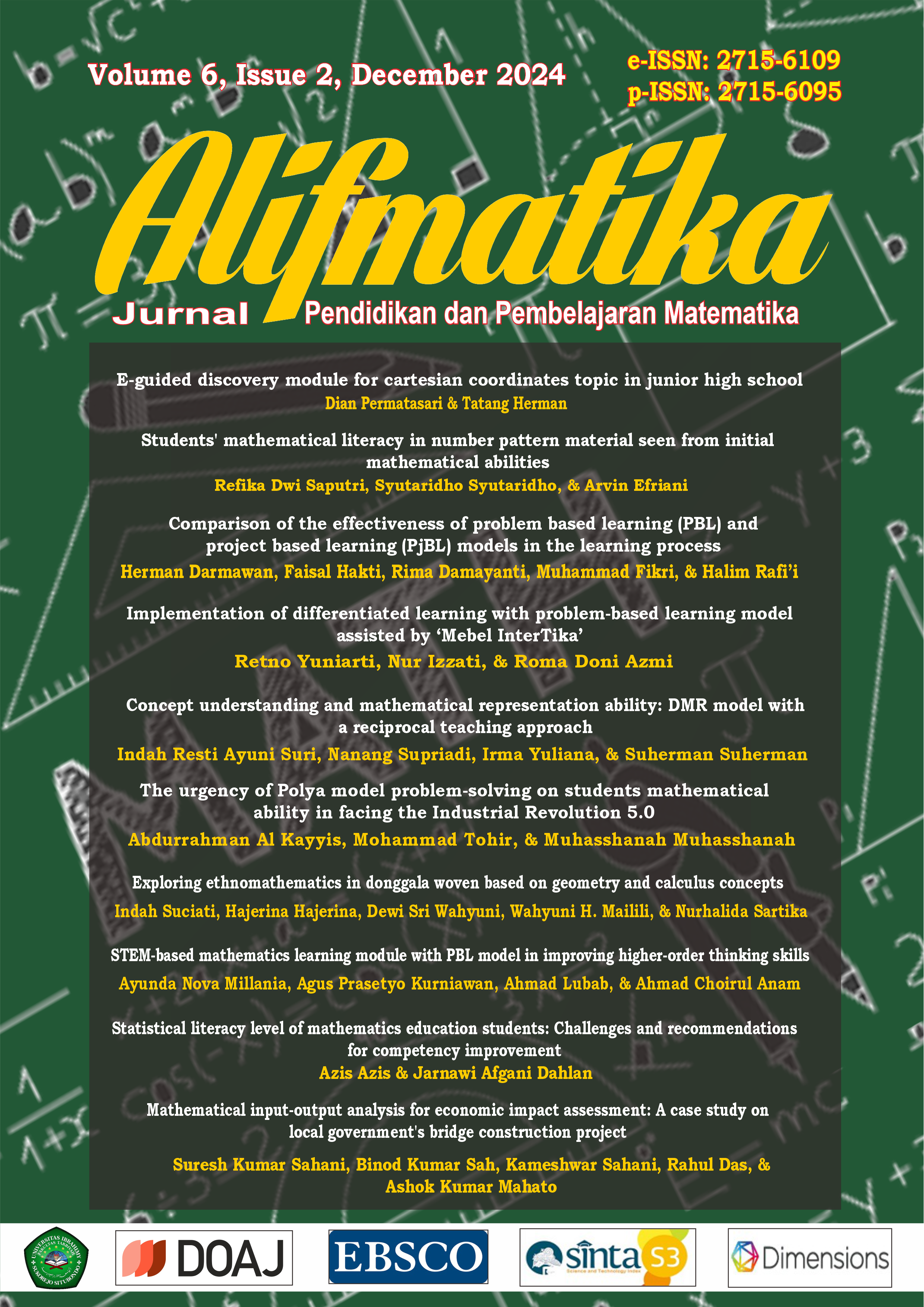
Concept understanding and mathematical representation ability: DMR model with a reciprocal teaching approach
DOI:
https://doi.org/10.35316/alifmatika.2024.v6i2.205-217Keywords:
Concept Understanding, DMR, Mathematical Representation, Reciprocal TeachingAbstract
Understanding mathematical concepts and representations in mathematics learning is an understanding that needs to be mastered by students in order to show students in the learning process and solve various mathematical problems. In this article we report how MTs students in South Lampung Regency understand concepts and mathematical representations after being treated with DMR learning with a reciprocal teaching approach. This researcher used the Quasy Experimental Design research type with a 2x2 factorial design. The population of this study were MTs students in Central Lampung Regency with samples taken using Cluster Random sampling techniques totaling 60 students (experimental class n = 30 and control class n = 30). The instruments used to collect data were essay tests for understanding concepts and mathematical representations. The data analysis technique in this research is Multivariate Analysis of Variant (MANOVA) with a large significance value . Based on the calculations that have been carried out, the results show that the p-value of understanding concepts is 0.000 and mathematical representation is 0.000, so that the p-value of each understanding is less than 0.05, it can be concluded that there is an influence of the DMR learning model with reciprocal teaching on students' understanding of concepts and mathematical representations simultaneously or partially. The results of understanding mathematical representations were better than understanding concepts for the two learning treatments given.
Downloads
References
Adnyana, P. G. W., Suarsana, I. M., & Suharta, I. G. P. (2021). Multi-representation discourse model and math problem solving skills of high school students. Journal of Learning Improvement and Lesson Study, 1(1), 40–48. https://doi.org/10.24036/jlils.v1i1.8
Agustina, T., Sukmana, N., & Rahmawati, D. (2019). Penerapan model diskursus multi representasi (DMR) untuk meningkatkan pemahaman konsep matematis siswa dalam materi bangun datar di kelas IV SD [Application of the multi-representation discourse model (DMR) to improve students' understanding of mathematical concepts in flat geometry material in grade IV of elementary school]. Educare, 17(2), 151–158. http://jurnal.fkip.unla.ac.id/index.php/educare/article/view/256
Alaban, A. (2024). Gamification techniques to enhance student engagement in library services. Library Progress International, 44(1s), 1–16. https://www.bpasjournals.com/library-science/index.php/journal/article/view/148
Andreou, C., Papastavrou, E., & Merkouris, A. (2014). Learning styles and critical thinking relationship in baccalaureate nursing education: a systematic review. Nurse Education Today, 34(3), 362–371. https://doi.org/10.1016/j.nedt.2013.06.004
Azizah, L. N., Junaedi, I., & Suhito. (2019). Kemampuan representasi matematis ditinjau dari gaya kognitif siswa kelas X pada pembelajaran matematika dengan model problem based learning [Mathematical representation ability reviewed from the cognitive style of class X students in mathematics learning with the problem based learning model]. PRISMA, Prosiding Seminar Nasional Matematika, 2(1), 355–365. https://journal.unnes.ac.id/sju/prisma/article/view/28952
Budarsini, K. P., Suarsana, I. M., & Suparta, I. N. (2018). Model diskursus multi representasi dan kemampuan pemahaman konsep matematika siswa sekolah menegah pertama [Multi-representation discourse model and junior high school students' mathematical concept understanding ability]. PYTHAGORAS: Jurnal Matematika dan Pendidikan Matematika, 13(2), 110–118. http://doi.org/10.21831/pg.v13i2.20047
Cheng, W., & Khoo, C. S. G. (2021). Information structures in sociology research papers: Modeling cause–effect and comparison relations in research objective and result statements 1. Journal of the Association for Information Science and Technology, 72(11), 1367–1385. https://doi.org/10.1002/asi.24486
Chusni, M. M. (2023). The implementation of discovery-based multiple representations learning (DMRL) to enhance student’s critical thinking skills. Kasetsart Journal of Social Sciences, 44(2), 429–434. https://so04.tci-thaijo.org/index.php/kjss/article/view/266269
Downer, J., Sabol, T. J., & Hamre, B. (2010). Teacher–child interactions in the classroom: Toward a theory of within-and cross-domain links to children’s developmental outcomes. Early Education and Development, 21(5), 699–723. https://doi.org/10.1080/10409289.2010.497453
Frye, A. W., & Hemmer, P. A. (2012). Program evaluation models and related theories: AMEE guide no. 67. Medical Teacher, 34(5), e288–e299. https://doi.org/10.3109/0142159X.2012.668637
Gilchrist, P. O., Alexander, A. B., Green, A. J., Sanders, F. E., Hooker, A. Q., & Reif, D. M. (2021). Development of a pandemic awareness stem outreach curriculum: Utilizing a computational thinking taxonomy framework. Education Sciences, 11(3), 1–13. https://doi.org/10.3390/educsci11030109
Grace, J. B., Schoolmaster Jr, D. R., Guntenspergen, G. R., Little, A. M., Mitchell, B. R., Miller, K. M., & Schweiger, E. W. (2012). Guidelines for a graph‐theoretic implementation of structural equation modeling. Ecosphere, 3(8), 1–44. https://doi.org/10.1890/ES12-00048.1
Huda, U., Musdi, E., & Nari, N. (2019). Analisis Kemampuan Representasi Matematis Siswa dalam Menyelesaikan Soal Pemecahan Masalah Matematika [Analysis of Students' Mathematical Representation Ability in Solving Mathematical Problems]. Jurnal Ta’dib, 22(1), 19-25. https://doi.org/10.31958/jt.v22i1.1226
Hunter, J. (2017). Developing interactive mathematical talk: Investigating student perceptions and accounts of mathematical reasoning in a changing classroom context. Cambridge Journal of Education, 47(4), 475–492. https://doi.org/10.1080/0305764X.2016.1195789
Jeram, S. (2024). Applying active learning in undergraduate research methods. PS: Political Science & Politics, 57(1), 107–112. https://doi.org/10.1017/S1049096523000574
Kartika, Y. (2018). Analisis kemampuan pemahaman konsep matematis peserta didik kelas VII SMP pada materi bentuk aljabar [Analysis of the mathematical concept understanding ability of grade VII junior high school students on algebraic form material]. Jurnal Pendidikan Tambusai, 2(58), 777–785. https://jptam.org/index.php/jptam/article/view/25
Lewthwaite, S., & Nind, M. (2016). Teaching research methods in the social sciences: Expert perspectives on pedagogy and practice. British Journal of Educational Studies, 64(4), 413–430. https://doi.org/10.1080/00071005.2016.1197882
Malone, T. W., & Lepper, M. R. (2021). Making learning fun: A taxonomy of intrinsic motivations for learning. In Aptitude, learning, and instruction (pp. 223–254). Routledge. https://www.taylorfrancis.com/chapters/edit/10.4324/9781003163244-10/making-learning-fun-thomas-malone-mark-lepper
Maulani, D., Suyono, S., & Noornia, A. (2017). Pengaruh penerapan model reciprocal teaching terhadap kemampuan komunikasi matematis ditinjau dari self-concept siswa di SMAN kecamatan Tambun Selatan Bekasi [The Influence of the application of the reciprocal teaching model on mathematical communication skills reviewed from the self-concept of students at SMAN Tambun Selatan District, Bekasi]. Jurnal Penelitian Dan Pembelajaran Matematika, 10(2), 14-24. https://dx.doi.org/10.30870/jppm.v10i2.2026
Mawaddah, S., & Maryani, R. (2016). Kemampuan pemahaman konsep matematis siswa SMP dalam pembelajaran menggunakan model penemuan terbimbing (discovery learning) [The ability to understand mathematical concepts of junior high school students in learning using guided discovery models (discovery learning)]. EDU-MAT Jurnal Pendidikan Matematika, 4(1), 76–85. http://doi.org/10.20527/edumat.v4i1.2292
Medina Herrera, L. M., Juárez Ordóñez, S., & Ruiz-Loza, S. (2024). Enhancing mathematical education with spatial visualization tools. Frontiers in Education, 9, 1229126. https://doi.org/10.3389/feduc.2024.1229126
Misel, & Suwangsih, E. (2016). Penerapan pendekatan matematika realistik untuk meningkatkan kemampuan representasi matematis siswa [Application of realistic mathematics approach to improve students' mathematical representation ability]. Metodik Didaktik: Jurnal Pendidikan Ke-SD-An, 10(2), 27–36. https://doi.org/10.17509/md.v10i2.3180
Opoku, E. E. O., Dogah, K. E., & Aluko, O. A. (2022). The contribution of human development towards environmental sustainability. Energy Economics, 106(2), 105782. https://doi.org/10.1016/j.eneco.2021.105782
Phillips, A. M., Gouvea, E. J., Gravel, B. E., Beachemin, P.-H., & Atherton, T. J. (2023). Physicality, modeling, and agency in a computational physics class. Physical Review Physics Education Research, 19(1), 10121. https://journals.aps.org/prper/abstract/10.1103/PhysRevPhysEducRes.19.010121
Pressick-Kilborn, K., & te Riele, K. (2008). Learning from reciprocal peer observation: A collaborative self-study. Studying Teacher Education, 4(1), 61–75. https://doi.org/10.1080/17425960801976354
Purwasih, R., & Bernad, M. (2018). Pembelajaran diskursus multi representasi terhadap peningkatan kemampuan komunikasi dan disposisi matematis mahasiswa [Multi-representation discourse learning towards improving students' mathematical communication and disposition skills]. Jurnal Riset Pendidikan Matematika, 5(1), 43-52. http://doi.org/10.21831/jrpm.v5i1.13589
Qin, W., Wang, X., Hu, Z., Wang, L., Lan, Y., & Hong, R. (2024). Math word problem generation via disentangled memory retrieval. ACM Transactions on Knowledge Discovery from Data, 18(5), 1–21. https://dl.acm.org/doi/abs/10.1145/3639569
Rezeki, S. (2017). Meningkatkan kemampuan representasi matematis siswa melalui penerapan model pembelajaran novick [Improving students' mathematical representation skills through the application of the Novick learning model]. SAP (Susunan Artikel Pendidikan), 1(3), 281-291. http://doi.org/10.30998/sap.v1i3.1203
Rukiyah, S., Widiyastuti, R., & Thahir, A. (2020). Pembelajaran diskursus multi representasi (DMR) dengan sparkol videoscribe untuk meningkatkan kemampuan representasi matematis [Multi-representation discourse (DMR) learning with sparkol videoscribe to improve mathematical representation skills]. Edu Sains: Jurnal Pendidikan Sains Dan Matematika, 8(2), 32–42. https://doi.org/10.23971/eds.v8i2.1565
Schünemann, N., Spörer, N., & Brunstein, J. C. (2013). Integrating self-regulation in whole-class reciprocal teaching: A moderator–mediator analysis of incremental effects on fifth graders’ reading comprehension. Contemporary Educational Psychology, 38(4), 289–305. https://doi.org/10.1016/j.cedpsych.2013.06.002
Seal, C. (2022). Relationship between student-centered, active learning strategies and student success in an undergraduate nursing course. Walden University. https://scholarworks.waldenu.edu/dissertations/13764/
Singh, H. K., & Azman, H. H. (2023). Visualizing algebra: Exploring a gifted 3rd grader’s problem-solving techniques for enhanced conceptual understanding in algebra education. International STEM Journal, 4(2), 1–11.
Sunarya, P. A. (2022). The impact of gamification on IDU (ilearning instruction) in expanding understudy learning inspiration. International Transactions on Education Technology, 1(1), 59–67. https://doi.org/10.33050/itee.v1i1.190
Tamsah, H., Ilyas, J. B., & Yusriadi, Y. (2021). Create teaching creativity through training management, effectiveness training, and teacher quality in the covid-19 pandemic. Journal of Ethnic and Cultural Studies, 8(4), 18–35. https://doi.org/10.29333/ejecs/800
Tyas, W. H., Sujadi, I., & Riyadi. (2016). Representasi matematis siswa dalam menyelesaikan masalah matematika pada materi aritmatika sosial dan perbandingan ditinjau dari gaya kognitif siswa kelas VII SMP Negeri 15 Surakarta tahun ajaran 2014/2015 [Students' mathematical representation in solving mathematical problems on social arithmetic and comparison material reviewed from the cognitive style of class VII students of SMP Negeri 15 Surakarta in the 2014/2015 academic year.]. Jurnal Elektronik Pembelajaran Matematika Vol.4 2339-1685 Http://Jurnal.Fkip.Uns.Ac.Id REPRESENTASI, 4(8), 781–792.
Uno, H. B., & Mohamad, N. (2022). Belajar dengan pendekatan PAILKEM: Pembelajaran aktif, inovatif, lingkungan, kreatif, efektif, menarik [Learning with the PAILKEM approach: Active, innovative, environmental, creative, effective, interesting learning]. Bumi Aksara.
Utomo, I. W. (2017). Pengaruh brand image, brand awareness, dan brand trust terhadap brand loyalty pelanggan online shopping (studi kasus karyawan di BSI Pemuda) [The influence of brand image, brand awareness, and brand trust on brand loyalty of online shopping customers (case study of employees at BSI Pemuda)]. Jurnal Komunikasi, 8(1), 76-84. https://doi.org/10.31294/jkom.v8i1.2327
Wijaya, H. (2018). Analisis data kualitatif model Spradley (etnografi) [Spradley model qualitative data analysis (ethnography)]. Sekolah Tinggi Theologia Jaffray, 3(1), 1–10. https://core.ac.uk/download/pdf/287061605.pdf
Wilkinson, I. A. G., Parr, J. M., Fung, I. Y. Y., Hattie, J. A. C., & Townsend, M. A. R. (2002). Discussion: modeling and maximizing peer effects in school. International Journal of Educational Research, 37(5), 521–535. https://doi.org/10.1016/S0883-0355(03)00018-1
Youens, B., Smethem, L., & Sullivan, S. (2014). Promoting collaborative practice and reciprocity in initial teacher education: realising a ‘dialogic space’through video capture analysis. Journal of Education for Teaching, 40(2), 101–113. https://doi.org/10.1080/02607476.2013.871163
Yuna, A. Y., Mujib, & Suri, R. A. (2018). Model pembelajaran scramble dan time token arends (TTA) untuk meningkatkan kemampuan pemahaman konsep matematis peserta didik [Scramble and Time Token Arends (TTA) learning models to improve students' mathematical concept understanding abilities]. Seminar Nasional Matematika Dan Pendidikan Matematika, 475–480.
Zannrni, I. M., & Shareef, L. B. (2023). The effectiveness of politeness achievements on students’ academic performance. Cihan University-Erbil Journal of Humanities and Social Sciences, 7(1), 115–120. https://journals.cihanuniversity.edu.iq/index.php/cuejhss/article/view/937
Downloads
Published
How to Cite
Issue
Section
License
Copyright (c) 2024 Alifmatika: Jurnal Pendidikan dan Pembelajaran Matematika

This work is licensed under a Creative Commons Attribution-ShareAlike 4.0 International License.
COPYRIGHT NOTICE
Author (s) who publish in Alifmatika: Jurnal Pendidikan dan Pembelajaran Matematika agree to the following terms:
- The Author (s) submitting a manuscript do so on the understanding that if accepted for publication, copyright of the article shall be assigned to Alifmatika: Jurnal Pendidikan dan Pembelajaran Matematika, Tarbiyah Faculty of Ibrahimy University as the publisher of the journal. Consecutively, author(s) still retain some rights to use and share their own published articles without written permission from Alifmatika: Jurnal Pendidikan dan Pembelajaran Matematika. This work is licensed under a Creative Commons Attribution-ShareAlike 4.0 International License.
- Copyright encompasses rights to publish and provide the manuscripts in all forms and media for the purpose of publication and dissemination, and the authority to enforce the rights in the manuscript, for example in the case of plagiarism or in copyright infringement.
- Alifmatika: Jurnal Pendidikan dan Pembelajaran Matematika and the Editors make every effort to ensure that no wrong or misleading data, opinions or statements be published in the journal. In any way, the contents of the articles and advertisements published in Alifmatika: Jurnal Pendidikan dan Pembelajaran Matematika are the sole responsibility of their respective authors and advertisers.
- The Copyright Transfer Form can be downloaded here [Copyright Transfer Form Alifmatika]. The copyright form should be signed originally and send to the Editorial Office in the form of original mail, scanned document to alifmatika[at]ibrahimy.ac.id or upload the scanned document in the comments column when sending the manuscript.













_by_Matematohir.jpg)