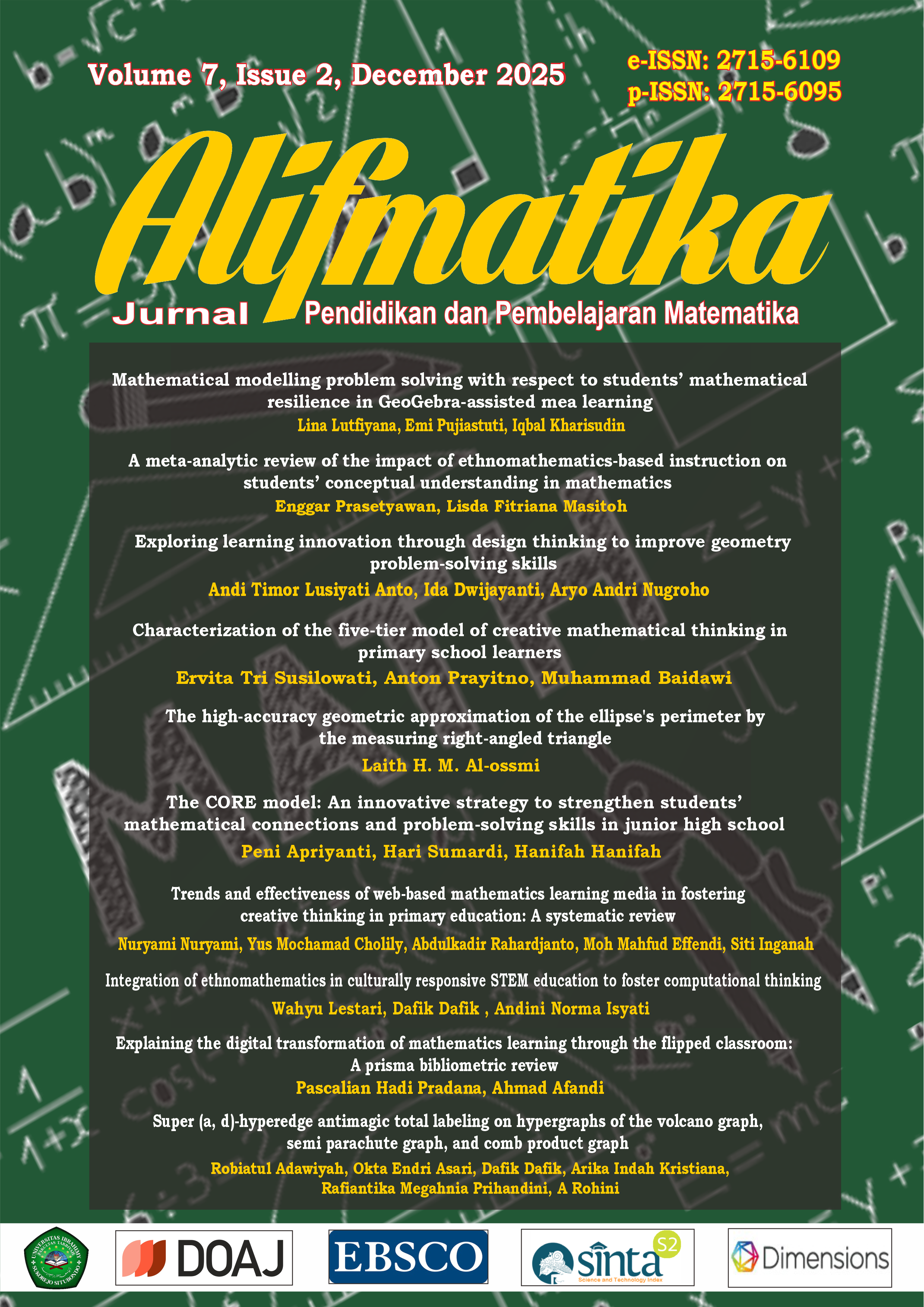
Explaining the digital transformation of mathematics learning through the flipped classroom: A prisma bibliometric review
DOI:
https://doi.org/10.35316/alifmatika.2025.v7i2.375-390Keywords:
Bibliometrics, Educational Technology, Flipped Classroom, Mathematics Learning, PrismaAbstract
This study aims to systematically examine publication trends, implementation methods, pedagogical approaches, impacts, target education levels, and the role of digital technology in the application of the flipped classroom model in mathematics learning. The method used is the Systematic Literature Review (SLR) based on PRISMA guidelines, with additional bibliometric analysis using VOSviewer to map the relationship and development of keywords in the literature published between 2023 and 2025. The analysis of 16 selected articles indicates a growing research trend, marked by a shift from conceptual investigations toward studies emphasizing impact and student learning experiences. The results show that digital transformation in mathematics learning is reflected through the integration of digital instructional videos, LMS platforms, and online learning resources that restructure learning from a teacher-centered approach to a technology-supported, student-centered model. The findings also indicate a shift in research focus from conceptual discussions toward practical implementation and learner outcomes. The flipped classroom is implemented through a combination of pre-class digital preparation and in-class interactive activities that promote autonomy, engagement, and 21st-century skills. Despite variations in context, many of the identified challenges, such as limited digital competence and low pre-class engagement, remain relevant to Indonesian students. Overall, the study successfully addresses its objectives and provides insights that can serve as a reference for developing contextual, technology-driven mathematics learning strategies.
Downloads
References
Albar, M. (2025). Effect of google sites-assisted flipped classroom discovery learning model and cognitive style on mathematics problem-solving skills and student learning independence. Ianna Journal of Interdisciplinary Studies, 7(2), 236–249. https://doi.org/10.5281/zenodo.15462037
Annajmi, A., & Dedi Kuswandi. (2024). Flipped classroom; Inovasi pengaturan lingkungan belajar dalam pembelajaran matematika [Flipped classroom: Innovation in the arrangement of learning environments in mathematics learning]. DIAJAR: Jurnal Pendidikan Dan Pembelajaran, 3(1), 116–124. https://doi.org/10.54259/diajar.v3i1.2227
Ariani, D. N. (2022). The impact of android module-based inquiry flipped classroom learning on mathematics problem solving and creative thinking ability. International Journal of Interactive Mobile Technologies, 16(24), 32–46. https://doi.org/10.3991/ijim.v16i24.35749
Awi, Naufal, M. A., Sutamrin, & Huda, M. (2024). Enhancing geometry achievement in pre-service mathematics teachers: the impact of a scaffolded flipped classroom using a learning management system. Journal of Ecohumanism, 3(6), 637–645. https://doi.org/10.62754/joe.v3i6.4035
Bedebayeva, M., Kadirbayeva, R., Koshkinbayeva, M., Shaldarbekov, Z., & Urmatova, A. (2025). The integration of gamification into the adapted flipped classroom to enhance students’ academic performance. TEM Journal, 14(2), 1407–1419. https://doi.org/10.18421/TEM142-41
Beltozar-Clemente, S., Iparraguirre-Villanueva, O., Zapata-Paulini, J., & Cabanillas-Carbonell, M. (2023). Changing mathematical paradigms at the university level: feedback from a flipped classroom at a peruvian university. International Journal of Engineering Pedagogy, 13(6), 76–89. https://doi.org/10.3991/ijep.v13i6.40763
Çebi, A., & Reisoglu, I. (2020). Digital competence: A study from the perspective of pre-service teachers in Turkey. Journal of New Approaches in Educational Research, 9(2), 294–308. https://doi.org/10.7821/naer.2020.7.583
Cevikbas, M. (2020). Flipped classroom as a reform-oriented approach to teaching mathematics. Zdm Mathematics Education, 52(7), 1291–1305. https://doi.org/10.1007/s11858-020-01191-5
Cevikbas, M. (2022). Student engagement in a flipped secondary mathematics classroom. International Journal of Science and Mathematics Education, 20(7), 1455–1480. https://doi.org/10.1007/s10763-021-10213-x
Cevikbas, M. (2023). Can flipped classroom pedagogy offer promising perspectives for mathematics education on pandemic-related issues? A systematic literature review. Zdm Mathematics Education, 55(1), 177–191. https://doi.org/10.1007/s11858-022-01388-w
Cevikbas, M., & Kaiser, G. (2022). Student engagement in a flipped secondary mathematics classroom. International Journal of Science and Mathematics Education, 20(7), 1455–1480. https://doi.org/10.1007/s10763-021-10213-x
Ding, H. (2024). A flipped classroom teaching model of college mathematics in colleges and universities based on the background of deep learning. Applied Mathematics and Nonlinear Sciences, 9(1), 1-15. https://doi.org/10.2478/amns.2023.2.01234
Egara, F. O. (2024). Effect of flipped classroom learning approach on mathematics achievement and interest among secondary school students. Education and Information Technologies, 29(7), 8131–8150. https://doi.org/10.1007/s10639-023-12145-1
Egorova, V., Bedia Jiménez, J., Fernández Quiruelas, V., Frías Domínguez, M. D., García Manzanas, R., Pérez Carabaza, S., Sordo García, C., & Casanueva Vicente, A. (2025). Audiovisual support for a flipped classroom in Engineering Mathematics labs. European Public and Social Innovation Review, 10, 1–22. https://doi.org/10.31637/epsir-2025-2121
Ergene, Ö. (2024). The effect of the flipped classroom model on students’ proportional reasoning. Journal of Pedagogical Research, 8(1), 294–311. https://doi.org/10.33902/JPR.202425424
Estévez-Méndez, J. L., Díaz Palencia, J. L., Sánchez Sánchez, A., & Roa González, J. (2024). Evaluación de variables contextuales en la implementación de la metodología flipped classroom en educación secundaria. RIED-Revista Iberoamericana de Educación a Distancia, 27(2), 317–337. https://doi.org/10.5944/ried.27.2.38980
Fitrah, M. (2025). The impact of integrated project-based learning and flipped classroom on students’ computational thinking skills: Embedded mixed methods. Education Sciences, 15(4). https://doi.org/10.3390/educsci15040448
Fredriksen, H. (2021). Exploring realistic mathematics education in a flipped classroom context at the tertiary level. International Journal of Science and Mathematics Education, 19(2), 377–396. https://doi.org/10.1007/s10763-020-10053-1
Fredriksen, H., Rebenda, J., Rensaa, R. J., & Pettersen, P. (2024). Inquiry-based linear algebra teaching and learning in a flipped classroom framework: A case study. Primus, 1970. https://doi.org/10.1080/10511970.2024.2375712
Fung, C. H. (2021). Systematic literature review of flipped classroom in mathematics. Eurasia Journal of Mathematics, Science and Technology Education, 17(6), 1–17. https://doi.org/10.29333/ejmste/10900
Gestiardi, R. (2025). Belajar dan pengajaran matematika di era digital: Systematic literature review [Learning and teaching mathematics in the digital age: Systematic literature review]. JP2M (Jurnal Pendidikan dan Pembelajaran Matematika), 11(1), 235-245. https://doi.org/10.29100/jp2m.v11i1.7071
Gonzales, G., & Gonzales, R. (2024). Enhancing educational research pedagogy: Integrating in-house peer review in a flipped/hybrid classroom environment. Social Sciences and Humanities Open, 9(2), 100889. https://doi.org/10.1016/j.ssaho.2024.100889
Hukom, J. (2025). Flipped classroom dalam pembelajaran matematika: Tantangan dan peluang untuk pembelajaran mandiri. jurnal ilmu ekonomi [Flipped classroom in mathematics learning: Challenges and opportunities for self-directed learning. Journal of Economics], Pendidikan dan Teknik, 2(1), 181-186. https://doi.org/10.70134/identik.v2i1.554
Kadarisma, G., Juandi, D., & Darhim. (2024). Global trends in flipped classroom research within mathematics education over past two decade: A bibliometric analysis. Infinity Journal, 13(2), 531–552. https://doi.org/10.22460/infinity.v13i2.p531-552
Karimah, W. (2019). Penerapan model flipped classroom berbantuan video pembelajaran terhadap kemampuan pemecahan masalah matematika siswa [Application of the flipped classroom model assisted by learning videos on students' mathematical problem-solving abilities]. Delta: Jurnal Ilmiah Pendidikan Matematika, 6(2), 25-32. https://doi.org/10.31941/delta.v6i2.913
Katopo, F. A., Runtu, P. V. J., & Pitoy, C. (2024). Model flipped classroom pada pembelajaran materi SPLDV: implementasi dan pengaruhnya terhadap hasil belajar siswa [The flipped classroom model in learning SPLDV material: implementation and its influence on student learning outcomes]. Jurnal Riset Dan Inovasi Pembelajaran, 4(1), 283–295. https://doi.org/10.51574/jrip.v4i1.1360
Kiem, M. T. (2024). Unpacking the advantages and challenges of flipped classrooms in initial mathematics teacher education in Vietnam. Eurasia Journal of Mathematics Science and Technology Education, 20(5). https://doi.org/10.29333/ejmste/14449
Kreis, Y. (2024). Transitioning from lectures to online flipped classrooms: enhancing pre-service teacher education in Luxembourg. Cogent Education, 11(1). https://doi.org/10.1080/2331186X.2024.2425895
Lo, C. K. (2021). Student engagement in mathematics flipped classrooms: implications of journal publications from 2011 to 2020. Frontiers in Psychology, 12(1), 1-12. https://doi.org/10.3389/fpsyg.2021.672610
Masero-Moreno, I. C., & Albort Morant, G. (2023). Implementación e influencia del modelo de clase invertida en el aprendizaje en línea de dos asignaturas universitarias. Educar, 60(1), 119–136. https://doi.org/10.5565/rev/educar.1765
Nielsen, K. L. (2023). Why can the flipped classroom frustrate students? experiences from an engineering mathematics course. Education Sciences, 13(4), 1-18. https://doi.org/10.3390/educsci13040396
Omoniyi, A. A. (2025). Teachers’ experiences with flipped classrooms in senior secondary mathematics instruction. Computers, 14(5), 1-29. https://doi.org/10.3390/computers14050180
Orlić, S., Marić, M., & Petojević, A. (2023). Implementing the flipped classroom model in mathematics class teaching. South African Journal of Education, 43(4), 1–10. https://doi.org/10.15700/saje.v43n4a2223
Rincón, Y. R., Munárriz, A., & Magreñán Ruiz, A. (2025). Flipped classroom or flip to foster self-regulation competencies in mathematics in economics and business students. International Journal of Educational Research, 130(May 2024). https://doi.org/10.1016/j.ijer.2025.102556
Romero, A. A. (2023). Flipped classroom in a digital learning space: Its effect on the students’ attitude toward mathematics. International Journal of Learning Teaching and Educational Research, 22(1), 210–227. https://doi.org/10.26803/ijlter.22.1.12
Ruiz-Palmero, J. (2023). Effectiveness of the flipped classroom in the teaching of mathematics in an online environment: Identification of factors affecting the learning process. Online Learning Journal, 27(2), 304–323. https://doi.org/10.24059/olj.v27i2.3239
Salas-Rueda, R. A. (2023). Perception of students about the effectiveness of the flipped classroom and technological tools in the learning of mathematics. Journal of Learning for Development, 10(3), 376–391. https://doi.org/10.56059/jl4d.v10i3.831
Salsabila, N. H., & Lu, U. (2024). Systematic Literature Review: Bahan Tayang Interaktif Berorientasi Model Pembelajaran Flipped Classroom Terhadap Pemahaman Konsep Matematika [Systematic Literature Review: Interactive Display Materials Oriented to the Flipped Classroom Learning Model for Understanding Mathematical Concepts]. Media Pendidikan Matematika, 12(2), 80-94. https://doi.org/10.33394/mpm.v12i2.13954
Sarwar, M. N. (2024). Fostering conceptual understanding of photocatalysis for sustainable development: A social constructivism flipped-classroom model. Sustainability Switzerland, 16(23), 1-24. https://doi.org/10.3390/su162310324
Sopamena, P. (2023). Effectiveness of flipped classroom model on mathematics achievement at the university level: A meta-analysis study. International Journal of Instruction, 16(1), 767–780. https://doi.org/10.29333/iji.2023.16143a
Strelan, P., Osborn, A., & Palmer, E. (2020). The flipped classroom: A meta-analysis of effects on student performance across disciplines and education levels. Educational Research Review, 30(1), 100314. https://doi.org/10.1016/j.edurev.2020.100314
Wang, X. (2025). Flipped classroom in mathematics education: a scoping review. In International Journal of Learning Teaching and Educational Research, 24(5), 40–60). https://doi.org/10.26803/ijlter.24.5.3
Watajdid, N. I., Lathifah, A., Andini, D. S., & Fitroh, F. (2021). Systematic literature review: peran media sosial instagram terhadap perkembangan digital marketing [Systematic literature review: the role of Instagram social media in the development of digital marketing]. Jurnal Sains Pemasaran Indonesia (Indonesian Journal of Marketing Science), 20(2), 163–179. https://doi.org/10.14710/jspi.v20i2.163-179
Wirth, L. (2024). Comparing different types of instructional videos in a flipped proof-based classroom. Frontiers in Education, 9(1), 1-14. https://doi.org/10.3389/feduc.2024.1438355
Yuliana, Y. (2024). Characteristics of the mobile problem-based learning flipped classroom (mPBLFC) mathematics learning model: a systematic literature review. Perspektivy Nauki I Obrazovania, 68(2), 261–277. https://doi.org/10.32744/pse.2024.2.16
Downloads
Published
How to Cite
Issue
Section
License
Copyright (c) 2025 Alifmatika: Jurnal Pendidikan dan Pembelajaran Matematika

This work is licensed under a Creative Commons Attribution-ShareAlike 4.0 International License.
COPYRIGHT NOTICE
Author (s) who publish in Alifmatika: Jurnal Pendidikan dan Pembelajaran Matematika agree to the following terms:
- The Author (s) submitting a manuscript do so on the understanding that if accepted for publication, copyright of the article shall be assigned to Alifmatika: Jurnal Pendidikan dan Pembelajaran Matematika, Tarbiyah Faculty of Ibrahimy University as the publisher of the journal. Consecutively, author(s) still retain some rights to use and share their own published articles without written permission from Alifmatika: Jurnal Pendidikan dan Pembelajaran Matematika. This work is licensed under a Creative Commons Attribution-ShareAlike 4.0 International License.
- Copyright encompasses rights to publish and provide the manuscripts in all forms and media for the purpose of publication and dissemination, and the authority to enforce the rights in the manuscript, for example in the case of plagiarism or in copyright infringement.
- Alifmatika: Jurnal Pendidikan dan Pembelajaran Matematika and the Editors make every effort to ensure that no wrong or misleading data, opinions or statements be published in the journal. In any way, the contents of the articles and advertisements published in Alifmatika: Jurnal Pendidikan dan Pembelajaran Matematika are the sole responsibility of their respective authors and advertisers.
- The Copyright Transfer Form can be downloaded here [Copyright Transfer Form Alifmatika]. The copyright form should be signed originally and send to the Editorial Office in the form of original mail, scanned document to alifmatika[at]ibrahimy.ac.id or upload the scanned document in the comments column when sending the manuscript.
















_by_Matematohir.jpg)