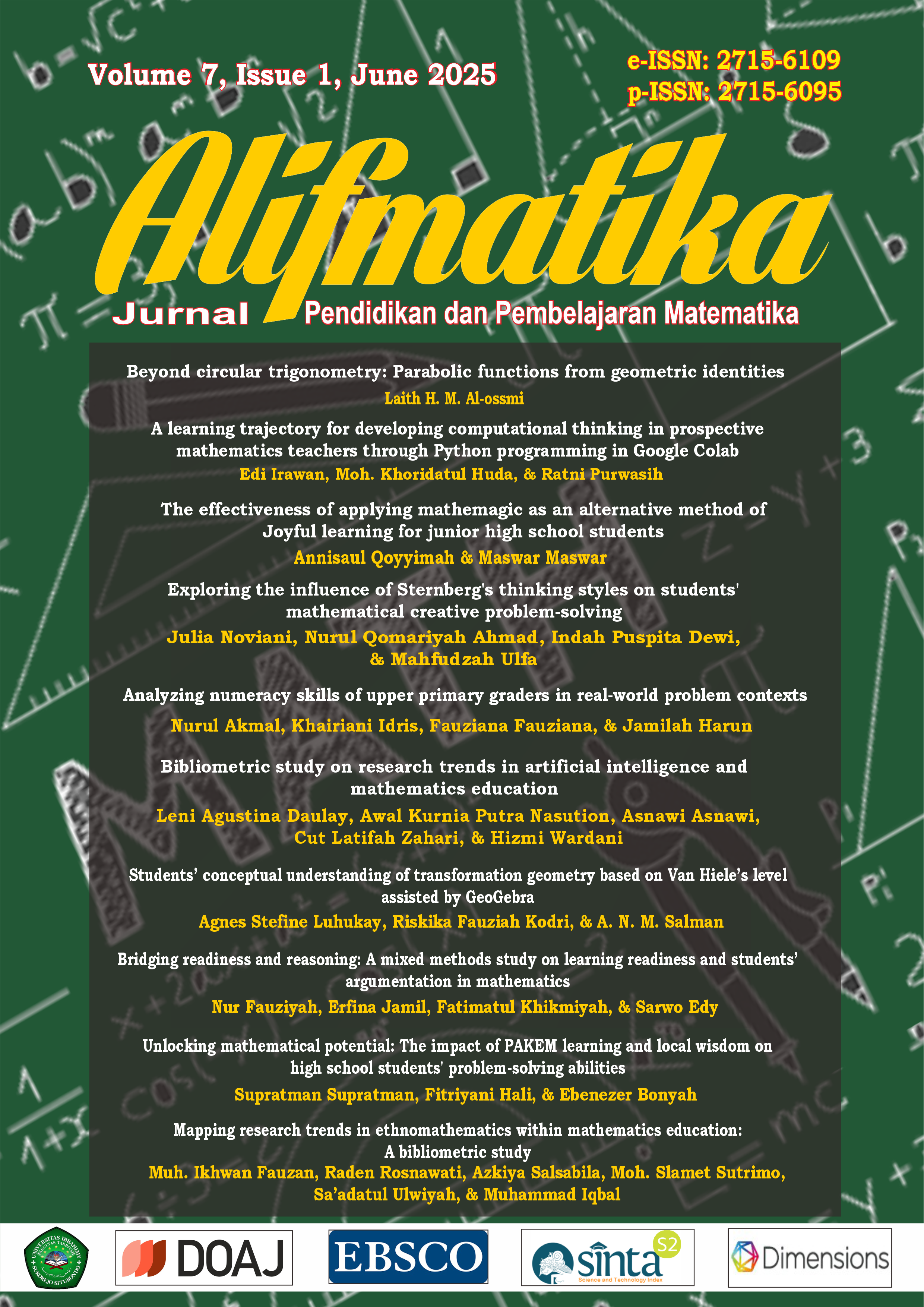
Students’ conceptual understanding of transformation geometry based on Van Hiele’s level assisted by GeoGebra
DOI:
https://doi.org/10.35316/alifmatika.2025.v7i1.148-166Keywords:
Conceptual Understanding, GeoGebra, Merdeka Curriculum, Transformation Geometry, Van Hiele TheoryAbstract
Mathematics has lower accomplishment than other subjects, according to TIMSS in 2011 and 2015 and PISA in 2015 and 2018. Geometry and measuring are the topics with the fewest right answers in the most recent National Exams, which were held in 2018 and 2019. According to the Minister of Education and Culture Regulation No. 16 of 2022, instructors must be able to use technology and communication devices in the learning process. The purpose of this study is to see how Van Hiele theory, helped by the Geogebra application, affects students' conceptual grasp of the geometry transformation topic taught in the D phase of the Merdeka Curriculum at the junior high school level. The subjects of this research were 55 students of grade IX who were divided into two groups, namely the experimental class which received learning with the application of Van Hiele theory assisted by the Geogebra application and the control class which applied conventional learning. The research was conducted using a mixed-methods approach, which combines both quantitative and qualitative methodologies. By using the Mann Whitney test on student score data of both class, it was concluded that there was no significant effect on level 0-visualization, level 1-analysis, and level 2-informal deduction, but there was a significant effect on students' abilities at level 3-deduction and level 4-rigor, which means that students who are taught using Van Hiele learning theory assisted by the Geogebra application have better conceptual understanding than students who are taught conventionally.
Downloads
References
Akinpelu, G. A., Akinpelu, S. A., Folorunsho, M. S., Ameen, K. S., Adebayo, S. R., & Daramola, C. Y. (2025). Impact of mastery learning instructional scheme on post-basic school students’ engagement levels in mathematics in Osogbo, Nigeria. Discover Education, 4(1), 1–18. https://doi.org/10.1007/s44217-025-00535-1
Arbain, N., & Shukor, N. A. (2015). The effects of GeoGebra on students achievement. Procedia-Social and Behavioral Sciences, 172(1), 208–214. https://doi.org/10.1016/j.sbspro.2015.01.356
Badan Standar Kurikulum dan Asesmen Pendidikan. (2022). Capaian pembelajaran mata pelajaran matematika fase A - fase F [Learning outcomes for mathematics subjects phase A - phase F]. Kementrian Pendidikan Dan Kebudayaan Riset Dan Teknologi Republik Indonesia, 11–12.
Budiman, H., & Rosmiati, M. (2020). Penerapan teori belajar van hiele berbantuan geogebra untuk meningkatkan kemampuan penalaran matematis siswa [Application of Van Hiele's learning theory assisted by Geogebra to improve students' mathematical reasoning abilities]. Prisma, 9(1), 47. https://doi.org/10.35194/jp.v9i1.845
Budiono, & Prasetia, A. (2022). Studi perbandingan hasil uji Wilcoxon pada data hasil pengukuran dan hasil kategori data penelitian kesehatan tingkat stress tekanan darah dan motorik halus [Comparative study of the results of the Wilcoxon test on measurement data and the results of health research data categories on stress levels, blood pressure and fine motor skills]. Jurnal Ilmiah Pamenang, 4(2), 8–15. https://doi.org/10.53599/jip.v4i2.94
Ghorbani, M., Izadi, F. S., Roshan, S. S., & Ebrahimpour, R. (2023). Assessing prospective teachers’ geometric transformations thinking: A Van Hiele theory-based analysis with eye tracking cognitive science method. Technology of Education Journal (TEJ), 18(1), 67–88. https://doi.org/10.22061/tej.2023.10350.2997
Gradini, E., Noviani, J., & Ulya, K. (2025). Fostering higher-order thinking skills in mathematics education: Strategies, challenges, and classroom practices. Prisma Sains: Jurnal Pengkajian Ilmu Dan Pembelajaran Matematika Dan IPA IKIP Mataram, 13(2), 135–163. https://doi.org/10.33394/j-ps.v13i2.15099
Handayani, E. D., Kusnawati, E., Sari, N. M., Yaniawati, P., & Zulkarnaen, M. I. (2022). Implementation of geogebra-assisted creative problem-solving model to improve problem solving ability and learning interest students. Al-Jabar: Jurnal Pendidikan Matematika, 13(1), 33–48. https://doi.org/10.24042/ajpm.v13i1.11341
Hearn, D. D., Baker, M. P., & Carithers, W. (2010). Computer graphics with open GL. Prentice Hall Press.
Kemendikbud. (2019). Peraturan Menteri Pendidikan dan Kebudayaan Republik Indonesia nomor 6 tahun 2019 tentang pedoman organisasi dan tata kerja satuan pendidikan dasar dan menengah [Regulation of the Minister of Education and Culture of the Republic of Indonesia Number 6 of 2019 concerning guidelines for the organization and work procedures of elementary and secondary education units]. Peraturan Menteri Pendidikan Dan Kebudayaan Republik Indonesia.
Kemendikbud, K. P. dan K. (2025). Hasil UN - pusat asesmen dan pembelajaran [UN Results - assessment and learning center]. Pusat Asesmen Dan Pembelajaran (Pusmenjar).
Kemendikbudristek. (2024). Peraturan Menteri Pendidikan, Kebudayan, Riset, dan Teknologi Nomor 032/H/KR/2024 [Regulation of the Minister of Education, Culture, Research, and Technology Number 032/H/KR/2024] (Issue 021).
Kim, T. K., & Park, J. H. (2019). More about the basic assumptions of t-test: normality and sample size. Korean Journal of Anesthesiology, 72(4), 331–335. https://doi.org/10.4097/kja.d.18.00292
Kusnendi, M. S. (2008). Model-model persamaan struktural [Structural equation models]. Alfabeta.
Mahlaba, S. C., & Mudaly, V. (2022). Exploring the relationship between commognition and the Van Hiele theory for studying problem-solving discourse in Euclidean geometry education. Pythagoras, 43(1), 1–11. https://doi.org/10.4102/pythagoras.v43i1.659
Mega, C., Ronconi, L., & De Beni, R. (2014). What makes a good student? How emotions, self-regulated learning, and motivation contribute to academic achievement. Journal of Educational Psychology, 106(1), 121. https://doi.org/10.1037/a0033546
Montolalu, C., & Langi, Y. (2018). Pengaruh pelatihan dasar komputer dan teknologi informasi bagi guru-guru dengan uji-T berpasangan (paired sample T-test) [The effect of basic computer and information technology training for teachers using paired sample T-test]. D’CARTESIAN, 7(1), 44. https://doi.org/10.35799/dc.7.1.2018.20113
Nurjaman, A., & Sari, I. P. (2017). The effect of problem posing approach towards students’ mathematical disposition, critical & creative thinking ability based on school level. Infinity Journal. https://doi.org/10.22460/infinity.v6i1.223
OECD. (2023). PISA 2022 Results (Volume II). OECD. https://doi.org/10.1787/a97db61c-en
Permendikbudristek. (2022). P Peraturan menteri pendidikan kebudayaan riset dan teknologi tentang standar proses pada pendidikan usia dini, jenjang pendidikan dasar dan jenjang pendidikan menengah [Regulation of the Minister of Education, Culture, Research and Technology concerning process standards in early childhood education, elementary education and secondary education]. Peraturan Menteri Pendidikan Dan Kebudayaan Republik Indonesia Nomor 16 Tahun 2022 Tentang Standar Proses Pendidikan Dasar Dan Menengah, 1(69), 5–24.
Pluye, P., & Hong, Q. N. (2014). Combining the power of stories and the power of numbers: mixed methods research and mixed studies reviews. Annual Review of Public Health, 35(1), 29–45. https://doi.org/10.1146/annurev-publhealth-032013-182440
Prastyo, H. (2020). Kemampuan matematika siswa indonesia berdasarkan TIMSS [Indonesian students' mathematical abilities based on TIMSS]. Jurnal Padegogik, 3(2), 111–117. https://doi.org/10.35974/jpd.v3i2.2367
Primasatya, N., & Jatmiko, J. (2018). Implementation of geometry multimedia based on van Hiele’s thinking theory for enhancing critical thinking ability for grade v students. International Journal of Trends in Mathematics Education Research, 1(2), 56–59. https://doi.org/10.33122/ijtmer.v1i2.40
Radović, S., Radojičić, M., Veljković, K., & Marić, M. (2020). Examining the effects of Geogebra applets on mathematics learning using interactive mathematics textbook. Interactive Learning Environments, 28(1), 32–49. https://doi.org/10.1080/10494820.2018.1512001
Schneider, M., & Preckel, F. (2017). Variables associated with achievement in higher education: A systematic review of meta-analyses. Psychological Bulletin, 143(6), 565. https://doi.org/10.1037/bul0000098
Siagian, T. A., Sumardi, H., Bimansah, R., & Nesta, R. A. (2023). 29218-Article Text-83318-97525-10-20240111. 21(02), 329–342.
TIMSS. (2023). TIMSS 2015. In the OSCE Code of Conduct on Politico-Military Aspects of Security.
Tohir, M. (2019). Hasil PISA Indonesia Tahun 2018 [Indonesian PISA Results 2018]. Paper of Matematohir.
Uwurukundo, M. S., Maniraho, J. F., & Tusiime, M. (2022). Enhancing students’ attitudes in learning 3-dimension geometry using GeoGebra. International Journal of Learning, Teaching and Educational Research, 21(6), 286–303. https://doi.org/10.26803/ijlter.21.6.17
Zulkardi, Z., Meryansumayeka, M., Putri, R. I. I., Alwi, Z., Nusantara, D. S., Ambarita, S. M., Maharani, Y., & Puspitasari, L. (2020). How students work with pisa-like mathematical tasks using covid-19 context. Journal on Mathematics Education, 11(3), 405–416. https://doi.org/10.22342/jme.11.3.12915.405-416
Downloads
Published
How to Cite
Issue
Section
License
Copyright (c) 2025 Alifmatika: Jurnal Pendidikan dan Pembelajaran Matematika

This work is licensed under a Creative Commons Attribution-ShareAlike 4.0 International License.
COPYRIGHT NOTICE
Author (s) who publish in Alifmatika: Jurnal Pendidikan dan Pembelajaran Matematika agree to the following terms:
- The Author (s) submitting a manuscript do so on the understanding that if accepted for publication, copyright of the article shall be assigned to Alifmatika: Jurnal Pendidikan dan Pembelajaran Matematika, Tarbiyah Faculty of Ibrahimy University as the publisher of the journal. Consecutively, author(s) still retain some rights to use and share their own published articles without written permission from Alifmatika: Jurnal Pendidikan dan Pembelajaran Matematika. This work is licensed under a Creative Commons Attribution-ShareAlike 4.0 International License.
- Copyright encompasses rights to publish and provide the manuscripts in all forms and media for the purpose of publication and dissemination, and the authority to enforce the rights in the manuscript, for example in the case of plagiarism or in copyright infringement.
- Alifmatika: Jurnal Pendidikan dan Pembelajaran Matematika and the Editors make every effort to ensure that no wrong or misleading data, opinions or statements be published in the journal. In any way, the contents of the articles and advertisements published in Alifmatika: Jurnal Pendidikan dan Pembelajaran Matematika are the sole responsibility of their respective authors and advertisers.
- The Copyright Transfer Form can be downloaded here [Copyright Transfer Form Alifmatika]. The copyright form should be signed originally and send to the Editorial Office in the form of original mail, scanned document to alifmatika[at]ibrahimy.ac.id or upload the scanned document in the comments column when sending the manuscript.












_by_Matematohir.jpg)