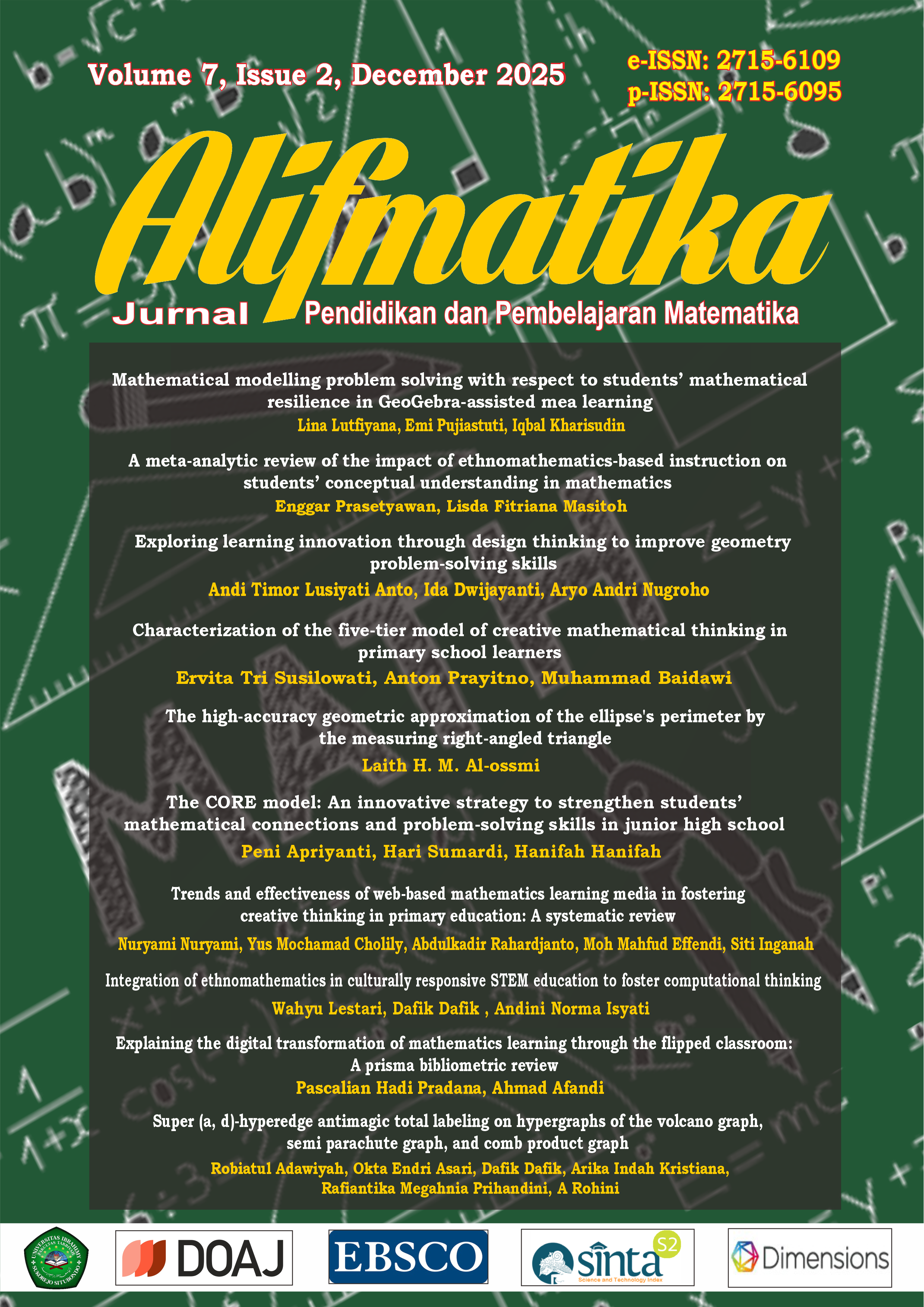
Characterization of the five-tier model of creative mathematical thinking in primary school learners
DOI:
https://doi.org/10.35316/alifmatika.2025.v7i2.295-309Keywords:
Creative Mathematical Thinking, Elementary Students, Open-Ended Tasks, Ordinal Data, Subanji Five-Stage ModelAbstract
Creative mathematical thinking skills among elementary students remain relatively low, largely due to predominantly procedural instruction, highlighting the need to examine the characteristics of their innovative thinking stages in solving data processing problems using the Subanji five-stage model. The study aimed to identify and describe students’ creative thinking patterns in handling ordinal data through the stages of pre-imitation, imitation, modification, combination, and construction. Employing a qualitative case study approach, data were collected from 38 fifth-grade students in Malang through open-ended tasks, think-aloud protocols, interviews, and documentation. The analysis involved data reduction and triangulation. Results revealed the distribution of students across stages: 10.53% at pre-imitation, 34.21% imitation, 23.68% modification, 18.42% combination, and 13.16% construction. Students showed a progression from routine and imitative approaches to independently constructed strategies, such as assigning weighted scores to ranked data and analyzing the frequency of options. These findings suggest that the Subanji model effectively captures the development of creative mathematical thinking and support the integration of open-ended tasks and scaffolded guidance to foster creativity in mathematics learning.
Downloads
References
Atmaja, S. A. A., Nusantara, T., & Subanji, S. (2023). Berpikir kreatif siswa dalam menyelesaikan permasalahan kontroversial matematis [Students' creative thinking in solving controversial mathematical problems]. AKSIOMA: Jurnal Program Studi Pendidikan Matematika, 12(1), 1240. https://doi.org/10.24127/ajpm.v12i1.6764
Clark, Q. M. (2024). A pedagogical approach: toward leveraging mathematical modeling and AI to support integrating humanities into STEM education. Frontiers in Education, 9, 1396104. https://doi.org/10.3389/FEDUC.2024.1396104/BIBTEX
Creswell, J. W. (2009). Research design qualitative, quantitative, and mixed approaches (3rd ed). SAGE.
Daiana, P., Surahmat, S., & Fathani, A. H. (2021). Profile of students’ mathematical creative thinking ability in solving mathematical problem. Formatif: Jurnal Ilmiah Pendidikan MIPA, 11(1), 49–62. https://doi.org/10.30998/formatif.v11i1.7810
Gavrilović, B. (2023). Mathematical modeling in teaching using data analytics. Norma. https://doi.org/10.5937/norma2301079g
Hill, H. C., Ball, D. L., & Schilling, S. G. (2008). Unpacking Pedagogical Content Knowledge: Conceptualizing and Measuring Teachers’ Topic-Specific Knowledge of Students. Journal for Research in Mathematics Education, 39(4), 372–400. https://doi.org/10.5951/jresematheduc.39.4.0372
Iamcham, N., & Chanchusakun, S. (2024). The effect of the mathematics instruction model on enhancing mathematical thinking. International Journal of Evaluation and Research in Education (IJERE), 13(5), 3130–3138. https://doi.org/10.11591/IJERE.V13I5.29609
Koparan, T., Dinar, H., Koparan, E. T., & Haldan, Z. S. (2023). Integrating augmented reality into mathematics teaching and learning and examining its effectiveness. Thinking Skills and Creativity, 47, 101245. https://doi.org/10.1016/J.TSC.2023.101245
Fathoni, I. M., Isnarto, & Haryani, S. (2018). Mathematically creative thinking abilities students of elementary school on learning inquiry training based on learningstyle article info. Journal of Primary Education JPE, 7(2), 121–128. https://journal.unnes.ac.id/sju/index.php/jpe/article/view/23160
Mullis, I. V. S., Martin, M. O., Foy, P., Kelly, D. L., Fishbein, B., & Pirls, T. &. (2020). International results in mathematics and science timss & pirls. TIMSS & PIRLS International Study Center, Boston College.
Ndiung, S., & Menggo, S. (2024). Project-based learning in fostering creative thinking and mathematical problem-solving skills: evidence from primary education in indonesia. International Journal of Learning, Teaching and Educational Research, 23(8), 289–308. https://doi.org/10.26803/ijlter.23.8.15
OECD. (2023). Pisa 2022 Results. In Factsheets: Vol. I. https://www.oecd-ilibrary.org/education/pisa-2022-results-volume-i_53f23881-en%0Ahttps://www.oecd.org/publication/pisa-2022-results/country-notes/germany-1a2cf137/
Prayitno, A., & Widayanti, F. D. (2020). Identification of student thinking error patterns in construction of mathematical proof. Üniversitepark Bülten, 9(1), 7–14. https://doi.org/10.22521/unibulletin.2020.91.1
Prayitno, A., & Widayanti, F. D. (2024). Unveiling students’ refractive thinking process who use a single strategy in decision making. Edumatika : Jurnal Riset Pendidikan Matematika, 7(2). https://doi.org/10.32939/EJRPM.V7I2.3868
Rundquist, R., Holmberg, K., Rack, J., Mohseni, Z., & Masiello, I. (2024). Use of learning analytics in K–12 mathematics education: systematic scoping review of the impact on teaching and learning. Journal of Learning Analytics, 11(3), 174–191. https://doi.org/10.18608/jla.2024.8299
Shaw, S. T., Luna, M. L., Rodriguez, B., Yeh, J., Villalta, N., & Ramirez, G. (2022). Mathematical creativity in elementary school children: general patterns and effects of an incubation break. Frontiers in Education, 7(March), 1–8. https://doi.org/10.3389/feduc.2022.835911
Subanji, Nusantara, T., Sukoriyanto, & Atmaja, S. A. A. (2023). Student’s creative model in solving mathematics controversial problems. Cakrawala Pendidikan, 42(2), 310–326. https://doi.org/10.21831/cp.v42i2.55979
Syolendra, D. F., & Laksono, E. W. (2019). The effect of discovery learning on students’ integrated thinking abilities and creative attitudes. Journal of Physics: Conference Series, 1156(1). https://doi.org/10.1088/1742-6596/1156/1/012018
Downloads
Published
How to Cite
Issue
Section
License
Copyright (c) 2025 Alifmatika: Jurnal Pendidikan dan Pembelajaran Matematika

This work is licensed under a Creative Commons Attribution-ShareAlike 4.0 International License.
COPYRIGHT NOTICE
Author (s) who publish in Alifmatika: Jurnal Pendidikan dan Pembelajaran Matematika agree to the following terms:
- The Author (s) submitting a manuscript do so on the understanding that if accepted for publication, copyright of the article shall be assigned to Alifmatika: Jurnal Pendidikan dan Pembelajaran Matematika, Tarbiyah Faculty of Ibrahimy University as the publisher of the journal. Consecutively, author(s) still retain some rights to use and share their own published articles without written permission from Alifmatika: Jurnal Pendidikan dan Pembelajaran Matematika. This work is licensed under a Creative Commons Attribution-ShareAlike 4.0 International License.
- Copyright encompasses rights to publish and provide the manuscripts in all forms and media for the purpose of publication and dissemination, and the authority to enforce the rights in the manuscript, for example in the case of plagiarism or in copyright infringement.
- Alifmatika: Jurnal Pendidikan dan Pembelajaran Matematika and the Editors make every effort to ensure that no wrong or misleading data, opinions or statements be published in the journal. In any way, the contents of the articles and advertisements published in Alifmatika: Jurnal Pendidikan dan Pembelajaran Matematika are the sole responsibility of their respective authors and advertisers.
- The Copyright Transfer Form can be downloaded here [Copyright Transfer Form Alifmatika]. The copyright form should be signed originally and send to the Editorial Office in the form of original mail, scanned document to alifmatika[at]ibrahimy.ac.id or upload the scanned document in the comments column when sending the manuscript.















_by_Matematohir.jpg)