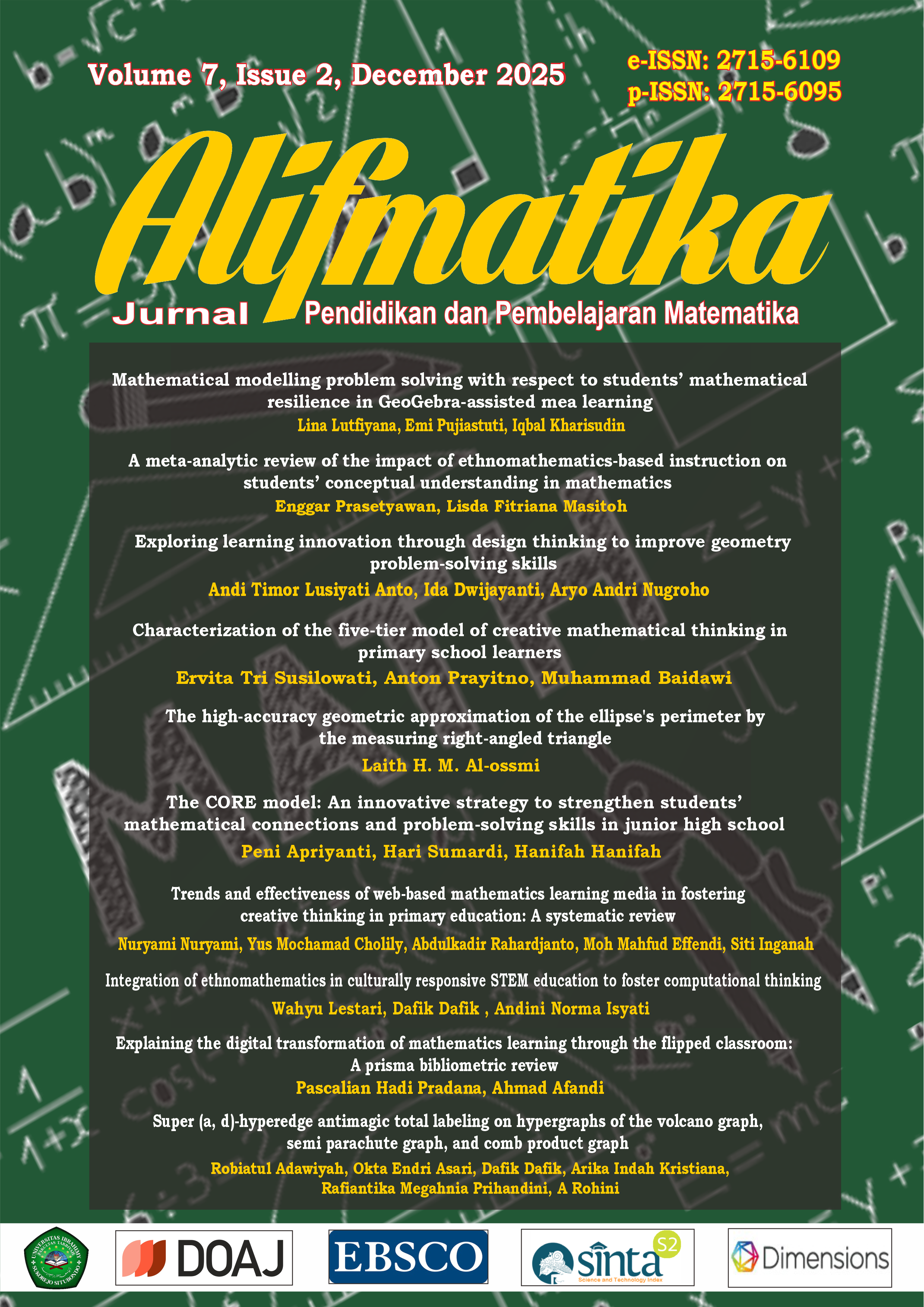
Mathematical modelling problem solving with respect to students’ mathematical resilience in GeoGebra-assisted mea learning
DOI:
https://doi.org/10.35316/alifmatika.2025.v7i2.233-259Keywords:
Mathematical Modelling, Mathematical Resilience, MEA, Problem-Solving, GeoGebraAbstract
Problem-solving is a crucial 21st-century skill that plays a vital role in mathematics education. One practical approach to developing this skill is through mathematical modelling, particularly by employing GeoGebra-assisted MEA learning. This study aims to: (1) evaluate the quality of GeoGebra-assisted MEA learning; (2) examine the influence of mathematical resilience on Mathematical Modelling Problem-Solving Ability (MMPSA); and (3) describe students’ MMPSA based on their levels of mathematical resilience. A mixed-methods approach was employed using a Sequential Explanatory design, with instruments including questionnaires, tests, observations, and interviews. The sample consisted of Class VII A as the experimental group and Class VII B as the control group, each comprising 30 students. Eight students were selected as qualitative subjects based on their mathematical resilience levels. The results indicate that GeoGebra-assisted MEA learning demonstrates high instructional quality and significantly enhances students’ MMPSA. Quantitative findings show that mathematical resilience has a significant effect, accounting for 30% of the variance in students’ problem-solving performance. These results are further supported by qualitative data obtained through observations and interviews. Students with high resilience tended to be confident, persistent, and effective in solving problems. Those with moderate resilience showed adequate capability but lacked precision, while students with low resilience were easily discouraged and exhibited low self-confidence. In conclusion, integrating quantitative and qualitative findings underscores the importance of fostering mathematical resilience to enhance students’ problem-solving abilities, particularly in the context of GeoGebra-assisted MEA in mathematical modelling.
Downloads
References
Akkan, S. N., & Horzum, T. (2024). Illuminating the landscape of mathematical resilience: A systematic review. Journal of Pedagogical Research, 8(1), 312–338. https://doi.org/10.33902/JPR.202420093
Ansori, A. (2020). Analisis kemampuan resiliensi dalam meningkatkan kemampuan koneksi matematis siswa [Analysis of resilience ability in improving students' mathematical connection ability]. JPMI – Jurnal Pembelajaran Matematika Inovatif, 3(4), 353–362. https://doi.org/10.22460/jpmi.v3i4.353-362
Astrilian, I. A. K. C., & Wibawa, K. A., & Wulandari, I. G. A. P. A. (2025). Pembelajaran discovery learning berbantuan geogebra untuk meningkatkan pemahaman matematis siswa pada materi bangun ruang sisi lengkung kelas IX-4 SMP Negeri 7 Denpasar [Geogebra-assisted discovery learning to improve students' mathematical understanding of curved-sided geometric shapes in class IX-4 of SMP Negeri 7 Denpasar]. Jurnal Pembelajaran Dan Pengembangan Matematika (PEMANTIK), 5(1), 55-65. https://doi.org/10.36733/pemantik.v5i1.11378
’Athiyah, F., Umah, U., & Syafrudin, T. (2020). Pengaruh mathematical resilience terhadap kemampuan pemecahan masalah matematis siswa [The influence of mathematical resilience on students' mathematical problem-solving abilities]. JKPM (Jurnal Kajian Pendidikan Matematika), 5(2), 223–234. http://doi.org/10.30998/jkpm.v5i2.5286
Bliss, K., & Libertini, J. (2016). GAIMME: Guidelines for Assessment & Instruction in Mathematical Modelling Education. United State America: COMAP & SIAM.
Daud, J. M. (2021). Pengaruh model pembelajaran means ends analysis (MEA) terhadap hasil belajar siswa pada muatan pelajaran IPA kelas IV SDN 8 Tilongkabila Kabupaten Bonebolango [The influence of the means ends analysis (MEA) learning model on student learning outcomes in the science subject matter of class IV SDN 8 Tilongkabila, Bonebolango Regency]. Pascasarjana Universitas Negeri Gorontalo Prosiding Seminar Nasional Pendidikan Dasar “Merdeka Belajar dalam Menyambut Era Masyarakat 5.0”. https://ejurnal.pps.ung.ac.id/index.php/PSNPD/article/view/1059
Davita, P. W. C., & Pujiastuti, H. (2020). Anallisis kemampuan pemecahan masalah matematika ditinjau dari gender [Analysis of mathematical problem solving ability from a gender perspective]. Kreano, Jurnal Matematika Kreatif-Inovatif, 11(1), 110–117. https://doi.org/10.15294/kreano.v11i1.23601
Denada, E., Laila, F. M., & Simanullang, M. C. (2025). Pengaruh penerapan augmented reality GeoGebra terhadap kemampuan pemecahan masalah pada mahasiswa jurusan matematika dalam materi elemen maksimum dan minimum pada sistem bilangan real [The effect of applying GeoGebra augmented reality on problem-solving abilities of mathematics students in the material of maximum and minimum elements in the real number system]. Jurnal Pendidikan MIPA, 15(1), 2621-9166. https://doi.org/10.37630/jpm.v15i1.2602
Dwikoranto, Munasir, Setiani, R., Suyitno, Surasmi, W. A., Tresnaningsih, S., & Pramonoadi. (2020). Increasing the potential of student science process skills through project based laboratory. Journal Of Physics: Conference Series, 1569(4), 042066. https://doi.org/10.1088/1742-6596/1569/4/042066
Elmujahidah, R. I., Mulyono, & Banjarnahor, H. (2019). Mathematical communicaton capability and learning motivation by using means-ends analysis (MEA) learning model in Grade VIII students at MTs. Al-Washliyah Tembung. Journal of Education and Practice, 10(32), 45–50. https://doi.org/10.7176/jep/10-32-05
Fatimah, A. E., Purba, A., & Siregar, Y. A. (2020). Hubungan resiliensi matematis terhadap kemampuan pemecahan masalah matematis mahasiswa pada mata kuliah matematika dasar [The relationship between mathematical resilience and students' mathematical problem-solving abilities in basic mathematics courses]. Journal of Didactic Mathematics, 1(3), 151-157.
Farhan, M. (2020). Kontribusi resiliensi matematis terhadap kemampuan pemecahan masalah pada matakuliah matematika diskrit [The contribution of mathematical resilience to problem-solving abilities in discrete mathematics courses]. Prosiding Seminar Nasional Sains, 1(1), 392–397.
Fitriani, F., Hayati, R., Sugeng, S., Srimuliati, S., & Herman, T. (2022). Students’ Ability to Solve Mathematical Problems Through Polya Steps. Journal of Engineering Science and Technology Special Issue on ICMScE2022, 25–32. https://jestec.taylors.edu.my/Special%20Issue%20ICMScE2022/ICMScE2022_04.pdf
Fitriani, Herman, T., & Fatimah, S. (2023). Considering the mathematical resilience in analyzing students’ problem-solving ability through learning model experimentation. International Journal of Instruction, 16(1), 219–240. https://doi.org/10.29333/iji.2023.16113a
Haerani, A., Novianingsih, K., & Turmudi. (2021). Analysis of students' errors in solving word problems viewed from mathematical resilience. JTAM (Jurnal Teori dan Aplikasi Matematika), 5(1), 246-253. https://doi.org/10.31764/jtam.v5i1.3928
Hamid, R. M., & Rosyidi, A. H. (2025). Pemodelan matematis kolaboratif siswa SMP pada materi fungsi linier [Collaborative mathematical modeling of junior high school students on linear function material]. Mathedunesa, 14(2). 515-539. https://doi.org/10.26740/mathedunesa.v14n2.p515-539
Harahap, I. H., & Manurung, A. A. (2022). Analisis pengaruh resiliensi terhadap kemampuan pemecahan masalah matematis siswa di MTs Ruhul Islam Sialambue [Analysis of the influence of resilience on students' mathematical problem-solving abilities at MTs Ruhul Islam Sialambue]. Jurnal Edu Tech, 8(1), 94-97. https://doi.org/10.30596/edutech.v8i1.9962
Hermawan, T., Santoso, F. S., & Putra, A. P. (2025). Pengaruh penggunaan GeoGebra terhadap kemampuan pemecahan masalah matematis ditinjau dari self-efficacy siswa [The effect of using GeoGebra on mathematical problem-solving abilities viewed from students' self-efficacy]. Indo-Mathedu Intellectuals Journal, 6(2), 2672-2678. https://doi.org/10.54373/imeij.v6i2.2835
Karolina, A., Nurdiana, A., & Parsatiwi, N. (2021). Pengaruh model pembelajaran means ends analysis (mea) terhadap kemampuan pemecahan masalah matematika siswa kelas VIII semester ganjil SMP PGRI 2 Bandar Lampung tahun pelajaran 2021/2022 [The influence of the means-ends analysis (MEA) learning model on the mathematical problem-solving abilities of eighth-grade students in the odd semester of SMP PGRI 2 Bandar Lampung in the 2021/2022 academic year.]. Jurnal Ilmiah Mahasiswa Pendidikan Matematika (JMPM), 3(1), 1–15. https://eskripsi.stkippgribl.ac.id/index.php/matematika/article/view/19
Kharisudin, I., & Cahyati, N. E. (2020). Problem-Solving ability using mathematical modelling strategy on model eliciting activities based on mathematics self-concept. Journal of Physics: Conference Series, 1567(3). https://doi.org/10.1088/1742-6596/1567/3/032067
Klang, N., Karlsson, N., Kilborn, W., Eriksson, P., & Karlberg, M. (2021). Mathematical problem-solving through cooperative learning the importance of peer acceptance and friendships. Frontiers in Education, 6. https://doi.org/10.3389/feduc.2021.710296
Lee, C., & Ward-Penny, R. (2022). Agency and fidelity in primary teachers’ efforts to develop mathematical resilience. Teacher Development, 26(1), 75–93. https://doi.org/10.1080/13664530.2021.2006768
Ling, A. N. B., & Mahmud, M. S. (2023). Challenges of teachers when teaching sentence-based mathematics problem-solving skills. Frontiers in Psychology, 13. https://doi.org/10.3389/fpsyg.2022.1074202
Lutfiyana, L., Pujiastuti, E., & Kharisudin, I. (2023). Systematic Literature Review: Resiliensi matematis dan kemampuan pemecahan masalah matematis [Systematic Literature Review: Mathematical resilience and mathematical problem-solving ability]. Jurnal Cendekia : Jurnal Pendidikan Matematika, 7(3), 2167–2177. https://doi.org/10.31004/cendekia.v7i3.2445
Maharani, S., & Bernard, M. (2018). Analisis hubungan resiliensi matematik terhadap kemampuan pemecahan masalah siswa pada materi lingkaran [Analysis of the relationship between mathematical resilience and students' problem-solving abilities on circle material]. JPMI: Jurnal Pembelajaran Matematika Inovatif, 1(5), 819–826. https://doi.org/10.22460/jpmi.v1i5.p819-826
Miranti, N. K., Agoestanto, A., & Kurniasih, A. W. (2015). Komparasi pembelajaran MEA dan PBL terhadap kemampuan pemecahan masalah dan disposisi matematis siswa SMP kelas VIII pada materi SPLDV [Comparison of MEA and PBL learning on problem-solving abilities and mathematical dispositions of eighth grade junior high school students on SPLDV material]. UJME: Unnes Journal of Mathematics Education, 4(3), 213–221. https://doi.org/10.15294/ujme.v4i3.9061
Mukarramah, M., Edy, S., & Suryanti, S. (2022). Pengaruh penggunaan software GeoGebra terhadap kemampuan pemahaman konsep dan pemecahan masalah matematika peserta didik SMP [The effect of using GeoGebra software on the ability to understand concepts and solve mathematical problems of junior high school students]. JIPM (Jurnal Ilmiah Pendidikan Matematika), 11(1), 67. https://doi.org/10.25273/jipm.v11i1.13309
Nadia, R., Musriandi, R., Aryani, I., Anzora, & Rahmi. (2025). Pengaruh model pembelajaran means ends analysis (MEA) berbantuan software bagatrix terhadap kemampuan pemecahan masalah matematis [The influence of the means ends analysis (MEA) learning model assisted by Bagatrix software on mathematical problem solving abilities]. Jurnal Dedikasi Pendidikan, 9(1), 517-528. https://doi.org/10.30601/dedikasi.v9i1.4516
Nurfitri, R. A., & Jusra, H. (2021). Analisis kemampuan pemecahan masalah matematis peserta didik ditinjau dari resiliensi matematis dan gender [Analysis of students' mathematical problem-solving abilities in terms of mathematical resilience and gender]. Jurnal Cendekia : Jurnal Pendidikan Matematika, 5(2), 1943–1954. https://doi.org/10.31004/cendekia.v5i2.723
Prahani, B. K., Suprapto, N., Rachmadiarti, F., Sholahuddin, A., Mahtari, S., Suyidno, & Siswanto, J. (2021). Online scientific creativity learning (OSCL) in science education to improve students’ scientific creativity in Covid-19 Pandemic. Journal Of Turkish Science Education, 18(1), 77-90. https://doi.org/10.36681/tused.2021.73
Rahmatiya, R., & Miatun, A. (2020). Analisis kemampuan pemecahan masalah matematis ditinjau dari resiliensi matematis siswa SMP [Analysis of mathematical problem solving abilities viewed from the perspective of junior high school students' mathematical resilience]. Teorema: Teori Dan Riset Matematika, 5(2), 187. https://doi.org/10.25157/teorema.v5i2.3619
Ramadannia, C., Nasrullah, A., Yendra, N., Sukmawati, S., & Ratnasari, S. (2024). Implementasi GeoGebra pada numbered head together terhadap kemampuan pemecahan masalah matematis dan keaktifan belajar siswa SMP [Implementation of GeoGebra in Numbered Heads Together on the Mathematical Problem Solving Ability and Learning Activeness of Junior High School Students]. JPMI (Jurnal Pembelajaran Matematika Inovatif), 7(1), 261–272. https://doi.org/10.22460/jpmi.v7i1.21497
Rohantizani, Nuraina, & Hayati, R. (2025). Kemampuan pemecahan masalah dan resiliensi matematis melalui tinjauan pustaka sistematis [Mathematical problem-solving ability and resilience through a systematic literature review]. Jurnal Pendidikan Matematika Malikussaleh, 5(2), 259-271. https://doi.org/10.29103/jpmm.v5i2.22229
Rohmah, S., Kusmayadi, T. A., & Fitriana, L. (2020). The effect of the treffinger learning model on mathematical connection ability students viewed from mathematical resilience. International Journal of Multicultural and Multireligious Understanding, 7(5), 275–284. https://doi.org/10.18415/ijmmu.v7i5.1621
Sekali, E. C. B. K., & Boentolo, F. (2025). Pengaruh penggunaan media geogebra terhadap hasil belajar matematika bangun ruang [The influence of using GeoGebra media on the learning outcomes of spatial mathematics]. Aletheia, 6(1), 37-46. https://doi.org/10.9744/aletheia.6.1.37-46
Simbolon, A. K. (2020). Penggunaan software GeoGebra dalam meningkatkan kemampuan matematis siswa pada pembelajaran geometri di SMP N 2 Tanjung Morawa [The use of GeoGebra software to improve students' mathematical abilities in geometry learning at SMP N 2 Tanjung Morawa]. Jurnal Cendekia: Jurnal Pendidikan Matematika, 4(2), 1106–1114. https://doi.org/10.31004/cendekia.v4i2.351
Siregar, S., Syaban, M., & Irmawan. (2017). Penerapan model pembelajaran means ends-analisys (MEA) untuk meningkatkan kemampuan pemecahan masalah matematis [Application of the means-ends-analysis (MEA) learning model to improve mathematical problem-solving skills]. EDUCARE, 15(2), 55-66 https://jurnal.fkip.unla.ac.id/index.php/educare/article/view/221
Szabo, Z. K., Körtesi, P., Guncaga, J., Szabo, D., & Neag, R. (2020). Examples of problem-solving strategies in mathematics education supporting the sustainability of 21st-century skills. Sustainability (Switzerland), 12(23), 1–28. https://doi.org/10.3390/su122310113
Tabriji, J. (2025). Menciptakan lingkungan belajar yang menyenangkan untuk meningkatkan keaktifan siswa kelas III SDN Gempol Kolot 2 [Creating a fun learning environment to increase the activeness of grade III students at SDN Gempol Kolot 2]. Bhinneka: Jurnal Bintang Pendidikan dan Bahasa, 3(1), 58-66. https://doi.org/10.59024/bhinneka.v3i1.1132
Temur, Ö. D. (2012). Analysis of prospective classroom teachers’ teaching of mathematical modelling and problem solving. Eurasia Journal of Mathematics, Science & Technology Education, 8(2), 83–93. https://doi.org/10.12973/eurasia.2012.822a
Ulya, H., Sugiman, Rosnawati, R., & Retnawati, H. (2024). Technology-Based learning interventions on mathematical problem-solving: a meta-analysis of research in indonesia. International Journal of Evaluation and Research in Education, 13(1), 292–301. https://doi.org/10.11591/ijere.v13i1.26380
Verawati, N. N. S. P., Iswara, A., & Wahyudi. (2022). Validitas perangkat pembelajaran berbasis model kooperatif tipe student facilitator and explaining (SFAE) untuk meningkatkan hasil belajar fisika peserta didik [Validity of learning devices based on the cooperative model of the student facilitator and explaining (SFAE) type to improve students' physics learning outcomes]. Lensa: Jurnal Kependidikan Fisika, 10(1), 1-7. https://doi.org/10.33394/j-lkf.v10i1.5606
Wang, T., Zhang, L., Xie, Z., & Liu, J. (2023). How does mathematical modelling competency affect the creativity of middle school students? The roles of curiosity and guided inquiry teaching. Frontiers in Psychology, 13, 1–12. https://doi.org/10.3389/fpsyg.2022.1044580
Xenofontos, C., & Mouroutsou, S. (2023). Resilience in mathematics education research: a systematic review of empirical studies. Scandinavian Journal of Educational Research, 67(7), 1041–1055. https://doi.org/10.1080/00313831.2022.2115132
Xu, Z., & Qi, C. (2022). Middle school students’ mathematical problem-solving ability and the influencing factors in mainland China. Frontiers in Psychology, 13. https://doi.org/10.3389/fpsyg.2022.1042315
Zulkarnain, I., & Budiman, H. (2019). Pengaruh pemahaman konsep terhadap kemampuan pemecahan masalah matematika [The influence of conceptual understanding on mathematical problem solving ability]. Research and Development Journal of Education, 6(1). 18-27. http://doi.org/10.30998/rdje.v6i1.4093
Downloads
Published
How to Cite
Issue
Section
License
Copyright (c) 2025 Alifmatika: Jurnal Pendidikan dan Pembelajaran Matematika

This work is licensed under a Creative Commons Attribution-ShareAlike 4.0 International License.
COPYRIGHT NOTICE
Author (s) who publish in Alifmatika: Jurnal Pendidikan dan Pembelajaran Matematika agree to the following terms:
- The Author (s) submitting a manuscript do so on the understanding that if accepted for publication, copyright of the article shall be assigned to Alifmatika: Jurnal Pendidikan dan Pembelajaran Matematika, Tarbiyah Faculty of Ibrahimy University as the publisher of the journal. Consecutively, author(s) still retain some rights to use and share their own published articles without written permission from Alifmatika: Jurnal Pendidikan dan Pembelajaran Matematika. This work is licensed under a Creative Commons Attribution-ShareAlike 4.0 International License.
- Copyright encompasses rights to publish and provide the manuscripts in all forms and media for the purpose of publication and dissemination, and the authority to enforce the rights in the manuscript, for example in the case of plagiarism or in copyright infringement.
- Alifmatika: Jurnal Pendidikan dan Pembelajaran Matematika and the Editors make every effort to ensure that no wrong or misleading data, opinions or statements be published in the journal. In any way, the contents of the articles and advertisements published in Alifmatika: Jurnal Pendidikan dan Pembelajaran Matematika are the sole responsibility of their respective authors and advertisers.
- The Copyright Transfer Form can be downloaded here [Copyright Transfer Form Alifmatika]. The copyright form should be signed originally and send to the Editorial Office in the form of original mail, scanned document to alifmatika[at]ibrahimy.ac.id or upload the scanned document in the comments column when sending the manuscript.














_by_Matematohir.jpg)