STUDENTS' USE OF SOCIAL MEDIA: HOW IT EFFECT ON THE STUDENT TOLERANT CHARACTER AT MADRASAH?
DOI:
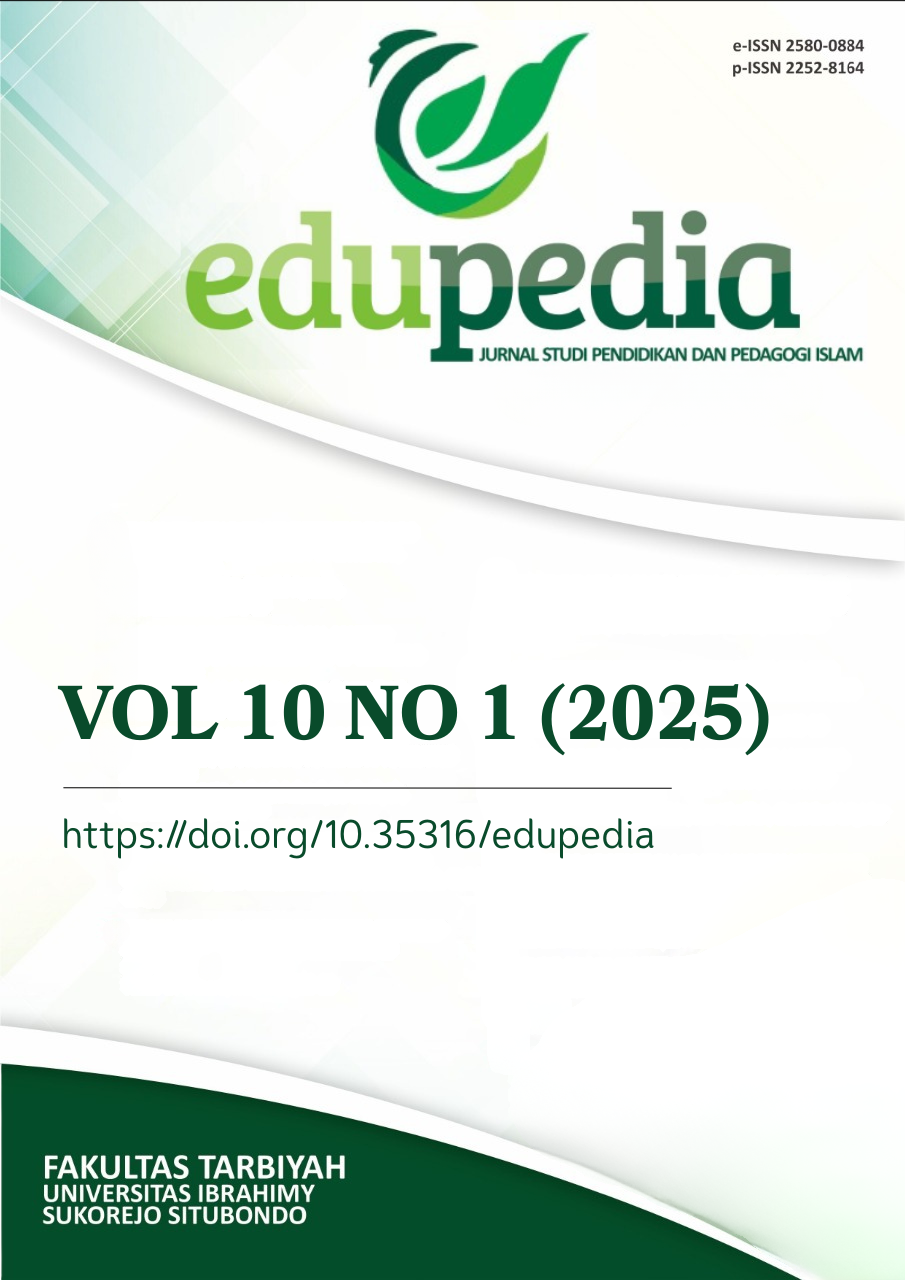
https://doi.org/10.35316/edupedia.v10i1.7221Keywords:
Social Media, Tolerant Character, Madrasah StudentAbstract
This study aims to determine the impact of the use of social media by students in madrasas on tolerant character. This research was conducted using a quantitative approach with a descriptive research method. The population of this study is madrasah students in Kebumen Regency. They were selected using the Simple Random Sampling method so that the number of samples taken was 75 students. Data was collected using a questionnaire distributed to respondents via GoogleForm. The results of the study showed that the intensity of social media use by students in madrasas was very high, namely 89%. This has a big impact on the tolerant character of students in madrasas, as evidenced by several aspects, including the content criteria that students see when using social media are in the high category with a percentage of 80%. In addition, student involvement in accessing content containing cultural or religious diversity values is very high with a percentage of 86%. Students’ interactions with individuals from different backgrounds when using social media are also very high with a percentage of 88%. The influence of social media on students' way of thinking about categorical differences is very high with a percentage of 92% and the use of social media as a means of learning about the importance of tolerance is very high with a percentage of 88%.
References
Abdellah Elfeky. (2017). Social Networks Impact factor on Students’ Achievements and Attitudes towards the “Computer in Teaching” Course at the College of Education. International Journal on E-Learning, 16(3), 231–244. Retrieved from https://www.learntechlib.org/primary/p/151873/
Aji, W. (2024). Humor untuk Mengatasi Ketegangan Teologis dan Potensi Konflik di Media Sosial. Jurnal Syntax Imperatif: Jurnal Ilmu Sosial Dan Pendidikan, 5(4), 725–743. doi: https://doi.org/10.36418/syntaximperatif.v5i4.459
Al Ketbi, N., Habes, M., Shaheen, L., Attar, R. W., Tahat, D., & Alhazmi, A. H. (2025). The impact of social media use on tolerance, community peace, online ethical awareness among adolescents in the United Arab Emirates. Frontiers in Psychology, 16(1), 1–10. doi: 10.3389/fpsyg.2025.1500727
Ardi, Z., & Putri, S. A. (2020). The analysis of the social media impact on the millennial generation behavior and social interactions. Southeast Asian Journal of Technology and Science, 1(2), 70–77. doi: https://doi.org/10.29210/81065100
Basuni, A. F., & Ningsih, T. (2025). Peran Media Sosial dalam Transformasi Proses Pembelajaran dan Interaksi Sosial pada Generasi Digital. Nusantara: Jurnal Pendidikan Indonesia, 5(1), 176–187. Retrieved from https://journal.rumahindonesia.org/index.php/njpi/index
Chudzaifah, I., & Rahmayanti, F. (2022). Pengaruh Media Sosial Terhadap Krisis Akhlak Peserta Didik. Transformasi : Jurnal Kepemimpinan & Pendidikan Islam, 6(1), 27–51. doi: 10.47945/transformasi.v6i1.817
Fajar, M., & Machmud, H. (2020). Penggunaan Media Sosial di Kalangan Siswa Sekolah Dasar. Diniyah : Jurnal Pendidikan Dasar, 1(1), 46–52. doi: 10.31332/dy.v1i1.1822
Gandara, Y., & Zulkifli. (2021). Urgensi Pembelajaran Nilai Berbasis Media Sosial untuk Menumbuhkan Keadaban Kewarganegaraan. Jurnal Educatio, 7(3), 713–723. doi: 10.31949/educatio.v7i3.1161
Gusti, Y., & Yulisamarhan. (2025). Dampak Penggunaan Media Sosial Terhadap Interaksi dan Kolaborasi Siswa Dalam Pembelajaran. Edu Research: Jurnal Penelitian Pendidikan, 6(1), 207–214. doi: https://doi.org/10.47827/jer.v6i1.519
Hew, W. W. (2018). THE ART OF DAKWAH : social media, visual persuasion and the Islamist propagation of Felix Siauw. Indonesia and the Malay World, 46(134), 61–79. doi: 10.1080/13639811.2018.1416757
Husain, S., & Wahyuni, A. E. D. (2021). Moderasi beragama berbasis tradisi pesantren pada Mahad Aly As’adiyah Sengkang Wajo Sulawesi Selatan. Harmoni, 20(1), 48–66. doi: Https://doi.org/10.32488/harmoni.v20i1.455
Ika Idris. (2024, November). Ujaran Kebencian di Pilkada Marak Bermunculan. Aliansi Jurnalis Independen, p. 1. Retrieved from https://aji.or.id/informasi/ujaran-kebencian-di-pilkada-marak-bermunculan
Kementerian Agama RI. (2019). Pedoman Implementasi Kurikulum Merdeka pada Madrasah.
Kemp, S. (2023). Digital 2023: Indonesia. Retrieved January 10, 2024, from Datereportal website: https://datareportal.com/reports/digital-2023-indonesia
Khairiyah, U. (2018). Respon Siswa Terhadap Media Dakon Matika Materi KPK dan FPB pada Siswa Kelas IV di SD/MI Lamongan. AL-MURABBI: Jurnal Studi Kependidikan Dan Keislaman, 5(2), 197–204. doi: 10.53627/jam.v5i2.3476
Kolhar, M., Kazi, R. N. A., & Alameen, A. (2021). Effect of social media use on learning, social interactions, and sleep duration among university students. Saudi Journal of Biological Sciences, 28(4), 2216–2222. doi: 10.1016/j.sjbs.2021.01.010
Lubis, D., & Siregar, H. S. (2021). Bahaya Radikalisme Terhadap Moralitas Remaja Melalui Teknologi Informasi (Media Sosial). Aplikasia: Jurnal Aplikasi Ilmu-Ilmu Agama, 20(1), 21–34. doi: 10.14421/aplikasia.v20i1.2360
Lukyanova, G. V. (2020). To Comment or Not to Comment: Communication Strategies of Social Media Commentators. IEEE Communication Strategies in Digital Society Seminar (ComSDS), 141–144. IEEE. doi: 10.1109/ComSDS49898.2020.9101250
Manisa, T., Aryati, E., & Marlina, R. (2018). Respon Siswa Terhadap LKS Berbasis Inkuiri Terbimbing Pada Submateri Sistem Pernapasan Manusia Kelas XI. Edukasi: Jurnal Pendidikan, 16(1), 1–10. doi: 10.31571/edukasi.v16i1.771
Mushodiq, M. A., & Saputra, A. A. (2021). Konsep Dinamika Kepribadian Amarah, Lamawah dan Mutmainnah Serta Relevansinya dengan Strukur Kepribadian Sigmund Freud. Bulletin of Counseling and Psychotherapy, 3(1), 38–48.
Nurman, Yusriadi, & Hamim, S. (2022). Development of Pluralism Education in Indonesia : A Qualitative Study. Journal of Ethnic and Cultural Studies, 9(3), 106–120. doi: http://dx.doi.org/10.29333/ejecs/1207 Copyright
Prastowo, A. (2013). Panduan Kreatif Membuat Bahan Ajar Inovatif. Jogjakarta: Diva Press.
Prihatiningsih, W. (2017). Motives for the Use of Instagram Social Media among Teenagers. Jurnal Communication, 8(1), 51–65. doi: https://doi.org/10.36080/comm.v8i1.651
Setiawan, D., Rahman, A., & Ramadhan, I. (2019). Pengaruh Media Sosial Terhadap Akhlak Siswa. Mozaic : Islam Nusantara, 5(1), 73–84. doi: 10.47776/mozaic.v5i1.133
Shofi Muzakki, A., Fitriyah, A., & Rizza, M. F. (2024). Digitalisasi Pendidikan Agama Islam Era Society 5.0: Mendorong Peningkatan Daya Saing Pendidikan di Indonesia. Mauriduna: Journal of Islamic Studies, 5(2), 679–689. doi: 10.37274/mauriduna.v5i2.1279
Siti, K., & Nurizzati, Y. (2018). Dampak Penggunaan Teknologi Informasi dan Komunikasi Terhadap Perilaku Sosial Siswa di MAN 2 Kuningan. Edueksos : Jurnal Pendidikan Sosial & Ekonomi, 7(2), 161–176. doi: 10.24235/edueksos.v7i2.3370
Tengku Sinar Marwanda, Masnida Wati Suryani, Sinta Amalia, & Rosita Dongoran. (2025). Pengaruh Media Sosial Terhadap Pola Komunikasi dan Interaksi Sosial di Kalangan Siswa. Counselia; Jurnal Bimbingan Konseling Pendidikan Islam, 6(1), 216–224. doi: 10.31943/counselia.v6i1.181
Toubet, M., Ainol, & Bahrudin, B. (2022). No Title. Jurnal Pendidikan Tambusai, 6(2), 13983–13987. doi: https://doi.org/10.31004/jptam.v6i2.4657
Turmudi, E. (2021). Merajut Harmoni, Membangun Bangsa: Memahami Konflik dalam Masyarakat Indonesia. Jakarta: Pustaka Obor Indonesia.
Wahyono, S. B., Budiningsih, A., Suyantiningsih, S., & Rahmadonna, S. (2022). Multicultural Education and Religious Tolerance: Elementary School Teachers’ Understanding of Multicultural Education in Yogyakarta. Al-Jami’ah: Journal of Islamic Studies, 60(2), 467–508. doi: 10.14421/ajis.2022.602.467-508
Winingsih, H., Syafe’i, I., Fauzan, A., & Fadilah, M. K. (2022). Konsep Akhlak dalam Kitab Adabul ‘Alim Wal Muta’allim dan Implementasinya pada Pembinaan Akhlak Santri. Fitrah: Journal of Islamic Education, 3(2), 114–129. doi: 10.53802/fitrah.v3i2.153
Yuan, S., & Lou, C. (2020). How Social Media Influencers Foster Relationships with Followers: The Roles of Source Credibility and Fairness in Parasocial Relationship and Product Interest. Journal of Interactive Advertising, 20(2), 133–147. doi: https://doi.org/10.1080/15252019.2020.1769514
Zavattaro, S. M., & Brainard, L. A. (2019). Social media as micro-encounters. International Journal of Public Sector Management, 32(5), 562–580. doi: 10.1108/IJPSM-02-2018-0059
Downloads
Published
How to Cite
Issue
Section
License
Copyright (c) 2025 M Risdamuddin, A. Malik, Miftahul Alimin, Inah Inah

This work is licensed under a Creative Commons Attribution-ShareAlike 4.0 International License.
Edupedia: Jurnal Studi Pendidikan dan Pedagogi Islam adopts the Creative Commons Attribution–ShareAlike 4.0 International License, which allows users to reproduce, modify, and distribute published articles in any medium for lawful purposes, provided that appropriate attribution is given to the original author(s) and the journal, the license is properly cited, any changes are clearly indicated, and derivative works are distributed under identical licensing terms.
Copyright on articles is retained by the respective author(s), without restrictions. A non-exclusive license is granted to Edupedia: Jurnal Studi Pendidikan dan Pedagogi Islam to publish the article and identify itself as its original publisher, along with the commercial right to include the article in a hardcopy issue for sale to libraries and individuals.