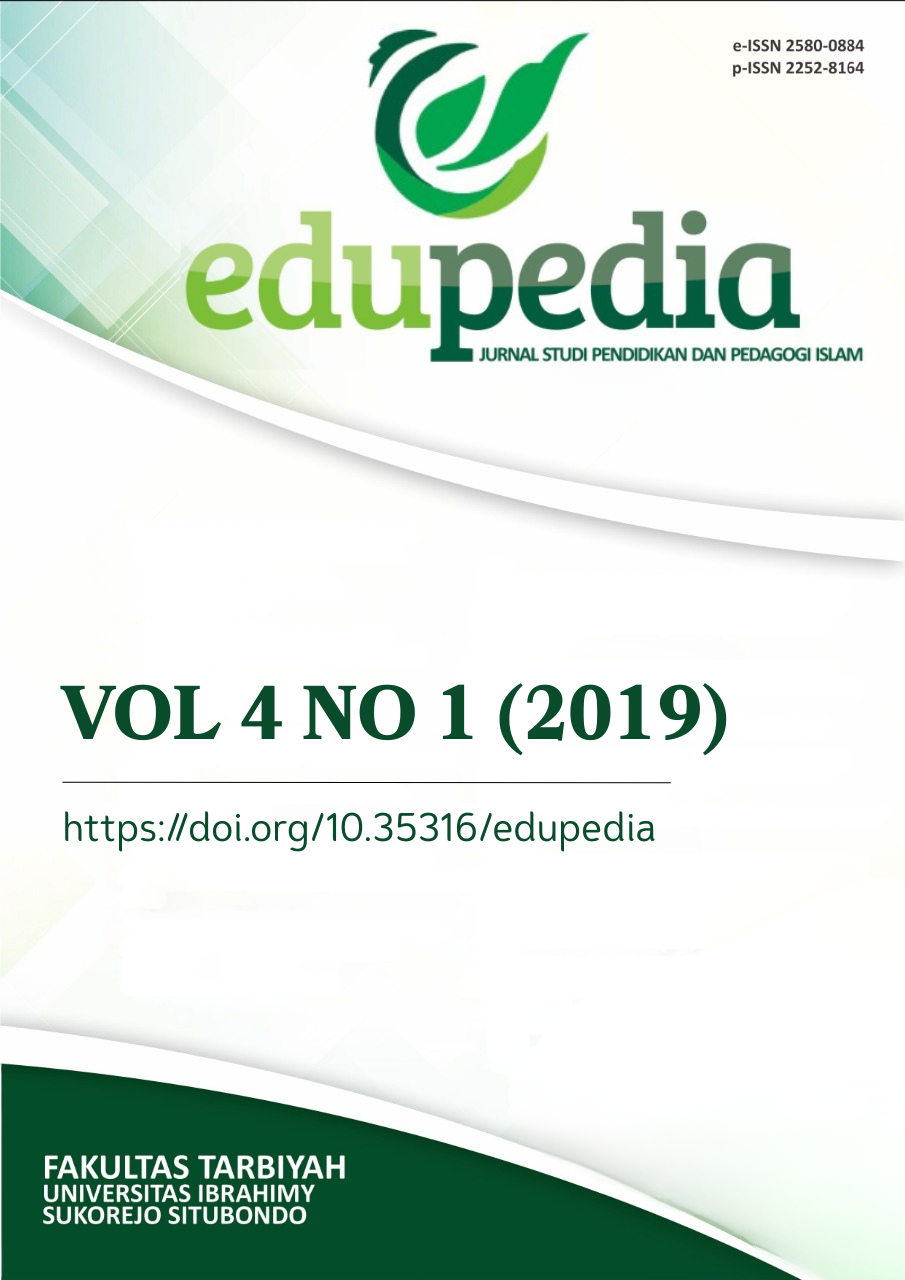
PENILAIAN AUTENTIK PADA MATAPELAJARAN PENDIDIKAN AGAMA ISLAM
DOI:
https://doi.org/10.35316/edupedia.v4i1.528Keywords:
Authentic Assessment, Islamic Education.Abstract
Teaching is an art means that the art of managing people who have a variety of different characters. The teacher should be able to recognize these different characters so that he can easily master them so that the subject is easily mastered by them. However, the teacher is not easy to do that. It is no less difficult in learning to do assessment, because when assessment teachers are required to be careful and meticulous so that the results are not wrong, be careful in determining appropriate measurement tools as measured, or careful in operating the right tools, especially teachers are required able to do a complete assessment (authentic) in three domains (cognitive, psychomotor, and affective). This article reviews how to carry out authentic assessments in Islamic Education (Pendidikan Agama Islam) learning.
Additional Files
Published
How to Cite
Issue
Section
License
Edupedia: Jurnal Studi Pendidikan dan Pedagogi Islam adopts the Creative Commons Attribution–ShareAlike 4.0 International License, which allows users to reproduce, modify, and distribute published articles in any medium for lawful purposes, provided that appropriate attribution is given to the original author(s) and the journal, the license is properly cited, any changes are clearly indicated, and derivative works are distributed under identical licensing terms.
Copyright on articles is retained by the respective author(s), without restrictions. A non-exclusive license is granted to Edupedia: Jurnal Studi Pendidikan dan Pedagogi Islam to publish the article and identify itself as its original publisher, along with the commercial right to include the article in a hardcopy issue for sale to libraries and individuals.