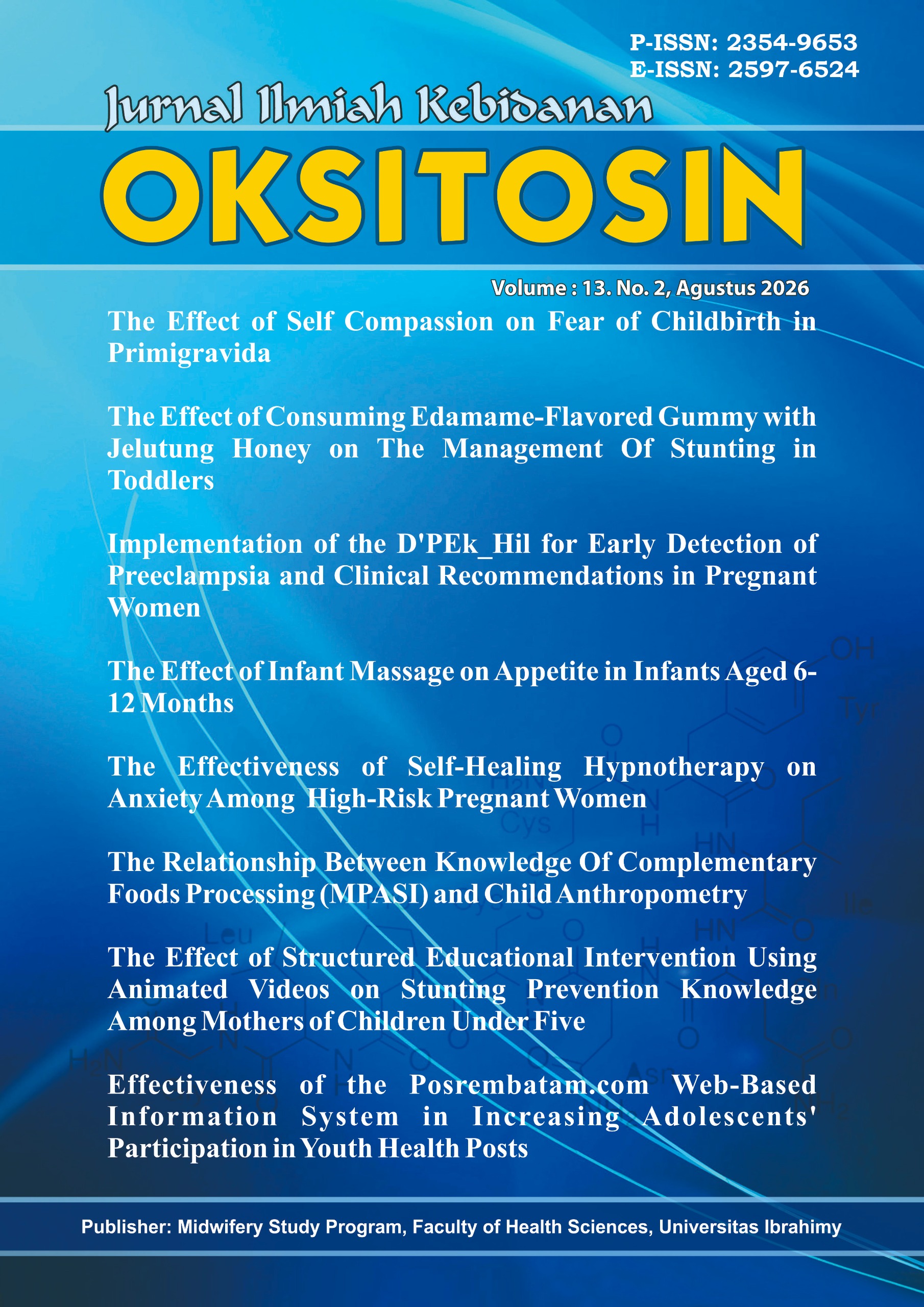
Implementation of the D’PEk_Hil for Early Detection of Preeclampsia and Clinical Recommendations in Pregnant Women
DOI:
https://doi.org/10.35316/oksitosin.v13i02.9105Keywords:
Early Detection, Human in the loop, Preeclampsia, RecommendationAbstract
Early detection and the management provide strategic role to decide therapies for mothers with high risk of preeclampsia and to prevent further complication. Expert-consulting system-based application could accelerate the early detection of preeclampsia and provides immediate expert feedbacks. This research and development attempted to implement D’PEk_Hil application for early detection and provide preeclampsia recommendation. This quasi-experimental design used posttest only design with non-equivalent control group. The subjects were 28 midwives grouped into intervention group to receive D’PEk_Hil application, consisting of 14 midwives; and control group to receive Mother-Child handbook, consisting of 14 midwives. The researchers analyzed the data with independent t-test. D’PEk_Hil application, observed in the intervention group, yieleded an immediate diagnose provision with 435,46 ± 25,809 (seconds) while the control group was with 608,11 ± 62,756 (seconds), (p-value of 0.01). The intervention group had a speed of providing recommendation for 444,46 ± 25,809 (seconds) while the control group was 695,25 ± 62,756 (seconds), (p-value of 0.000). The results revealed significant mean differences of diagnosis provision speed and in terms of providing recommendation based on the diagnoses between the groups. The D’PEk_Hill implementation could improve the time efficiency to early detect and provide therapy recommendaitons for preeclampsia mothers.
Downloads
References
Aini, F. N., Widyawati, M. N., & Suryono, S. (2019). Early Detection of Preeclampsia using a Rule Based System Information System. Journal of Physics: Conference Series, 1179(1), 012139. https://doi.org/10.1088/1742-6596/1179/1/012139
Aldika Akbar, M. I., Gumilar, K. E., Aziz, M. A., Pribadi, A., Bachnas, M. A., Aryanda, R. A., & Dekker, G. (2025). Maternal death associated with preeclampsia in Indonesia. Pregnancy Hypertension, 42, 101400. https://doi.org/10.1016/j.preghy.2025.101400
Alian, S., Li, J., & Pandey, V. (2018). A Personalized Recommendation System to Support Diabetes Self-Management for American Indians. IEEE Access, 6, 73041–73051. https://doi.org/10.1109/ACCESS.2018.2882138
Budd, S., Robinson, E. C., & Kainz, B. (2021). A survey on active learning and human-in-the-loop deep learning for medical image analysis. Medical Image Analysis, 71, 102062. https://doi.org/10.1016/j.media.2021.102062
Campbell, J. I., Aturinda, I., Mwesigwa, E., Burns, B., Santorino, D., Haberer, J. E., Bangsberg, D. R., Holden, R. J., Ware, N. C., & Siedner, M. J. (2017). The Technology Acceptance Model for Resource-Limited Settings (TAM-RLS): A Novel Framework for Mobile Health Interventions Targeted to Low-Literacy End-Users in Resource-Limited Settings. AIDS and Behavior, 21(11), 3129–3140. https://doi.org/10.1007/s10461-017-1765-y
Chen, X., Yuan, L., Ji, Z., Bian, X., & Hua, S. (2022). Development and validation of the prediction models for preeclampsia: a retrospective, single-center, case-control study. Annals of Translational Medicine, 10(22), 1221–1221. https://doi.org/10.21037/atm-22-4192
Cresswell, J. A., Alexander, M., Chong, M. Y. C., Link, H. M., Pejchinovska, M., Gazeley, U., Ahmed, S. M. A., Chou, D., Moller, A.-B., Simpson, D., Alkema, L., Villanueva, G., Sguassero, Y., Tunçalp, Ö., Long, Q., Xiao, S., & Say, L. (2025). Global and regional causes of maternal deaths 2009–20: a WHO systematic analysis. The Lancet Global Health, 13(4), e626–e634. https://doi.org/10.1016/S2214-109X(24)00560-6
Espinilla, M., Medina, J., García-Fernández, Á.-L., Campaña, S., & Londoño, J. (2017). Fuzzy Intelligent System for Patients with Preeclampsia in Wearable Devices. Mobile Information Systems, 2017, 1–10. https://doi.org/10.1155/2017/7838464
Girardi, D., Küng, J., Kleiser, R., Sonnberger, M., Csillag, D., Trenkler, J., & Holzinger, A. (2016). Interactive knowledge discovery with the doctor-in-the-loop: a practical example of cerebral aneurysms research. Brain Informatics, 3(3), 133–143. https://doi.org/10.1007/s40708-016-0038-2
Gultom, A. M. R. (2024). The Impact of Antenatal Health Education on Healthy Pregnancy and Safe Delivery. Journal of Social Research, 3(3), 858–865. https://doi.org/https://doi.org/10.55324/josr.v3i3.1970
Hermansyah, Y., Lazuardi, L., & Basri, M. H. (2017). Efektivitas penerapan aplikasi m-health untuk posyandu di Puskesmas Kembang Seri Kabupaten Bengkulu Tengah. Journal of Information Systems for Public Health, 2(1), 57–67. https://doi.org/10.22146/jisph.11240
Holzinger, A., Valdez, A. C., & Ziefle, M. (2016). Towards Interactive Recommender Systems with the Doctor-in-the-Loop. Conference : Mensch Und Computer 2016, 1–9. https://doi.org/http://dx.doi.org/10.18420/muc2016-ws11-0001
Idris, M., Wijaya, A., Septian, L., Happy, T. A., & Graharti, R. (2025). Pemanfaatan Kecerdasan Buatan Sebagai Alat Bantu Diagnosis di Bidang Kesehatan : Literatur Review. Jurnal Kesehatan Unila, 9(1), 117–121.
Khan, B., Allah Yar, R., Khakwani, A. khan, Karim, S., & Arslan Ali, H. (2022). Preeclampsia Incidence and Its Maternal and Neonatal Outcomes With Associated Risk Factors. Cureus. https://doi.org/10.7759/cureus.31143
Manik, H. (2026). Integrasi Kecerdasan Buatan dalam Diagnostik Medis: Peluang dan Tantangan di Era Kesehatan Digital . Indonesian Journal of Medicine, Health and Nursing, 1(1), 45–57.
Mou, A. D., Barman, Z., Hasan, M., Miah, R., Hafsa, J. M., Das Trisha, A., & Ali, N. (2021). Prevalence of preeclampsia and the associated risk factors among pregnant women in Bangladesh. Scientific Reports, 11(1), 21339. https://doi.org/10.1038/s41598-021-00839-w
Musyoka, F. M., Thiga, M. M., & Muketha, G. M. (2019). A 24-hour ambulatory blood pressure monitoring system for preeclampsia management in antenatal care. Informatics in Medicine Unlocked, 16, 100199. https://doi.org/10.1016/j.imu.2019.100199
Negandhi, P., Chauhan, M., Das, A., Sharma, J., Neogi, S., & Sethy, G. (2016). Computer tablet-based health technology for strengthening maternal and child tracking in Bihar. Indian Journal of Public Health, 60(4), 329–333. https://doi.org/10.4103/0019-557X.195868
Nurhayati, N. (2025). Pregnant Women’s Knowledge About Early Detection of Preeclampsia at The Akbar Medica Clinic Mojokerto Regency. Journal of Scientific Research, Education, and Technology (JSRET), 4(4), 2370–2376. https://doi.org/10.58526/jsret.v4i4.939
Permatasari, A. D., Trihandini, I., Bahar, R. J., & Kurniawan, R. (2021). Manfaat Penggunaan Mobile Health (m-Health) Dalam Pencatatan dan Pelaporan Kesehatan Ibu. Jurnal Biostatistik, Kependudukan, Dan Informatika Kesehatan, 1(2), 100–112. https://doi.org/10.7454/bikfokes.v1i2.1010
Rahman, Md. A., Victoros, E., Ernest, J., Davis, R., Shanjana, Y., & Islam, Md. R. (2024). Impact of Artificial Intelligence (AI) Technology in Healthcare Sector: A Critical Evaluation of Both Sides of the Coin. Clinical Pathology, 17. https://doi.org/10.1177/2632010X241226887
Rana, S., Lemoine, E., Granger, J. P., & Karumanchi, S. A. (2019). Preeclampsia : Pathophysiology, Challenges, and Perspectives. Circulation Research, 124(7), 1094–1112. https://doi.org/10.1161/CIRCRESAHA.118.313276
Rothstein, J. D., Jennings, L., Moorthy, A., Yang, F., Gee, L., Romano, K., Hutchful, D., Labrique, A. B., & LeFevre, A. E. (2016). Qualitative Assessment of the Feasibility, Usability, and Acceptability of a Mobile Client Data App for Community-Based Maternal, Neonatal, and Child Care in Rural Ghana. International Journal of Telemedicine and Applications, 2016, 1–14. https://doi.org/10.1155/2016/2515420
Salloum, S. A., Qasim Mohammad Alhamad, A., Al-Emran, M., Abdel Monem, A., & Shaalan, K. (2019). Exploring Students’ Acceptance of E-Learning Through The Development of a Comprehensive Technology Acceptance Model. IEEE Access, 7, 128445–128462. https://doi.org/10.1109/ACCESS.2019.2939467
Simbolon, O., Widyawati, M. N., Kurnianingsih, K., Kubota, N., & Ng, N. (2020). Predicting the Risk of Preeclampsia using Soft Voting-based Ensemble and Its Recommendation. 2020 International Symposium on Community-Centric Systems (CcS), 1–6. https://doi.org/10.1109/CcS49175.2020.9231400
Tesfahun, E., Tadesse, S., Hailu, A., Minda, A., Ekubay, M., Tariku, B., & Dagnaw, A. (2023). Prevalence of Preeclampsia and Associated Factors among Antenatal Care Attending Mothers at Tirunesh Beijing General Hospital, Addis Ababa, Ethiopia. Advances in Public Health, 2023, 1–5. https://doi.org/10.1155/2023/1132497
Trayner, I., & Taylor, L. J. (2017). NHS Western Isles - Involving our Patients: Faster Access to Treatment for Hypertension in Primary Care. International Journal of Integrated Care, 17(5), 203. https://doi.org/10.5334/ijic.3513
Vera-Ponce, V. J., Loayza-Castro, J. A., Ballena-Caicedo, J., Valladolid-Sandoval, L. A. M., Zuzunaga-Montoya, F. E., & Gutierrez De Carrillo, C. I. (2025). Global prevalence of preeclampsia, eclampsia, and HELLP syndrome: a systematic review and meta-analysis. Frontiers in Reproductive Health, 7, 1–18. https://doi.org/10.3389/frph.2025.1706009
Wedagu, M. A., Chen, D., Hussain, M. A. I., Gebremeskel, T., Orlando, M. T., & Manzoor, A. (2020). Medicine Recommendation System For Diabetes Using Prior Medical Knowledge. Proceedings of the 2020 4th International Conference on Vision, Image and Signal Processing, 1–5. https://doi.org/10.1145/3448823.3448872
Wolfewicz, A. (2020, September 24). Human-in-the-loop in Machine Learning: What is it and how does it work? Medium. https://medium.com/levity/human-in-the-loop-in-machine-learning-what-is-it-and-how-does-it-work-d2483c763171
Yang, S., Korayem, M., AlJadda, K., Grainger, T., & Natarajan, S. (2017). Combining content-based and collaborative filtering for job recommendation system: A cost-sensitive Statistical Relational Learning approach. Knowledge-Based Systems, 136, 37–45. https://doi.org/10.1016/j.knosys.2017.08.017
Downloads
Published
How to Cite
Issue
Section
License
Copyright (c) 2026 Oksitosin : Jurnal Ilmiah Kebidanan

This work is licensed under a Creative Commons Attribution-NonCommercial-ShareAlike 4.0 International License.