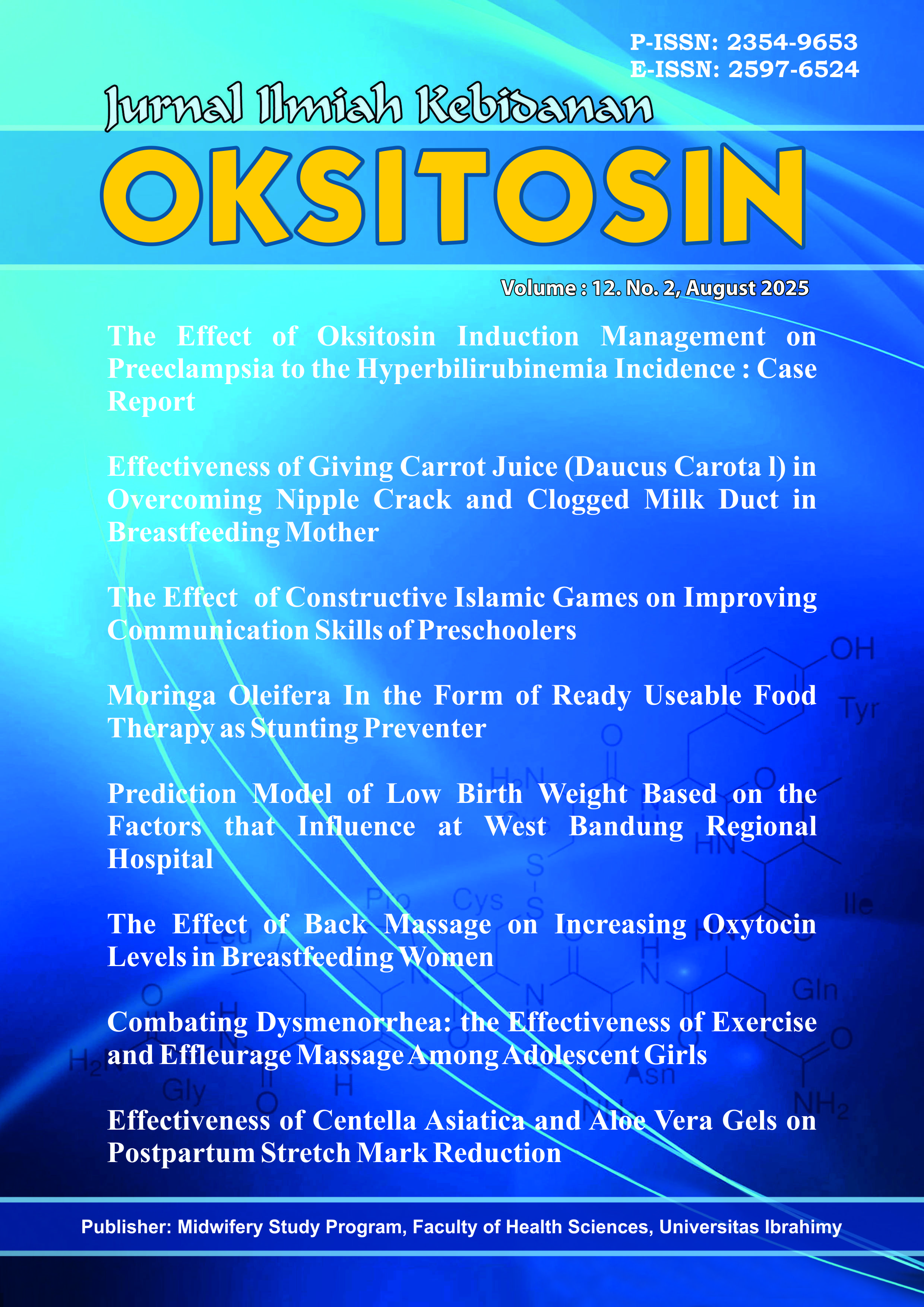
Combating Dysmenorrhea: the Effectiveness of Exercise and Effleurage Massage Among Adolescent Girls
DOI:
https://doi.org/10.35316/oksitosin.v12i2.7497Keywords:
Adolescent, Dysmenorrhea, Exercise, Efflurage MassageAbstract
Dysmenorrhea is a condition characterized by menstrual pain, commonly presenting as lower abdominal cramps that may radiate to the back. The primary cause is often linked to hormonal imbalances. Non-pharmacological approaches, such as physical exercise and massage therapy, have been shown to help alleviate the symptoms. This study aimed to evaluate the effectiveness of exercise for dysmenorrhea and effleurage massage in reducing menstrual pain among adolescent girls at the Melak Health Vocational School. A quasi-experimental design with a two-group pre-test and post-test approach was used. The study population included all female students from classes X, XI, and XII, with a total of 48 participants selected through total sampling. Pain intensity was measured using the Numeric Rating Scale (NRS), and the data were analyzed using the Wilcoxon and Mann-Whitney tests. The results indicated that both interventions significantly reduced menstrual pain, with a p-value of 0.000 (p < 0.05) for each group. Furthermore, the Mann-Whitney test revealed a significant difference between the two interventions, with a p-value of 0.001 (p < 0.05). Exercise for dysmenorrhea demonstrated a greater average effect than effleurage massage, with a mean difference of 11.25. Based on these findings, it is recommended that adolescent girls consider both exercise and effleurage massage as non-pharmacological options for managing menstrual pain, with exercise for dysmenorrhea proving to be the more effective therapy.
Downloads
References
Argaheni, N.B. (2021) ‘Systematic Review : The Effect of Massage Effleurage on Dysmenorrhea’, Jurnal Ners dan Kebidanan (Journal of Ners and Midwifery), 8(1), pp. 138–143. Available at: https://doi.org/10.26699/jnk.v8i1.art.p138-143.
Ariani, D., Septiani, H. and Solama, W. (2023) ‘Overview of Student Skills in Performing a Combination of Effleurage Massage Techniques and Slow Deep Breathing to Reduce Menstrual Pain’, Nurul Ilmi : Journal of Health Sciences and Midwifery, 1(2), pp. 57–62. Available at: https://doi.org/10.52221/NURI.V1I2.348.
Arisani, G. and Wahyuni, S. (2022) ‘The Effectiveness of Telecounseling on Anxiety and Self-Care Dysmenorrhea in Young Women’, Journal of Health Education, 7(2), pp. 82–88. Available at: https://doi.org/10.15294/jhe.v7i2.57312.
Armour, M. et al. (2019) ‘The Prevalence and Academic Impact of Dysmenorrhea in 21,573 Young Women: A Systematic Review and Meta-Analysis.’, Journal of Women’s Health, 28(8), pp. 1161–1171. Available at: https://doi.org/10.1089/JWH.2018.7615.
Barassi, G. et al. (2018) ‘Somato-Visceral Effects in the Treatment of Dysmenorrhea: Neuromuscular Manual Therapy and Standard Pharmacological Treatment’, Journal of alternative and complementary medicine (New York, N.Y.), 24(3), pp. 291–299. Available at: https://doi.org/10.1089/ACM.2017.0182.
Brown, J. and Brown, S. (2017) ‘WITHDRAWN: Exercise for dysmenorrhoea’, The Cochrane database of systematic reviews, 2(2). Available at: https://doi.org/10.1002/14651858.CD004142.PUB3.
Emelya, S. et al. (2023) ‘The effect of dysmenorrhea gymnastics on reducing the level of menstrual pain (dysmenorrhea)’, Journal of Current Health Sciences, 3(2), pp. 57–62. Available at: https://doi.org/10.47679/JCHS.202319.
Februanti, S. et al. (2020) ‘ADOLESCENT DISMENORE PREVALENCE IN WEST JAVA, INDONESIA: PRELIMINARY STUDY’, Journal of critical reviews, 7(13). Available at: https://doi.org/10.31838/JCR.07.13.112.
Hendianti, A. et al. (2022) ‘The Relationship Between Menstrual Cycle Length and Lifestyle With Dysmenorrhea Among Adolescents in Indonesia: A Cross-sectional Study’, KnE Medicine, 2(2), pp. 21-29–21–29. Available at: https://doi.org/10.18502/KME.V2I2.11064.
Hermaniati, U. and Nofa Anggraini (2023) ‘Efektivitas Senam Dismenore Dengan Massage Effleurage Terhadap Nyeri Haid Pada Remaja Putri’, Jurnal Ilmiah Keperawatan (Scientific Journal of Nursing), 9(3), pp. 171–177. Available at: https://doi.org/10.33023/jikep.v9i3.1604.
Hidayati, T.A. et al. (2024) ‘Application of effleurage massage technique in postpartum pain 1’, 5(2), pp. 651–656.
Kannan, P., Cheung, K.K. and Lau, B.W.M. (2019) ‘Does aerobic exercise induced-analgesia occur through hormone and inflammatory cytokine-mediated mechanisms in primary dysmenorrhea?’, Medical hypotheses, 123, pp. 50–54. Available at: https://doi.org/10.1016/J.MEHY.2018.12.011.
Kusuma, T.A., Hikmanti, A. and Yanti, L. (2023) ‘Penerapan Senam Dismenore Untuk Meringankan Nyeri Dismenore’, 6, pp. 3896–3909.
Lailatun, L. (2023) ‘The Effect of Effleurage Massage on Reducing Dysmenorrhea in Adolescent Girls in Sukarama Village, Cianjur Regency, Indonesia’, Arkus, 9(2), pp. 381–383. Available at: https://doi.org/10.37275/ARKUS.V9I2.391.
López-Liria, R. et al. (2021) ‘Efficacy of Physiotherapy Treatment in Primary Dysmenorrhea: A Systematic Review and Meta-Analysis’, International journal of environmental research and public health, 18(15). Available at: https://doi.org/10.3390/IJERPH18157832.
Macgregor, B. et al. (2023) ‘Disease Burden of Dysmenorrhea: Impact on Life Course Potential’, International Journal of Women’s Health, 15, p. 499. Available at: https://doi.org/10.2147/IJWH.S380006.
Matchock, R.L. (2023) ‘Menstrual Patterns and Age of Menarche in Young Women from the United States’, Women’s Health – Open Journal, 9(1), pp. 8–14. Available at: https://doi.org/10.17140/WHOJ-9-150.
Molla, A. et al. (2022) ‘Prevalence of dysmenorrhea and associated factors among students inEthiopia: A systematic review and meta-analysis’, Women’s Health, 18. Available at: https://doi.org/10.1177/17455057221079443.
Nursyamsiana, N. and Kusyairi, A. (2024) ‘Efektivitas Abdominal Stretching Exercise Dan Massage Effleurage Terhadap Penurunan Nyeri Dismenore Pada Remaja Di Pondok Putri Hafshawaty Pesantren Zainul Hasan’, Jurnal Ilmiah Kesehatan Mandira Cendikia, 3(8), pp. 143–154. Available at: https://journal.mandiracendikia.com/index.php/JIK-MC/article/view/1349 (Accessed: 15 June 2025).
Obuchowska, K. et al. (2022) ‘The diagnosis and treatment of primary dysmenorrhea’, Journal of Education, Health and Sport, 12(9), pp. 632–638. Available at: https://doi.org/10.12775/jehs.2022.12.09.076.
Petraglia, F. et al. (2017) ‘Dysmenorrhea and related disorders’, F1000Research, 6. Available at: https://doi.org/10.12688/F1000RESEARCH.11682.1.
Pramesti, W.I. and Sudaryanto, W.T. (2024) ‘Is Effleurage Massage Effective to Reduce Menstrual Pain in Female Students?’, Indonesian Journal of Medicine, 9(1), pp. 91–97. Available at: https://doi.org/10.26911/theijmed.2024.09.01.11.
Preeti, P. and Jagga, V. (2024) ‘EFFECTIVENESS OF EXERCISES IN MANAGEMENT OF PAIN IN DYSMENORRHEA: A REVIEW’, INDIAN JOURNAL OF APPLIED RESEARCH, pp. 69–71. Available at: https://doi.org/10.36106/IJAR/8102573.
Putri, N.E., Wilson and Putri, E.A. (2020) ‘Hubungan Regulasi Emosi Terhadap Intensitas Nyeri Haid (Dismenore) Pada Siswi Sekolah Menengah Pertama Negeri 8 Pontianak’, Jurnal Nasional Ilmu Kesehatan, 3(2), pp. 51–61.
Rahmawati, P.L., Dwiningsih, S.R. and Herawati, L. (2021) ‘Combination of Effleurage and Kneading Massage Can Reduce Intensity of Dysmenorrhea’, Indonesian Midwifery and Health Sciences Journal, 4(1), pp. 51–59. Available at: https://doi.org/10.20473/imhsj.v4i1.2020.51-59.
Retni, A., Harismayanti, H. and Umani, R.P. (2023) ‘The Effect of Giving Effleurage Massage Techniques on Reduction of Labor Pain in Labor Pain in Women in Labor’, Journal of Community Health Provision, 3(2), pp. 39–47. Available at: https://doi.org/10.55885/JCHP.V3I2.267.
Ryan, S.A. et al. (2023) ‘Dysmenorrhea’, Indian journal of pediatrics, 13(2), pp. 90–96. Available at: https://www.ncbi.nlm.nih.gov/books/NBK560834/ (Accessed: 13 September 2024).
Sari, D.P., Sat, S. and Hamranani, T. (2019) ‘Pengaruh Terapi Massage Effleurage terhadap Penurunan Nyeri Haid Pada Remaja Putri di Klaten’, 14(02), pp. 123–126.
Thiyagarajan, D.K., Basit, H. and Jeanmonod, R. (2022) ‘Physiology, Menstrual Cycle’, StatPearls [Preprint]. Available at: https://www.ncbi.nlm.nih.gov/books/NBK500020/ (Accessed: 14 September 2024).
Trisnawati, Y. and Mulyandari, A. (2020) ‘Pengaruh Latihan Senam Dismenore terhadap Penurunan Nyeri Dismenore pada Mahasiswa Kebidanan’, Gorontalo Journal of Public Health, 3(2), pp. 71–79. Available at: https://doi.org/10.32662/GJPH.V3I2.1176.
Tyas, E.S. et al. (2023) ‘The Effect of Abdominal Stretching, Yoga, and Dysmenorrhea Exercises on Prostaglandin Levels and Pain’, International Journal of Public Health Excellence (IJPHE), 3(1), pp. 442–449. Available at: https://doi.org/10.55299/ijphe.v3i1.734.
Zairina, R. and Utomo, B. (2023) ‘Relationship Between Duration and Regularity of Menstrual Cycle With Primary Dysmenorrhea in Adolescents’, Indonesian Midwifery and Health Sciences Journal, 7(1), pp. 63–69. Available at: https://doi.org/10.20473/imhsj.v7i1.2023.63-69.
Downloads
Published
How to Cite
Issue
Section
License
Copyright (c) 2025 Oksitosin : Jurnal Ilmiah Kebidanan

This work is licensed under a Creative Commons Attribution-NonCommercial-ShareAlike 4.0 International License.