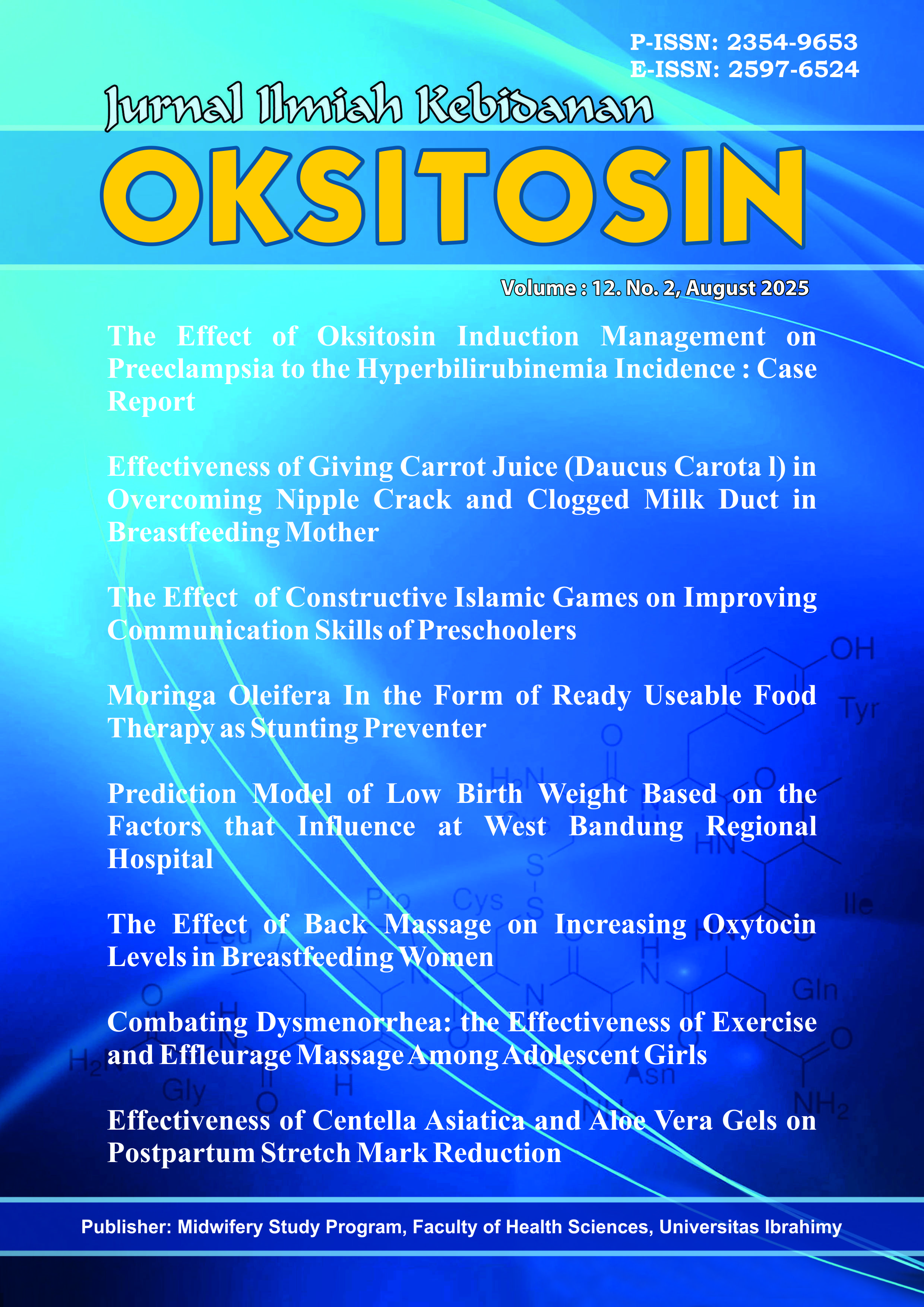
Prediction Model of Low Birth Weight Based on the Factors that Influence at West Bandung Regional Hospital
DOI:
https://doi.org/10.35316/oksitosin.v12i2.6544Keywords:
Predictive model, birth weight, maternal weight, maternal age, parity, pregnancy spacing, MUACAbstract
Low Birth Weight (LBW) is a major contributor to neonatal mortality and developmental disorders in Indonesia. In West Bandung Regency, the prevalence of LBW remains high and plays a significant role in the overall infant mortality rate in West Java Province. Despite this, no locally adapted predictive model has been developed to assess LBW risk based on maternal characteristics. This study aimed to construct a predictive model for LBW using maternal factors among mothers delivering at three district public hospitals: RSUD Cililin, RSUD Lembang, and RSUD Cikalong Wetan. This quantitative study employed a retrospective approach involving 265 respondents selected through purposive sampling. Data were collected from medical records and brief interviews and analyzed using multiple linear regression. The research was conducted between January and March 2024. The results showed that among six independent variables tested, three had a statistically significant effect on infant birth weight: maternal age (p = 0.047), maternal weight gain during pregnancy (p = 0.004), and parity (p < 0.001). The predictive model generated was: Y = 2570.162 + 3.739X₁ – 11.501X₂ – 94.726X₃, with an R² value of 0.464, indicating that 46.4% of the variation in birth weight can be explained by the model. The model suggests that maternal age positively influences birth weight, whereas excessive maternal weight gain and higher parity show a negative relationship. This model can be used by healthcare providers as an early screening tool to detect LBW risk and to support targeted nutrition education and antenatal interventions at health service facilities.
Downloads
References
Aisah, S., Handayani, H., Gunawan, I., & Muttaqin, Z. (2024). Faktor-Faktor Yang Berhubungan Dengan Kejadian Berat Bayi Lahir Rendah (BBLR) Di Ruang Perinatologi RSUD dr. Soekardjo Kota Tasikmalaya. Student Health Journal, 1, 101–113. https://doi.org/10.35568/senal.v1i3.5092
Bajwa, N., Siddiqui, M., Awais, M., Rasool, A., Amin, A., Khan, M., & Afzal, S. (2024). Risk Factors Associated With Low-Birth-Weight Babies in Tertiary Health Care Facilities in Lahore, Pakistan: A Case-Control Study. Cureus, 16(7). https://doi.org/10.7759/cureus.63832
Barwanto, L. A., & Ramadhan, A. (2024). Identifikasi Pola Demografi Di Provinsi Jawa Barat Dengan Spatial Autocorrelation: Mempersiapkan Momentum Puncak Bonus Demografi. Creative Research Journal, 10(01), 1–16. https://doi.org/10.34147/crj.v10i1.327
Correa-De-Araujo, R., & Yoon, S. S. (2021). Clinical Outcomes in High-Risk Pregnancies Due to Advanced Maternal Age. Journal of Women’s Health, 30(2), 160–167. https://doi.org/10.1089/jwh.2020.8860
Čvorović, J. (2024). The Association Between Maternal Age at Childbirth and Child Nutritional Outcomes: A Cross-sectional Study From Serbian Roma Communities. Global Pediatric Health, 11. https://doi.org/10.1177/2333794X241298831
Dewey, K. G., & Cohen, R. J. (2007). Does birth spacing affect maternal or child nutritional status? A systematic literature review. Maternal and Child Nutrition, 3(3), 151–173. https://doi.org/10.1111/j.1740-8709.2007.00092.x
Fall, C. H. D. (2013). Europe PMC Funders Group Fetal malnutrition and long-term outcomes. Nestle Nutr Inst Workshop Ser., 74, 11–25. https://doi.org/10.1159/000348384.Fetal
Fatmawati, E., & Wati, D. R. (2021). Hubungan Paritas Dengan Berat Badan Lahir Rendah (BBLR). IJMT : Indonesian Journal of Midwifery Today, 1(1), 49. https://doi.org/10.30587/ijmt.v1i1.3419
Gemilastari, R., Zeffira, L., Malik, R., & Tri Septiana, V. (2024). Karakteristik Bayi Dengan Berat Badan Lahir Rendah (BBLR). Scientific Journal, 3(1), 16–26. https://doi.org/10.56260/sciena.v3i1.125
Hilaire, M., Andrianou, X. D., Lenglet, A., Ariti, C., Charles, K., Buitenhuis, S., Van Brusselen, D., Roggeveen, H., Ledger, E., Denat, R. S., & Bryson, L. (2021). Growth and neurodevelopment in low birth weight versus normal birth weight infants from birth to 24 months, born in an obstetric emergency hospital in Haiti, a prospective cohort study. BMC Pediatrics, 21(1), 1–16. https://doi.org/10.1186/s12887-021-02605-3
Indriyani, I., Oktariza, R. T., Noviyanti, N., & Virginia, J. A. (2023). Mid-Upper arm circumference in pregnant women and its correlation to birth weight. Muhammadiyah Medical Journal, 4(1), 32. https://doi.org/10.24853/mmj.4.1.32-38
Kemenkes BKPK. (2023). Survei Kesehatan Indonesia (SKI) 2023 Dalam Angka.
Kemenkes RI. (2018). Hasil Utama Riset Kesehatan Dasar (RISKESDAS). https://doi.org/10.1088/1751-8113/44/8/085201
Ningsih, N. A. W., & Sumarmi, S. (2023). Literature Review: Hubungan Pertambahan Berat Badan Ibu Selama Kehamilan dengan Kejadian Berat Badan Lahir Rendah (BBLR) di Indonesia. Media Gizi Kesmas, 12(2), 1064–1069. https://doi.org/10.20473/mgk.v12i2.2023.1064-1069
Nisak, S. K., & Nadhiroh, S. R. (2024). Hubungan Lingkar Lengan Atas (LILA) pada Ibu Hamil dengan Kejadian Berat Badan Lahir Rendah (BBLR): Systematic Review. Media Gizi Kesmas, 13(1), 512–520. https://doi.org/10.20473/mgk.v13i1.2024.512-520
Nursanti, D. P., & Lestari, N. D. (2020). Analysis of The Factor That Influence The Incidence of CED In Pregnant Women at Turi Health Center Lamongan Regency. Journal for Quality in Public Health, 4(1), 126–130. https://doi.org/10.30994/jqph.v4i1.172
Rizkika, A., Rahfiludin, M. Z., & Asna, A. F. (2023). Low Birth Weight Related Factors at Kertek 2 Public Health Centre Wonosobo Regency. Amerta Nutrition, 7(1), 37–44. https://doi.org/10.20473/amnt.v7i1.2023.37-44
Thornburg, K. L., & Valent, A. M. (2024). Maternal Malnutrition and Elevated Disease Risk in Offspring. Nutrients, 16(16), 1–16. https://doi.org/10.3390/nu16162614
Wang, S., Yang, L., Shang, L., Yang, W., Qi, C., Huang, L., Xie, G., Wang, R., & Chung, M. C. (2020). Changing trends of birth weight with maternal age: a cross-sectional study in Xi’an city of Northwestern China. BMC Pregnancy and Childbirth, 20(1), 1–8. https://doi.org/10.1186/s12884-020-03445-2
Wardani, N. M. S., Tirtawati, G. A., & Utarini, G. A. E. (2025). Analisis Hubungan Usia Ibu dan Paritas terhadap Kejadian Bayi Berat Lahir Rendah di Wilayah Kerja Puskesmas Blahbatuh II: Pendekatan Retrospektif. Jurnal Penelitian Inovatif, 5(2), 1951–1958. https://doi.org/10.54082/jupin.1417
WHO. (2017). MONITORING HEALTH FOR SDGs. World Health Organization.
WHO. (2022). World Health Statistics. 2022.
Widowati, N., Ningtyias, F. W., & Sulistiyani. (2024). Analysis of Maternal Factors with the Incidence of LBW Infants at Situbondo Health Center: Study of Cohort Register Data in 2020. Amerta Nutrition, 8(3), 368–375. https://doi.org/10.20473/amnt.v8i3.2024.368-375
Workineh, Y., Semachew, A., Ayalew, E., Animaw, W., Tirfie, M., & Birhanu, M. (2020). Prevalence of perinatal asphyxia in East and Central Africa: systematic review and meta-analysis. Heliyon, 6(4). https://doi.org/10.1016/j.heliyon.2020.e03793
Downloads
Published
How to Cite
Issue
Section
License
Copyright (c) 2025 Oksitosin : Jurnal Ilmiah Kebidanan

This work is licensed under a Creative Commons Attribution-NonCommercial-ShareAlike 4.0 International License.