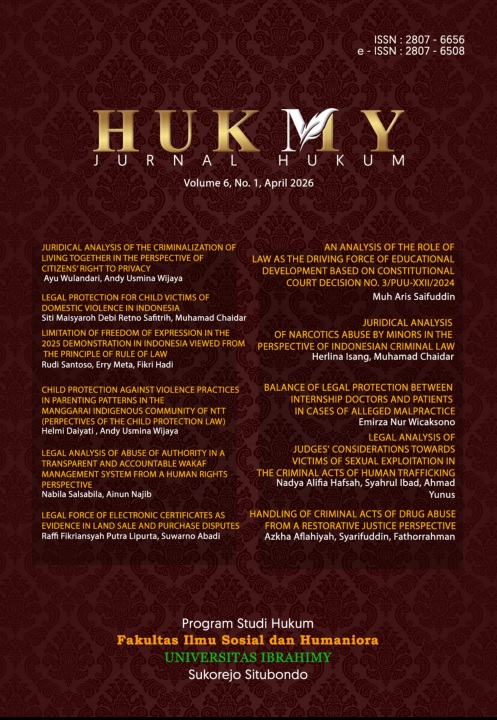
LIMITATION OF FREEDOM OF EXPRESSION IN THE 2025 DEMONSTRATION IN INDONESIA VIEWED FROM THE PRINCIPLE OF RULE OF LAW
DOI:
https://doi.org/10.35316/hukmy.2026.v6i1.1156-1169Keywords:
Human Rights, Freedom Of Speech, Demonstration, Rule Of LawAbstract
Freedom of expression and speech is a constitutional right guaranteed in Article 28E Paragraphs (2) and (3) of the 1945 Constitution, and is included as a right that cannot be reduced under any circumstances according to Article 28I Paragraph (1). However, in the context of demonstrations, problems sometimes arise in the form of riots and looting, as occurred during the demonstrations in August-September 2025 in Indonesia. This normative study aims to analyze the restrictions on freedom of expression in the 2025 demonstrations in Indonesia from the perspective of the principle of the rule of law. Using a statute and conceptual approach, this study examines the legal regulations governing these constitutional rights and the government's application of the principle of the rule of law. The results show that restrictions on freedom of expression are regulated in a limited manner in Article 28J Paragraph (2) of the 1945 Constitution and Law Number 9 of 1998. In the context of the 2025 demonstrations, which were marred by violence and looting, if the government wishes to impose restrictions, their application must refer to principle of the rule of law, which encompasses three main pillars: the supremacy of law (legal certainty and restrictions on the power of officials), equality before the law (equal treatment and accountability of officials), and the principle of proportionality. Any restrictions imposed by the state must have a valid legal basis, be aimed at protecting legitimate objectives and proportionate in a democratic society, in accordance with international human rights law standards.
References
Apsari, Kirana, and Komang Pradnyana Sudibya. “Harmonisasi Hak Atas Kebebasan Berpendapat Dan Berekspresi Serta Hak Individu Atas Reputasi Dalam Perspektif Ham.” Jurnal Kertha Negara 9, no. 10 (2021).
Detik. “Aksi Penjarahan Rumah Sahroni Hingga Sri Mulyani Mulai Diselidiki.” Detik News, 2025. https://news.detik.com/berita/d-8091648/aksi-penjarahan-rumah-sahroni-hingga-sri-mulyani-mulai-diselidiki.
———. “Aksi Penjarahan Rumah Sahroni Hingga Sri Mulyani Mulai Diselidiki.” Detik News, 2025.
Endarto, Budi, Arief Syahrul Alam, Muhammad Harist Murdani, Taufiqurrahman, Nur Hidayatul Fithri, Andy Usmina Wijaya, Fikri Hadi, and
Farina Gandryani. Potret Hukum Kontemporer Di Indonesia. Yogyakarta: KYTA Jaya Mandiri, 2022.
Fadjar, Mukhtie. Tipe Negara Hukum. Malang: Bayu Media Publishing, 2005.
Farig, Muamar Azmar Mahmud. “Rule of Law Dalam Situasi Krisis: Mengawal Batas Kekuasaan Aparat Dalam Negara Demokratis.” Mahkamah Agung Republik Indonesia News, 2025. https://marinews.mahkamahagung.go.id/artikel/rule-of-law-dalam-situasi-krisis-mengawal-batas-kekuasaan-0wY.
Hadi, Fikri. “Negara Hukum Dan Hak Asasi Manusia Di Indonesia.” Wijaya Putra Law Review 1, no. 2 (2022). https://doi.org/https://doi.org/10.38156/wplr.v1i2.79.
Hadi, Fikri, and Farina Gandryani. “Konstitusionalitas Otorita Ibu Kota Nusantara Sebagai Bentuk Pemerintahan Daerah.” Majalah Hukum Nasional; 52, no. 1 (2022). https://doi.org/https://doi.org/10.33331/mhn.v52i1.164.
Hadi, Fikri, Farina Gandryani, and Fatma Afifah. “PERUBAHAN UNDANG-UNDANG DASAR NEGARA REPUBLIK INDONESIA TAHUN 1945 DALAM PERSPEKTIF TEORI HUKUM KONSTITUSI.” Wijaya Putra Law Review 4, no. 1 (April 29, 2025): 61–84. https://doi.org/10.38156/wplr.v4i1.223.
Hutabarat, Ramly. Persamaan Di Hadapan Hukum (Equality Before The Law) Di Indonesia. Jakarta: Ghalia Indonesia, 1985.
Isharyanto. Kedaulatan Rakyat Dan Sistem Perwakilan Menurut UUD 1945. Yogyakarta: Penerbit WR, 2016.
Lufty, Arya Fajar, and Junifer Dame Panjaitan. “Analisis Yuridis Pidana Dalam Kasus Demonstrasi Yang Berujung Pada Kerusuhan: Studi Tentang Implementasi Pasal 170 KUHP Dan Implikasinya Terhadap Kebebasan Berbicara Di Indonesia.” Media Hukum Indonesia 3, no. 2 (2025). https://doi.org/https://doi.org/10.5281/zenodo.16900555.
Mardianto, Kevin. “Pembatasan Masa Jabatan Anggota Legislatif Dalam Bingkai Demokrasi Konstitusional.” Jurnal Hukum Lex Generalis 6, no. 8 (2025). https://doi.org/https://doi.org/10.56370/jhlg.v6i8.1477.
Marzuki, Peter Mahmud. Penelitian Hukum. Jakarta: Kencana Prenadamedia Group, 2016.
Matompo, Osgar S. “Pembatasan Terhadap Hak Asasi Manusia Dalam Prespektif Keadaan Darurat.” Jurnal Media Hukum 21, no. 1 (2014).
Montolalu, Christian Imanuel, Donna O. Setiabudhi, and Nelly Pinangkaan. “Implementasi Prinsip Rule Of Law Dalam Pemerintah Dan Perlindungan Hak Asasi Manusia Di Indonesia.” Lex Et Societatis X, no. 4 (2022).
Noer, Zakiah, and Ari Setiawan. “KEWENANGAN SATUAN PENGAMAN DALAM MELAKSANAKAN TUGAS DAN WEWENANG KEPOLISIAN TERBATAS.” Jurnal Pro Hukum : Jurnal Penelitian Bidang Hukum Universitas Gresik 11, no. 1 (2022). https://doi.org/https://doi.org/10.55129/.v11i1.1707.
Olivia, Denindah. “HAKIKAT KEBEBASAN BEREKSPRESI DALAM PERSPEKTIF HUKUM HAK ASASI MANUSIA.” RIO LAW JURNAL 1, no. 2 (November 27, 2020). https://doi.org/10.36355/rlj.v1i2.409.
Prasetyo, Teguh. Hukum Dan Sistem Hukum Berdasarkan Pancasila. Yogyakarta: Media Perkasa, 2013.
Puannandini, Dewi Asri, Fitrilano Putri Yonsah Minanda, Nayla Isny Az-Zahra, and Wafaa Maulida Aghnia. “KEBEBASAN BEREKSPRESI MELALUI KARYA DI INDONESIA: STUDI KASUS BAND SUKATANI.” Jurnal Media Akademik 3, no. 7 (2025). https://doi.org/https://doi.org/10.62281/v3i7.2524.
Toha, Hanna Theresia Febiola, Cornelis Djelfie Massie, and Grace Yurico Bawole. “TANGGUNG JAWAB OKNUM KEPOLISIAN YANG BERTINDAK REPRESIF DALAM PENGAMANAN DEMONSTRASI ANARKIS.” Lex Privatum 13, no. 2 (2024).
Zaini, Aziza Zulia, and Aji Wibowo. “ANALISIS TERHADAP PEMBATASAN PERLINDUNGAN HAK KEBEBASAN BEREKSPRESI DALAM MEDIA SOSIAL MENURUT HUKUM HAM INTERNASIONAL.” Reformasi Hukum Trisakti 3, no. 1 (June 30, 2021): 12–29. https://doi.org/10.25105/refor.v3i1.10274.
Downloads
Published
How to Cite
Issue
Section
License
Copyright (c) 2026 HUKMY : Jurnal Hukum

This work is licensed under a Creative Commons Attribution-NonCommercial-ShareAlike 4.0 International License.