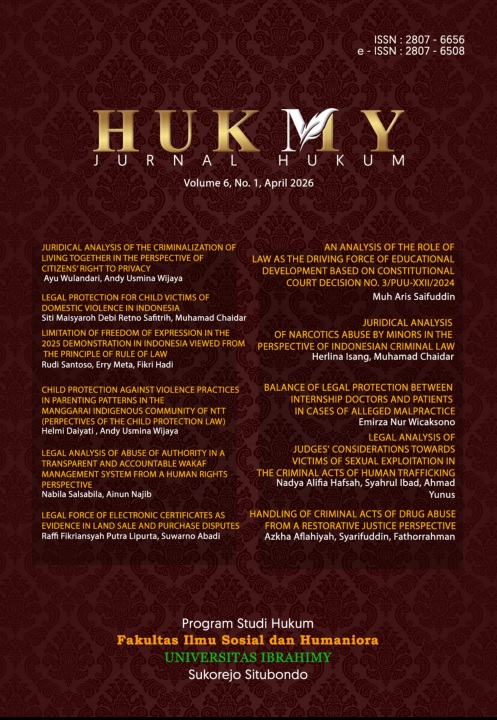
JURIDICAL ANALYSIS OF THE CRIMINALIZATION OF LIVING TOGETHER IN THE PERSPECTIVE OF CITIZENS’ RIGHT TO PRIVACY
DOI:
https://doi.org/10.35316/hukmy.2026.v6i1.1126-1139Keywords:
Living Together, Human Rights, New Criminal CodeAbstract
In the context of protecting citizens' right to privacy, this study discusses the criminalization of living together behavior as regulated in Article 412 of the new Criminal Code (KUHP). In this research, the limits of the state's authority to regulate the private sphere are examined through a normative legal approach, using both statutory and conceptual approaches. The results of the analysis show that the policy of criminalizing living together creates tension between the protection of public morals and respect for individual freedom. Since it does not meet the requirements of the harm principle, this provision potentially violates the principles of proportionality and the ultimum remedium doctrine. Therefore, the policy must be revised to align with the Constitution, the principles of Pancasila, and international human rights standards.
References
Akitha, F., & Rinwigati, P. (2025). Kriminalisasi kohabitasi dalam Pasal 412 Undang-undang Nomor 1 Tahun 2023 tentang Kitab Undang-undang Hukum Pidana sebagai upaya perlindungan hak asasi manusia pelaku dari tindakan main hakim sendiri (Eigenrechting). Khatulistiwa: Jurnal Pendidikan Dan Sosial Humaniora, 5(2), 216. https://doi.org/10.55606/khatulistiwa.v5i2.5837
Ashworth, A., & Zedner, L. (2012). Prevention and criminalization: Justifications and limits. New Criminal Law Review: An International and Interdisciplinary Journal, 15(4), 553.
Borgerud, C. (2025). The public right of access to research data–an ethical dilemma? Journal of Documentation, 359.
Cahyani, I. O., Hermansyah, H., & Abunawas, A. (2025). Kohabitasi dan hukum pidana baru Indonesia: Antara progresivitas kriminalisasi dan nilai ketimuran. Tanjungpura Legal Review, 3(2).
Garcia, V., Disemadi, H. S., & Arief, B. N. (2020). The enforcement of restorative justice in Indonesia criminal law. Legality: Jurnal Ilmiah Hukum, 28(1), 29.
Goossens, E. (2021). One trend, a patchwork of laws: An exploration of why cohabitation law is so different throughout the Western world. International Journal of Law, Policy and the Family, 35(1), 20.
Harcourt, B. E. (2001). Joel Feinberg on crime and punishment: Exploring the relationship between the moral limits of the criminal law and the expressive function of punishment. Buffalo Criminal Law Review, 5(1), 164.
Husak, D. (2008). Overcriminalization: The limits of the criminal law. Oxford University Press.
Irawan, A., & Iranti, V. K. G. (2025). Kohabitasi dalam KUHP 2023: Analisis yuridis atas intervensi hukum pidana terhadap kehidupan pribadi. Journal of Islamic and Law Studies, 9(1), 7.
Kartodinudjo, P. M. Y. (2023). Tinjauan kriminalisasi perbuatan kohabitasi dalam perspektif hukum pidana. Bureaucracy Journal: Indonesia Journal of Law and Social-Political Governance, 3(2), 1315.
Maulana, F. (2025). Politik hukum sanksi pidana atas perbuatan kohabitasi di Indonesia (p. 6).
Mill, J. S. (2014). On Liberty by John Stuart Mill. BookRix.
Nurhayati, Y., Ifrani, I., & Said, M. Y. (2021). Metodologi normatif dan empiris dalam perspektif ilmu hukum. Jurnal Penegakan Hukum Indonesia, 2(1), 9.
Prawira, M. R. Y. (2024). Potensi overkriminalisasi pada pengaturan tindak pidana kohabitasi dalam Kitab Undang–Undang Hukum Pidana: Perspektif fair trial. Jurnal Hukum Statuta, 4(1), 35. https://doi.org/10.35586/jhs.v4i1.9530
Qayyum, H. I., Efri, Y., & Prakasa, R. S. (2025). Tinjauan kriminologi terhadap kumpul kebo (Samen Laven) sebagai fenomena prilaku penyimpangan sosial. Sumbang12 Law Journal, 3(2), 167.
Ritonga, Z., Syam, S. A., & Lubis, F. (2024). Kebijakan kriminalisasi dan dekriminalisasi KUHP baru. INNOVATIVE: Journal Of Social Science Research, 4(4), 3957–3967.
Rizki, A., & Siregar, R. A. (2025). Tantangan perubahan dan perkembangan KUHP baru di Indonesia. Jurnal Hukum Mimbar Justitia (JHMJ), 11(1), 210.
Safitri, N. I., & Wahyudi, E. (2023). Kriminalisasi perbuatan kohabitasi dalam perspektif pembaharuan Kitab Undang-Undang Hukum Pidana (KUHP) di Indonesia. Jurnal Ilmiah Wahana Pendidikan, 9(20), 612–625.
Sholikah, A., Hidayati, R., Parmono, B., Muhibbin, M., & Ilmania, N. F. (2023). Regulasi hukum terhadap pemidanaan orang yang melakukan kohabitasi (kumpul kebo). JUSTISI, 10(1), 178. https://doi.org/10.33506/js.v10i1.3009
Siregar, M. (2024). Teori Hukum Progresif dalam Konsep Negara Hukum Indonesia. 8(2).
Yang, C. L. W. (2025). Marriage, cohabitation, and institutional context: Household specialization among same‐sex and different‐sex couples. Journal of Marriage and Family, 87(1), 318.
Downloads
Published
How to Cite
Issue
Section
License
Copyright (c) 2026 HUKMY : Jurnal Hukum

This work is licensed under a Creative Commons Attribution-NonCommercial-ShareAlike 4.0 International License.