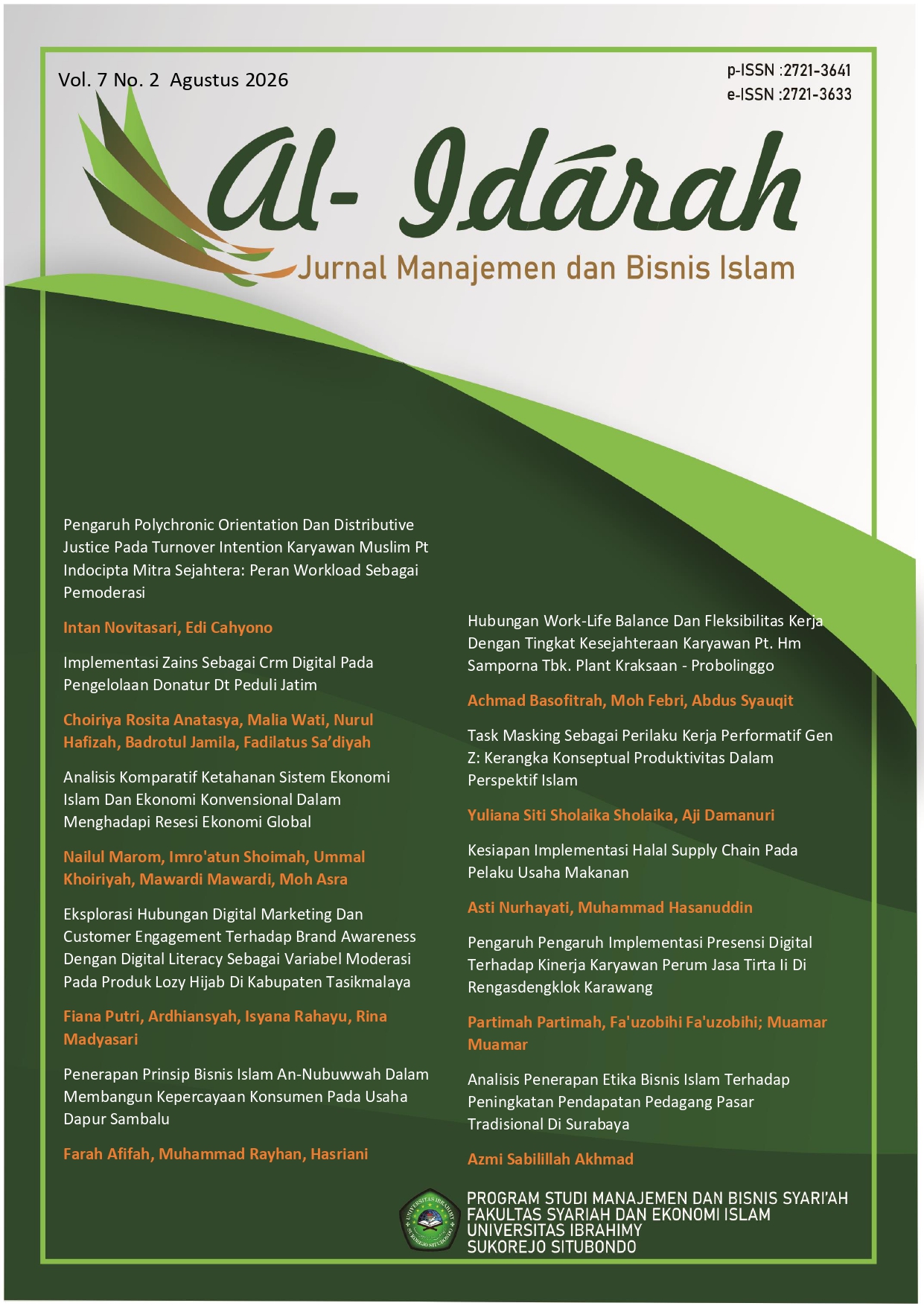
TASK MASKING SEBAGAI PERILAKU KERJA PERFORMATIF GEN Z: KERANGKA KONSEPTUAL PRODUKTIVITAS DALAM PERSPEKTIF ISLAM
DOI:
https://doi.org/10.35316/idarah.2026.v7i2.94-104Kata Kunci:
Task masking, Produktivitas Kerja, Etika Kerja IslamiAbstrak
This study aims to analyse the phenomenon of Task masking as performative work behaviour in modern working cultures, as well as to reconstruct the meaning of productive work from an Islamic perspective. This phenomenon has emerged in response to the presentism-based work system, which still considers working hours to be the main indicator of productivity. The research method used was a qualitative approach with a conceptual study design based on a literature review, through the analysis of relevant literature related to modern management theory, work behaviour, and Islamic work ethics. The results of the study show that Task masking is a consequence of a work system that emphasises time control and the display of productivity, thus encouraging workers to perform symbolic activities rather than produce substantive outputs. This has an impact on increased psychological pressure, decreased authenticity of work, and reduced motivation and engagement among workers. From an Islamic perspective, this phenomenon raises ethical issues as it contradicts the principles of Amanah, honesty, and professional conduct, but it is also the responsibility of organisations to create fair and balanced working systems. This study concludes that there is a need for a reconstruction of the work productivity paradigm that is not only results-oriented, but also considers the integrity of the process, work-life balance, and Islamic ethical work values.
Unduhan
Diterbitkan
Cara Mengutip
Terbitan
Bagian
Lisensi
Hak Cipta (c) 2026 Yuliana Siti Sholaika Sholaika, Aji Damanuri

Artikel ini berlisensi Creative Commons Attribution 4.0 International License.