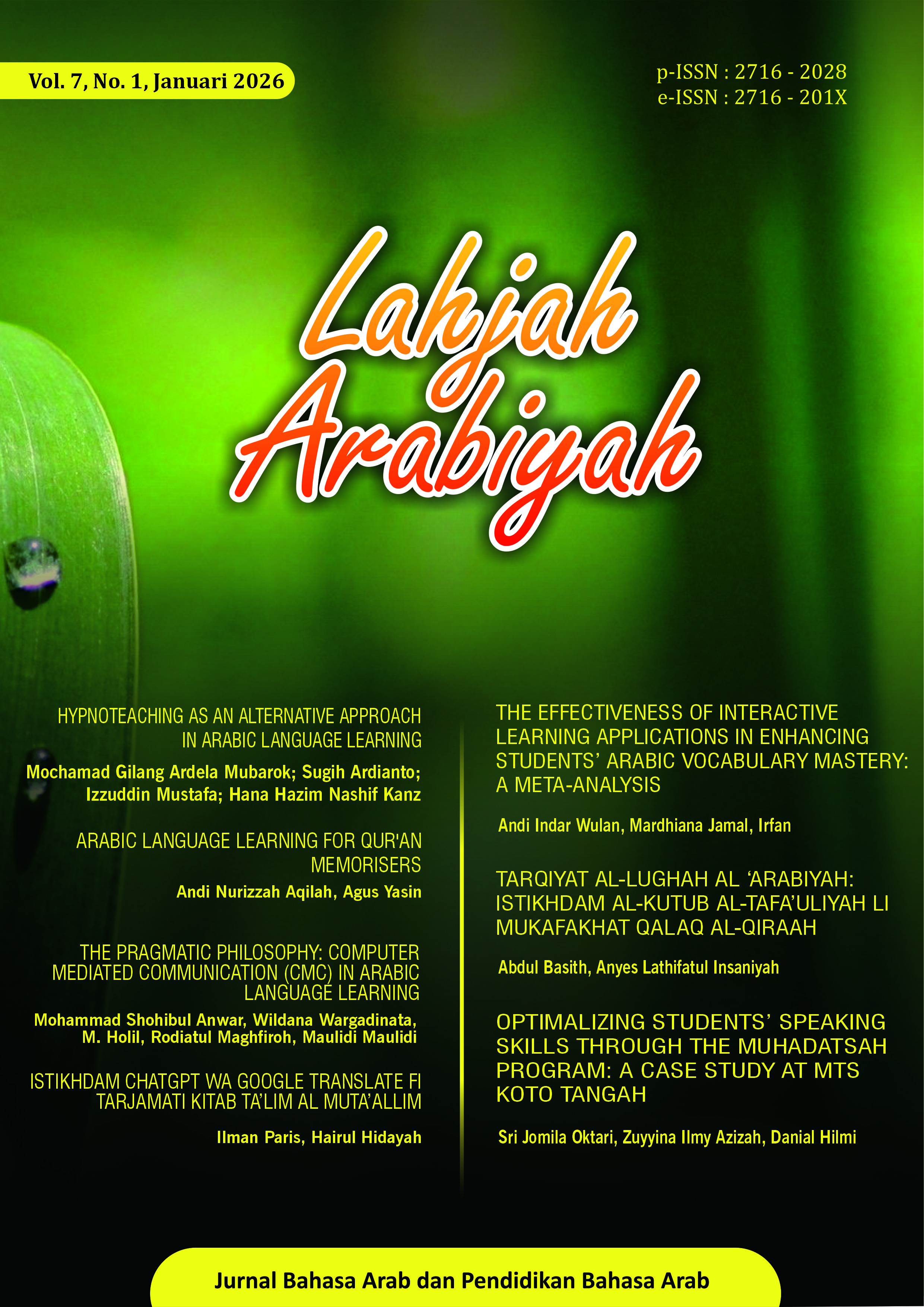
THE PRAGMATIC PHILOSOPHY: COMPUTER MEDIATED COMMUNICATION (CMC) IN ARABIC LANGUAGE LEARNING
Keywords:
Arabic Learning, CMC (Computer Mediated Communication), The Pragmatic PhilosophyAbstract
This study explores the conceptual relationship between Pragmatism and Computer-Mediated Communication (CMC) within the context of Arabic language education. Pragmatism emphasizes the practical value of knowledge, aligning with the objective of Arabic instruction to develop communicative competence. CMC, particularly through Synchronous (SCMC) and Asynchronous (ACMC) modes, serves as a modern pedagogical tool to support language learning. This research adopts a literature-based approach by analyzing current academic sources to evaluate how CMC can enhance Arabic language acquisition through collaborative and contextual interaction. The findings suggest that effective integration of CMC can significantly improve students' proficiency, especially in a digital learning environment. The study offers valuable insights for developing innovative Arabic language teaching strategies that are aligned with pragmatic educational goals.
Downloads
References
Amin, Risma Fahrul. “Computer Mediated Communication (Cmc) Dalam Pembelajaran Bahasa Inggris.” LISAN AL-HAL: Jurnal Pengembangan Pemikiran Dan Kebudayaan 14, no. 2 (2020): 341–60. https://doi.org/10.35316/lisanalhal.v14i2.796.
Ancheta, Jeffrey Rosario. “Computer-Mediated Communication in Language Teaching: Challenges and Responses of Filipino ESL Teachers in the Philippines.” Jurnal Komunikasi: Malaysian Journal of Communication 41, no. 1 (2025): 351–67. https://doi.org/10.17576/JKMJC-2025-4101-20.
Braun, Virginia, and Victoria and Clarke. “Reflecting on Reflexive Thematic Analysis.” Qualitative Research in Sport, Exercise and Health 11, no. 4 (August 8, 2019): 589–97. https://doi.org/10.1080/2159676X.2019.1628806.
Chew, Shin Yi, and Lee Luan Ng. “Computer-Mediated Communication (CMC).” In Palgrave Macmillan, Cham, edited by Shin Yi Chew and Lee Luan Ng, 27–52. Cham: Springer International Publishing, 2021. https://doi.org/10.1007/978-3-030-67425-0_3.
Gráinne Kirwan. AN INTRODUCTION TO CYBERPSYCHOLOGY. Routledge, Taylor & Francis Group. UK, 2024. https://doi.org/https://doi.org/10.4324/9781003092513.
Hadjah, Ahadrnus. “Computer Mediated Communication (CMC), Pola Baru Berkomunikasi.” Al-Munzir 8, no. 2 (2015): 275–89.
Harb, Mustafa. “Disagreement among Arabic Speakers in Faceless Computer-Mediated Communication.” Journal of Politeness Research, Journal of Politeness Research, 17, no. 2 (2021): 233–64. https://doi.org/doi:10.1515/pr-2017-0045.
Hung, Bui Phu, Anh Tram Dang Pham, and Priyambada Purohit. “Computer Mediated Communication in Second Language Education BT - New Trends and Applications in Internet of Things (IoT) and Big Data Analytics.” In Springer International Publishing, edited by Rohit Sharma and Dilip Sharma, 45–60. Cham: Springer International Publishing, 2022. https://doi.org/10.1007/978-3-030-99329-0_4.
Jiang, Liping. “On Effective Utilization of Computer-Mediated Communication Technology in Network-Based Foreign Language Teaching.” Wireless Communications and Mobile Computing 2022 (2022). https://doi.org/10.1155/2022/1048311.
Kern, Richard, Paige Ware, and Mark Warschauer. “Network-Based Language Teaching BT - Second and Foreign Language Education.” In Springer International Publishing, edited by Nelleke Van Deusen-Scholl and Stephen May, 1–13. Cham: Springer International Publishing, 2016. https://doi.org/10.1007/978-3-319-02323-6_30-1.
Kessler, Matt, Shawn Loewen, and Daniel Trego. “Synchronous Video Computer-Mediated Communication in English Language Teaching.” ELT Journal 75, no. 3 (July 1, 2021): 371–76. https://doi.org/10.1093/elt/ccab007.
Kosasih, Ahmad. “FILSAFAT PENDIDIKAN PRAGMATISME Telaah Atas Teori Manajemen Pendidikan John Dewey.” Faktor : Jurnal Ilmiah Kependidikan 9, no. 1 (2022): 98. https://doi.org/10.30998/fjik.v9i1.11416.
Liang, Yuhua Jake, and Joseph B. Walther. “Computer Mediated Communication.” International Encyclopedia of the Social & Behavioral Sciences: Second Edition 4, no. 1 (2015): 504–9. https://doi.org/10.1016/B978-0-08-097086-8.95090-6.
Nabilah, Rifqah, and Ruby Abrilian. “Learning Arabic in the Era of Society 5 . 0,” 2024, 10–11.
Pimada, Luluk Humairo, and Muhammad Afif Amrulloh. “Penerapan Media Elektronik Pada Pembelajaran Bahasa Arab.” Lahjah Arabiyah: Jurnal Bahasa Arab Dan Pendidikan Bahasa Arab 1, no. 2 (2020): 120–28. https://doi.org/10.35316/lahjah.v1i2.819.
Quan-Haase, Anabel, Guang Ying Mo, and Barry Wellman. “Connected Seniors: How Older Adults in East York Exchange Social Support Online and Offline.” Information Communication and Society 20, no. 7 (2017): 967–83. https://doi.org/10.1080/1369118X.2017.1305428.
Satiri, Hasani Aceng, Nulhakim Lukman, Ruhiyat Yayat, Hadi Anwar Cecep. “Filsafat Pendidikan Pragmatisme Sebuah Analisis Tentang Teori Pragmatisme Dalam Pendidikan.” INNOVATIVE: Journal Of Social Science Research 4 (2024): 5262–72.
Shadiev, Rustam, Ting Ting Wu, and Yueh Min Huang. “Using Image-to-Text Recognition Technology to Facilitate Vocabulary Acquisition in Authentic Contexts.” ReCALL 32, no. 2 (2020): 195–212. https://doi.org/10.1017/S0958344020000038.
Silvia, Mimi, Dian Rousta, and Daniel Gilrandy. “Application of Computer-Mediated Communication Theory in Online Learning.” Jurnal Komunikasi Indonesia 11, no. 2 (2022). https://doi.org/10.7454/jkmi.v11i2.1032.
Snyder, Hannah. “Literature Review as a Research Methodology: An Overview and Guidelines.” Journal of Business Research 104 (2019): 333–39. https://doi.org/https://doi.org/10.1016/j.jbusres.2019.07.039.
Sykes, Julie M. “Synchronous CMC and Pragmatic Development: Effects of Oral and Written Chat.” CALICO Journal, 2005, 399–431.
Zhao, Mengfei, Nooreen Noordin, Norhakimah Khaiessa Binti Ahmad, and Lingxin Liu. “Effectiveness of Mobile-Assisted Language Learning in Developing Oral English in Higher Education: A Comparative Systematic Review.” World Journal of English Language 15, no. 1 (2024): 56. https://doi.org/10.5430/wjel.v15n1p56.
Downloads
Published
How to Cite
Issue
Section
License
Copyright (c) 2026 Mohammad Shohibul Anwar, Wildana Wargadinata, M. Holil, Rodiatul Maghfiroh, Maulidi Maulidi

This work is licensed under a Creative Commons Attribution-ShareAlike 4.0 International License.
Authors who publish with this journal agree to the following terms:
- Authors retain copyright and grant the journal right of first publication with the work simultaneously licensed under a Creative Commons Attribution-ShareAlike 4.0 International License that allows others to share the work with an acknowledgement of the work's authorship and initial publication in this journal.
- Authors are able to enter into separate, additional contractual arrangements for the non-exclusive distribution of the journal's published version of the work (e.g., post it to an institutional repository or publish it in a book), with an acknowledgement of its initial publication in this journal.
- Authors are permitted and encouraged to post their work online (e.g., in institutional repositories or on their website) prior to and during the submission process, as it can lead to productive exchanges, as well as earlier and greater citation of published work.















_by_Matematohir.jpg)