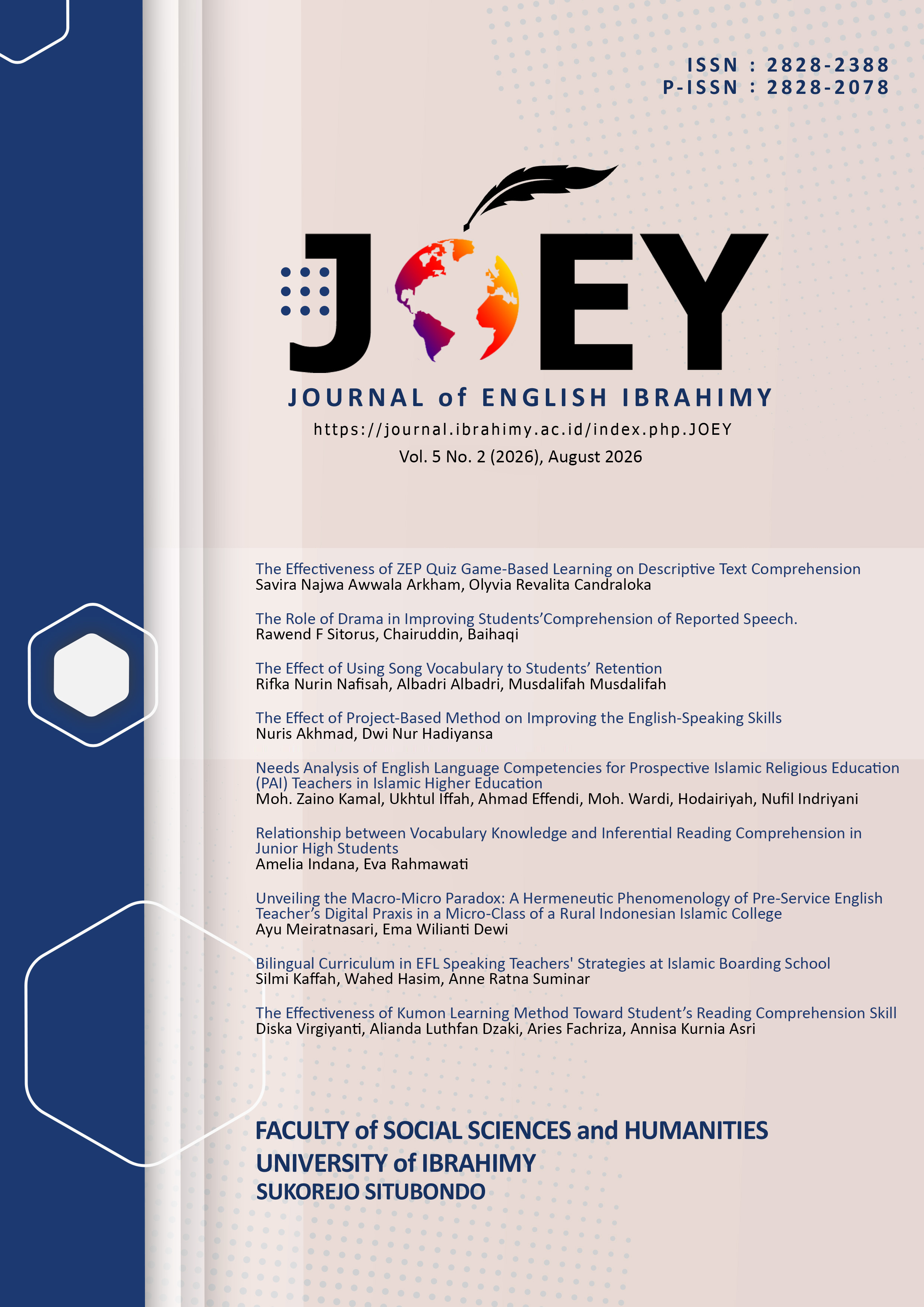
Needs Analysis of English Language Competencies for Prospective Islamic Religious Education (PAI) Teachers in Islamic Higher Education
English
DOI:
https://doi.org/10.35316/joey.2026.v5i2.58-69Kata Kunci:
MZKAbstrak
This study analyzed the English language competency needs of prospective Islamic Religious Education (PAI) teachers in Islamic higher education institutions. The study was conducted at STIT Aqidah Usymuni Sumenep as the research site, and the informants included lecturers, students, and alumni. This study employed a qualitative approach with a case study design to describe the English language competency needs of prospective PAI teachers in Islamic higher education institutions. The study highlighted two main aspects of needs: objective needs and learning needs. Objectively, the findings indicated that students needed reading, writing, speaking, and listening skills to understand academic texts and communicate in scholarly contexts. From a learning perspective, the findings showed that English instruction needed to be relevant to Islamic studies through an English for Specific Purposes (ESP) approach. The findings suggested that Islamic higher education institutions needed to design contextual and systematic English programs to support the professional development and global competitiveness of prospective PAI teachers.
Referensi
Adibah, I. Z., & Chasanah, U. (2025). Developing a pai curriculum that is responsive to diversity. At Turots: Jurnal Pendidikan Islam, 232–240.
Adilah, N., Riyadi, S., & Suwardi, S. (2024). SYSTEMATIC LITERATURE REVIEW: OBSTACLES AND STRATEGIES TO IMPROVE THE COMPETENCE OF PAI TEACHERS IN SENIOR HIGH SCHOOLS. Journal of Social and Economics Research, 6(2), 1090–1103.
Ahsan, M., Masrukhi, M., Haryono, H., & Rusdarti, R. (2019). Developing a Management Model of PAI Teachers’ Competency Improvement Based on Online Networks. The Journal of Educational Development, 7(1), 24-â.
Alem, D. D. (2020). An overview of data analysis and interpretations in research. International Journal of Academic Research in Education and Review, 8(1), 1–27.
Arif, M., Abd Aziz, M. K. N., & Ma’arif, M. A. (2025). A Recent Study on Islamic Religious Education Teachers’ Competencies in the Digital Age: A Systematic Literature Review. Journal of Education and Learning (EduLearn), 19(2), 587–596.
Assegaf, A. R., Zainiyah, H. S., & Fahmi, M. (2022). Curriculum innovation for the internationalization of Islamic education study program at higher education institutions in Surabaya, Indonesia. Millah: Journal of Religious Studies, 671–706.
Bocanegra-Valle, A. (2016). Needs analysis for curriculum design. In The Routledge handbook of English for academic purposes (pp. 560–576). Routledge.
Creswell, J. W. (2018). A Mixed-Method Approach. In Writing Center Talk over Time. https://doi.org/10.4324/9780429469237-3
Dian, D., Indayanti, A. N., Fanani, A. I., & Nurhayati, E. (2023). Optimizing Islamic Religious Colleges In Facing The Era of Globalization. Tafkir: Interdisciplinary Journal of Islamic Education, 4(1), 58–77.
Edy, S., & Arifin, B. S. (2024). Development Of The Islamic Religious Education Curriculum Considering Academic And Practical Balance. Journal of Language and Literature Education, 1(3), 148–167.
Firman. (2022). Need Analysis of Indonesian Teaching Materials at Islamic Religious Universities. Edukasi Islami: Jurnal Pendidikan Islam, 11(1), 1–9. https://doi.org/10.30868/ei.v11i01.3781
Hajar, A. (2024). Navigating Globalization: Reforming Islamic Education for the 21st Century. Sinergi International Journal of Islamic Studies, 2(1), 53–65.
Kamal, M. Z. (2025). ANALYSIS OF STUDENTS’DIFFICULTIES FOR ENGLISH SUBJECT IN THE ISLAMIC EDUCATION DEPARTMENT AT STIT AQIDAH USYMUNI SUMENEP. An-Nas, 9(2), 184–195.
Kamal, M. Z., Albadri, A., & Effendi, A. (2025). Analysis of Speaking Problems for English Subject in Islamic Education Department at STIT Aqidah Usymuni Sumenep: English. JOEY: Journal of English Ibrahimy, 4(2), 28–33.
Khan, N., Sarwar, A., Chen, T. B., & Khan, S. (2022). Connecting digital literacy in higher education to the 21st century workforce. Knowledge Management & E-Learning, 14(1), 46–61.
Latifah, E. N., Malihah, N., & Irwansyah, F. S. (n.d.). Assessment of Pedagogical Competence of Islamic Religious Education (PAI) Teachers: A Literature Review. ASEAN Journal of Religion, Education, and Society; Vol 4, No 1 (2025): AJORES: Volume 4, Issue 1, April 2025. https://ejournal.bumipublikasinusantara.id/index.php/ajores/article/view/683
Ludviana, V. (2025). A Contextual and Adaptive Approach to PAI Learning for 21st Century Education at SMPN 1 Kras, Kediri. Ensiklopedia: Jurnal Pendidikan Dan Inovasi Pembelajaran Saburai, 5(02), 270–279.
Muzaki, M., Firdaus, S., & Mustajab, D. (2025). Revitalizing the Value of Tolerance in Islamic Religious Education (PAI) Learning to Face the Challenges of Multiculturalism. Journal of Educational Sciences, 9(6), 5804–5813.
Seargeant, P., & Erling, E. J. (2011). The discourse of ‘English as a language for international development’: Policy assumptions and practical challenges. Dreams and Realities, 248–268.
Setiawan, R. A. (2026). Rahmatan lil ‘Alamin as a Pedagogical Paradigm in Islamic Education: A Literature Review. Jurnal Harmoni Pendidikan, 2(1), 81–96.
Sidqurrahman, Z. (2024). The integration of Islamic perspectives in teaching English as a foreign language: A systematic literature review. Journal of Social and Economics Research, 6(2), 223–245.
Suharsimi, A. (2006). Prosedur penelitian suatu pendekatan praktik. Jakarta: Rineka Cipta, 134, 252.
Swami, N. (2025). THE ROLE OF ENGLISH IN GLOBAL COMMUNICATION: CHALLENGES AND OPPORTUNITIES. Journal of Advanced Interdisciplinary Studies-p-ISSN 3050-8924 En e-ISSN 3050-8932, 1(1), 1–9.
Walliman, N. (2021). Research methods: The basics. Routledge.
Wicagsono, M. A., & Al, B. M. A. M. H. (2023). Strategies for improving teacher pedagogic competence industrial revolution era 4.0. Multicultural Islamic Education Review, 1(1), 15–25.
Zein, K. N., & Arifudin, I. (2025). Analysis of Instructional Needs and General Instructional Objectives in Islamic Religious Education (IRE) Learning: An Integrated Literature Review. Cristal International Journal of Interdisciplinary Research, 1(2), 82–90.
Unduhan
Diterbitkan
Cara Mengutip
Terbitan
Bagian
Lisensi
Hak Cipta (c) 2026 JOEY: Journal of English Ibrahimy

Artikel ini berlisensiCreative Commons Attribution-NonCommercial-ShareAlike 4.0 International License.