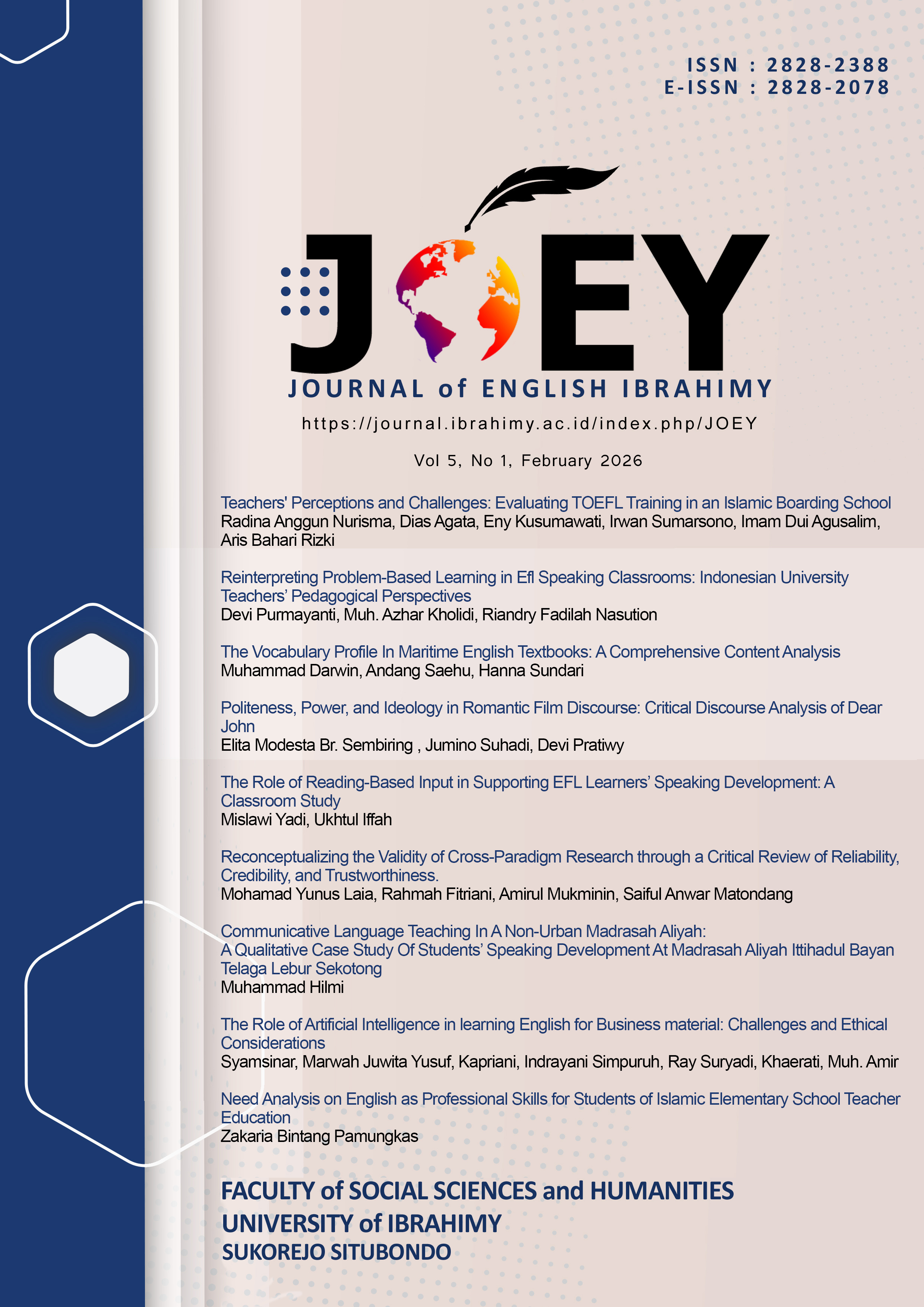
The Vocabulary Profile in Maritime English Textbooks: A Comprehensive Content Analysis
English
DOI:
https://doi.org/10.35316/joey.2026.v5i1.37-47Kata Kunci:
Maritime English, Vocabulary Profile, Standard Marine Communication Phrases, Technical Vocabulary, Content AnalysisAbstrak
This study investigated the vocabulary profile of the Maritime English (ME) textbook Effective Communication at Sea: Mastering SMCP for Maritime Safety and Efficiency (Batu, 2024). Employing a mixed-methods corpus content analysis, a 35,000-token corpus was processed through AntConc to determine lexical frequency across K1, K2, and K3 (off-list/technical) levels, alongside a qualitative semantic audit of polysemic terms and SMCP alignment. Results reveal a distinctive lexical distribution of 72.5% K1, 8.0% K2, and 19.5% K3 tokens, indicating a high technical density optimized for vocational training. Grammatical analysis shows a heavy dominance of nouns (60%) and verbs (30%), reflecting the action-oriented nature of maritime commands. The study confirmed the presence of critical polysemic shifts in high-frequency words (e.g., bridge, draft, head), where meanings deviate drastically from general English. Finally, qualitative evaluation confirms that the textbook achieves high functional integration of IMO-mandated Standard Marine Communication Phrases (SMCP) across both internal and external communication categories. These findings establish a data-driven "70-10-20" vocabulary profile model for the design and audit of vocational maritime instructional materials
Referensi
Batu, N. L. (2024). Effective communication at sea: Mastering SMCP for maritime safety and efficiency. [Penerbit Fiktif].
Bowker, L., & Pearson, J. (2002). Working with specialized language: A practical guide to terminology. Lawrence Erlbaum Associates.
Coxhead, A. (2000). A new academic word list. TESOL Quarterly, 34(2), 213–233. https://doi.org/10.2307/3587951
Creswell, J. W. (2014). Research design: Qualitative, quantitative, and mixed methods approaches (4th ed.). SAGE Publications.
Douglas, D. (2000). Assessing language for specific purposes. Cambridge University Press.
Flowerdew, J. (1993). Content and discourse: The limits of instructional design. TESOL Quarterly, 27(4), 743–750.
Hutchinson, T., & Waters, A. (1987). English for specific purposes: A learning-centred approach. Cambridge University Press.
Hyland, K. (2006). English for academic purposes: An advanced resource book. Routledge.
International Maritime Organization. (2001). Standard marine communication phrases (SMCP).
Larsen-Freeman, D. (2003). Teaching language: From grammar to grammaring. Heinle & Heinle.
Long, M. H. (2005). Problems in SLA: The role of the input, the nature of the language user, and the nature of the language usage. Language Testing, 22(3), 295–302. https://doi.org/10.1191/0265532205lt308oa
Nation, I. S. P. (1990). Teaching and learning vocabulary. Heinle & Heinle.
Nation, I. S. P. (2001). Learning vocabulary in another language. Cambridge University Press.
Paltridge, B. (2001). Genre and the language learning classroom. University of Michigan Press.
Read, J. (2000). Assessing vocabulary. Cambridge University Press.
Richards, J. C., & Renandya, W. A. (2002). Methodology in language teaching: An anthology of current practice. Cambridge University Press.
Strevens, P. (1988). ESP after twenty years: A reappraisal. In M. J. L. De La Cruz (Ed.), Language development: A look to the future (pp. 1–13). Ateneo de Manila University Press.
Suswanto, I. D., & Awwabin, M. (2020). Analysis of maritime English reading materials in the second semester students of shipping department at PIP Makassar. Jurnal Saintara, 6(1), 10–20. https://doi.org/10.52475/saintara.v6i1.152
Taylor, C. E., & Dimmock, E. D. (2006). Maritime English for the 21st century: Meeting the demands of global shipping. Journal of Maritime Research, 3(2), 15–30.
Trimble, L. (1985). English for science and technology: A discourse approach. Cambridge University Press.
Ur, P. (1996). A course in language teaching: Practice and theory. Cambridge University Press.
Vagapova, S. (2018). Maritime English and SMCP in the global communication context. Procedia Engineering, 205, 63–69. https://doi.org/10.1016/j.proeng.2017.10.150
Weber, R. (1990). Basic content analysis (2nd ed.). SAGE Publications.
West, M. (1953). A general service list of English words. Longman, Green and Co.
Widdowson, H. G. (1978). Teaching language as communication. Oxford University Press.
Wilkins, D. (1976). Notional syllabuses: A taxonomy and its relevance to foreign language curriculum development. Oxford University Press. https://doi.org/10.1037/11193-000
Wiranty, G. M., Saehu, A., Sundari, H., & Alaqad, M. H. (2024). Profiling vocational school students’ word knowledge level: A study in Jakarta Timur. JEELS (Journal of English Education and Linguistics Studies), 11(1), 81–105. https://doi.org/10.30762/jeels.v11i1.1718
Xie, J. C. (2010). A corpus analysis of vocabulary in EFL course books for high school. Foreign Language Learning Theory and Practice, 1, 55–61.
Yu, M., & Renandya, W. A. (2021). A corpus-based study of the vocabulary profile of high school English textbooks in China. LEARN Journal: Language Education and Acquisition Research Network, 14(1), 28–49.
Zimmerman, C. B. (2009). Word knowledge: A vocabulary teachers' handbook. Oxford University Press.
Unduhan
Diterbitkan
Cara Mengutip
Terbitan
Bagian
Lisensi
Hak Cipta (c) 2026 JOEY: Journal of English Ibrahimy

Artikel ini berlisensiCreative Commons Attribution-NonCommercial-ShareAlike 4.0 International License.