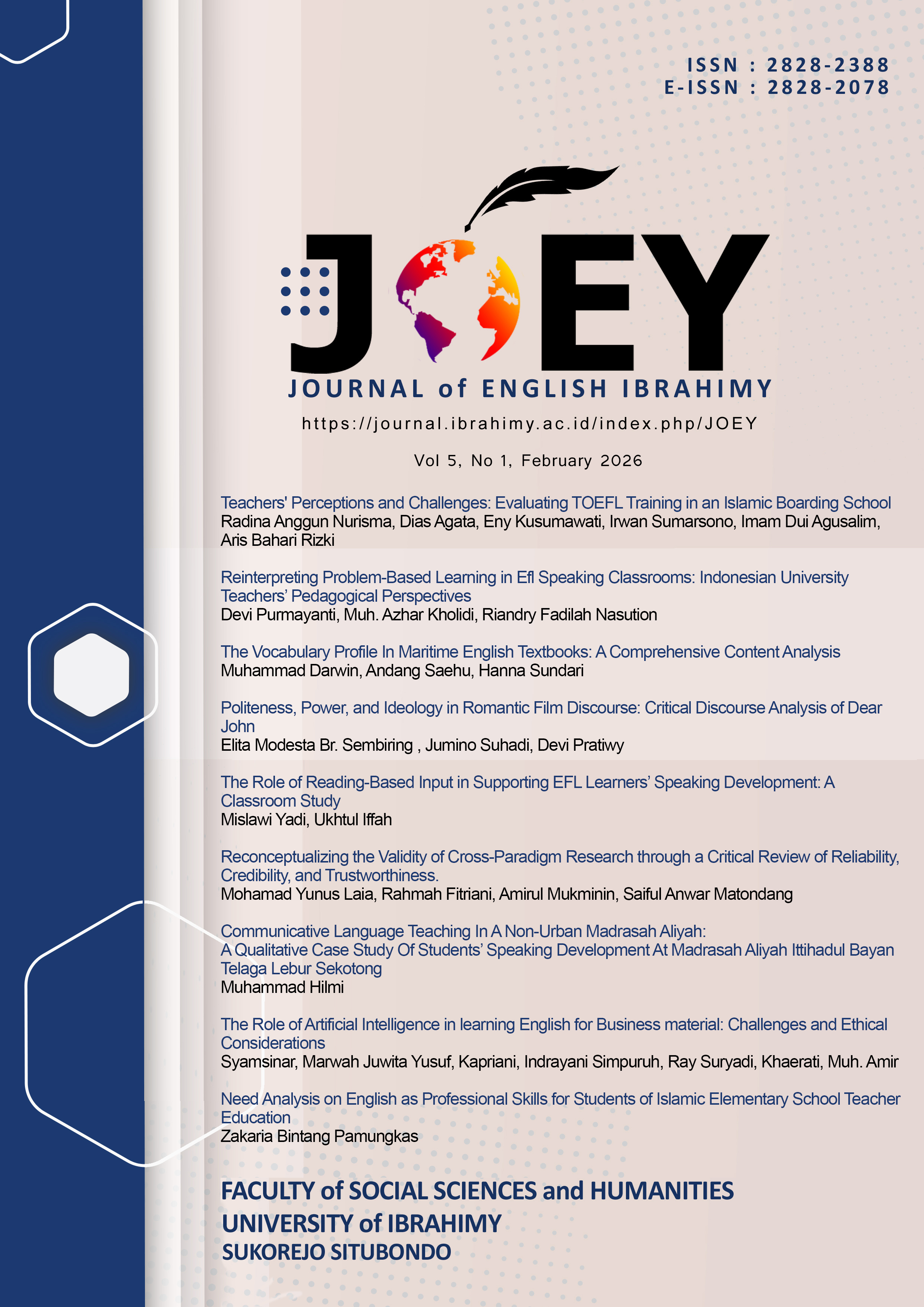
Reinterpreting Problem-Based Learning in EFL Speaking Classrooms: Indonesian University Teachers’ Pedagogical Perspectives
English
DOI:
https://doi.org/10.35316/joey.2026.v5i1.20-36Kata Kunci:
Problem-Based Classroom Learning, speaking skillAbstrak
Problem-Based Learning (PBL) has gained prominence as a pedagogical approach for promoting learner autonomy, critical thinking, and communicative competence. However, little is known about how PBL is interpreted, adapted, and enacted by teachers in English as a Foreign Language (EFL) speaking classrooms, particularly in Indonesian higher education. This qualitative study examined Indonesian university EFL teachers’ perceptions and enactment of PBL in speaking instruction. Semi-structured interviews were conducted with five instructors from diverse institutional contexts and analyzed using thematic analysis. The findings show that teachers did not implement PBL as a fixed instructional model but reinterpreted it as a context-sensitive, fluency-oriented pedagogy shaped by learner readiness, classroom culture, and institutional constraints. While PBL was perceived to enhance student engagement, speaking confidence, and willingness to communicate, it was primarily adapted as discussion- and task-based activities rather than sustained inquiry cycles. These adaptations reveal how teacher cognition and local educational conditions mediate global pedagogical models. By foregrounding teachers situated enactment of PBL, this study extends existing PBL theory in EFL contexts and challenges assumptions that learner-centered pedagogies transfer seamlessly across settings. The study proposes a more context-responsive understanding of PBL for EFL speaking instruction and offers implications for teacher education, curriculum design, and institutional support in similarly constrained contexts.
Referensi
Alkhateeb, M. A. (2019). The impact of problem-based learning on English language learners’ motivation and speaking skills. International Journal of Instruction, 12(3), 37–54. https://doi.org/10.29333/iji.2019.1233a
Azzahra, N. R., & Nurkamto, J. (2024). How do EFL teachers navigate problem-based learning in Indonesian classrooms? Voices of English Language Education Society, 8(3). https://doi.org/10.29408/veles.v8i3.27956
Barron, B., & Darling-Hammond, L. (2008). Teaching for meaningful learning: A review of research on inquiry-based and cooperative learning. In Powerful learning: What we know about teaching for understanding. Jossey-Bass.
Barrows, H. S., & Tamblyn, R. M. (1980). Problem-based learning: An approach to medical education. Springer.Barrows, H. S. (2000). Problem-based learning applied to medical education. Southern Illinois University Press.
Barrows, H. S. (2020). A taxonomy of problem-based learning methods. In D. Boud & G. Feletti (Eds.), The challenge of problem-based learning (3rd ed., pp. 1–12). Routledge.
Beckett, G. H. (2002). Teacher and student evaluations of project-based instruction. TESL Canada Journal, 19(2), 52–66. https://doi.org/10.18806/tesl.v19i2.930
Beckett, G. H., & Slater, T. (2005). The project framework: A tool for language, content, and skills integration. English Language Teaching Journal, 59(2), 108–116. https://doi.org/10.1093/eltj/cci024
Braun, V., & Clarke, V. (2006). Using thematic analysis in psychology. Qualitative Research in Psychology, 3(2), 77–101. https://doi.org/10.1191/1478088706qp063oa
Creswell, J. W. (2014). Research design: Qualitative, quantitative, and mixed methods approaches (4th ed.). SAGE Publications.
Chun, D. M. (2010). Critical literacies and problem-based learning in English language education. Language Teaching Research, 14(2), 183–201. https://doi.org/10.1177/1362168809346505
Dörnyei, Z. (2005). The psychology of the language learner: Individual differences in second language acquisition. Lawrence Erlbaum.
Duch, B. J., Groh, S. E., & Allen, D. E. (Eds.). (2001). The power of problem-based learning: A practical “how to” for teaching undergraduate courses in any discipline. Stylus.
Gillies, R. M. (2003). Cooperative learning: The social and intellectual outcomes of learning in groups. Routledge.
Harland, T. (2003). Vygotsky’s zone of proximal development and problem-based learning: Linking a theoretical concept with practice through action research. Teaching in Higher Education, 8(2), 263–272. https://doi.org/10.1080/1356251032000052483
Harsono, Y. M. (2020). EFL teachers’ readiness to implement student-centered learning in Indonesia. Indonesian Journal of English Language Teaching, 15(2), 149–163.
Hmelo-Silver, C. E. (2004). Problem-based learning: What and how do students learn? Educational Psychology Review, 16(3), 235–266. https://doi.org/10.1023/B:EDPR.0000034022.16470.f3
Hung, W. (2011). Theory to reality: A few issues in implementing problem-based learning. Educational Technology Research and Development, 59(4), 529–552. https://doi.org/10.1007/s11423-011-9198-1
Jonassen, D. H. (2011). Supporting problem solving in PBL. Interdisciplinary Journal of Problem-Based Learning, 5(2), 95–119. https://doi.org/10.7771/1541-5015.1256
Lie, A. (2017). English and identity in multicultural contexts: Issues, challenges, and opportunities. Indonesian Journal of Applied Linguistics, 7(3), 509–516. https://doi.org/10.17509/ijal.v7i3.9826
Long, M. H. (2015). Second language acquisition and task-based language teaching. Wiley-Blackwell.
Lu, J., & Bridges, S. (2016). Exploring the value of problem-based learning in language learning and teaching. Innovations in Education and Teaching International, 53(6), 566–576. https://doi.org/10.1080/14703297.2015.1029459
Major, C. H., & Palmer, B. (2001). Assessing the effectiveness of problem-based learning in higher education: Lessons from the literature. Academic Exchange Quarterly, 5(1), 4.
Nguyen, T. M. (2013). EFL students’ challenges in using PBL to develop speaking skills. Asian EFL Journal, 15(4), 123–146.
Ngo, J. (2024). Empowering speaking skills through problem-based learning in Indonesian blended classrooms. Inovasi Kurikulum, 21(1). https://ejournal.upi.edu/index.php/JIK/article/view/76037
Ngo, T. (2024). Enhancing EFL learners’ speaking skills through problem-based learning in blended classrooms. Journal of Language Teaching and Research, 15(1), 45–58. https://doi.org/10.17507/jltr.1501.05
Nurkamto, J., & Sarosa, T. (2020). Indonesian EFL teachers’ attitudes toward project-based learning. LEARN Journal: Language Education and Acquisition Research Network, 13(1), 230–249.
Palinkas, L. A., Horwitz, S. M., Green, C. A., Wisdom, J. P., Duan, N., & Hoagwood, K. (2015). Purposeful sampling for qualitative data collection and analysis in mixed method implementation research. Administration and Policy in Mental Health and Mental Health Services Research, 42(5), 533–544. https://doi.org/10.1007/s10488-013-0528-y
Putra, A. D. (2022). Challenges in developing speaking skills among EFL university students in Indonesia. Jurnal Bahasa dan Pendidikan, 18(2), 110–121.
Richards, J. C. (2008). Teaching listening and speaking: From theory to practice. Cambridge University Press.
Rahman, A., & Cahyani, H. (2021). Teachers’ beliefs and practices of project-based learning in Indonesian EFL classrooms. Journal on English as a Foreign Language, 11(2), 293–314. https://doi.org/10.23971/jefl.v11i2.2918
Richards, J. C., & Lockhart, C. (1994). Reflective teaching in second language classrooms. Cambridge University Press.
Sari, D. K. (2022). Collaborative practices among Indonesian EFL teachers in implementing project-based learning. Asian EFL Journal, 26(4), 45–66.
Savery, J. R. (2006). Overview of problem-based learning: Definitions and distinctions. Interdisciplinary Journal of Problem-Based Learning, 1(1), 9–20. https://doi.org/10.7771/1541-5015.1002
Savery, J. R. (2015). Overview of problem-based learning: Definitions and distinctions. Essential Readings in Problem-Based Learning, 9–20.
Schmidt, H. G., & Moust, J. H. C. (2000). Factors affecting small-group tutorial learning: A review of research. In D. H. Evensen & C. E. Hmelo (Eds.), Problem-based learning: A research perspective on learning interactions (pp. 19–52).
Suherdi, D. (2019). Professional development and teacher agency in implementing project-based learning. Indonesian Journal of Applied Linguistics, 9(2), 341–353. https://doi.org/10.17509/ijal.v9i2.20265
Suryanto. (2014). Issues in teaching English in a cultural context: A case of Indonesia. The Journal of English Literacy Education, 1(2), 75–82. https://doi.org/10.36706/jele.v1i2.91
Tan, O. S. (2003). Problem-based learning innovation: Using problems to power learning in the 21st century. Cengage Learning Asia.
Tareq, M. R., & Darwis, R. (2021). Enhancing EFL speaking skills through problem-based learning: A classroom action study. Journal of Language and Linguistic Studies, 17(4), 1900–1911.
Tareq, M., & Darwis, M. (2021). Implementing project-based learning to improve EFL learners’ speaking skills. TESOL International Journal, 16(2), 125–142.
Thomas, J. W. (2000). A review of research on project-based learning. Autodesk Foundation. Retrieved from https://www.asec.purdue.edu/lct/HBCU/documents/AReviewofResearchofProject-BasedLearning.pdf
Utami, K. H. D., & Rismadewi, N. W. M. (2024). The implementation of problem-based learning on students’ speaking skills in English for personality development course. The Art of Teaching English as a Foreign Language, 5(1), 77–86. https://doi.org/10.36663/tatefl.v5i1.703
Utami, R., & Rismadewi, A. (2024). The effectiveness of problem-based learning in improving students’ speaking proficiency. Journal of English Language Studies, 9(1), 67–82. https://doi.org/10.xxxx/jels.v9i1.xxx
Walker, H. Leary, C. E. Hmelo-Silver, & P. A. Ertmer (Eds.), Essential readings in problem-based learning: Exploring and extending the legacy of Howard S. Barrows (pp. 5–15). Purdue University Press.
Wood, D. F. (2003). ABC of learning and teaching in medicine: Problem-based learning. BMJ, 326(7384), 328–330. https://doi.org/10.1136/bmj.326.7384.328
Woods, D. R. (2006). Preparing for PBL. McMaster University Bookstore.
Yew, E. H. J., & Goh, K. (2016). Problem-based learning: An overview of its process and impact on learning. Health Professions Education, 2(2), 75–79. https://doi.org/10.1016/j.hpe.2016.01.004
Zhang, L. J., & Yuan, R. E. (2021). Empowering learners in the 21st century through problem-based learning: An EFL classroom perspective. Language Teaching Research, 25(2), 181–204. https://doi.org/10.1177/1362168819829018
Zhang, Y., & Cheng, L. (2021). Effects of problem-based learning on learners’ critical thinking and intercultural communication skills in EFL classrooms. Language Teaching Research, 25(6), 827–846. https://doi.org/10.1177/1362168820964125
Unduhan
Diterbitkan
Cara Mengutip
Terbitan
Bagian
Lisensi
Hak Cipta (c) 2026 JOEY: Journal of English Ibrahimy

Artikel ini berlisensiCreative Commons Attribution-NonCommercial-ShareAlike 4.0 International License.