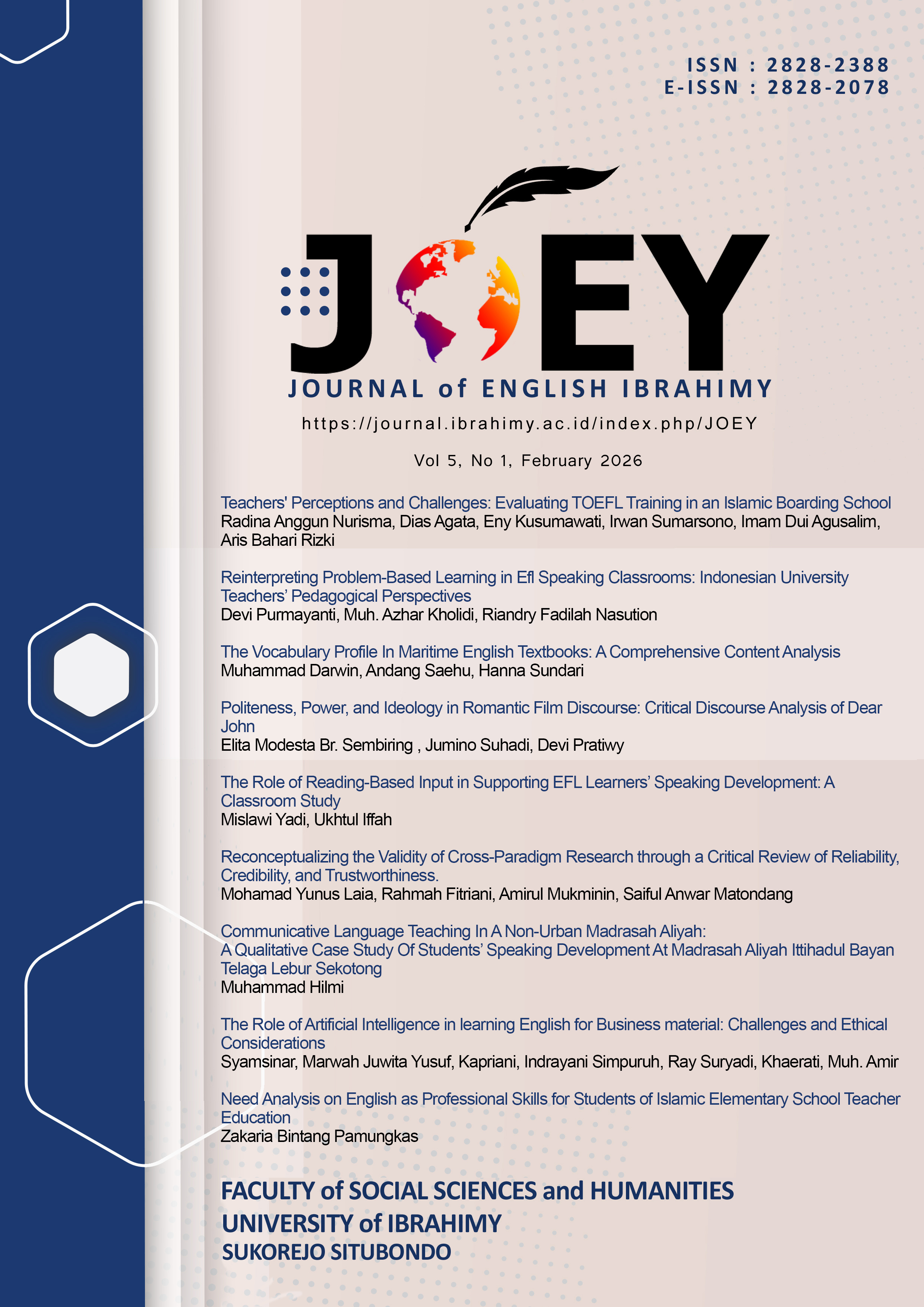
Communicative Language Teaching in a Non-Urban Madrasah Aliyah: A Qualitative Case Study of Students’ Speaking Development at Madrasah Aliyah Ittihadul Bayan Telaga Lebur Sekotong
English
DOI:
https://doi.org/10.35316/joey.2026.v5i1.81-93Keywords:
communicative language teaching (ctl), speaking, english language teaching, madrasah aliyahAbstract
Speaking ability in English is an essential communicative skill in responding to the demands of globalization; however, it remains a challenge for students in Indonesia, particularly at the Madrasah Aliyah level in rural areas. Low student participation in speaking English and the dominance of conventional teaching methods indicate the need for a more communicative and contextual learning approach. Therefore, this study aims to explore and describe the implementation of Communicative Language Teaching (CLT) in improving students’ speaking ability at Madrasah Aliyah Ittihadul Bayan Telaga Lebur Sekotong. This research employed a qualitative approach with a case study design. The data were collected through classroom observations, in-depth interviews with teachers and students, and documentation, and were analyzed thematically. The findings reveal that the implementation of CLT through communicative activities such as pair work, group discussions, and role play was able to enhance students’ courage, activeness, and self-confidence in speaking English. In addition, CLT created a more collaborative classroom atmosphere and encouraged students to perceive speaking as a process of communication rather than mere memorization. This study concludes that CLT is effectively implemented in the Madrasah Aliyah context and provides important implications for the development of more communicative English language teaching. Future research is recommended to examine the implementation of CLT in a broader madrasah context and to combine qualitative and quantitative approaches in order to obtain a more comprehensive understanding.
References
Alharbi, H. A. (2015). Improving Students’ English Speaking Proficiency in Saudi Public Schools. International Journal of Instruction, 8(1), 105–116.
Canale, M. (1983). From communicative competence to communicative language pedagogy 1. In Language and Communication. Routledge.
Candadila, R. Y., & Puspitasari, D. (2025). Communicative Language Teaching (CLT): A Strategy to Enhance Students’ Speaking Skills and Motivation. Aisyah Journal of English Language Teaching (AIJELT), 4(1), 31–38. https://doi.org/10.30604/aijelt.v4i1.1995
Creswell, J. W., & Poth, C. N. (2016). Qualitative Inquiry and Research Design: Choosing Among Five Approaches. SAGE Publications.
EF United States. (2025). Indonesian English Proficiency Index. EF English Proficiency Index. https://www.ef.edu/epi/regions/asia/indonesia/
Elmiwati, E., Rismiwati, R., & Noto, S. R. (2024). Improving Students’ Speaking Skill by Applying Communicative Language Teaching (CLT). Jurnal Review Pendidikan Dan Pengajaran, 7(2), 3337–3345. https://doi.org/10.31004/jrpp.v7i2.26378
Goh, C. C. M., & Burns, A. (2012). Teaching Speaking: A Holistic Approach. Cambridge University Press.
Hiep, P. H. (2007). Communicative Language Teaching: Unity within Diversity. ELT Journal, 61(3), 193–201. https://doi.org/10.1093/elt/ccm026
Ilyas S, Mujahidah, M., & Asni, Y. (2023). The Effectiveness of Communicative Language Teaching (CLT) Method to Improve Students Speaking Skill. Al-Irsyad: Journal of Education Science, 2(2), 161–167. https://doi.org/10.58917/aijes.v2i2.79
Inayah, Y., & Sya, M. F. (2024). Pembelajaran Bahasa yang Komunikatif: Pendekatan Efektif Communicative Language Teaching (CLT) dalam Meningkatkan Kemampuan Berkomunikasi Siswa di Sekolah Dasar. Cendikia: Jurnal Pendidikan Dan Pengajaran, 2(8), 382–393. ttps://doi.org/10.572349/cendikia.v2i8.2361
Littlewood, W. (2014). Communication-oriented language teaching: Where are we now? Where do we go from here? Language Teaching, 47(3), 349–362. https://doi.org/10.1017/S0261444812000134
Long, M. H. (2015). Second language acquisition and task-based language teaching. Wiley-Blackwell.
Miles, M. B., Huberman, A. M., & Saldaña, J. (2020). Qualitative data analysis: A methods sourcebook (Fourth edition). SAGE.
Mulyanah, E. Y., Ishak, I., & Dewi, R. K. (2018). The Effect Of Communicative Language Teaching On Students Speaking Skill. CICES (Cyberpreneurship Innovative and Creative Exact and Social Science), 4(1), 67–75. https://doi.org/10.33050/cices.v4i1.478
Nurdayani, A., Sakina, R., & Uyun, A. S. (2024). The Use of Communicative Language Teaching (CLT) Approach in Teaching Speaking Skill: A Descriptive Qualitative Study at The 7th Grade of Binar Ilmu Boarding School. Biormatika : Jurnal Ilmiah Fakultas Keguruan Dan Ilmu Pendidikan, 10(1), 43–58. https://doi.org/10.35569/biormatika.v10i1.1809
Ockey, G. J. (2024). Assessing Listening. In The Routledge Handbook of Second Language Acquisition and Listening. Routledge.
Qasserras, L. (2023). Systematic Review of Communicative Language Teaching (CLT) in Language Education: A Balanced Perspective. European Journal of Education and Pedagogy, 4(6), 17–23. https://doi.org/10.24018/ejedu.2023.4.6.763
Qurniati, T. (2023). The Influence of Communicative Language Teaching Approach and Speaking Habit Towards the Eighth Grade Student’s Speaking Ability. English Community Journal, 7(1), 12–16. https://doi.org/10.32502/ecj.v7i1.5328
Richards, J. C. (2015). Key Issues in Language Teaching. Cambridge University Press.
Richards, J. C., & Rodgers, T. S. (2014). Approaches and methods in language teaching (Third edition). Cambridge University Press. https://doi.org/10.1017/9781009024532
Sato, M., & Ballinger, S. (2015). Raising language awareness in peer interaction: A cross-context,cross-methodology examination. In Awareness Matters. Routledge.
Savignon, S. J. (1997). Communicative competence: Theory and classroom practice : texts and contexts in second language learning (2nd ed). McGraw-Hill.
Susanti, S. (2025). Group Work of Communicative Language Teaching Approach for Boosting Speaking Interactive Purposes. English Education and Literature Journal, 5(02), 288–299. https://doi.org/10.53863/e-jou.v5i02.1717
Tisdell, E. J., Merriam, S. B., & Stuckey-Peyrot, H. L. (2025). Qualitative Research: A Guide to Design and Implementation. John Wiley & Sons.
Yin, R. K. (2018). Case study research and applications: Design and methods (Sixth edition). SAGE.
Yonatan, A. Z. (2025, November 26). Benarkah Kemampuan Berbahasa Inggris Anak Muda Indonesia Turun? GoodStats Data. https://data.goodstats.id/statistic/benarkah-kemampuan-berbahasa-inggris-anak-muda-indonesia-turun-UKxhm
Zhang, X., & Ardasheva, Y. (2019). Sources of college EFL learners’ self-efficacy in the English public speaking domain. English for Specific Purposes, 53, 47–59. https://doi.org/10.1016/j.esp.2018.09.004
Downloads
Published
How to Cite
Issue
Section
License
Copyright (c) 2026 JOEY: Journal of English Ibrahimy

This work is licensed under a Creative Commons Attribution-NonCommercial-ShareAlike 4.0 International License.