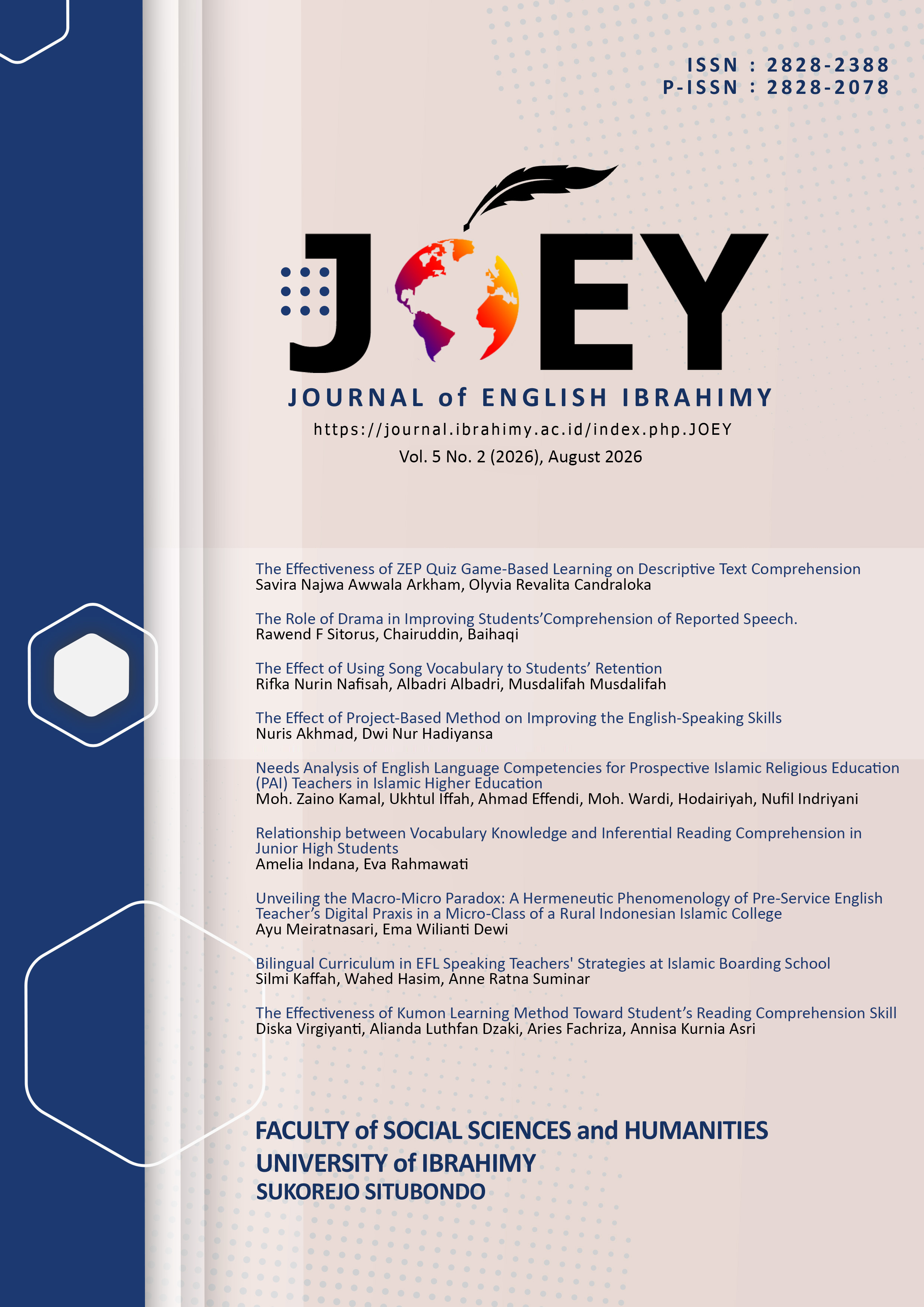
Relationship between Vocabulary Knowledge and Inferential Reading Comprehension in Junior High Students
English
DOI:
https://doi.org/10.35316/joey.2026.v5i2.70-90Keywords:
Vocabulary Knowledge, Inferential Reading ComprehensionAbstract
Vocabulary knowledge is an essential component of reading comprehension, particularly inferential comprehension, which requires readers to interpret implicit meaning rather than relying solely on explicitly stated information. For many EFL learners, an insufficient vocabulary base makes inferential comprehension difficult to achieve. Although previous studies have widely confirmed the importance of vocabulary for reading comprehension, limited research has specifically examined how vocabulary knowledge across different word-frequency levels relates to inferential reading comprehension at the junior high school students’ vocabulary knowledge and their inferential reading comprehension using a quantitative correlational design involving 53 eighth-grade students. Vocabulary knowledge was measured using the Updated Vocabulary Levels Test (1000-5000 levels), while inferential reading comprehension was assessed through an inference-based reading test adapted from TOEFL Junior materials. Data were analyzed using descriptive statistics and Spearman’s rho correlation. The results showed that students achieved strong mastery at the 1000-word level (92.5%), with mastery declining and becoming more varied at the 2000-word (62.3%) through 5000-word levels. Inferential reading comprehension yielded a mean score of 57.83, falling into the sufficient category. Spearman’s rho analysis revealed a significant moderate positive correlation between vocabulary knowledge and inferential reading comprehension (r = .488, p = .000), particularly strong at the 1000-word (r = .513) and 2000-word (r = .541) levels. These findings indicate that vocabulary mastery at basic and intermediate levels serves as a primary predictor of inferential reading performance, suggesting that teachers should prioritize structured vocabulary instruction to facilitate students’ transition toward higher-order reading skills.
References
Al Qunayeer, H. S. (2021). An Investigation of the Relationship between Reading Comprehension, Vocabulary Knowledge, and English Language Proficiency Level of Saudi EFL Learners. Advances in Language and Literary Studies, 12(2), 59. https://doi.org/10.7575/aiac.alls.v.12n.2.p.59
Alsowat, H. H. (2022). The Mediating Roles of Gender and Academic Field in the Relationship between Vocabulary Knowledge and Reading Comprehension of EFL Students. Universal Journal of Educational Research, 10(2), 146–159. https://doi.org/10.13189/ujer.2022.100204
Arikunto, S. (2018). Dasar-Dasar Evaluasi Pendidikan (3rd ed.). Bumi Aksara.
Ary, D., Jacobs, L. C., & Sorensen, C. (2009). Introduction to Research in Education (8th ed.). Wadsworh Cengage Learning.
Binder, K. S., Cote, N. G., Lee, C., Bessette, E., & Vu, H. (2017). Beyond breadth: the contributions of vocabulary depth to reading comprehension among skilled readers. Journal of Research in Reading, 40(3), 333–343. https://doi.org/10.1111/1467-9817.12069
Brassell, Danny., & Rasinski, T. V. . (2008). Comprehension that works : taking students beyond ordinary understanding to deep comprehension. Shell Education.
Castles, A., Rastle, K., & Nation, K. (2018). Ending the Reading Wars: Reading Acquisition From Novice to Expert. Psychological Science in the Public Interest, 19(2), 93. https://doi.org/10.1177/1529100618786959
Clinton, V., Taylor, T., Bajpayee, S., Davison, M. L., Carlson, S. E., & Seipel, B. (2020). Inferential comprehension differences between narrative and expository texts: A systematic review and meta-analysis. Reading and Writing 33. https://doi.org/10.1007/s11145-020
Cohen, L., Manion, L., & Morrison, K. (2007). Research Methods in Education (6, Ed.; 6th ed.). Routledge.
Cooter, R. B., Joseph, D. G., & Flynt, E. S. (1986). Eliminating the Literal Pursuit of Reading Comprehension. Journal of Clinical Raeding: Research and Practice, 2.
Dagnaw, A. T. (2023). Revisiting the role of breadth and depth of vocabulary knowledge in reading comprehension. Cogent Education, 10(1). https://doi.org/10.1080/2331186X.2023.2217345
ETS. (2014). Official Guide to the TOEFL Junior® Standard Test (1st ed.). Educational Testing Service.
Gallagher, M. A., Barber, A. T., Beck, J. S., & Buehl, M. M. (2019). Academic Vocabulary: Explicit and Incidental Instruction for Students of Diverse Language Backgrounds. Reading and Writing Quarterly, 35(2), 84–102. https://doi.org/10.1080/10573569.2018.1510796
Ghozali, Imam. (2018). Aplikasi analisis multivariate dengan program SPSS (9th ed.). Badan Penerbit Universitas Diponegoro.
Graesser, A. C., Singer, M., & Trabasso, T. (1994). Constructing Inferences During Narrative Text Comprehension. In Psychological Review (Vol. 101, Number 3).
Hahn, R. (2014). Master TOEFL Junior Intermediate (CEFR Level B1): Reading Comprehension. Nhân Trí Việt.
Hall, C., Vaughn, S., Barnes, M. A., Stewart, A. A., Austin, C. R., & Roberts, G. (2020). The Effects of Inference Instruction on the Reading Comprehension of English Learners With Reading Comprehension Difficulties. Remedial and Special Education, 41(5), 259–270. https://doi.org/10.1177/0741932518824983
Kementerian Pendidikan, K. R. dan T. R. I. (2022). Capaian Pembelajaran Mata Pelajaran Bahasa Inggris Fase A-Fase F untuk SD/MI/Program Paket A, SMP/MTs/Program Paket B, dan SMA/MA/SMK/MAK/Program Paket C.
Kispal, Anne. (2008). Effective teaching of inference skills for reading : literature review. Department for Children, Schools and Families.
Koda, K. (2005). Insights into Second Language Reading. Cambridge University Press. https://doi.org/10.1017/CBO9781139524841
Ma, Y., & Lin, W. (2015). A Study on the Relationship between English Reading Comprehension and English Vocabulary Knowledge. Education Research International, 2015, 1–14. https://doi.org/10.1155/2015/209154
McGregor, K. K., Oleson, J., Bahnsen, A., & Duff, D. (2013). Children with developmental language impairment have vocabulary deficits characterized by limited breadth and depth. International Journal of Language and Communication Disorders, 48(3), 307–319. https://doi.org/10.1111/1460-6984.12008
Mishra, P., Pandey, C. M., Singh, U., Gupta, A., Sahu, C., & Keshri, A. (2019). Descriptive statistics and normality tests for statistical data. Annals of Cardiac Anaesthesia, 22(1), 67–72. https://doi.org/10.4103/aca.ACA_157_18
Nation, I. S. P. (2022). Learning Vocabulary in Another Language (3rd ed.). Cambridge University Press. https://doi.org/https://doi.org/10.1017/9781009093873
Noordman, L. G. M., & Vonk, W. (2015). Inferences in Discourse, Psychology of. In International Encyclopedia of the Social & Behavioral Sciences: Second Edition (pp. 37–44). Elsevier Inc. https://doi.org/10.1016/B978-0-08-097086-8.57012-3
Pallant, J. (2020). SPSS Survival Manual. Routledge. https://doi.org/10.4324/9781003117452
Perfetti, C. (2007). Reading ability: Lexical quality to comprehension. Scientific Studies of Reading, 11(4), 357–383. https://doi.org/10.1080/10888430701530730
Quines, Z. M. (2023). Impact of Students’ Vocabulary Level to their Reading and Writing Performance. International Journal of English Language and Linguistics Research, 11(2), 18–32. https://doi.org/10.37745/ijellr.13/vol11n21832
Rabadi, R. I. (2023). Examining the Role of Breadth and Depth of Vocabulary Knowledge in Reading Comprehension of English Language Learners. Jordan Journal of Modern Languages and Literatures, 15(1), 327–345. https://doi.org/10.47012/jjmll.15.1.17
Rizki Asani, F. (2022). Students’ Difficulties Analysis in Reading Comprehension at The Second Grade of MTs Nurul Ikhlas.
Saeedi, G., Khanmohammadi, A., & Mahmmodi, H. (2016). Reading Comprehension and Its Importance in Learning English as a Second Language. International Journal of EFL, 1(1), 61. https://doi.org/10.21462/ijefl.v1i1.1
Shi, Y. (2023). How Inference Making Mediates the Relation Between Vocabulary Knowledge and Reading Comprehension for Chinese EFL Middle School Students. English Teaching(South Korea), 78(3), 85–104. https://doi.org/10.15858/engtea.78.3.202309.85
Singer, M., Andrusiak, P., Reisdorf, P., & Black, N. L. (1992). Individual differences in bridging inference processes. In Memory & Cognition (Vol. 20, Number 5).
Sugiyono. (2021). Metode penelitian kuantitatif, kualitatif, dan R&D (3rd ed.). Alfabeta, CV.
Taber, K. S. (2018). The Use of Cronbach’s Alpha When Developing and Reporting Research Instruments in Science Education. Research in Science Education, 48(6), 1273–1296. https://doi.org/10.1007/s11165-016-9602-2
Webb, S., Sasao, Y., & Ballance, O. (2017). The updated Vocabulary Levels Test. ITL - International Journal of Applied Linguistics, 168(1), 33–69. https://doi.org/10.1075/itl.168.1.02web
Webb, S., Sasao, Y., & Ballance, O. (2017). The updated Vocabulary Levels Test: Developing and validating two new forms of the VLT. ITL - International Journal of Applied Linguistics, 168(1), 34–70.
Downloads
Published
How to Cite
Issue
Section
License
Copyright (c) 2026 JOEY: Journal of English Ibrahimy

This work is licensed under a Creative Commons Attribution-NonCommercial-ShareAlike 4.0 International License.