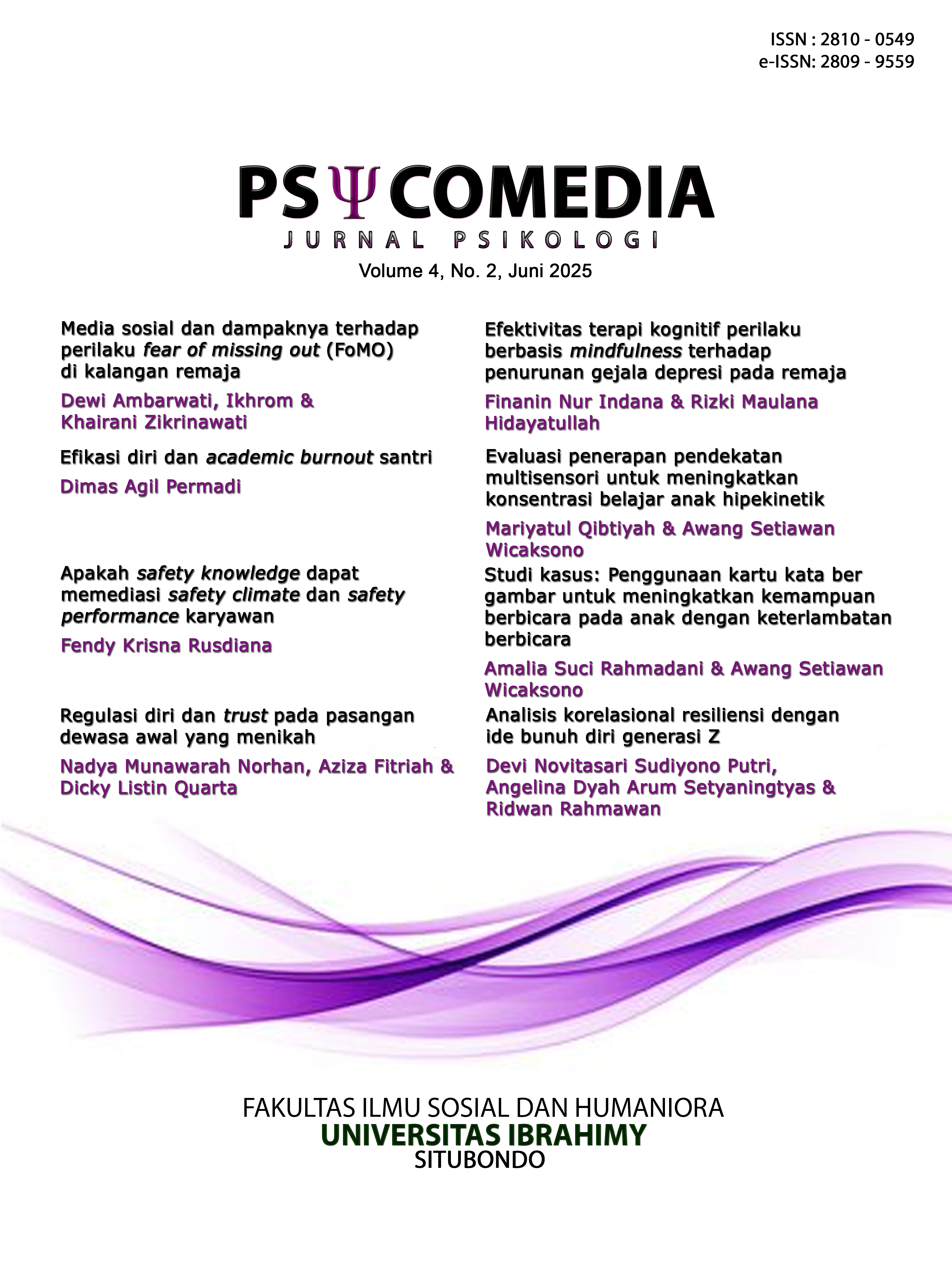
Efikasi diri dan academic burnout santri
DOI:
https://doi.org/10.35316/psycomedia.2025.v4i2.86-92Kata Kunci:
Academic Burnout, Islamic Student, Self-EfficacyAbstrak
This study aims to determine the relationship between self-efficacy and academic burnout among students enrolled in senior high school. The sample consisted of 96 students in grades 11 and 12 who were selected using simple random sampling. The study employs a quantitative correlational approach to examine the presence or absence of a relationship between the two variables. Data analysis in this study utilizes Pearson's correlation. The results indicate a negative and significant relationship between self-efficacy and academic burnout. These findings suggest that students with high levels of self-efficacy tend to experience lower levels of academic burnout.
Referensi
Al Mursyidin, R. A., & Hakim, A. M. (2023). Tailoring teaching approaches to mitigate student burnout in Islamic boarding school management. Managere: Indonesian Journal of Educational Management, 5(1), 90–100. https://doi.org/10.52627/ijeam.v5i1.336.
Alwisol. (2009). Psikologi kepribadian. UMM Press.
Azwar, S. 2012. Reliabilitas dan validitas. Pustaka Pelajar
Bandura, A. (1997). Self-efficacy: The exercise of control. W.H. Freeman and Company.
Biremanoe, I. (2021). Dampak academic burnout terhadap kualitas hidup mahasiswa. Jurnal Psikologi Terapan, 9(2), 112–121.
Biremanoe, M. E. (2021). Burnout akademik mahasiswa tingkat akhir. KoPeN: Konferensi Pendidikan Nasional, 3(2), 165-172.
Fauziah, F., & Rachmawati, I. (2019). Hubungan efikasi diri dengan academic burnout pada siswa SMA. Jurnal Psikologi Pendidikan dan Konseling, 5(1), 45–52. https://doi.org/10.1177/0022022102033005003.
Isbadi, M. I. (2022). Hubungan regulasi emosi dengan academic burnout pada santri tahfidz Pondok Pesantren Annuqayah Latee Guluk-Guluk Sumenep. Psychospiritual: Jurnal Psikologi dan Tasawuf, 3(1). https://psychospiritual.uinkhas.ac.id/index.php/psycho/article/view/63.
Lin, S.-H., & Huang, Y.-C. (2014). Life stress and academic burnout. Active Learning in Higher Education, 15(1), 77–90. https://doi.org/10.1177/1469787413514651.
Maslach, C., & Jackson, S. E. (1981). The measurement of experienced burnout. Journal of Occupational Behavior, 2(2), 99–113. https://doi.org/10.1002/job.4030020205.
Maslach, C., Jackson, S. E., & Leiter, M. P. (2001). Maslach Burnout Inventory manual (3rd ed.). Palo Alto, CA: Consulting Psychologists Press.
Nazwa, S. (2023). Hubungan coping strategy dengan academic burnout pada santri aliyah Pesantren Tahfizh Qur’an Al-Fuad Seruway Aceh Tamiang [Skripsi, UIN Ar-Raniry]. https://repository.ar-raniry.ac.id/id/eprint/42395/.
Oktia, V. (2022). Pengaruh academic burnout dan academic engagement terhadap school well-being santri pesantren. Nusantara Journal of Behavioral and Social Sciences, 1(3), 89–94. https://doi.org/10.47679/202213.
Pajares, F. (2002). Overview of social cognitive theory and of self-efficacy. Emory University. Retrieved from https://www.uky.edu/~eushe2/Pajares/eff.html.
Peraturan Menteri Agama Republik Indonesia Nomor 31 Tahun 2000 tentang Pendidikan Pesantren
Schaufeli, W. B., Martínez, I. M., Pinto, A. M., Salanova, M., & Bakker, A. B. (2002). Burnout and engagement in university students: A cross-national study. Journal of Cross-Cultural Psychology, 33(5), 464–481.
Schunk, D. H. (1991). Self-efficacy and academic motivation. Educational Psychologist, 26(3–4), 207–231. https://doi.org/10.1080/00461520.1991.9653133.
Schwarzer, R. and Jerusalem, M. (1995). General self-efficacy scale. In J. Weinman, S. Wright and M. Johnston (Eds.) Measures in health psychology: A user portfolio. Causal and control beliefs. NFER-Nelson, Windor, England.
Sugiyono. (2019). Metode penelitian kuantitatif, kualitatif, dan R&D. Bandung: Alfabeta.
Yang, H. J. (2004). Factors affecting student burnout and academic achievement in multiple enrolment programs in Taiwan’s technical-vocational colleges. International Journal of Educational Development, 24(3), 283–301. https://doi.org/10.1016/j.ijedudev.2003.12.001
Zimmerman, B. J. (2000). Self-efficacy: An essential motive to learn. Contemporary Educational Psychology, 25(1),82–91. https://doi.org/10.1006/ceps.1999.1016.
Unduhan
Diterbitkan
Cara Mengutip
Terbitan
Bagian
Lisensi
Hak Cipta (c) 2025 Dimas Agil Permadi

Artikel ini berlisensiCreative Commons Attribution-NonCommercial-ShareAlike 4.0 International License.