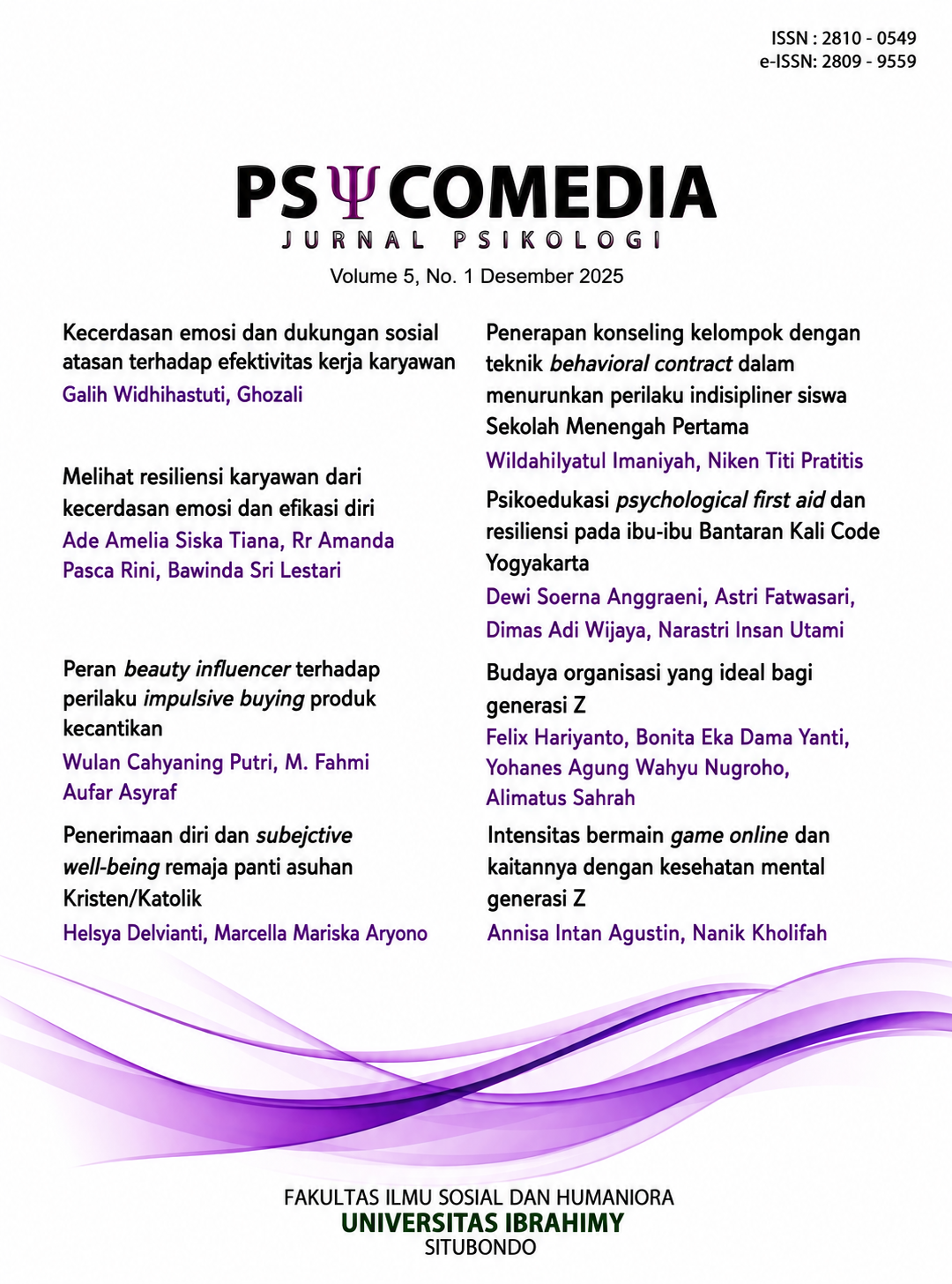
Psikoedukasi psychological first aid dan resiliensi pada ibu-ibu di Bantaran Kali Code Yogyakarta
DOI:
https://doi.org/10.35316/psycomedia.2025.v5i1.60-67Keywords:
Psychoeducation, Psychological First Aid, ResilienceAbstract
This study aims to measure the effectiveness of psychoeducation based on Psychological First Aid (PFA) in improving the resilience of mothers living in Jogoyudan Village, along the banks of the Code River, Yogyakarta. The research employed a pre-test and post-test design to evaluate changes in resilience levels before and after the training, involving 6 mothers residing in the Code River area. The analysis results showed a significant difference in resilience scores between the pre-test and post-test, with a p-value of 0.027 (p < 0.05). These findings indicate that PFA-based psychoeducation effectively enhances resilience among mothers in the Code River area. Further analysis revealed that the more frequently PFA training was provided, the higher the levels of resilience achieved. This study offers significant practical contributions. PFA-based interventions can be implemented as an effective strategy to enhance resilience within the context of community empowerment. By incorporating this approach into community development programs, individuals, especially those living in disaster-prone areas, are expected to be better prepared to face life's challenges. This study recommends continuous PFA training to strengthen the psychological resilience of communities residing in high-risk environments.
References
Bekircan, E., Usta, G., & Torpuş, K. (2024). The effect of psychological first aid intervention on stress and psychological resilience in volunteers participating in 2023 earthquakes centered in Kahramanmaraş, Turkey. Current Psychology: A Journal for Diverse Perspectives on Diverse Psychological Issues, 43(12), 11383–11393. https://doi.org/10.1007/s12144-023-05239-z
Brymer, M., Jacobs, A., Layne, C., Pynoos, R., Ruzek, J., Steinberg, A., Vernberg, M., & Watson, P. (2006). Psychological first aid: Field guide (2nd ed.). National Child Traumatic Stress Network and National Center for PTSD.
Figueroa, R. A., Cortés, P. F., Miller, C., Marín, H., Gillibrand, R., Hoeboer, C. M., & Olff, M. (2024). The effect of a single session of psychological first aid in the emergency department on PTSD and depressive symptoms three months post-intervention: Results of a randomised controlled trial. European Journal of Psychotraumatology, 15(1), 2364443.
Grey, I., Arora, T., Thomas, J., Saneh, A., Tohme, P., & Abi-Habib, R. (2020). The role of perceived social support on depression and sleep during the COVID-19 pandemic. Psychiatry Research, 293, 1–6. https://doi.org/10.1016/j.psychres.2020.113452
Hermosilla, S., Forthal, S., Sadowska, K., Magill, E. B., Watson, P., & Pike, K. M. (2023). We need to build the evidence: A systematic review of psychological first aid on mental health and well‐being. Journal of Traumatic Stress, 36(1), 5–16. https://doi.org/10.1002/jts.22888
Luthar, S. S. (Ed.). (2003). Resilience and vulnerability: Adaptation in the context of childhood adversities. Resilience and Vulnerability: Adaptation in the Context of Childhood Adversities., xxxi, 574–xxxi, 574. https://doi.org/10.1017/CBO9780511615788
M. Hechanova, Ma. R., Manaois, J. O., & V. Masuda, H. (2019). Evaluation of an organization-based psychological first aid intervention. Disaster Prevention and Management, 28(3), 401–411. https://doi.org/10.1108/DPM-10-2018-0330
Meichenbaum, D. (2008). Bolstering resilience: Benefiting from lessons learned. In Treating traumatized children: Risk, resilience and recovery (1st ed.). Routledge.
Mendes, K. N., Peres, C. H. M., Cerqueira, A. V., Assumpção, T. A., Loch, A. A., & Reavley, N. J. (2022). Cultural adaptation of the guidelines for offering mental health first aid to a person after a potentially traumatic event: A delphi expert consensus study in Brazil. BMC Psychiatry, 22(1), 661. https://doi.org/10.1186/s12888-022-04269-4
Octaryani, M., & Baidun, A. (2018). Uji validitas konstruk resiliensi. Jurnal Pengukuran Psikologi Dan Pendidikan Indonesia (JP3I), 6(1), 43–52. https://doi.org/10.15408/jp3i.v6i1.8150
Pooley, J. A., & Cohen, L. (2010). Resilience: A definition in context. Australian Community Psychologist, 22(1), 30–37.
Samarasekara, V. (2025). Empowering rural communities through culturally-adapted psychological first aid: A community-embedded framework. Journal of Social Sciences, 3(1), 98–119. https://doi.org/10.4038/jssnisd.v3i1.27
Shultz, J. M., & Forbes, D. (2014). Psychological first aid: Rapid proliferation and the search for evidence. Disaster Health, 2(1), 3–12. https://doi.org/10.4161/dish.26006
Sugiono. (2013). Metode penelitian pendidikan: Pendekatan kuantitatif, kualitatif dan R&D. Alfabeta.
Ungar, M. (Ed.). (2021). Multisystemic resilience: Adaptation and transformation in contexts of change. Oxford University Press.
Vandsburger, E., Harrigan, M., & Biggerstaff, M. (2008). In Spite of All, We Make It: Themes of Stress and Resiliency as Told by Women in Families Living in Poverty. Journal of Family Social Work, 11(1), 17–35. https://doi.org/10.1080/10522150802007303
Wang, L., Norman, I., Edleston, V., Oyo, C., & Leamy, M. (2024). The Effectiveness and Implementation of Psychological First Aid as a Therapeutic Intervention After Trauma: An Integrative Review. Trauma, Violence & Abuse, 25(4), 2638–2656. https://doi.org/10.1177/15248380231221492
World Health Organization. (2009). Psychological first aid: Guide for field workers. WHO Press.
Downloads
Published
How to Cite
Issue
Section
License
Copyright (c) 2025 Dewi Soerna Anggraeni, Astri Fatwasari, Dimas Adi Wijaya, Narastri Insan Utami

This work is licensed under a Creative Commons Attribution-NonCommercial-ShareAlike 4.0 International License.