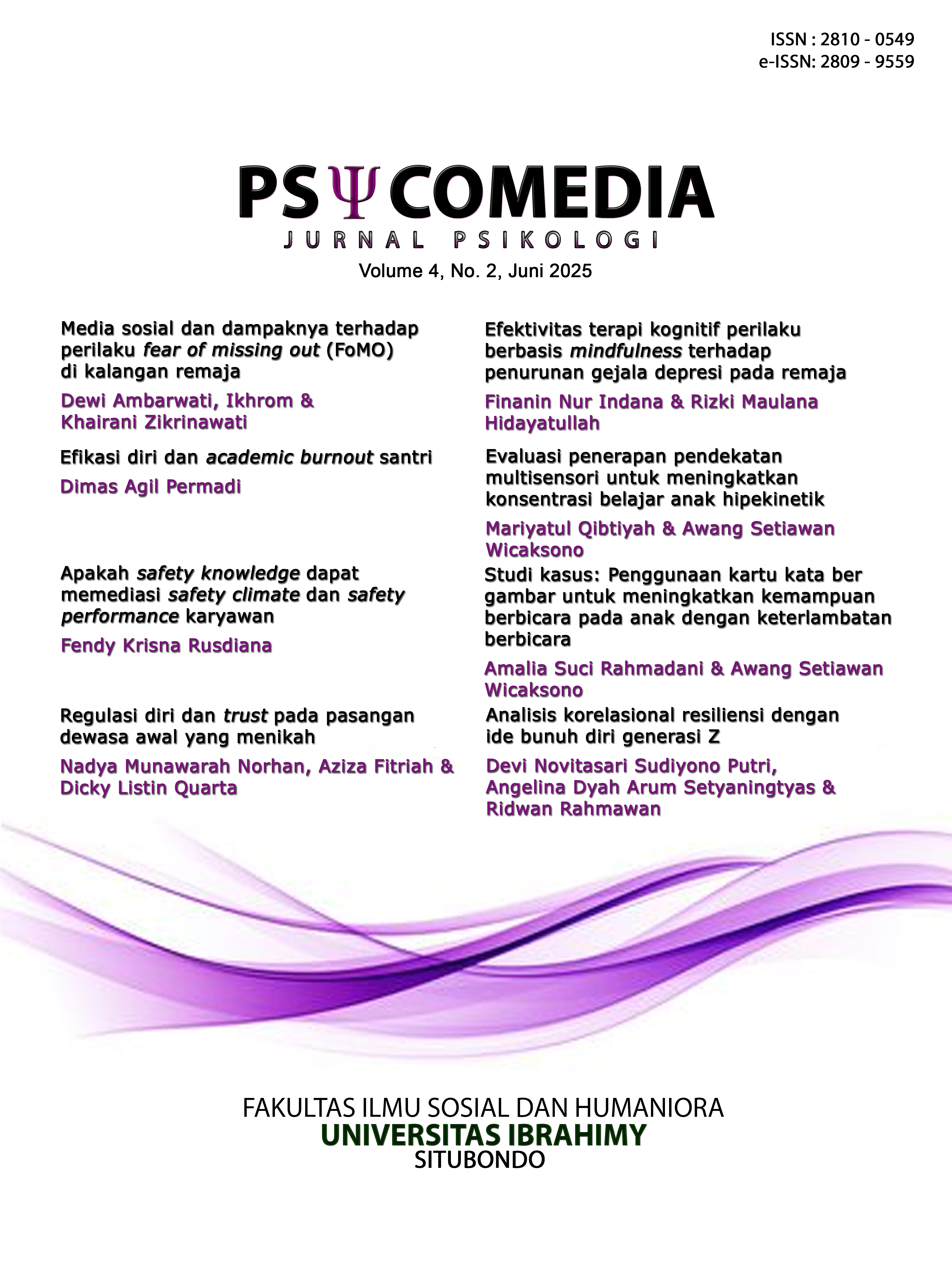
Apakah safety knowledge dapat memediasi safety climate dan safety performance karyawan?
DOI:
https://doi.org/10.35316/psycomedia.2025.v4i2.93-102Keywords:
Safety Climate, Safety Knowledge, Safety PerformanceAbstract
Safety knowledge plays an important role in improving safety performance in a company. This must be supported by a company safety climate that promotes workplace safety. This study examines the role of safety knowledge as a mediating variable in the influence of safety climate on employee safety performance. The population for this study consists of employees in the production division of a company that manufactures steel and iron. The sample size is 76 employees selected randomly by the researcher. The data analysis technique used in this study was mediation analysis using the JASP application version 0.19.1. The results of this study indicate that safety knowledge can act as a mediating variable because it plays an important role in changing behavior and improving employee safety performance. The knowledge acquired by employees is processed and transformed into behavior that prioritizes safety at work.
References
Amosu, A. M., Degun, A. M., Atulomah, N. O. S., Olanrewju, M. F., & Aderibigbe, K. A. (2011). The Level of Knowledge Regarding Occupational Hazards among Nurses in Abeokuta, Ogun State, Nigeria. Current Research Journal of Biological Sciences, 3(6), 586–590.
Barbaranelli, C., Petitta, L., & Probst, T. M. (2015). Does safety climate predict safety performance in Italy and the USA? Cross-cultural validation of a theoretical model of safety climate. Accident Analysis & Prevention, 77, 35–44. https://doi.org/10.1016/j.aap.2015.01.012
Brondino, M., Silva, S. A., & Pasini, M. (2012). Multilevel approach to organizational and group safety climate and safety performance: Co-workers as the missing link. Safety Science, 50(9), 1847–1856. https://doi.org/10.1016/j.ssci.2012.04.010
Christian, M. S., Bradley, J. C., Wallace, J. C., & Burke, M. J. (2009). Workplace safety: A meta-analysis of the roles of person and situation factors. Journal of Applied Psychology, 94(5), 1103–1127. https://doi.org/10.1037/a0016172
Cooper, M. D., & Phillips, R. A. (2004). Exploratory analysis of the safety climate and safety behavior relationship. Journal of Safety Research, 35(5), 497–512. https://doi.org/10.1016/j.jsr.2004.08.004
Goniewicz, M., Wloszczak-Szubzda, A., Niemcewicz, M., Witt, M., Marciniak-Niemcewicz, A., & Jarosz, M. J. (2012). Injuries caused by sharp instruments among healthcare workers–international and Polish perspectives. Annals of Agricultural and Environmental Medicine, 19(3), 523–527.
Griffin, M. A., & Neal, A. (2000). Perceptions of safety at work: A framework for linking safety climate to safety performance, knowledge, and motivation. Journal of Occupational Health Psychology, 5(3), 347.
Hejduk, I., & Tomczyk, P. (2015). Young Workers’ Occupational Safety Knowledge Creation and Habits. 6th International Conference on Applied Human Factors and Ergonomics (AHFE 2015) and the Affiliated Conferences, AHFE 2015, 3, 395–401. https://doi.org/10.1016/j.promfg.2015.07.184
Hofmann, D. A., Jacobs, R., & Landy, F. (1995). High reliability process industries: Individual, micro, and macro organizational influences on safety performance. Journal of Safety Research, 26(3), 131–149. https://doi.org/10.1016/0022-4375(95)00011-E
Huang, Y.-H., Ho, M., Smith, G. S., & Chen, P. Y. (2006). Safety climate and self-reported injury: Assessing the mediating role of employee safety control. Accident Analysis & Prevention, 38(3), 425–433. https://doi.org/10.1016/j.aap.2005.07.002
Jiang, L., Yu, G., Li, Y., & Li, F. (2010). Perceived colleagues’ safety knowledge/behavior and safety performance: Safety climate as a moderator in a multilevel study. Safety Climate: New Developments in Conceptualization, Theory, and Research, 42(5), 1468–1476. https://doi.org/10.1016/j.aap.2009.08.017
Kasza, G., Izsó, T., Kunszabó, A., Szakos, D., Lénárt, I., Bozánné Békefi, E., Vongxay, K., Popp, J., Oláh, J., Lakner, Z., Nugraha, W. S., Bognár, L., & Süth, M. (2024). Consumer knowledge, attitudes, and behaviour regarding food safety – A perspective from Laos. Heliyon, 10(9), 1–15. https://doi.org/10.1016/j.heliyon.2024.e29725
Lee, Y.-H., Lu, T.-E., Yang, C. C., & Chang, G. (2019). A multilevel approach on empowering leadership and safety behavior in the medical industry: The mediating effects of knowledge sharing and safety climate. Safety Science, 117, 1–9. https://doi.org/10.1016/j.ssci.2019.03.022
Liu, X., Huang, G., Huang, H., Wang, S., Xiao, Y., & Chen, W. (2015). Safety climate, safety behavior, and worker injuries in the Chinese manufacturing industry. Safety Science, 78, 173–178. https://doi.org/10.1016/j.ssci.2015.04.023
Motowidlo, S. J., & Van Scotter, J. R. (1994). Evidence that task performance should be distinguished from contextual performance. Journal of Applied Psychology, 79(4), 475–480. https://doi.org/10.1037/0021-9010.79.4.475
Najjar, S., Nafouri, N., Vanhaecht, K., & Euwema, M. (2015). The relationship between patient safety culture and adverse events: A study in palestinian hospitals. Safety in Health, 1(1), 16. https://doi.org/10.1186/s40886-015-0008-z
Ndejjo, R., Musinguzi, G., Yu, X., Buregyeya, E., Musoke, D., Wang, J.-S., Halage, A. A., Whalen, C., Bazeyo, W., & Williams, P. (2015). Occupational health hazards among healthcare workers in Kampala, Uganda. Journal of Environmental and Public Health, 2015(1), 1–9. https://doi.org/10.1155/2015/913741
Neal, A., Griffin, M. A., & Hart, P. M. (2000). The impact of organizational climate on safety climate and individual behavior. Safety Science, 34(1), 99–109. https://doi.org/10.1016/S0925-7535(00)00008-4
Odonkor, S. T., & Sallar, A. M. (2024). Occupational health and safety knowledge, attitudes and practices among healthcare workers in Accra Ghana. Scientific African, 24, e02130. https://doi.org/10.1016/j.sciaf.2024.e02130
Okun, A., Guerin, R., Smith, R., Baker, D., & DiMeo-Ediger, M. (2024). Evaluation of changes in knowledge and attitude among youth after a one-hour introduction to workplace safety and health: Safety Matters. Journal of Safety Research, 89, 306–311. https://doi.org/10.1016/j.jsr.2024.02.001
Sugiyono. (2013). Metode penelitian kuantitatif, kualitatif dan R & D. Alfabeta.
Vinodkumar, M. N., & Bhasi, M. (2010). Safety management practices and safety behaviour: Assessing the mediating role of safety knowledge and motivation. Accident Analysis & Prevention, 42(6), 2082–2093. https://doi.org/10.1016/j.aap.2010.06.021
Viragi, P. S., Ankola, A. V., & Hebbal, M. (2013). Occupational hazards in dentistry – Knowledge attitudes and practices of dental practitioners in Belgaum city. Journal of Pierre Fauchard Academy (India Section), 27(3), 90–94. https://doi.org/10.1016/j.jpfa.2013.10.002
Wongta, A., Sawarng, N., Tongchai, P., Yana, P., & Hongsibsong, S. (2024). Agricultural Health and Safety: Evaluating Farmers’ Knowledge, Attitude, and Safety Behavior in Northern Thailand. Safety and Health at Work, 15(4), 435–440. https://doi.org/10.1016/j.shaw.2024.09.005
Wu, C., Li, N., & Fang, D. (2017). Leadership improvement and its impact on workplace safety in construction projects: A conceptual model and action research. International Journal of Project Management, 35(8), 1495–1511. https://doi.org/10.1016/j.ijproman.2017.08.013
Xue, Y., Fan, Y., & Xie, X. (2020). Relation between senior managers’ safety leadership and safety behavior in the Chinese petrochemical industry. Journal of Loss Prevention in the Process Industries, 65, 104142. https://doi.org/10.1016/j.jlp.2020.104142
Zierold, K. M., Welsh, E. C., & McGeeney, T. J. (2012). Attitudes of Teenagers Towards Workplace Safety Training. Journal of Community Health, 37(6), 1289–1295. https://doi.org/10.1007/s10900-012-9570-z
Zohar, D. (2003). Safety climate: Conceptual and measurement issues. In Handbook of occupational health psychology. (pp. 123–142). American Psychological Association. https://doi.org/10.1037/10474-006
Downloads
Published
How to Cite
Issue
Section
License
Copyright (c) 2025 Fendi Krisna Rusdiana

This work is licensed under a Creative Commons Attribution-NonCommercial-ShareAlike 4.0 International License.