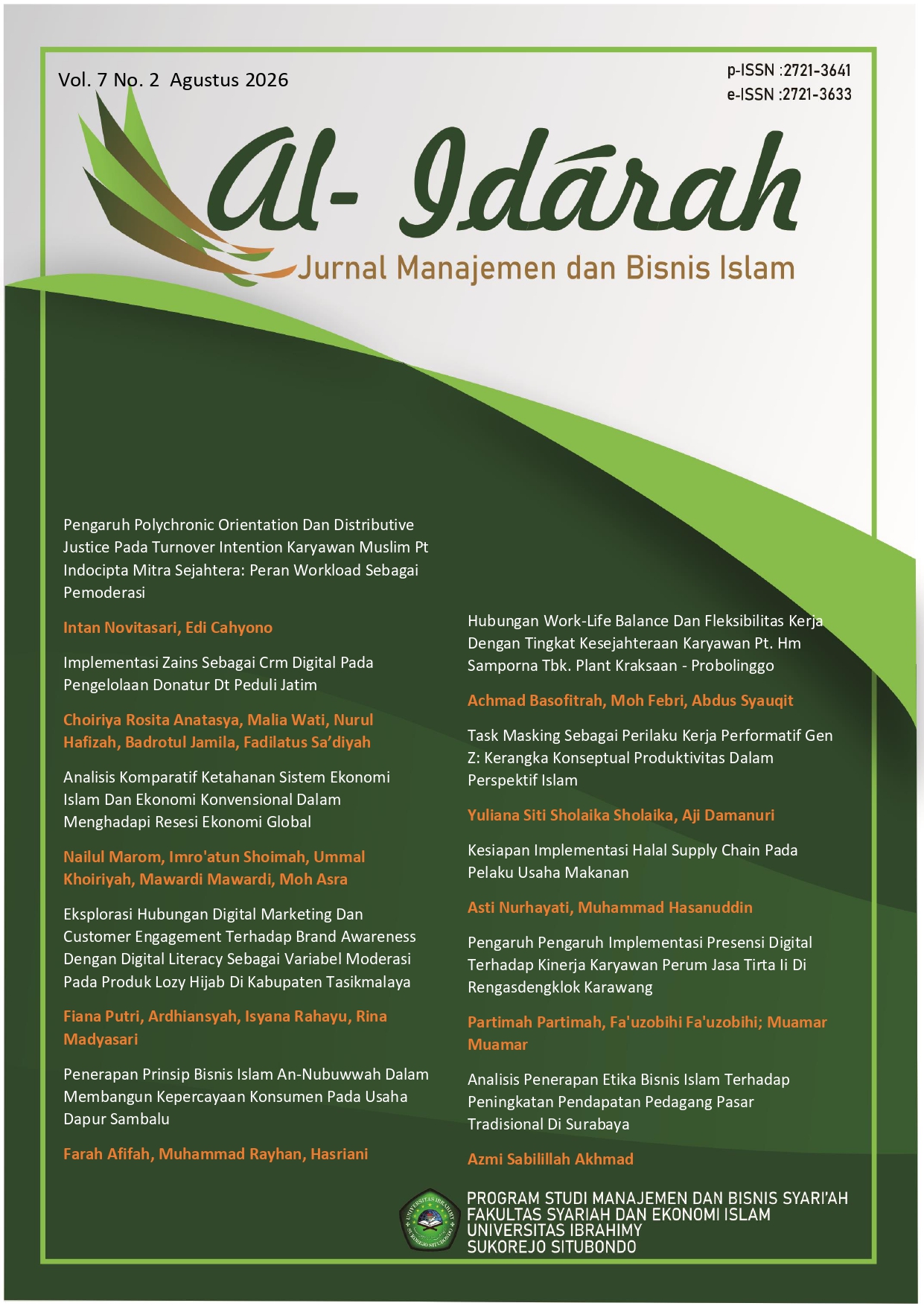
ANALISIS PENERAPAN ETIKA BISNIS ISLAM TERHADAP PENINGKATAN PENDAPATAN PEDAGANG PASAR TRADISIONAL DI SURABAYA
DOI:
https://doi.org/10.35316/idarah.2026.v7i2.131-139Keywords:
Islamic Business Ethics, Trader Income, Traditional Market, Honesty, TrustworthinessAbstract
This study examines the application of Islamic business ethics and its influence on the income of traditional market traders in Surabaya. A quantitative descriptive approach was employed with 300 respondents selected through proportional random sampling from three traditional markets: Pasar Keputran, Pasar Wonokromo, and Pasar Genteng. Data were gathered using Likert-scale questionnaires, non-participant observation, and official documentation. Simple linear regression was used for hypothesis testing. Findings indicate that the overall application of Islamic business ethics reached a mean score of 3.72 out of 5, classified as good. The amanah (trustworthiness) indicator obtained the highest score (3.91), while tabligh (transparency) received the lowest (3.48). Regression analysis confirmed a significant and positive effect of Islamic business ethics on trader income (t = 8.73, sig. 0.000 < 0.05), with a regression coefficient of 1,011,250. This suggests that consistent ethical conduct strengthens consumer trust and leads to sustainable income growth.
Downloads
Published
How to Cite
Issue
Section
License
Copyright (c) 2026 Azmi Sabilillah Akhmad

This work is licensed under a Creative Commons Attribution 4.0 International License.