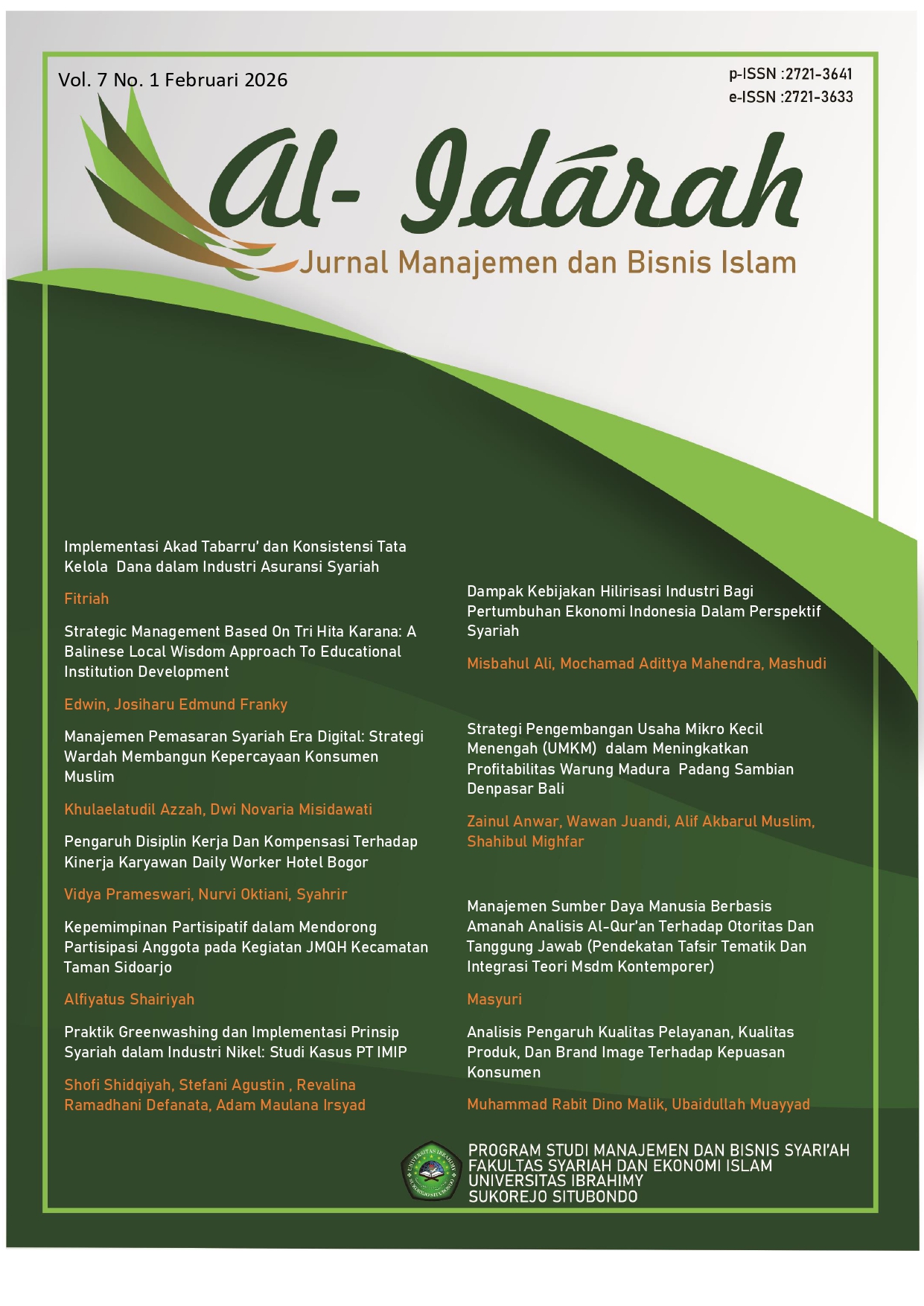
DAMPAK KEBIJAKAN HILIRISASI INDUSTRI BAGI PERTUMBUHAN EKONOMI INDONESIA DALAM PERSPEKTIF SYARIAH
DOI:
https://doi.org/10.35316/idarah.2026.v7i1.76-93Keywords:
KKebijakan Hilirisasi Industri, ekonomi, UMKM Syariah, ProfitabilitasAbstract
Ccommodities that were previously exported in raw form or raw materials become semi-finished or finished goods. Thus, the value of the country's exports becomes greater. The downstream program provides added value benefits to products, increases economic growth from regional to national levels, creates new products for the international market, and optimizes the use of natural resources as an effort to support economic growth in Indonesia. The results of the discussion of this research are the discussion in maqasid sharia, there are several supporting components, such as Hifzu Addin, Hifzu An-nafs, Al-aql, An-nasl, and Al-mal. evaluation of the impact of downstream policies cannot be separated from moral and ethical elements, especially in Indonesia, where the majority of people are Muslim. By considering the perspective of sharia, which emphasizes the principles of justice, sustainability, and social responsibility, it is important to determine whether the implementation of industrial downstreaming policies is in line with sharia values that include economic justice, environmental preservation, and community development.
Downloads
Published
How to Cite
Issue
Section
License
Copyright (c) 2026 Misbahul Ali, Mochamad Adittya Mahendra , Mashudi Mashudi

This work is licensed under a Creative Commons Attribution 4.0 International License.