
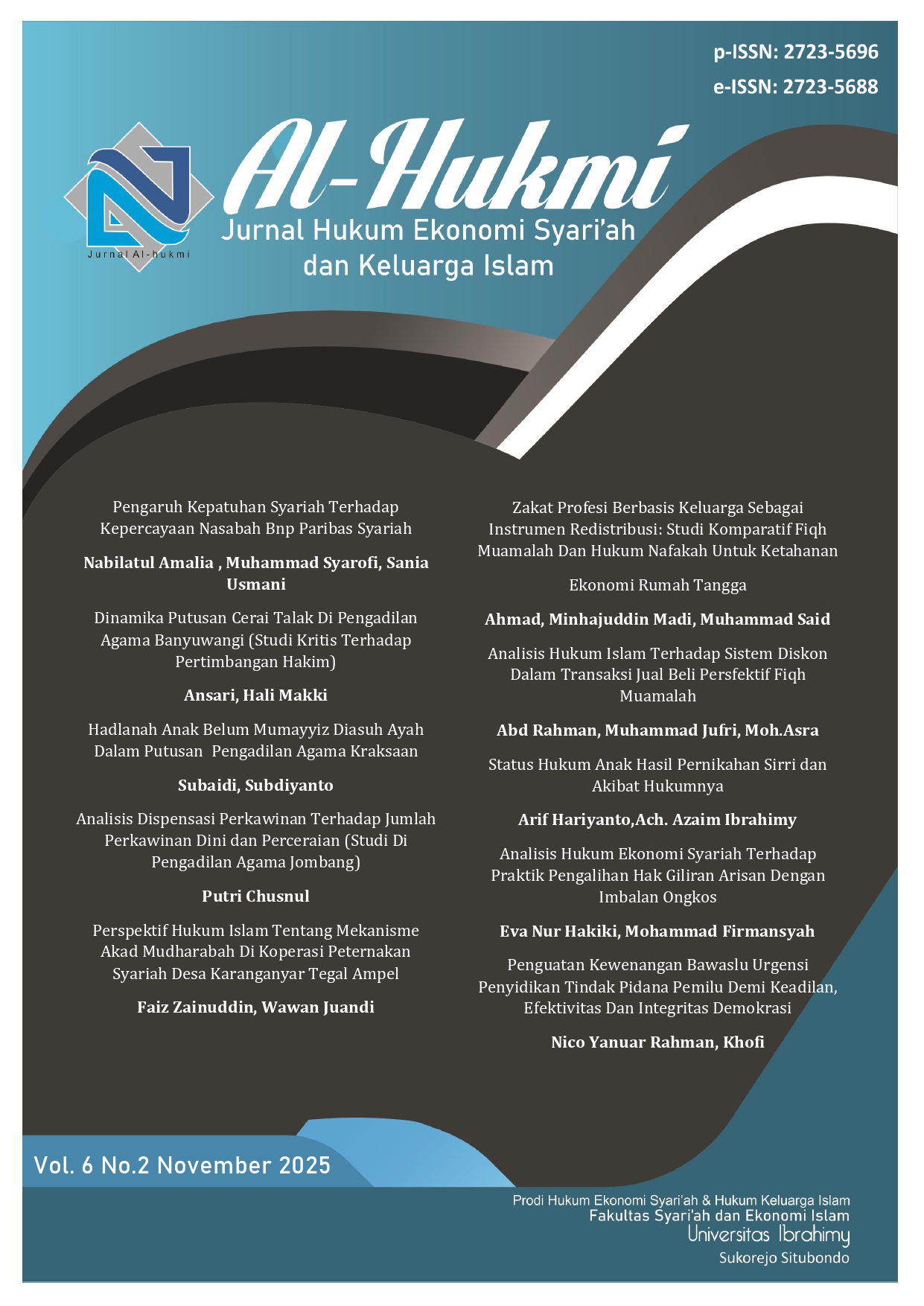
HADLANAH ANAK BELUM MUMAYYIZ DIASUH AYAH DALAM PUTUSAN PENGADILAN AGAMA KRAKSAAN
DOI:
https://doi.org/10.35316/alhukmi.v6i2.9233Keywords:
Hadlanah, Ghairu mumayyiz, survivalAbstract
This study examines the granting of custody rights (hadhanah) of a child who
has not yet reached the age of mumayyiz to the father based on a decision of
the Kraksaan Religious Court, which in principle differs from the general
provisions of Islamic law and the Compilation of Islamic Law (KHI) that
prioritize the mother as the primary caregiver. The background of this research
arises from the reality of divorce that produces legal consequences concerning
child custody, where the best interest of the child must become the primary
consideration in determining guardianship rights. This research aims to
analyze the legal considerations used by judges in granting custody to the
father and to assess their conformity with Islamic law perspectives and
applicable legal regulations. The study employs a qualitative field research
method, utilizing primary data obtained from field findings and secondary
data from literature, classical fiqh texts, and related legal sources.
The findings indicate that although normatively a child who has not yet
reached mumayyiz age is entitled to maternal custody, such rights may be
forfeited if the mother fails to meet the qualifications of a proper guardian
(hadhin), such as abandoning the child, failing to appear in court proceedings,
or being unable to ensure the child’s physical and psychological welfare. In
the case examined, the judge granted custody to the father after considering
trial facts demonstrating that the mother had left the child and did not show
responsibility for caregiving. This decision was grounded in the Marriage
Law, the KHI, and the opinions of Islamic jurists emphasizing that the child’s
welfare and best interest constitute the primary principle in custody
determination.
In conclusion, the judicial decision granting custody to the father does not
contradict Islamic law insofar as it is based on the child’s welfare and the
mother’s unfitness as a caregiver. This study underscores that the protection
and well-being of the child must remain the central orientation in resolving
custody disputes, beyond general normative assumptions.
Keywords:
Downloads
Published
How to Cite
Issue
Section
License
Copyright (c) 2026 Subyanto Subyanto, Subaidi Subaidi

This work is licensed under a Creative Commons Attribution 4.0 International License.