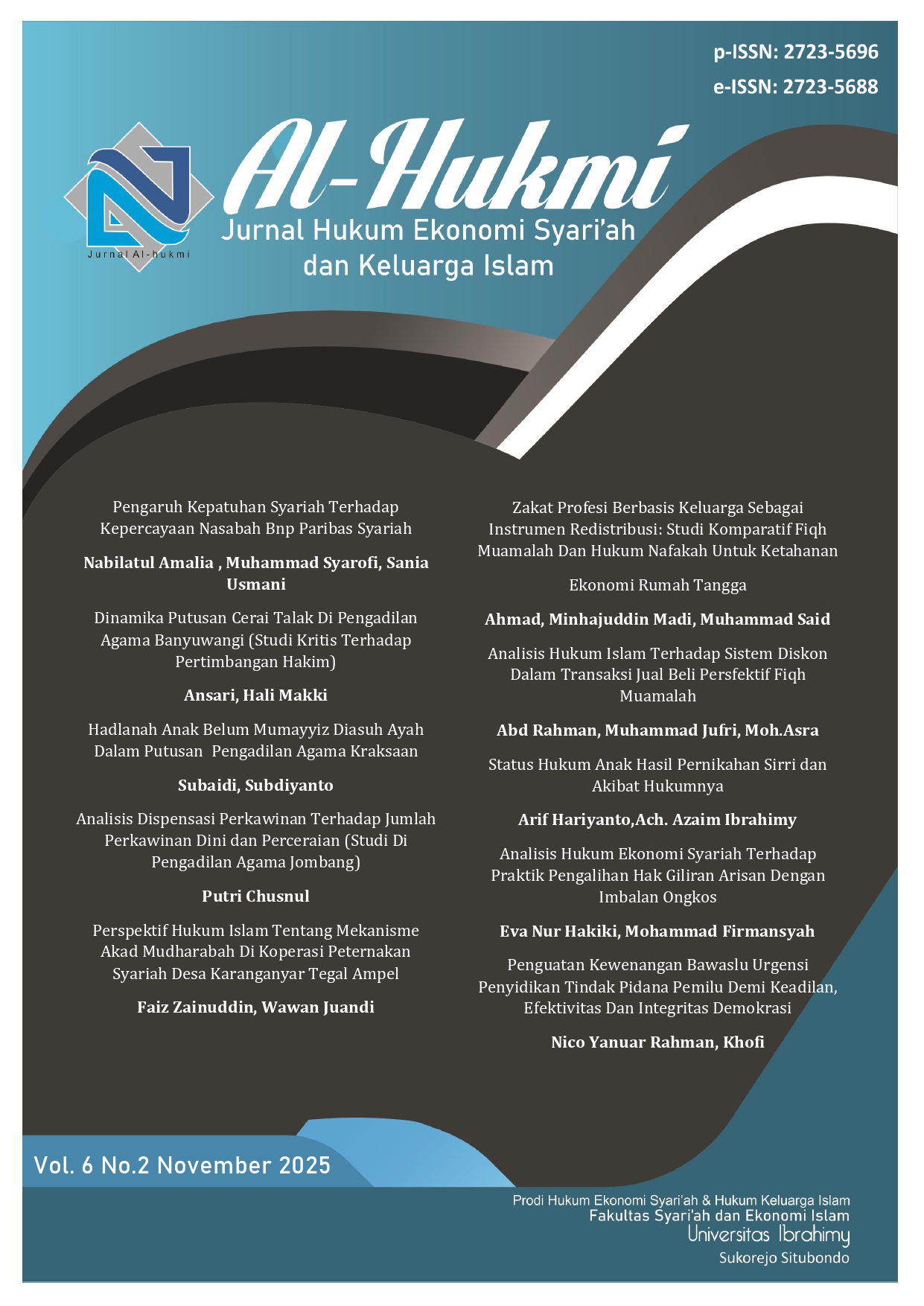
ANALISIS HUKUM ISLAM TERHADAP SISTEM DISKON DALAM TRANSAKSI JUAL BELI PERSFEKTIF FIQH MUAMALAH
DOI:
https://doi.org/10.35316/alhukmi.v6i2.9225Keywords:
Akad Jual beli, saham syariah, fiqh muamalahAbstract
This study examines the practice of price discounts in sale and purchase transactions from the perspective of Islamic law within the framework of fiqh muamalah. Discounts are widely applied as a promotional strategy in modern trade to attract consumers by offering price reductions. However, in practice, discounts may raise normative issues, particularly when accompanied by price manipulation, lack of transparency, and misleading promotional practices. This research employs a qualitative library-based approach (library research), utilizing primary sources such as the Qur’an, Sunnah, and classical fiqh muamalah literature, as well as secondary sources including scholarly journals and relevant academic studies. Data analysis is conducted using the Miles and Huberman model through the stages of data reduction, data display, and conclusion drawing. The findings indicate that discounts are fundamentally permissible in Islam when conducted under the contract of al-muwadla’ah and implemented with fairness, transparency, and compliance with the essential pillars and conditions of Islamic sales contracts. Nevertheless, discount practices become inconsistent with Sharia principles when they involve elements of tadlis (deception in price information), gharar (uncertainty regarding the object or quality of goods), or najasy (manipulative promotion creating false market perceptions). Therefore, discounts in commercial transactions are considered valid only when free from fraudulent practices, ensuring mutual consent, honesty, and the achievement of maslahah (public benefit). This study highlights the importance of applying Islamic ethical principles in contemporary marketing practices to preserve justice and integrity in economic transactions..
Downloads
Published
How to Cite
Issue
Section
License
Copyright (c) 2026 Muhammad Jufri, Abd. Rahman, Moh. Asra

This work is licensed under a Creative Commons Attribution 4.0 International License.