
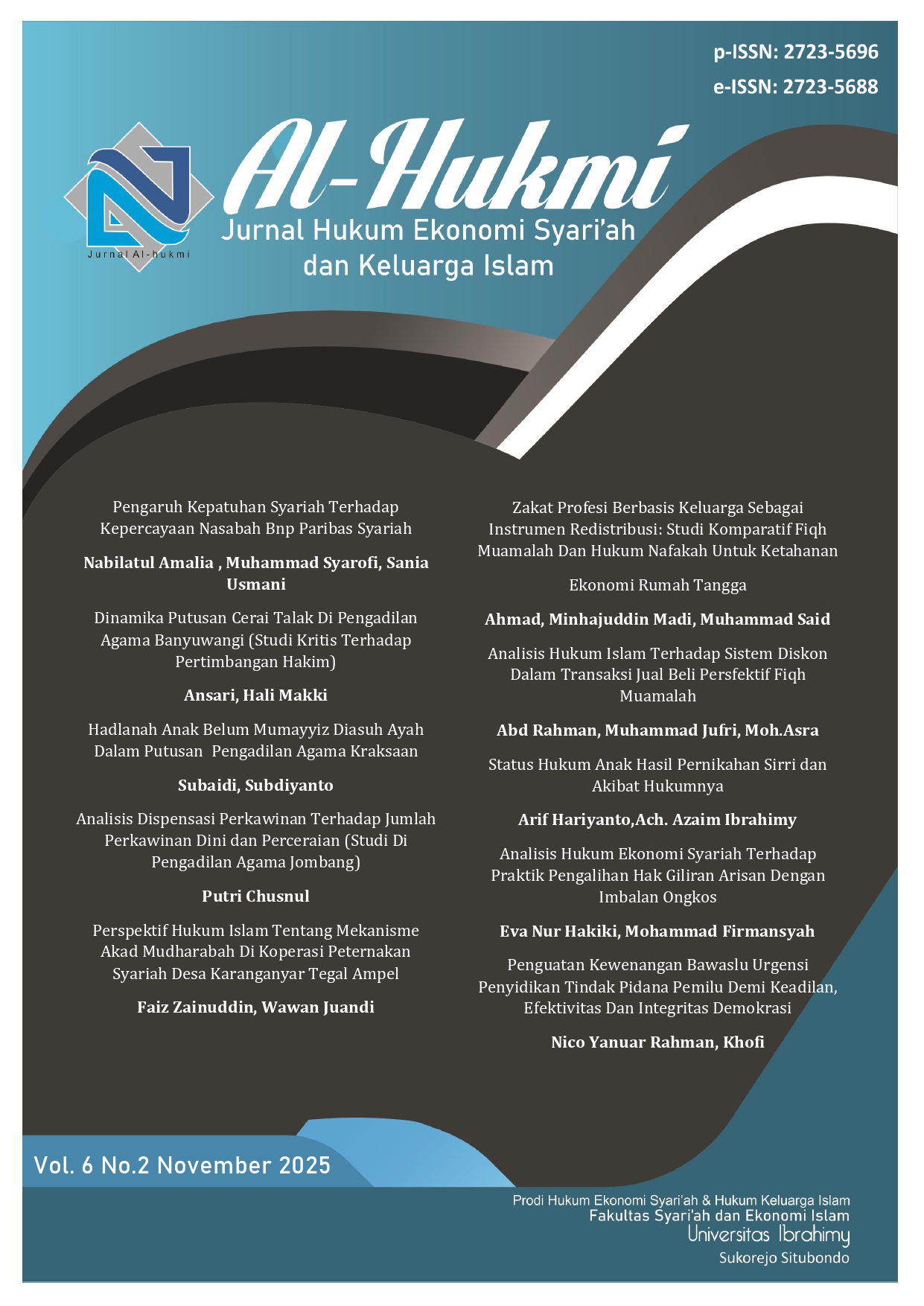
DINAMIKA PUTUSAN CERAI TALAK DI PENGADILAN AGAMA BANYUWANGI
DOI:
https://doi.org/10.35316/alhukmi.v6i2.8179Keywords:
Dynamics of Decisions, Divorce Divorce, Judge's ConsiderationsAbstract
The dynamics of talaq divorce decisions in the Banyuwangi Religious Court reflect a transformation in religious justice practice that moves from a formalistic approach to a more humanist and contextual substantive justice paradigm. This study aims to analyze how judges consider legal, moral, and social aspects in imposing talaq divorce decisions and assess the extent to which substantive justice is realized in the practice of religious justice. The method used is a descriptive-critical qualitative approach with data collection techniques through in-depth interviews with judges and litigants, court observations, and analysis of decision documents. The results of the study show that judges at the Banyuwangi Religious Court have tried to balance juridical and religious moral considerations, although there are still inconsistencies in the determination of alimony and the implementation of mediation. In conclusion, the dynamics of talaq divorce decisions reflect a transformation towards a more humanistic, transparent, and benefit-oriented judicial paradigm. The implication is that it is necessary to strengthen the capacity of judges in the perspective of gender justice, the application of maqasid al-shari'ah, and the establishment of contextual legal considerations guidelines so that talaq divorce decisions are more fair, consistent, and responsive to the social needs of the community
Downloads
Published
How to Cite
Issue
Section
License
Copyright (c) 2026 Ansari Ansari, Hali Makki

This work is licensed under a Creative Commons Attribution 4.0 International License.