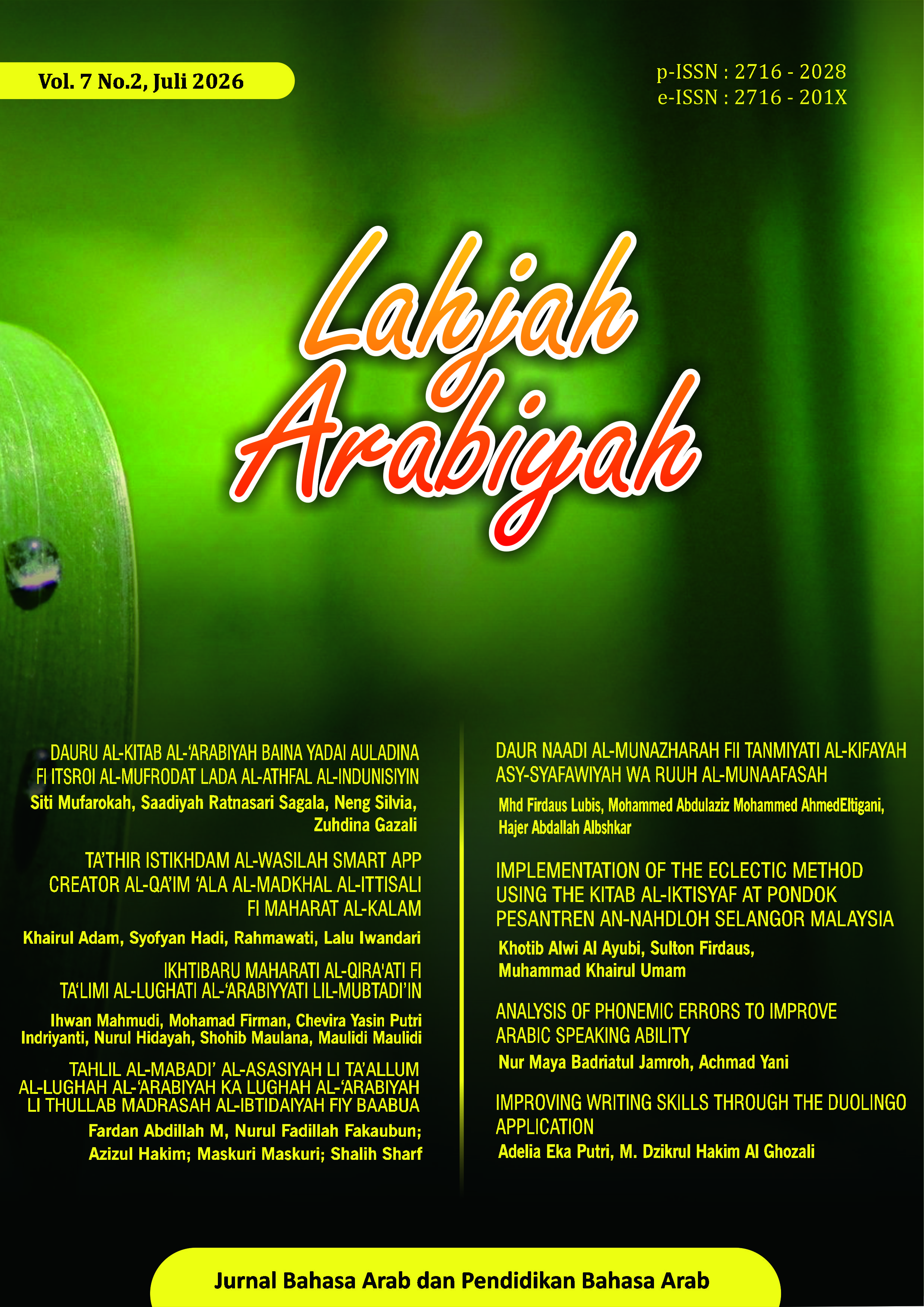
IMPLEMENTATION OF THE ECLECTIC METHOD USING THE KITAB AL-IKTISYAF AT PONDOK PESANTREN AN-NAHDLOH SELANGOR MALAYSIA
Keywords:
Eclectic Method, Kitab Al-Iktisyaf, Classical Islamic Texts, Pesantren, Islamic EducationAbstract
This study aims to (1) describe the implementation of the eclectic method in teaching Kitab AlIktisyaf at Pondok Pesantren An-Nahdloh Selangor Malaysia, and (2) analyze its impact on students’ comprehension, participation, and reflective abilities. The eclectic method serves as an integrative pedagogical approach that combines traditional pesantren methods such as bandongan, sorogan, and halaqah with modern learning strategies, including contextual discussion, interactive questioning, group learning, guided memorization, and project-based learning. This research employs a qualitative descriptive approach using a case study design. Data were collected through participatory observation, in-depth interviews, and documentation, then analyzed through data reduction, data display, and conclusion drawing. The findings reveal that the implementation of the eclectic method creates an active and collaborative learning atmosphere, enhances students’ understanding of linguistic structures and classical text meanings, and fosters reflective attitudes toward contextual Islamic values. This study contributes to the development of Islamic pedagogical discourse by demonstrating that the eclectic method not only preserves traditional pesantren learning traditions but also strengthens students’ participation, contextual understanding, and reflective learning abilities through the integration of classical and modern instructional strategies. Further smore, this approach reinforces the integration between traditional pesantren scholarship and modern pedagogical innovation. However, several challenges remain, including limited instructional time, differences in students’ abilities, and teachers’ pedagogical readiness to manage varied methods. Thus, the eclectic method has proven to be an integrative, contextual, and adaptive learning model for modern Islamic education while maintaining the traditional values of pesantren-based learning.
Downloads
References
Abdullah, M. “Eclectic Method in Islamic Education: A Contextual Approach to Pedagogy.” Journal of Islamic Pedagogy 14, no. 2 (2022): 45–59.
Ach Syarif Hidayatullah, Imam Fauji. “Analisis Buku Al-Iktisyaf Dalam Pembelajaran Nahwu Di Pendahuluan,” no. 212071900030 (2024).
Ade Aslama, and Anggoro Putranto. “Penerapan Metode Tanya Jawab Untuk Meningkatkan Keaktifan Dan Hasil Belajar IPS Kelas VIII SMPN 2 Ngantru.” Jurnal Pendidikan Dan Ilmu Sosial (Jupendis) 2, no. 4 (2024): 51–66. https://doi.org/10.54066/jupendis.v2i4.2121.
Afifa, Nurul, Abd Halim, Kaharuddin Ramli, Darmawati Darmawati, and Hamsa Hamsa. “Implementasi Metode Qawaid Wa Tarjamah Dan Mauqiuli’rab Santri Pondok Pesantren Al-Risalah Batetangnga Polman.” Journal on Education 7, no. 1 (2024): 4111–24. https://doi.org/10.31004/joe.v7i1.7004.
Amin, A, and M Rahim. “Eclectic Pedagogies in Classical Islamic Learning: Revitalizing Kitab-Based Education in the Modern Era.” Journal of Contemporary Islamic Education 8, no. 2 (2024): 55–71.
Aziz, Abdul. “Implementation of the Al-Iktisyaf Book Memorization Method to Improve Vocabulary Mastery Among Students at Nurur Rohman Islamic Boarding” 5, no. 1 (2025): 16–29.
Brown, H D. Teaching by Principles: An Interactive Approach to Language Pedagogy. New York: Pearson Education, 2021.
Creswell, J W, and C N Poth. Qualitative Inquiry and Research Design: Choosing Among Five Approaches. 4th ed. Thousand Oaks, CA: Sage Publications, 2021.
Falaqi, Muhammad Rizal, Nur Qomari, and Apri Wardana Ritonga. “Maharah Kalam Learning in Higher Education Using a Collaborative Learning Based on Constructivism Theory.” Journal of Advanced Research in Social Sciences and Humanities 8, no. 2 (2023): 84–91. https://doi.org/10.26500/jarssh-08-2023-0204.
Fauzi, A. “Revitalisasi Metode Bandongan Dan Sorogan Di Era Digital.” Jurnal Tarbiyah Islamiyah 9, no. 2 (2021): 115–32.
Fifadhilni, Shendy Maftalia. “Teknik Kombinasi: Metode Ceramah, Diskusi Dan Tanya Jawab.” Pendidikan, 2022, 1–7.
Fu’adah, Shofwatul. “Penggunaan Strategi Mind Mapping Dalam Pembelajaran Kosakata Bahasa Arab.” Lahjah Arabiyah 3, no. 2 (2022): 139–44.
Hidayat, S. “Hybrid Learning in Pesantren-Based Arabic Instruction.” Jurnal Pendidikan Islam 11, no. 4 (2022): 245–60.
Husnaini, M., Ahmad Syauqi Fuady, and Yusuf. “Techniques for Implementing the Iktisyaf Method in Teaching the Yellow Book at Pesantren Puncak Darussalam, East Java, Indonesia.” Jurnal Pendidikan Agama Islam 20, no. 1 (2023): 83–97. https://doi.org/10.14421/jpai.v20i1.6798.
Ika Nahdati Rahmah. “Implementasi Metode Ceramah Dan Tanya Jawab Terhadap Efektivitas Pembelajaran Pendidikan Kemuhammadiyahan Di Sd Muhammadiyah Condongcatur.” Skripsi, 2021, 22.
Khalid, N, and R Hashim. “Integrative Islamic Pedagogy in Southeast Asian Pesantren Education.” International Journal of Islamic Studies 15, no. 3 (2021): 101–19.
Mahmood, R. “Eclectic Method in Arabic Language Teaching: Pedagogical Flexibility and Effectiveness.” Arab World English Journal 14, no. 1 (2023): 58–74.
Mahmoud, Z, and N Sulaiman. “Contextualizing the Eclectic Method in Islamic Education: Malaysian Perspectives.” Asian Journal of Education and Social Studies 11, no. 1 (2023): 44–60.
Manullang, Juanda, Hasudungan Sidabutar, and Agustinus Manullang. “Efektifitas Metode Diskusi Dalam Pembelajaran Pendidikan Agama Kristen Pada Masa Pandemi Covid-19.” Jurnal Imiah Pendidikan Dan Pembelajaran 5, no. 3 (2022): 502–9. https://doi.org/10.23887/jipp.v5i3.39268.
Maskuri, Maskuri, Mohammad Kholison, Wildatul Islamiyah, Universitas Ibrahimy, and Situbondo Indonesia. “Lahjah Arabiyah ِلجنة عربية.” Lahjah Arabiyah 3, no. 2 (2022): 139–44.
Maturedy, Faris, and Amirul Mukminin. “Analisis Buku Al Bidayah Dan Al Miftah Lil ‘Ulum.” Lahjah Arabiyah: Jurnal Bahasa Arab Dan Pendidikan Bahasa Arab 5, no. 1 (2024): 94–106. https://doi.org/10.35316/lahjah.v5i1.94-106.
Mufarrokhah, Ela, Fita Mustafida, and Ika Ratih Sulistiani. “Penerapan Metode Pembelajaran Kelompok Dalam Meningkatkan Keaktifan Peserta Didik Pada Pembelajaran Tematik Di Madrasah Ibtidaiyah.” Jurnal Pendidikan Madrasah Ibtidaiyah 5 (2023): 357–64.
Mukriadi, M, and A Gaffar. “Pembelajaran Kitab Kuning Dengan Menggunakan Kitab Al-Iktisyāf Di Pondok Pesantren Puncak Darussalam Pamekasan.” Al-Lubab: Jurnal Studi Islam Multidisipliner 3, no. 2 (2022). https://ejournal.kopertais4.or.id/mataraman/index.php/allubab/article/view/4945.
Muslih, Ahmad. “Peran Pesantren Al-Bukhori Ponorogo Dalam Meningkatkan Religiusitas Masyarakat Muslim Pedesaan.” Journal of Community Development and Disaster Management, 2021. https://doi.org/10.37680/jcd.v3i2.1032.
Nasir, R. “Paradigma Baru Pendidikan Pesantren Di Malaysia.” Malaysian Journal of Islamic Education 5, no. 1 (2023): 33–50.
Nisa, H. “Transformasi Pembelajaran Kitab Kuning Di Pesantren Modern.” Jurnal Studi Islam Dan Sosial 13, no. 2 (2023): 99–114.
Rahman, F, and M Taufiq. “Teacher Readiness in Implementing Eclectic Teaching Approaches in Pesantren.” Jurnal Pendidikan Islam Nusantara 9, no. 1 (2023): 77–95.
Sulaiman, A, and Z Karim. “Innovative Teaching in Malaysian Islamic Boarding Schools.” International Review of Education 70, no. 2 (2024): 87–105.
Syahid, A, S Subaedah, N Nurbaeti, and M Arsyam. “Meta-Analysis of Constructivist Learning Models in Improving Student Learning Outcomes.” Tafkir: Interdisciplinary Journal of Islamic Education 4, no. 4 (2023): 625–34. https://doi.org/10.31538/tijie.v4i4.718.
Yun, L, and A Ismail. “Hybrid Learning Integration in Islamic Boarding Schools: A New Pedagogical Direction.” Malaysian Journal of Learning and Instruction 19, no. 2 (2022): 88–103.
Downloads
Published
How to Cite
Issue
Section
License
Copyright (c) 2026 Khotib Alwi Al Ayubi, Sulton Firdaus, Muhammad Khairul Umam

This work is licensed under a Creative Commons Attribution-ShareAlike 4.0 International License.
Authors who publish with this journal agree to the following terms:
- Authors retain copyright and grant the journal right of first publication with the work simultaneously licensed under a Creative Commons Attribution-ShareAlike 4.0 International License that allows others to share the work with an acknowledgement of the work's authorship and initial publication in this journal.
- Authors are able to enter into separate, additional contractual arrangements for the non-exclusive distribution of the journal's published version of the work (e.g., post it to an institutional repository or publish it in a book), with an acknowledgement of its initial publication in this journal.
- Authors are permitted and encouraged to post their work online (e.g., in institutional repositories or on their website) prior to and during the submission process, as it can lead to productive exchanges, as well as earlier and greater citation of published work.















_by_Matematohir.jpg)