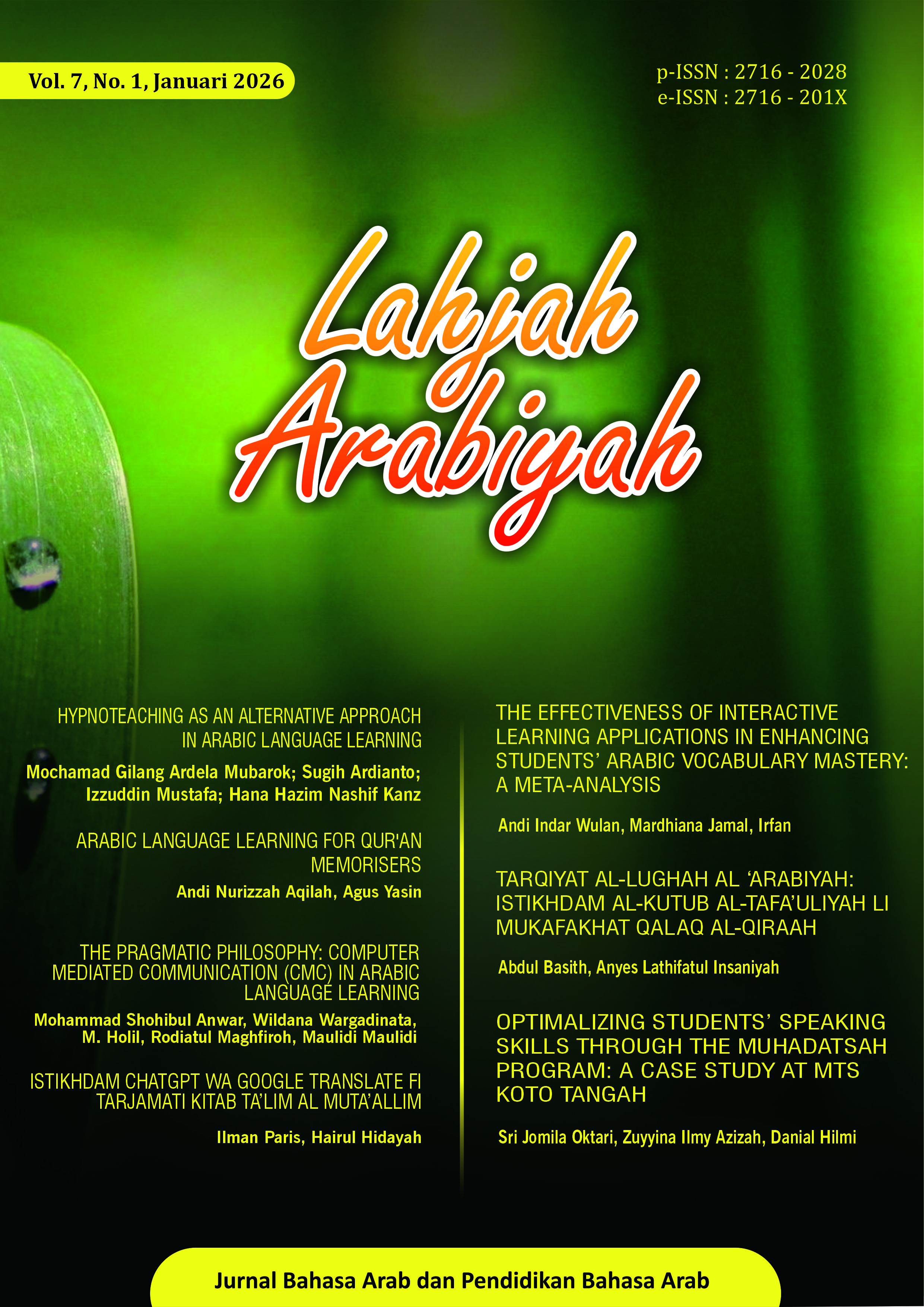
TARQIYAT AL-LUGHAH AL ‘ARABIYAH: ISTIKHDAM AL-KUTUB AL-TAFA’ULIYAH LI MUKAFAKHAT QALAQ AL-QIRAAH
ترقية اللغة العربية: استخدام الكتب التفاعلية لمكافحة قلق القراءة
Keywords:
Gamification, Interactive Textbooks, Arabic Reading AnxietyAbstract
This research was conducted to address the critical issue of Arabic reading anxiety, which hinders students' motivation, participation, and academic achievement. The main reason is that learning approaches specifically designed to reduce emotional and cognitive complexity in Arabic language learning are not yet optimal. The research uses a mixed methods approach with a sequential explanatory design. The quantitative stage consists of a quasi-experiment (pretest-posttest control group), while the qualitative stage includes participant observation, in-depth interviews, and document analysis. Quantitatively, the interactive book-based gamification intervention successfully reduced reading anxiety by 50%, increased motivation by 57.5%, and raised the average score from 70 to 85. Qualitative findings reveal that gamification creates a low-threat learning environment, fulfils the psychological needs of autonomy-competence-relatedness, and facilitates cognitive processing. However, 20-25% of students were less responsive, indicating variations in individual needs. Integrating gamification with interactive textbooks has proven effective as a transformative strategy to reduce Arabic reading anxiety while simultaneously increasing engagement and learning outcomes. This research recommends the implementation of an adaptive learning model that considers students' personal needs, as well as the need for further research with a broader scope.
Downloads
References
Abidin, M Z, and F D K Halis. “Pengembangan Aplikasi Online Berbasis Gamifikasi Untuk Meningkatkan Kompetensi Bahasa Inggris Listening Dan Reading Comprehension Dalam Persiapan Toeic Test.” Jurnal Teknologi Pembelajaran Indonesia 14, no. 2 (2024): 142–58.
Adkins-Jablonsky, Sarah J, Justin F Shaffer, J Jeffrey Morris, Ben England, and Samiksha Raut. “A Tale of Two Institutions: Analyzing the Impact of Gamified Student Response Systems on Student Anxiety in Two Different Introductory Biology Courses.” CBE—Life Sciences Education 20, no. 2 (2021): ar19.
Almelhes, Sultan A, and Hussain E Alsaiari. “A Conceptual Framework for Teaching Arabic as a Second Language.” Theory and Practice in Language Studies 14, no. 7 (2024): 2110–18.
Amiruddin, Ahmad Zaki bin, Zulazhan Ab Halim, and Nurkhamimi Zainuddin. “Teoritis Reka Bentuk Dan Pembangunan Kursus Bahasa Arab Dalam Talian.” International Online Journal of Language, Communication, and Humanities 4, no. 1 (2021): 1–13.
Arifuddin, Arifuddin. “Strategi Dalam Mengurangi Kecemasan Berbicara Bahasa Arab Pada Mata Kuliah Maharah Al-Kalam Mahasiswa Program Studi Pendidikan Bahasa Arab Angkatan 2020 Fakultas Tarbiyah Iain Parepare.” IAIN Parepare, 2023.
Chans, Guillermo M, and May Portuguez Castro. “Gamification as a Strategy to Increase Motivation and Engagement in Higher Education Chemistry Students.” Computers 10, no. 10 (2021): 132.
Chen, Yang, Luying Zhang, and Hua Yin. “A Longitudinal Study on Students’ Foreign Language Anxiety and Cognitive Load in Gamified Classes of Higher Education.” Sustainability 14, no. 17 (2022): 10905.
Deci, Edward L, and Richard M Ryan. “Self-Determination Theory.” Handbook of Theories of Social Psychology 1, no. 20 (2012): 416–36.
Derakhshan, Ali, Jalil Fathi, Mirosław Pawlak, and Mariusz Kruk. “Classroom Social Climate, Growth Language Mindset, and Student Engagement: The Mediating Role of Boredom in Learning English as a Foreign Language.” Journal of Multilingual and Multicultural Development 45, no. 8 (2024): 3415–33.
Fosnot, Catherine Twomey. Constructivism: Theory, Perspectives, and Practice. Teachers College Press, 2013.
Hein, George E. “Constructivist Learning Theory.” Institute for Inquiry 14 (1991).
Hou, Huei-Tse. “Learning Science through Cloud Gamification: A Framework for Remote Gamified Science Learning Activities Integrating Cloud Tool Sets and Three-Dimensional Scaffolding.” Information 14, no. 3 (2023): 165.
Majali, Salwa Al. “Positive Anxiety and Its Role in Motivation and Achievements among University Students.” International Journal of Instruction 13, no. 4 (2020): 975–86.
Masgumelar, Ndaru Kukuh, and Pinton Setya Mustafa. “Teori Belajar Konstruktivisme Dan Implikasinya Dalam Pendidikan Dan Pembelajaran.” GHAITSA: Islamic Education Journal 2, no. 1 (2021): 49–57.
Maskuri, Maskuri, Muhammad Jundi, and Suleman D Kadir. “ARABIC PROGRAM MANAGEMENT IN MODERN ISLAMIC BOARDING SCHOOL: A COMPARATIVE CASE STUDY.” Lahjah Arabiyah: Jurnal Bahasa Arab Dan Pendidikan Bahasa Arab 6, no. 2 (2025): 133–54.
Meutiawati, Ida. “Perspektif Koneksionisme Terhadap Aktivitas Belajar Di Era Teknologi Digital.” Desultanah-Journal Education and Social Science 2, no. 1 (2024): 81–100.
Ortiz-Garces, Iván, Jaime Govea, Roberto O Andrade, and William Villegas-Ch. “Optimizing Chatbot Effectiveness through Advanced Syntactic Analysis: A Comprehensive Study in Natural Language Processing.” Applied Sciences 14, no. 5 (2024): 1737.
Pratama, Hendri, and Rida Yanna Primanita. “Hubungan Determinasi Diri Dengan Pengambilan Keputusan Karir Pada Siswa Sma Di Kota Sawahlunto.” Jurnal Pendidikan Tambusai 7, no. 1 (2023): 1932–38.
Ruskandi, Kanda, Erik Yuda Pratama, and Dina Jatnika Nurmala Asri. Transformasi Arah Tujuan Pendidikan Di Era Society 5.0. CV. Caraka Khatulistiwa, 2021.
Ryan, Richard M, and Maarten Vansteenkiste. “Self-Determination Theory.” In The Oxford Handbook of Self-Determination Theory, 3–30. Oxford University Press, 2023.
Saba, Savira Savira. “Pemanfaatan Game Edukasi Untuk Meningkatkan Minat Dan Pemahaman Siswa Dalam Pembelajaran Sains.” JSE Journal Sains and Education 2, no. 02 (2024): 33–39.
Sahra, Ai Patimah, Kokom Komalasari, Ika Ismail Kayyis, Muhamad Andrian, and Sofyan Iskandar. “Evaluasi Manajemen Sekolah Dasar Studi Kasus Dalam Menantang Paradigma Konvensional Dan Menciptakan Inovasi Pendidikan Berkelanjutan.” Jurnal Ilmiah Global Education 6, no. 2 (2025): 313–22.
Saiu, Salvatore, and Enrico Grosso. “Controlled Audio-Visual Stimulation for Anxiety Reduction.” Computer Methods and Programs in Biomedicine 223 (2022): 106898.
Salsabila, Jihan. “Pola Komunikasi Orang Tua Terhadap Pecandu Game Mobile Legends Di SD N 05 Mampang Prapatan.” Media Komunikasi Efektif 1, no. 1 (2024): 29–38.
Seaborn, Katie, and Deborah I Fels. “Gamification in Theory and Action: A Survey.” International Journal of Human-Computer Studies 74 (2015): 14–31.
Setiawan, Zunan, I Made Pustikayasa, I Nyoman Jayanegara, I Nyoman Anom Fajaraditya Setiawan, I Nyoman Agus Suarya Putra, I Wayan Adi Putra Yasa, Wina Asry, I Nyoman Alit Arsana, Gentrifil Gamastra Chaniago, and Sarwo Eddy Wibowo. PENDIDIKAN MULTIMEDIA: Konsep Dan Aplikasi Pada Era Revolusi Industri 4.0 Menuju Society 5.0. PT. Sonpedia Publishing Indonesia, 2023.
Sweller, John. “Cognitive Load Theory.” In Psychology of Learning and Motivation, 55:37–76. Elsevier, 2011.
Taqiyudin, Ahmad, and Kamal Yusuf. “TAHSIN JAWDAT TA’LIM AL-LUGHAH AL-‘ARABIYAH MIN KHILAL TATHBIQ AL-MANHAJ AL-DIRASI AL-MUSTAQILL: تحسين جودة تعليم اللغة العربية من خلال تطبيق المنهج الدراسي المستقل.” Lahjah Arabiyah: Jurnal Bahasa Arab Dan Pendidikan Bahasa Arab 6, no. 2 (2025): 186–201.
Taubah, Miftachul, and Aisyatul Hanun. “Konsep Pembelajaran Bahasa Arab Dengan Pendekatan Positive Mental Attitude.” Lahjah Arabiyah: Jurnal Bahasa Arab Dan Pendidikan Bahasa Arab 5, no. 2 (2024): 211–28.
Thohir, Muhammad, Chananak Nabila Melinia, Hidayatus Sholihah, and Maharotun Nubaha. “Metode Pembelajaran Bahasa Arab.” kanzum books, 2021.
Tran, Thi Thu Trang. “A Review of Horwitz, Horwitz and Cope’s Theory of Foreign Language Anxiety and the Challenges to the Theory.” English Language Teaching 5, no. 1 (2012): 69–75.
Wang, Pinhao, Yujie Zhou, Guang Dai, Zhengke Li, Xin Zhao, Jiahui Lu, Cheng Yao, and Fangtian Ying. “Exploring Perceptions of Children’s Learning Stress for Stress Management.” In Science and Information Conference, 51–65. Springer, 2024.
Yahaya, Hazrati, Hanis Najwa Shaharuddin, Fudzla Suraiyya Abdul Raup, Nor Zahidah Ahmad, and Muhammad Hatta Shafri. “Persepsi Pelajar Terhadap Pemanfaatan Gamifikasi Dalam Pembelajaran Bahasa Arab.” Journal of Modern Language and Applied Linguistics 6, no. 2 (2022): 1–13.
Downloads
Published
How to Cite
Issue
Section
License
Copyright (c) 2026 Abdul Basith, Anyes Lathifatul Insaniyah

This work is licensed under a Creative Commons Attribution-ShareAlike 4.0 International License.
Authors who publish with this journal agree to the following terms:
- Authors retain copyright and grant the journal right of first publication with the work simultaneously licensed under a Creative Commons Attribution-ShareAlike 4.0 International License that allows others to share the work with an acknowledgement of the work's authorship and initial publication in this journal.
- Authors are able to enter into separate, additional contractual arrangements for the non-exclusive distribution of the journal's published version of the work (e.g., post it to an institutional repository or publish it in a book), with an acknowledgement of its initial publication in this journal.
- Authors are permitted and encouraged to post their work online (e.g., in institutional repositories or on their website) prior to and during the submission process, as it can lead to productive exchanges, as well as earlier and greater citation of published work.















_by_Matematohir.jpg)