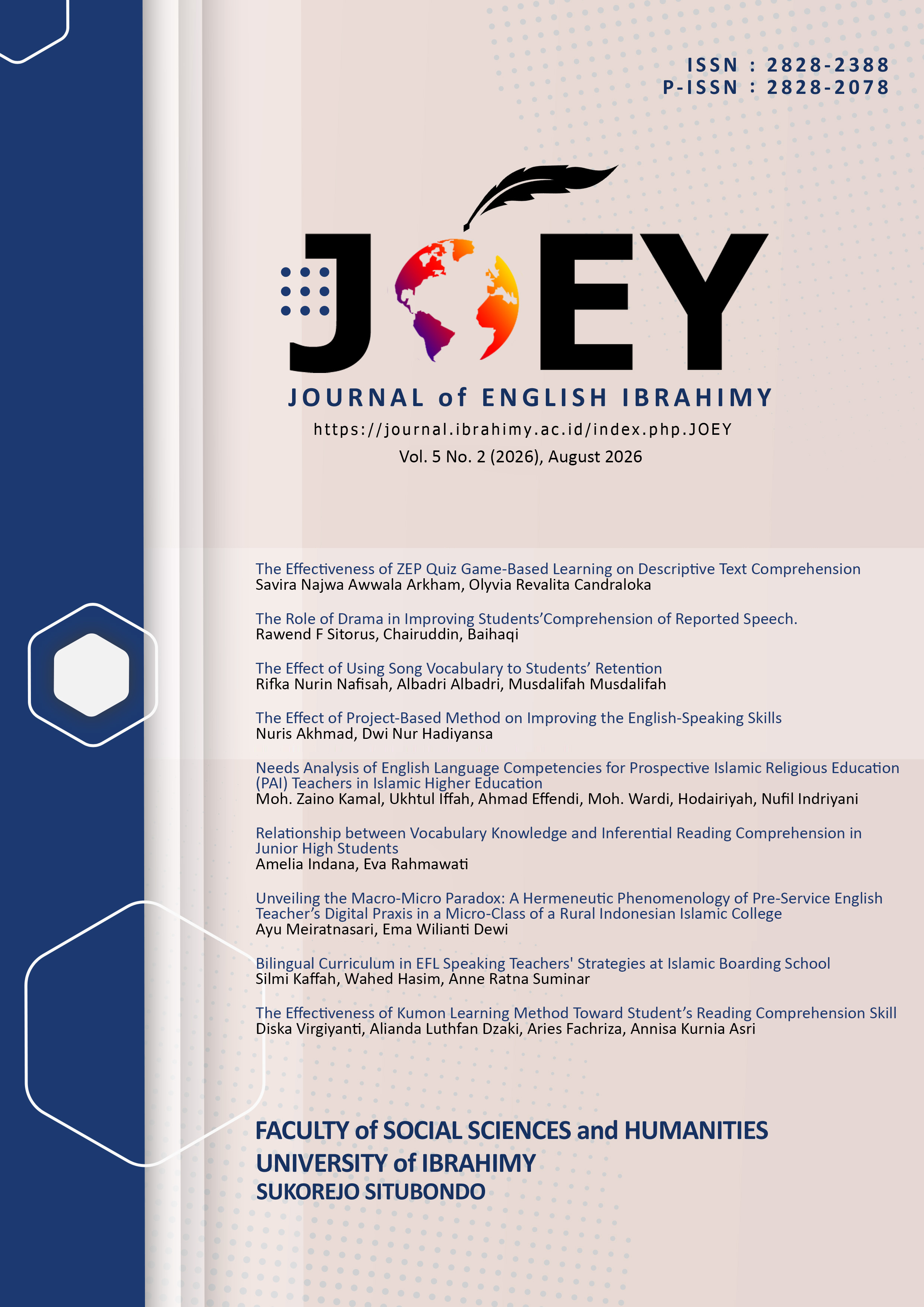
The Effectiveness of Kumon Learning Method Toward Student’s Reading Comprehension Skill
English
DOI:
https://doi.org/10.35316/joey.2026.v5i2.119-133Keywords:
Kumon Learning Method, Reading Comprehension, English as a Foreign Language (EFL), Reading Skills, English EducationAbstract
English proficiency has become increasingly important in supporting students’ academic and future professional success, encouraging parents to seek additional English learning opportunities outside formal education. One of the widely adopted institutions is Kumon, which applies an individualized and self-paced learning approach. However, studies discussing the effectiveness of the method in Kumon course in improving reading comprehension skills in English as a Foreign Language (EFL) classes remain limited, particularly in the Indonesian students. Therefore, this study aims to examine the effectiveness of the Kumon Learning Method toward students’ reading comprehension skills at Kumon course that is located in Ahmad Yani street, Purwokerto, East Java, Indonesia. This research employed a descriptive qualitative design involving six students aged 11–12 years old enrolled in the EFL Class. Data were collected through interviews, observations, questionnaires, and documentation. The findings reveal that the Kumon Learning Method effectively enhances students’ reading comprehension through individualized learning, leveled worksheets, repetitive practice, and Oral Reading Check (ORC) activities. Students demonstrated improvements in vocabulary acquisition, reading fluency, comprehension ability, confidence, and learning independence. In conclusion, the Kumon Learning Method provides an effective supplementary approach for improving reading comprehension skills in EFL learning and may serve as an alternative model for supporting English language development among young learners.
References
Ardiansyah, A. P., Yuliatiningtyas, S., & Komunikasi, I. (2022). ANALISIS SEMIOTIKA IKLAN KUMON “ BRINGS SUCCESS .” 1(2), 179–186.
Asipi, L. S., Rosalina, U., & Nopiyadi, D. (2022). The Analysis of Reading Habits Using Miles and Huberman Interactive Model to Empower Students ’ Literacy at IPB Cirebon. 2(3), 117–125.
Banditvilai, C. (2020). The Effectiveness of Reading Strategies on Reading Comprehension. 10(2). https://doi.org/10.18178/ijssh.2020.10.2.1012
Farani, M. A., Farmasari, S., & Isnaini, M. (2024). An Analysis of the Influences of Kumon Learning Method Toward the Learning of English as A Foreign Language. https://doi.org/10.29303/jeef.v4i1.609
Halimah, S. N. (2019). Peranan bimbingan belajar nurul fikri pamulang dalam membantu siswa lulus seleksi masuk ptn.
Hastuti, T. (2020). An Analysis Students Reading Comprehension in Descriptive Text at Tenth Grade Students of SMK Muhammadiyah 2 Metro.
Husna, A. H., & Murtini, R. T. (2019). A STUDY ON STUDENTS ’ MOTIVATION IN LEARNING ENGLISH AS ENGLISH FOREIGN LANGUAGE ( EFL ) AT STIKES CENDEKIA UTAMA. October, 207–220.
Indah, A. (2023). AN ANALYSIS OF STUDENTS ’ AUTONOMOUS LEARNING TO DEVELOP THEIR ENGLISH ABILITY AT KUMON INSTITUTION OF EDUCATION Written by :
Jumaira, V., Yulina, M., Wati, N. S., Ramadhani, N., Zazalmi, G. C., Berinal, F. A., Rizki, I., Umami, K., Irawan, Y., Zahara, I., Azizah, W., Dewi, K., & Amanda, D. (n.d.). SOLVING YOUNG LEARNERS ’ PROBLEM IN.
Kustini, T., Language, E., Program, E., & Majalengka, U. (2012). No Title. 5(2), 119–123.
Neil, J. (2004). UC Berkeley. https://doi.org/10.5070/B5.36364
Nunan, D. & Carter, R. (2001). Teaching English of Speaker to Other Language. 17(1), 48–50.
Orcos, L., Hern, R. M., Espigares, M. J., & Magreñ, Á. A. (2019). The Kumon Method : Its Importance in the Improvement on the Teaching and Learning of Mathematics from the First Levels of Early Childhood and Primary Education. 1–17. https://doi.org/10.3390/math7010109
Panjaitan, L., Siahaan, N. P. W., Tampubolon, V. A., & Sipayung, N. (2022). The Student ’ s Reading Problems In Private School In Pematangsiantar. 2(1), 24–28.
Rao, P. S. (2019). THE ROLE OF ENGLISH AS A GLOBAL LANGUAGE. Research Journal Of English (RJOE), 845(1), 65–79.
Trihapsari, I. B. (2021). PRACTICES OF TEACHING ENGLISH IN KUMON COURSE TULUNGAGUNG ENGLISH EDUCATION DEPARTMENT FACULTY OF TARBIYAH AND TEACHER TRAINING STATE ISLAMIC INSTITUTE ( IAIN ) OF.
Trilestari, K., Maya, R., Manurung, L., & Simangunsong, V. N. (2024). The benefits of learning english in early childhood: positive and negative effect.
Yuliasih, R., Suparno, P., Widodo, E., Akbar, P. M., & Pd, M. (2018). International Journal of Advanced Engineering and Management Research ISSN : 2456-3676 EVALUATION OF IMPLEMENTATION KUMON METHOD. 3(3).
Downloads
Published
How to Cite
Issue
Section
License
Copyright (c) 2026 JOEY: Journal of English Ibrahimy

This work is licensed under a Creative Commons Attribution-NonCommercial-ShareAlike 4.0 International License.