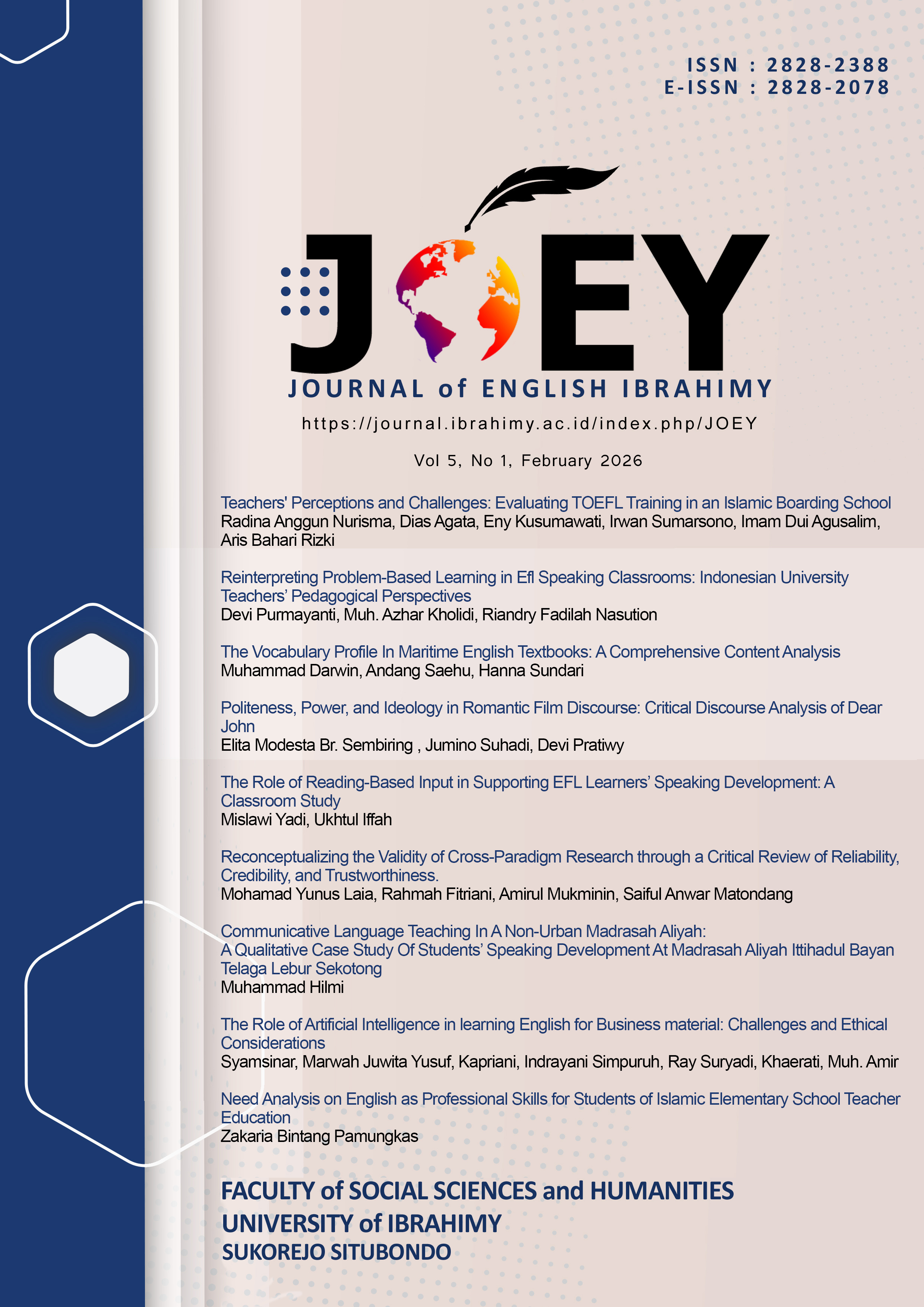
The Role of Artificial Intelligence in Learning English for Business material: Challenges and Ethical Considerations
English
DOI:
https://doi.org/10.35316/joey.2026.v5i1.94-107Keywords:
Artificial, intteligence, English for Business, technology, assignmentAbstract
This study investigated the role of AI tools in English for Business learning, identifies the challenges students face when using these tools, and proposes ethical considerations for their academic use. The researcher employed a descriptive qualitative research design and used purposive sampling to select the participants. The participants consisted of 104 students from STIE Tri Dharma Nusantara. The additional participants were four English lecturers, who discussed the challenges of students’ use of AI from their perspectives and offered consideration for ethical AI use in academic contexts. Data were collected through classroom observations, questionnaires, and semi-structured interviews with 6 students. The findings revealed that AI tools play four major roles in English for Business learning: facilitating effective and efficient learning processes, enhancing business communication competencies, serving as references and models, and acting as catalysts for learning rather than substitutes for educators. Survey results indicate moderate to high levels of AI usage among students. However, several challenges were identified, including unnatural or overly general language output, limited contextual and cultural understanding, reduced critical thinking, increased risk of plagiarism, diminished learning motivation, and lower self-confidence. Lecturers highlighted issues related to the similarity of students’ work and the difficulty in assessing genuine understanding. In response, this study emphasizes the importance of ethical AI integration through effective prompt design and positioning AI as a supportive learning assistant grounded in students’ prior knowledge.
References
Alhassan, A., Ali, N. A., & Ali, H. I. H. (2021). EFL students’ challenges in English-medium business programmes: Perspectives from students and content teachers. Cogent Education, 8(1), 0–15. https://doi.org/10.1080/2331186X.2021.1888671
Aljunaid, H. (2024). The impact of artificial intelligence on academic writing: a systematic literature review. International Journal of Learning Technology, 15(1), 26–55. https://doi.org/10.1504/IJLT.2025.149289
Badri, W., Solehan, & Parli, M. (2024). Artificial Intelligence in English Language Learning: Advantages and Challenges. Core.Ac.Uk, 04(03), 203–209. https://doi.org/https://doi.org/10.36085/telle.v4i3
Braknia, T., Guerfa, A., & Sakhri, A. (2025). The Role of Artificial Intelligence Technologies in Enhancing English Language Learning According to the Perspectives of A Sample of PhD Students. Integrative Perspectives of Social and Science Journal, 2(3), 127–141. https://www.researchgate.net/publication/396425277
Dja’far, V. H., & Hamidah, F. N. (2024). The Effectiveness of AI Technology in Improving Academic English Writing Skills in Higher Education. Journal of Language and Literature Studies, 4(3), 579–593. https://doi.org/https://doi.org/10.36312/jolls.v4i3.2031
Firdaus, J., Rakhma, U., Rahma, A. R., Fithriyyah, A., Mahsusi, & Afif, F. (2025). Ketergantungan Penggunaan Kecerdasan Buatan (AI) pada Tugas Akademik Mahasiswa Terhadap Kemampuan Berpikir Kritis dan Kreatif. Jurnal Kependidikan, 14 (1)(1), 1203–1214. https://doi.org/https://doi.org/10.58230/27454312.1634
Habibulloh, M. (2025). Ethics of Artificial Intelligence Usage in Education: A Qualitative Study on Teachers’ and Students’ Perceptions. International Journal of Pedagogics, 1(1), 1–11. https://doi.org/https://doi.org/10.71305/ijir.v1i1.222
Hamid, S. M., Bulkis, A., Mannong, M., & Irawan, N. (2025). Integrating Artificial Intelligence ( AI ) into EFL in Higher Education : Challenges and Opportunities for Indonesian Teachers and Students. Al-Ishlah: Jurnal Pendidikan Vol.17, 17(3), 5043–5058. https://doi.org/10.35445/alishlah.v17i3.7717
Hardani, Andriani, A., Fardani, R. A., Ustiawaty, J., Utami, E. F., Istiqomah, R., Sukmana, D., & Auliya, N. (2019). Metode Penelitian Kuantitatif. In Metode Penelitian Kualitatif&Kuantitaif (Vol. 1, Issue 1). Pustaka Ilmu.
Holmes, W., & Fadel, C. (2019). Artificial intelligence in education. Promise and implications for teaching and learning. Center for Curriculum Redesign. https://www.researchgate.net/publication/332180327_Artificial_Intelligence_in_Education_Promise_and_Implications_for_Teaching_and_Learning?enrichId=rgreq-17ffa4199d4036de79197f07d11279d5-XXX&enrichSource=Y292ZXJQYWdlOzMzMjE4MDMyNztBUzoxMTQzMTI4MTEzNzM1NTg
Huang, Y. (2024). Using Artificial Intelligence Technology to Improve Business English Language. Applied Mathematics and Nonlinear Sciences, 9(1), 1–14. https://doi.org/10.2478/amns-2024-2365
Irnawati, Fatmawati, Y., Mahardika, I. K., & Suratno. (2024). Ethics of Using Artificial Intelligence (AI) in Learning in a Philosophical Perspective. International Journal of Education, Information Technology and Others (IJEIT), 7(December), 319–330. https://doi.org/https://jurnal.peneliti.net/index.php/IJEIT/article/view/10977 p-ISSN:
Khanam, A., & Saafi, H. A. (2025). The Role of AI in English Language Teaching : An Overview. 13(11), 10–15. https://doi.org/10.35629/9467-13111015
Miles, M., Huberman, A., & Saldana, J. (2014). Qualitative data Analysis (3rd ed.). Sage Publications, Inc.
Mpolomoka, D. L., Luchembe, M., Mushibwe, C., Muvombo, M., Changala, M., Sampa, R. L., & Banda, S. (2025). Artificial Intelligence-Related Plagiarism in Education: a Systematic Review. European Journal of Education Studies, 12(4), 321–336. https://doi.org/10.46827/ejes.v12i4.6029
Niño, A. (2020). Exploring the use of online machine translation for independent language learning. Research in Learning Technology, 28(1063519), 1–32. https://doi.org/10.25304/rlt.v28.2402
Pangestu, H. P., & Suwartono, T. (2024). Exploring the Role of Artificial Intelligence ( AI ) Support in Assisting Students ’ English -Speaking Skills. English Education, Linguistics, and Literature Journal Vol., 3(2), 134–147. https://doi.org/: https://doi.org/10.31851/9zyg6g35
Paraguas, A. S. (2025). Advantages and Disadvantages of Integrating AI Tools to English Language Teaching : Systematic Literature Review. Journal of Literate, 6(1), 123–132. https://doi.org/10.47435/jle.v6i1.3704
Rianita, N. M., Nour, A. H., Pramugara Robby Yana, Angesti Palupiningsih, Novita Sari, Ika Sulis Setianingsih, Dianingtyas Murtanti Putri, Indah Afrisnti, Fetty Poerwita Sary, Ida Hendriyani, & Weka Kusumastiti. (2022). English for Business and Office. www.penerbitwidina.com
Robson, C. (2011). Real World Research 3rd Edition. Wiley.
Simaremare, Y. N., Sinambela, E., & Manik, S. (2023). Students’ Needs Analysis of Business English At ESP Class For Business Administration Department At Nommensen HKBP University. Cetta: Jurnal Ilmu Pendidikan, 6(4), 687–700. https://doi.org/10.37329/cetta.v6i4.2733
Situmorang, D. L., Husna, F., Subagio, L. A., Silvinia, M., & Raninsah, R. (2023). Systematic Literature Review: English for Specific Purposes (Esp) in Business Communication. Langue (Journal of Language and Education), 1(2). https://doi.org/10.22437/langue.v1i2.23590
Sugiyono. (2019). Metodologi Penelitian Kuantitatif, Kualitatif dan R & D. Alfabeta.
Tang, K. H. D. (2024). Implications of Artificial Intelligence for Teaching and Learning. Acta Pedagogia Asiana, 3(21), 65–79. https://doi.org/10.53623/apga.v3i2.404
Xiao, Y., Chatterjee, S., & Gehringer, E. (2022). A New Era of Plagiarism the Danger of Cheating Using AI. 2022 20th International Conference on Information Technology Based Higher Education and Training, ITHET 2022, 1–6. https://doi.org/https://doi.org/10.1109/ITHET56107.2022.10031827
Downloads
Published
How to Cite
Issue
Section
License
Copyright (c) 2026 JOEY: Journal of English Ibrahimy

This work is licensed under a Creative Commons Attribution-NonCommercial-ShareAlike 4.0 International License.