Pengelolaan Dana Zakat Dalam Pemberdayaan Ekonomi Masyarakat
DOI:
https://doi.org/10.35316/iltizam.v3i2.9177Keywords:
distribusi zakat, Zakat, Islamic economicsAbstract
This study aims to analyze the management of zakat funds in supporting community economic empowerment through a case study at the National Zakat Agency (BAZNAS) of Situbondo Regency, Indonesia. Zakat, as a key instrument in Islamic economics, serves not only as a religious obligation but also as a mechanism for income redistribution that can reduce poverty and improve the long-term welfare of zakat beneficiaries (mustahik). This research employs a descriptive qualitative approach. Data were collected through participant observation, in-depth interviews with BAZNAS management and staff, and institutional documentation. Data analysis was conducted using the Miles and Huberman interactive model, including data reduction, data display, and conclusion drawing, with validation ensured through source and method triangulation. The findings indicate that BAZNAS Situbondo has implemented a structured zakat management strategy covering the stages of zakat collection, distribution, and utilization in accordance with Indonesian Law No. 23 of 2011. Zakat collection is carried out through public awareness programs, strengthening Zakat Collection Units (UPZ), zakat pick-up services, and digital payment systems. Zakat distribution follows the eight categories of eligible recipients (asnaf) mentioned in Qur’an Surah At-Taubah verse 60, ensuring accurate targeting. Furthermore, zakat utilization is not limited to consumptive assistance but has been expanded into productive empowerment programs, including micro-business capital support, educational scholarships, healthcare services, and religious development initiatives. The study also identifies key challenges such as limited public awareness of zakat obligations and uneven distribution coverage in certain areas. Nevertheless, competent zakat administrators and well-designed empowerment programs serve as major supporting factors. This study confirms that productive zakat management through BAZNAS Situbondo holds significant potential as an instrument for sustainable local economic development and community empowerment..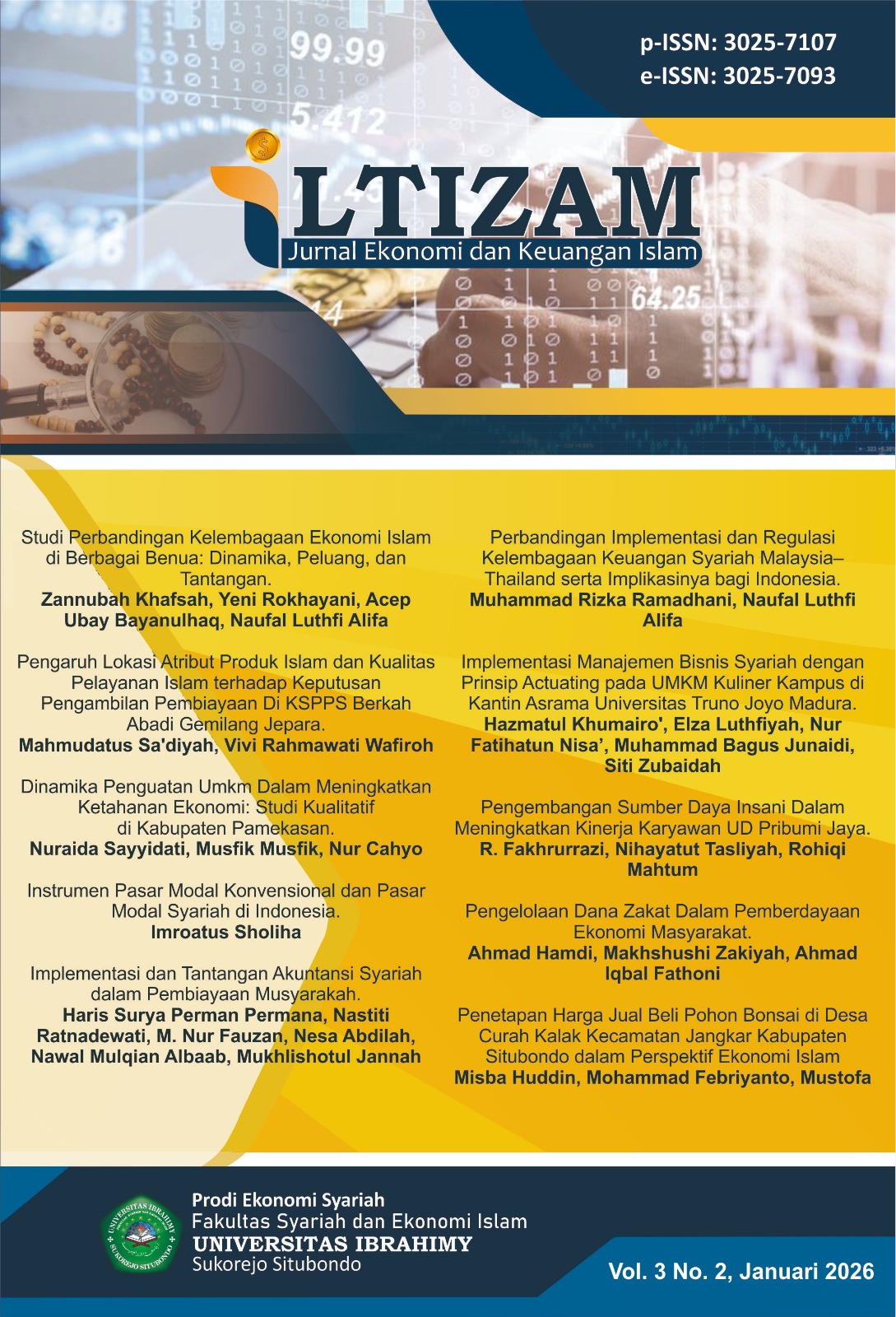
Downloads
Published
2026-01-31
Issue
Section
Articles
License
Copyright (c) 2026 Ahmad Hamdi, Makhshushi Zakiyah, Ahmad Iqbal Fathoni

This work is licensed under a Creative Commons Attribution 4.0 International License.